

Watchmakers and watch companies starting with the letter A
Discover renowned watchmakers and prestigious watch companies starting with the letter A. Explore detailed profiles, historical insights, and expert craftsmanship. Perfect for horology enthusiasts and collectors!
Agassiz Watch Co. S.A.
Agassiz Watch Co. S.A. was founded in 1876 and specialized in high-quality watches. A new calibre was designed based on regular 19”’ watch movements, smaller in diameter and as slim as technically possible. The firm designed entirely new and even thinner movements: first 17”’- 24/12th, then 20/12th and 17/12th. Later, Agassiz merged with Touchon & Co., Geneva, which specialized in very thin movements.
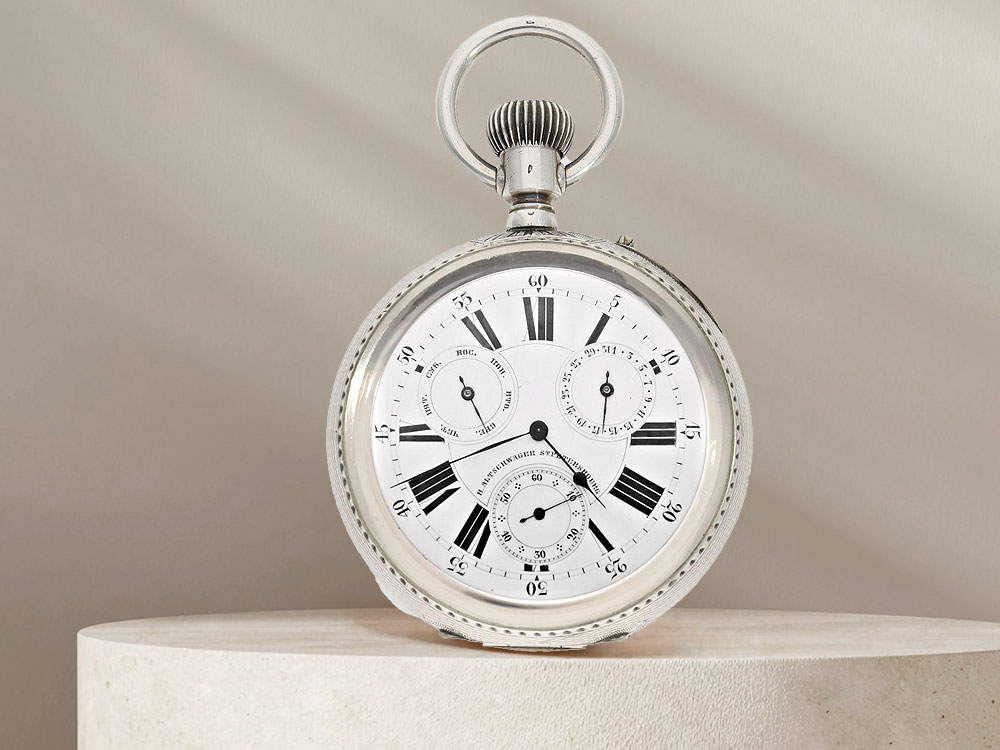
Altschwager, Bernhard Friedrich
Bernhard Friedrich Altschwager was a German-Russian engineer and inventor who lived in St. Petersburg during the late 19th and early 20th centuries. He owned a watch shop in St. Petersburg. His son Theodor Kröger (actually Bernhard Altschwager) did an apprenticeship as a watchmaker in Neuchâtel in 1913 and then returned to Russia, where he became a prisoner of war. Kröger became a very successful writer and described his experiences during the war. In his works, he criticized the negative side effects of the Russian Revolution from the point of view of a German citizen of the world.
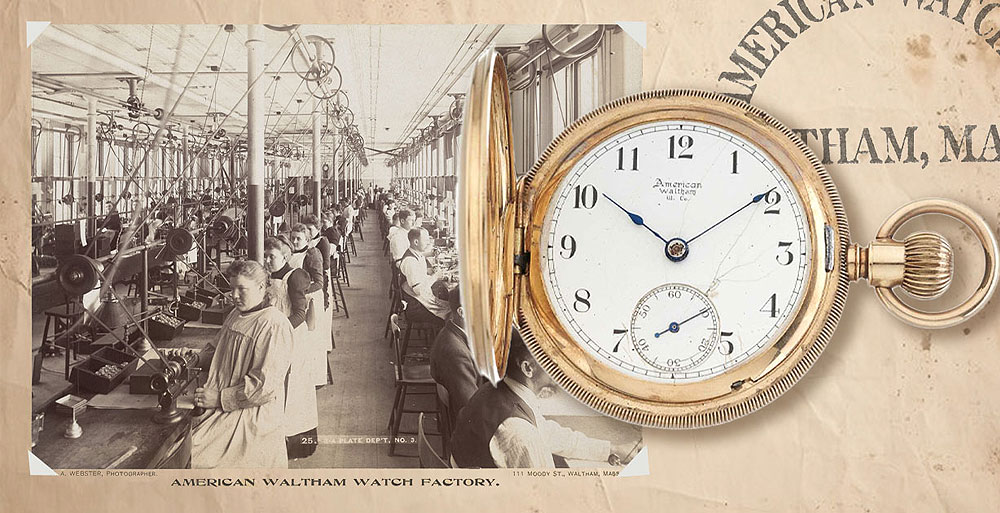
American Waltham Watch Company
The American Waltham Watch Company (also known as the Waltham Watch Co. or American Watch Co.) was founded in 1850 and played a significant role in watchmaking history. Its innovative approach to producing standardized and interchangeable watch components revolutionized the industry. Renamed multiple times, from American Horology Company and Boston Watch Co. to Appleton Tracy & Co. and finally to American Waltham Watch Co., the company continued to thrive despite facing challenges such as bankruptcy and the American Civil War.
The introduction of the 1897 pocket watch model and the company’s role as a major supplier of railway chronometers further solidified its reputation for precision and quality. Winning accolades at international exhibitions and contributing to the progression of watchmaking, the company left a lasting impact on the global industry.
The legacy of the American Waltham Watch Company lives on with its influence reaching not only across North America but also extending to 52 other countries worldwide.
Arnold, John
John Arnold was born in 1736 and died on August 11th, 1799. He was an English watchmaker and inventor. Arnold was apprenticed to his father, who was also a clockmaker in Bodmin, Cornwell and probably also worked with his uncle, a gunsmith. Around 1755, at the age of 19, he left England and worked as a watchmaker in the Hague, Holland, returning to England around 1757. In 1762, he met William McGuire on whom he made a sufficient impression and McGuire gave him a loan, enabling him to set up a workshop at Devereux Court, Strand, London. By the time he was 28, Arnold’s watches, be they verge or cylinder, displayed interesting original components such as straight-line compensation curbs and minute repeating by increments of 10 minutes instead of the more common 15 minutes.
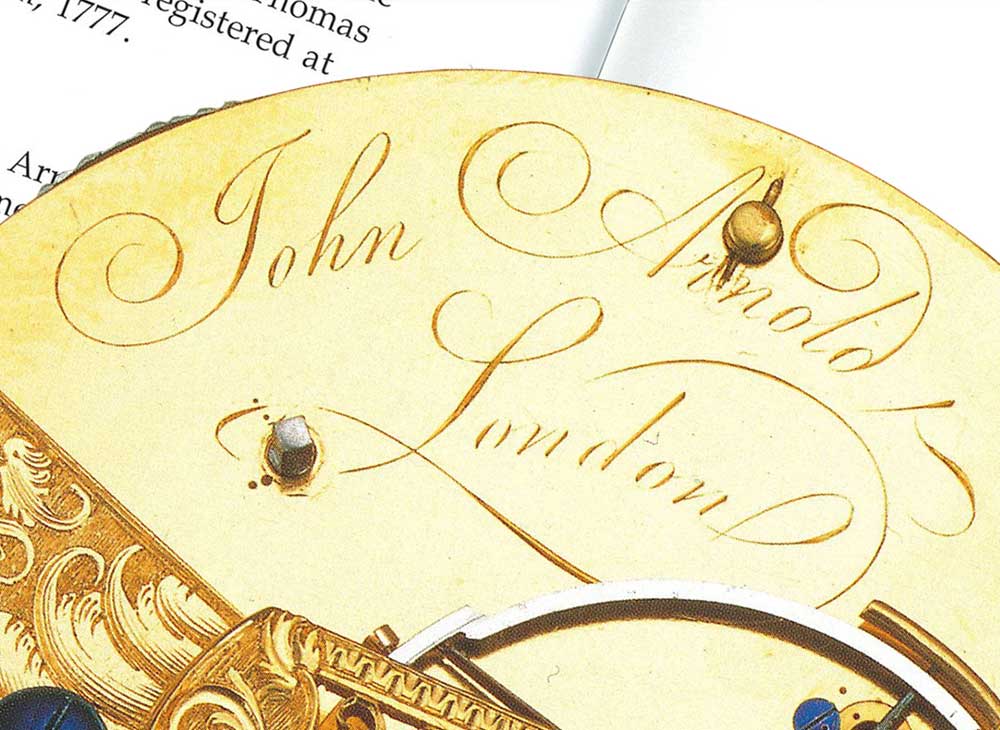
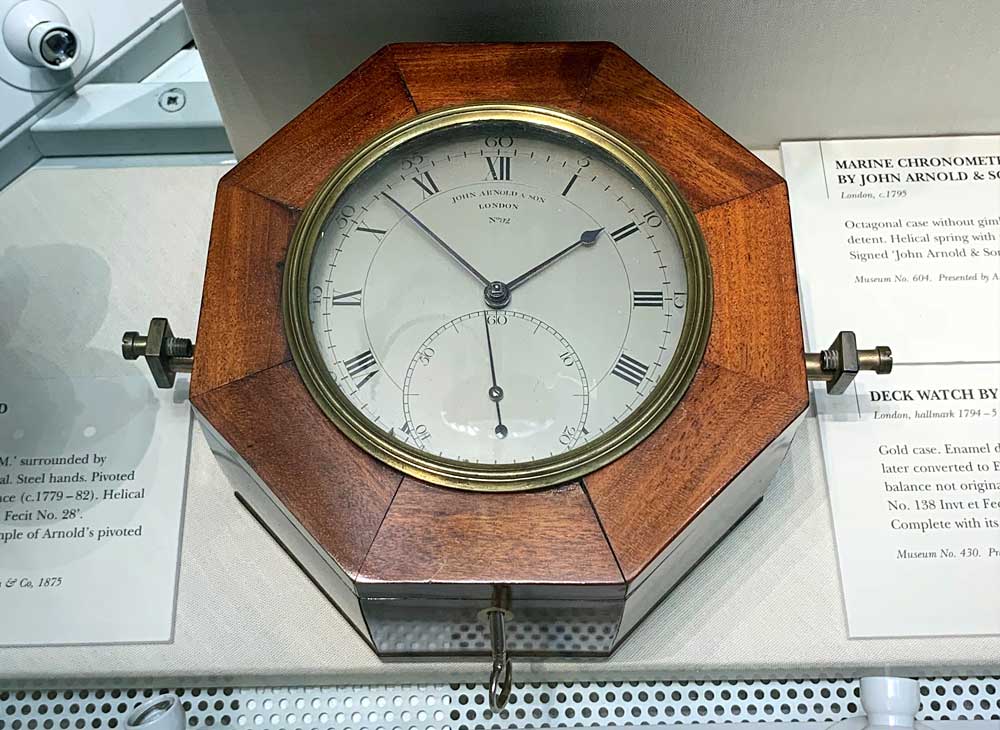
In 1764, Arnold obtained permission to present an exceptionally small half-quarter repeating watch with a cylinder escapement mounted in a ring to King George III. He made another watch for the King around 1768, which was a gold and enamel pair-cased watch with a movement that had every refinement, including minute repetition and centre seconds. It was around 1770 that Arnold developed a portable precision timekeeper. His basic design was simple whilst consistently accurate and mechanically reliable. Importantly, the relatively simple and conventional design of his movement facilitated its production in quantity at a reasonable price whilst also enabling easier maintenance and adjustment. He successfully found a way to simplify Harrison’s timekeeper design. He established himself at 2 Adam Street, Adelphi Buildings, Strand, in 1771 and researched marine chronometers here over the next eleven years. Arnold was the first to design a watch that was both practical and accurate, and also brought the chronometer into use in its modern sense, as a precision timekeeper. His technical progress enabled the quantity production of marine chronometers for use on board ships from around 1782.
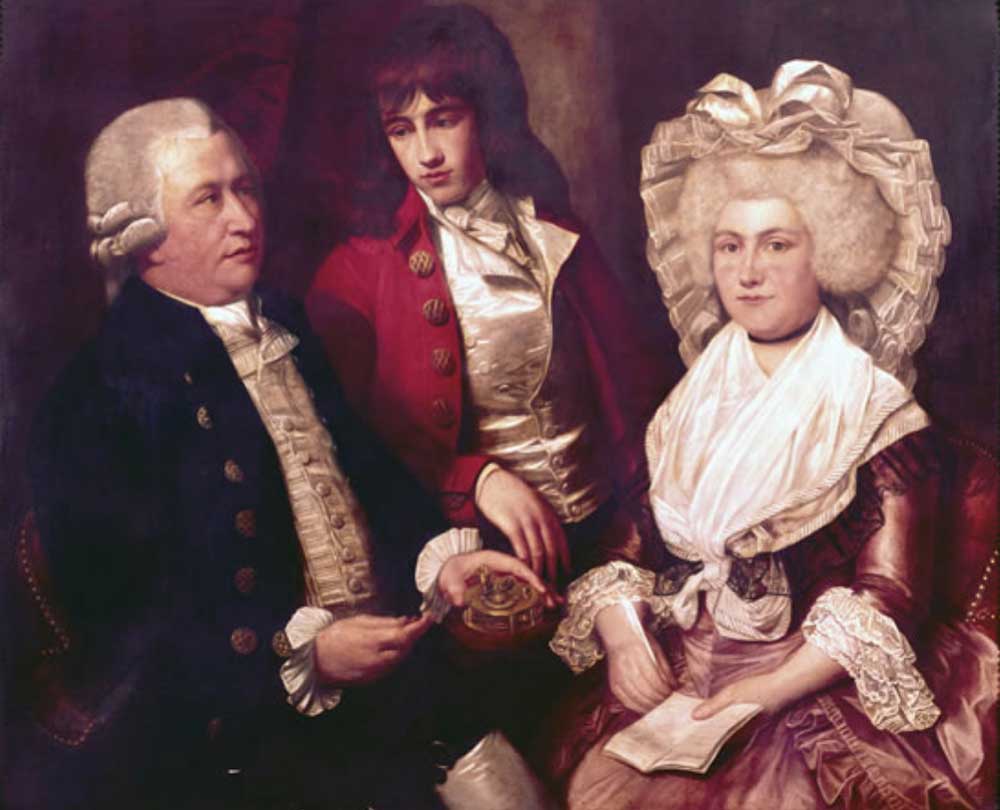
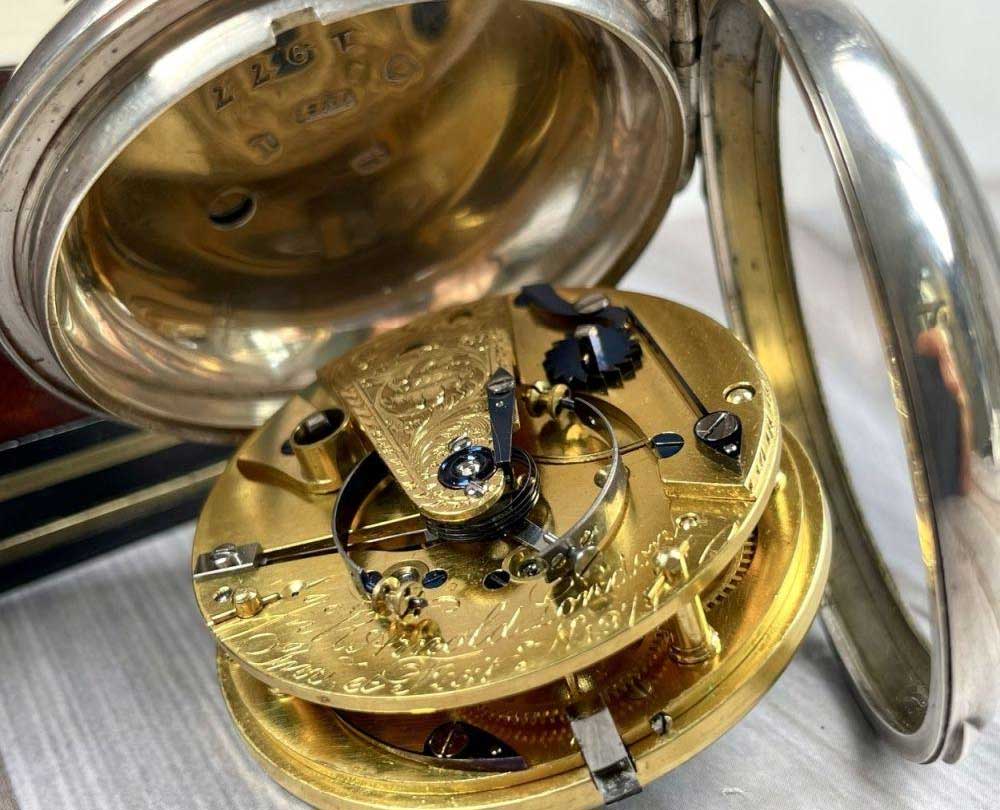
Arnold was admitted to the Clockmakers’ Company in 1783. The important French watchmaker Abraham-Louis Breguet was a very good friend of Arnold. It appears Arnold gave Breguet permission to incorporate or develop any of Arnold’s inventions and techniques into his watches. Arnold’s son John Roger Arnold was born in 1769 and served an apprenticeship with both his father and Abraham-Louis Breguet. In 1787, he and his father founded the company, Arnold & Son. John Arnold also appears to have been the first to think of the concept of the tourbillon. He seems to have experimented with his idea but died in 1799 before he could develop it further. It is known that Breguet made a successful and practical tourbillon mechanism around 1795 but he acknowledged Arnold as the inventor by presenting his first tourbillon in 1808 to Arnold’s son, John Roger, as a tribute to his friend Arnold Sr.
Arnold, John Roger
John Roger Arnold was born in 1769. He was the son of renowned British horologist John Arnold. He served an apprenticeship with both his father in 1783 and the eminent French watchmaker Abraham-Louis Breguet in Paris in 1792. In 1787, John Roger and his father founded the company, Arnold & Son. The younger Arnold became a member of the Clockmakers’ Company in 1796 and became a master in 1817. After his father died in 1799, he continued the business, taking up a partnership with E.J. Dent in 1830. The two craftsmen experimented heavily during their work together, in particular, they concentrated on the effects of magnetism on chronometers. Dent left Arnold in 1840, whereupon Arnold continued working on his own but died only three years later. Charles Frodsham bought the business after Arnold’s death in February 1843 and it flourished until 1858 under the name Arnold & Frodsham.
Assmann, Julius
Julius Assmann was born in 1827 and died in 1886 at the age of 58. He was a passionate watchmaker in Glashütte, Germany. Assmann at one time was employed by his father-in-law, Ferdinand Adolph Lange, the man who laid the cornerstone of the German watchmaking industry in the 1840s. He founded his own company in 1852, the Julius Assmann Deutsche Präzisions-Taschenuhren-Fabrik (German Precision Pocket Watch Factory) producing key wound pocket watches. Assmann was soon awarded the gold medal by the German Trade Industry. Within two years, his watches progressed to crown winding and the three quarter plates so characteristic of Glashütte.
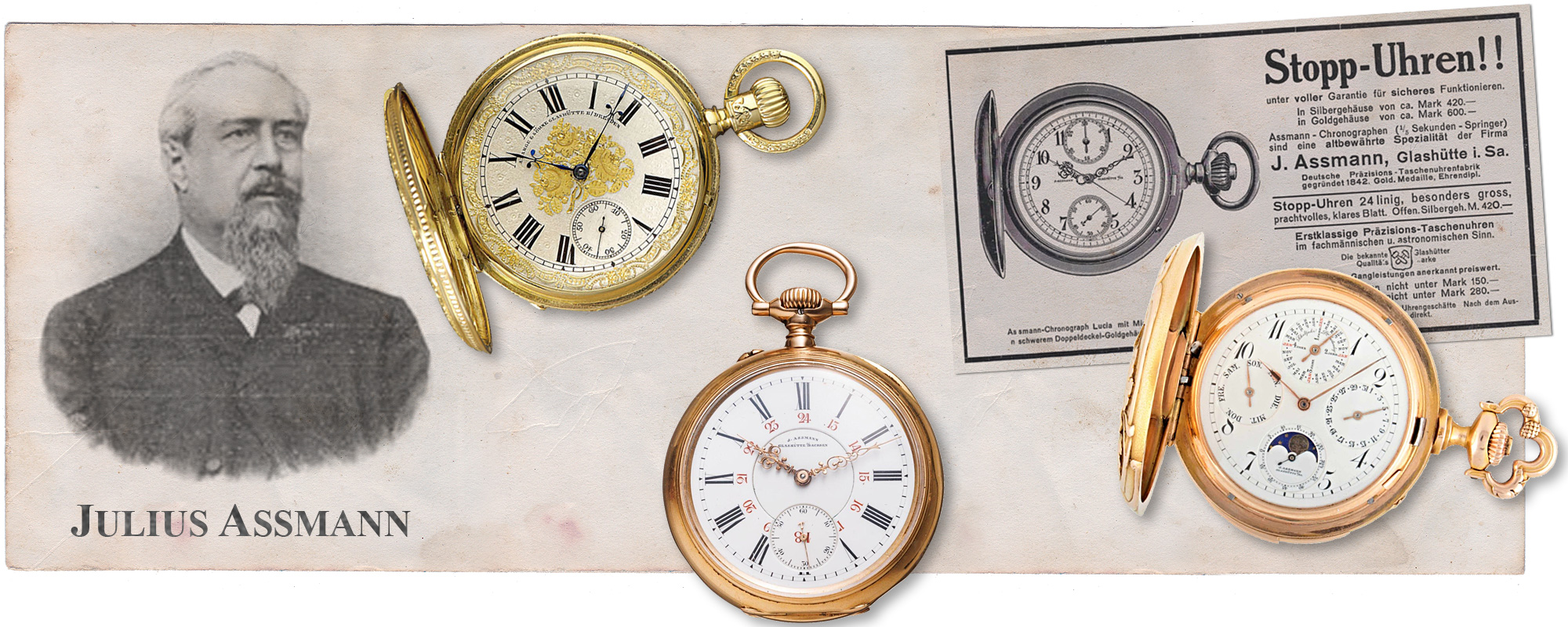
Assmann was a pioneer in the Glashütte watchmaking industry, co-founding the German Watchmaking School in 1878 and serving as its chairman until he died in 1886. The company’s focus on precision and quality, coupled with Assmann’s educational contributions, cemented Glashütte’s reputation as a hub for fine watchmaking.
After Julius Assmann’s death, his company continued under different leadership, and many of the original Glashütte watchmakers, including Assmann’s, eventually became part of the state-owned VEB Glashütter Uhrenbetriebe (GUB) in 1951. When Germany reunified, the company that arose from GUB was renamed Glashütte Original, which continues to be inspired by the legacies of the founding watchmakers, including that of Julius Assmann.
Audemars Piguet & Cie.
Audemars Piguet & Cie. Jules Louis Audemars, born on March 28th, 1851 and died on October 15th, 1918 and Edward Auguste Piguet born in 1853 and died in 1919 were two young and ambitious watchmakers who established their workshop in 1875 in their home village Le Brassus, Vallée de Joux, Switzerland. They initially operated under the name Audemars, Piguet. Audemars was in charge of production and technical aspects while Piguet focused on sales and management. Believing in the power of the Vallée de Joux’s network of artisanship and following their firm convictions, they set on crafting unique complicated mechanisms by hand at a time when serial production was looming with the rise of industrialisation.
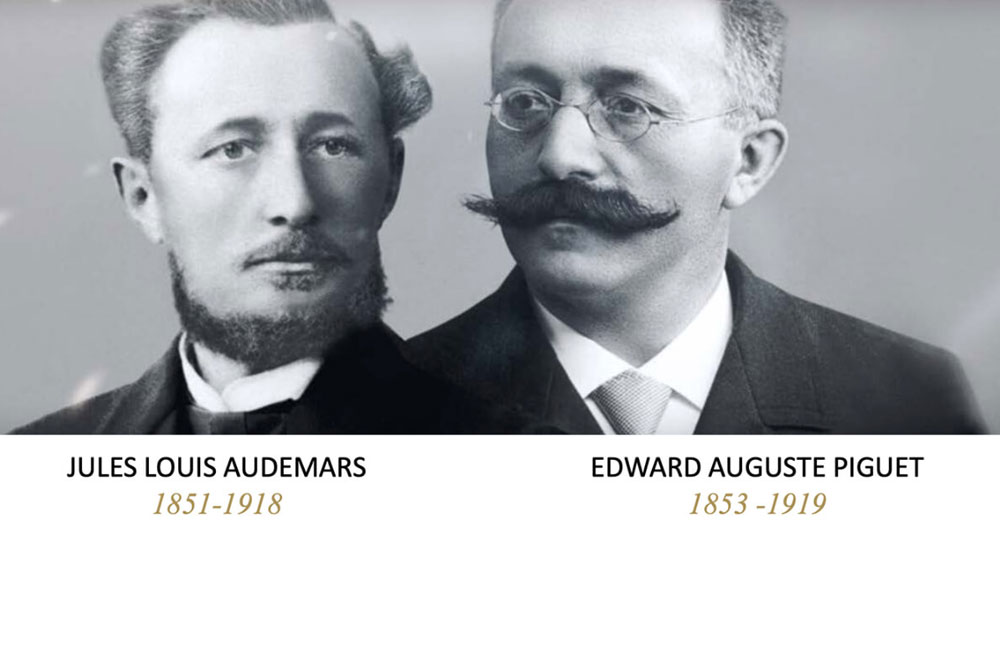
While the two entrepreneurs first produced complicated movements that were sold to Geneva-based firms, they soon orchestrated the production of complete watches in the region by coordinating the activities of a variety of craftsmen, buying in blanks, cases, dials, bracelets and sending out pieces for gem setting and decorating. The miniaturisation, design, assembly and setting of movements were then done at Audemars Piguet’s workbenches.

In 1881, they officially established the company as Audemars Piguet & Cie.
The company ledgers demonstrate that nearly 80% of the 1600 watches produced by Audemars Piguet between 1882 and 1892 included at least one, if not several complications. Refined chiming, chronograph and astronomical watches, assembled and finished by hand, have remained the beating heart of Audemars Piguet ever since.

