

Watchmakers and watch companies starting with the letter H
Highlighting notable watchmakers and historic watch companies starting with the letter H. Discover their stories, innovative designs, and craftsmanship. Perfect for horology enthusiasts and collectors!
Haas
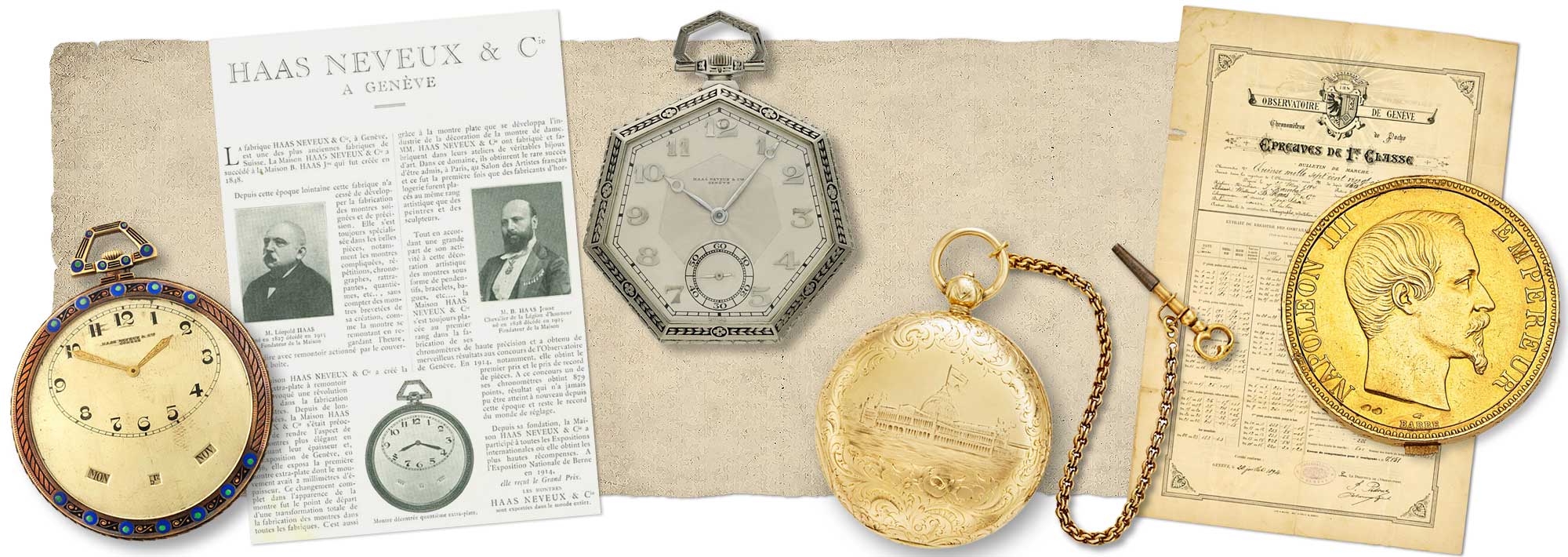
The brothers Léopold Haas (1827-1915) and Benjamin Haas (1828-1925) founded the Ancienne Manufacture des Montres Haas & Cie in Geneva in 1848. The name changed to “Ancienne Maison B. Haas Jeune” later and finally changed into “Haas Neveux & Co.” in 1884. It is one of the oldest Swiss watch manufacturers.
The Haas signature has always been one of the most sought after, thanks to the impeccable standards of the company. Haas gained a reputation as a manufacturer of fine chronometers, chronographs, and highly complicated watches. Among their most notable creations was the “remontoir perpétuel à décrochement” (1867 and 1873), a perpetual calendar (1872) and later the first ultra thin watch movement (circa 1896).
Hahn, Philipp Matthäus
Philipp Matthäus Hahn was born on November 25th, 1739 in Scharnhausen and he died on May 2nd, 1790 in Echterdingen. He was a German avid protestant clergyman, astronomer, inventor and minister of the parishes Onstmettingen, Kornwestheim and Echterdingen, but also one of the most eminent precision mechanics and watch and clockmakers of the 18th century. Hahn produced a large number of high-quality pocket watches, most of them with calendar and moon phase indications. He made calendar movements of exceptional mechanical quality and attractive design. He also made hall clocks as well as astronomical bracket clocks. In about 1763 he devised a precision sundial or helio-chronometer that incorporated the correction for the equation of time. Today his large observatory clock is one of the highlights of the clock museum in Furtwangen.
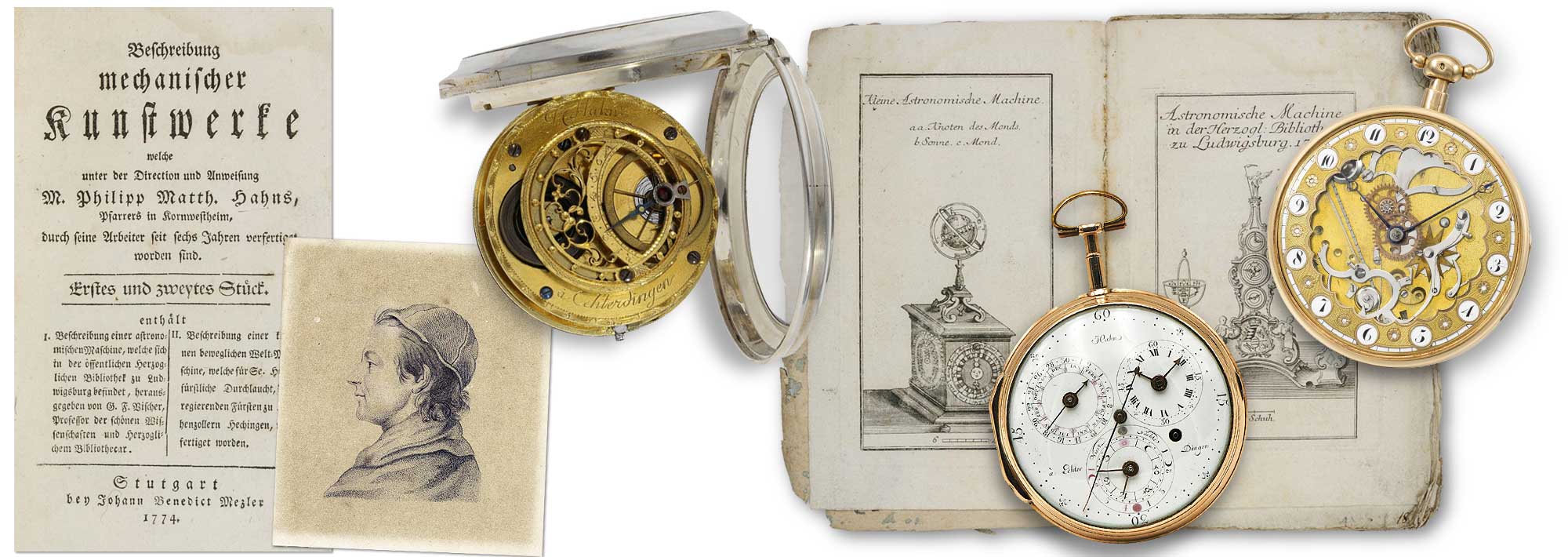
Hahn was the first maker in Germany to use the cylinder escapement in his pocket watches. He further was very interested in the production of calculators and scales, in 1774 he designed one of the earliest mechanical calculators and laid the foundation for Württemberg’s industry of weighing machines, which still enjoys an international reputation today.
His sons continued his work and signed their watches and clocks with the signature Hahn Hofmechanikus Stuttgart. Along with his sons Christoph Matthäus, Johann Georg, Christian Gottfried and Immanuel, Hahn’s brothers Georg David Polykarp and Egidius Stephanius Gottfried also worked temporarily in his workshop. The most notable makers in Hahn’s group were Jacob Auch, Georg Matthäus Burger, Georg Joseph Sandra, Philipp Gottfried Schaudt, Johann Gottfried Ewald Sechting, Mauritius Steiner and Christoph Friedrich Strubel.
Source: Meister der Uhrmacherkunst, Juergen Abeler, 1977
Hamilton, William
William Hamilton (1751–1801) was an English painter and illustrator. Hamilton was born in Chelsea, London, but travelled and worked in Italy with Antonio Zucchi for several years. He trained first as an architectural draftsman but soon moved to theatrical portraits and scenes from plays. Hamilton became an associate member of the Royal Academy in 1784 and was made a full member in 1789.
Hess & Metford
Hess & Metford were active in Geneva between 1840 and 1860 and succeeded the firm of Heil & Hess. The company’s reputation was principally for the sale of complicated, high-quality pocket watches destined for North America.
Howard, Edward
Edward Howard was a watchmaker in London circa 1780 to 1804. He was well-known and respected, his most notable accomplishment was the invention of the lever escapement. This invention greatly improved the accuracy of watches and made them more reliable. Howard also worked on developing chronometers, which were used for navigation at sea. In addition to his technical accomplishments, he was also known for his exquisite craftsmanship, attention to detail in the design of his watches and his contributions to the development of the marine chronometer. He was part of a team of watchmakers that included his brother, John Roger Arnold and Abraham-Louis Breguet. Together, they worked on various watchmaking projects and inventions, including the marine chronometer.
As for his watchmaking style, it is believed that he was influenced by the work of other prominent watchmakers of his time, such as George Graham and Thomas Mudge. Howard worked for both Graham and Mudge before establishing his own shop in 1775. Howard’s watches were highly sought after and are considered some of the finest examples of English watchmaking.
Huaud(t)
Pierre Huaud I (Le Père) was born in 1612 in Châtellerault, France, the son of Jean Huaud, a French goldsmith. In 1630, at the age of 18, Pierre fled to Geneva for religious reasons, following the path of many Protestant refugees. It is likely that he had already begun training as a goldsmith under his father or another French master—possibly in Blois.
Upon arrival in Geneva, Pierre entered a formal apprenticeship with Laurent Legère in 1630. He became a companion in 1634 and was received as a Master goldsmith in 1636, fulfilling the requirements to practice independently in Geneva.
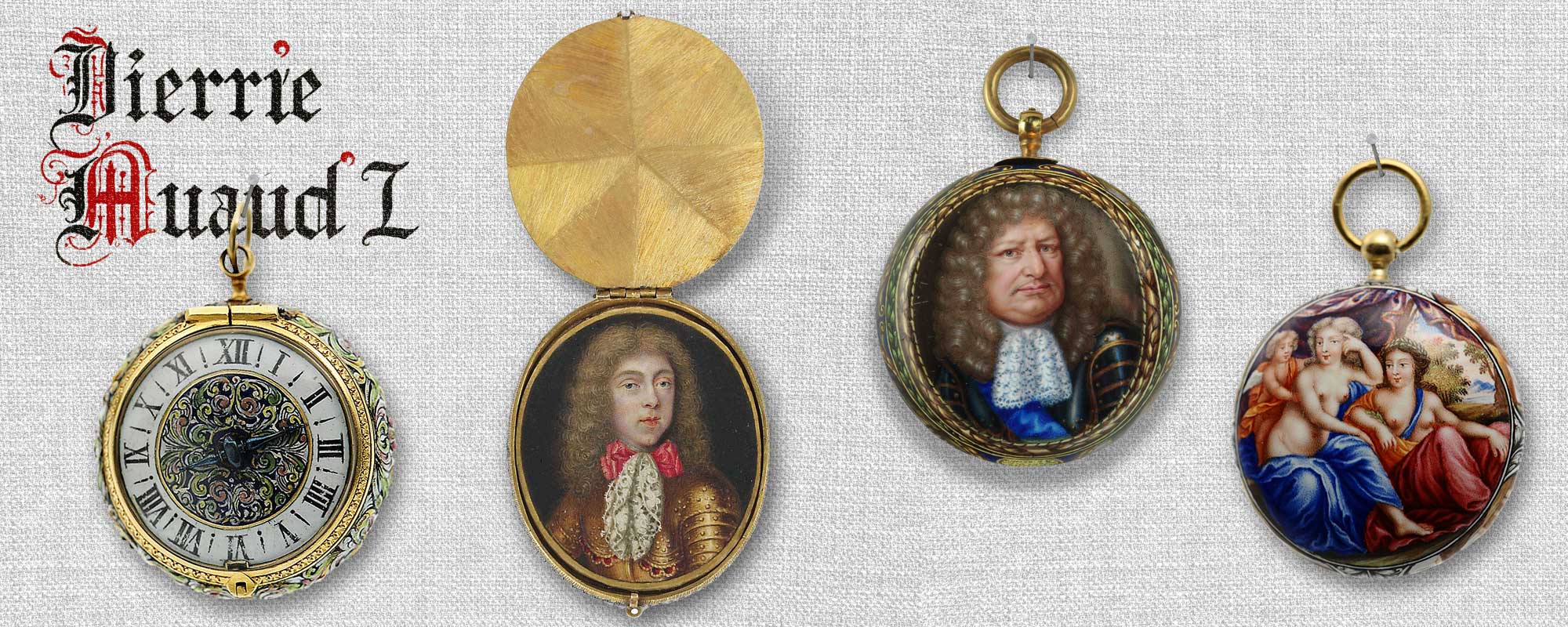
In 1643, Pierre Huaud I married Françoise Mussard. Together they had several children, including three sons who became enamellers: Pierre Huaud II (born 1647, died 1698), Jean-Pierre Huaud (born 1655, died 1725) and Ami Huaud (born 1657, died 1724).
Pierre Huaud I is regarded as the founder of the Huaud dynasty and a leading figure in what became known as the Geneva School of Enamel Painting. He popularized the pointillé technique, using minute dots of color to create depth, volume, and tonal subtlety.
In 1671, Pierre Huaud I and his three sons were formally admitted as bourgeois of the city of Geneva, marking their full civic and professional integration. Pierre Huaud I died in 1680, leaving the workshop to his sons.
Pierre Huaud II (1647–1698) became known for exceptionally refined enamel work, often depicting mythological subjects. His reputation led to his appointment as court enamel painter to the Elector of Brandenburg in Berlin.
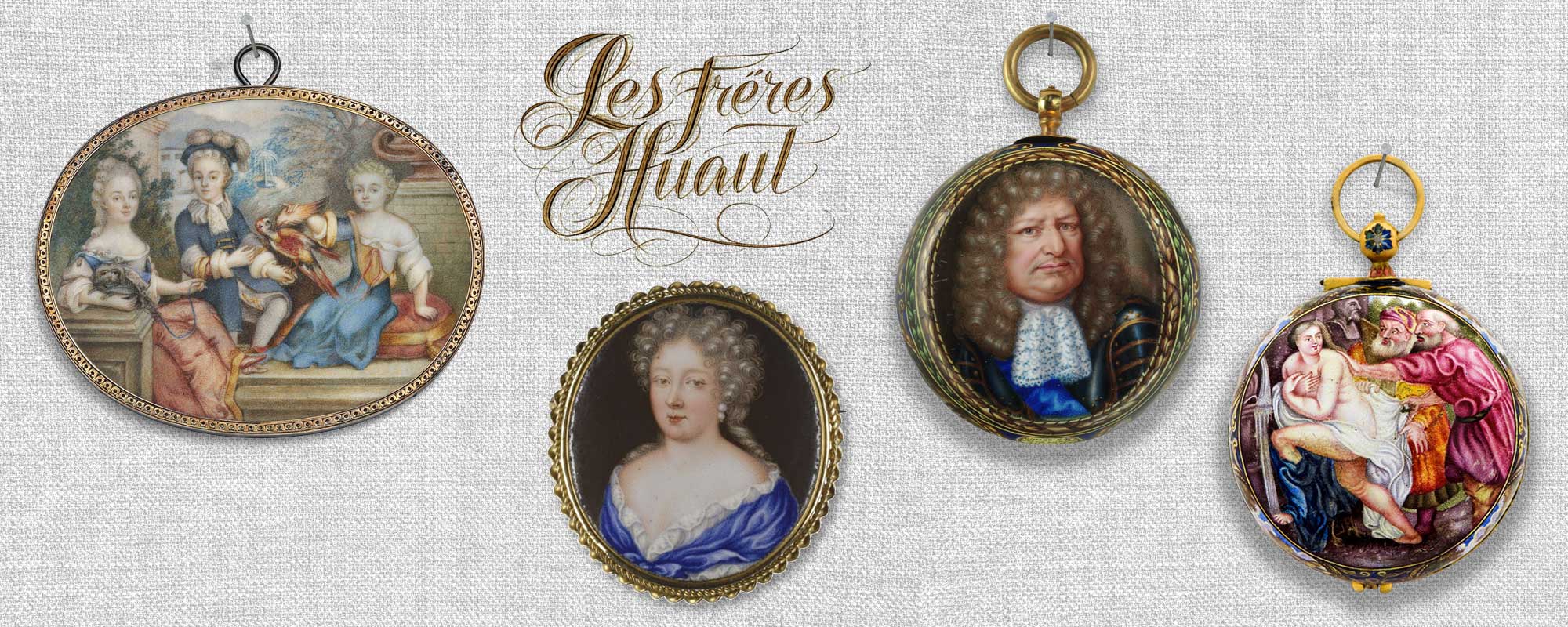
Jean-Pierre Huaud and Ami Huaud, known collectively as “Les deux Frères Huaut les jeunes”, frequently collaborated. Their enamel painted watch cases became among the finest produced by the Geneva School. From 1686 to 1700, the two brothers worked in Berlin, after which they returned to Geneva, continuing production primarily for export markets.
The enamel cases produced by Les Frères Huaut (or Huaud) were highly prized both at the time of their creation and in later centuries. Their works commonly featured: Biblical scenes, Classical Greek mythology (e.g., Venus and Adonis) and Allegorical subjects such as Roman Charity.
Watchmakers in London, Amsterdam, and Paris often commissioned Huaud decorated cases and then built movements specifically to fit them.
Surviving Huaud enamel cases are extremely rare, with fewer than 100 known examples. Today, they are held in major international collections, including The British Museum, The Louvre and the Metropolitan Museum of Art.
The Huaud family remains central to the history of Geneva enamel painting, representing its technical peak and international influence. After the deaths of the brothers Jean-Pierre and Ami Huaud, there is no evidence of the business continuing with the same prominence or level of artistry. The family’s legacy rests almost entirely on the work of the founder, Pierre Huaud I and his three sons, who established and dominated the Geneva school of enamel painting during the late 17th and early 18th centuries.
Huber, Noël
Noël Hubert, a French watchmaker, was born around 1582 and was baptized in the parish of Saint Michel. He became a master watchmaker in Rouen and later became the ‘governeur de la grosse horloge de Rouen’ (governor of the great clock of Rouen). In 1650, Hubert became a juré and was one of the founding members of the Rouen Watch Society, along with Robert Grébauval. He set up the watchmaking dynasties in Rouen. Many watchmakers from these Huguenot families later emigrated to Amsterdam, The Hague, Leiden, Geneva and London.
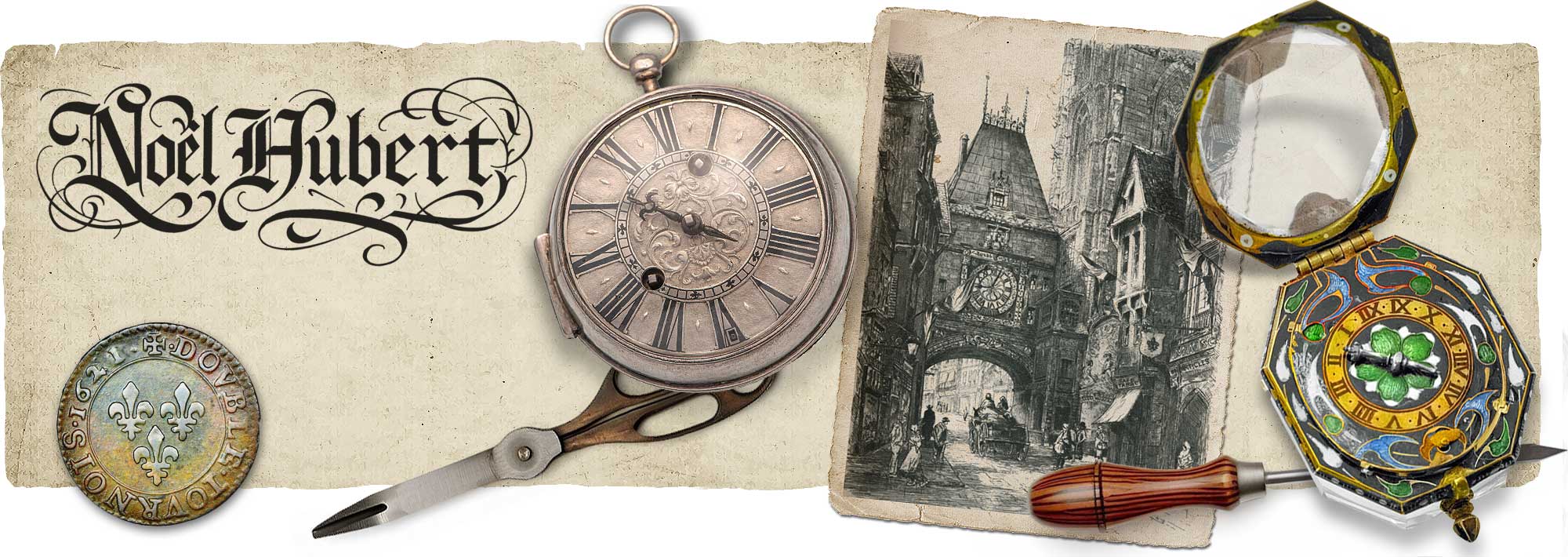
Noël Hubert was married twice, first to Catherine Lescuyer and then to Louise Levillain. He had ten children from his first and four from his second marriage. Catherine, one of Noël’s daughters from his first marriage, married clock and watchmaker Balthazar Martinot I (1610-1697). Marguerite, another daughter he had with Catherine Lescuyer, married Jhérosme Grébauval and Philippe, one of the sons from his second marriage, married Catherine Grébauval. It is presumed that Robert Grébauval, Jhérosme Grébauval and Catherine Grébauval were all related to each other. Jean Hubert, another son from his second marriage, married Marie Hébert, the daughter of a watchmaker. Noël Hubert passed away around 1654.
Huguenin & Fils
Huguenin & Fils was founded in the mid-19th century in Le Locle, Switzerland by Adolphe Huguenin. They exhibited watches and chronometers at the International Exhibition in Philadelphia in 1876. The firm registered its name in 1880 as required by the 1879 law with the trademark ‘A. Huguenin & Sons, Locle’ and for chronometers ‘A. Huguenin & Fils’.

