Watchmakers and watch companies starting with the letter M
Meet masterful watchmakers and major watch companies starting with the letter M. Discover their rich legacies, design ingenuity, and expert craftsmanship. Ideal for horology fans and collectors!
Markwick Markham
James Markwick and his son James Jr. were both fine watchmakers and worked in London. The elder was apprenticed on 25 June 1656 to Richard Taylor, and subsequently to Edward Gilpin. He became free of the Clockmakers’ Company on 6 August 1666. Six apprentices were bound to him between 1674 and 1699. In 1673 he succeeded the business of Samuel Betts behind the Royal Exchange. Although he held office in the Clockmakers’ Company, he was irregular in attendance, ceasing to tend to its affairs after 1700. He worked until at least 1706. His son, James Markwick Jr., became free of the Company in 1692 by patrimony.
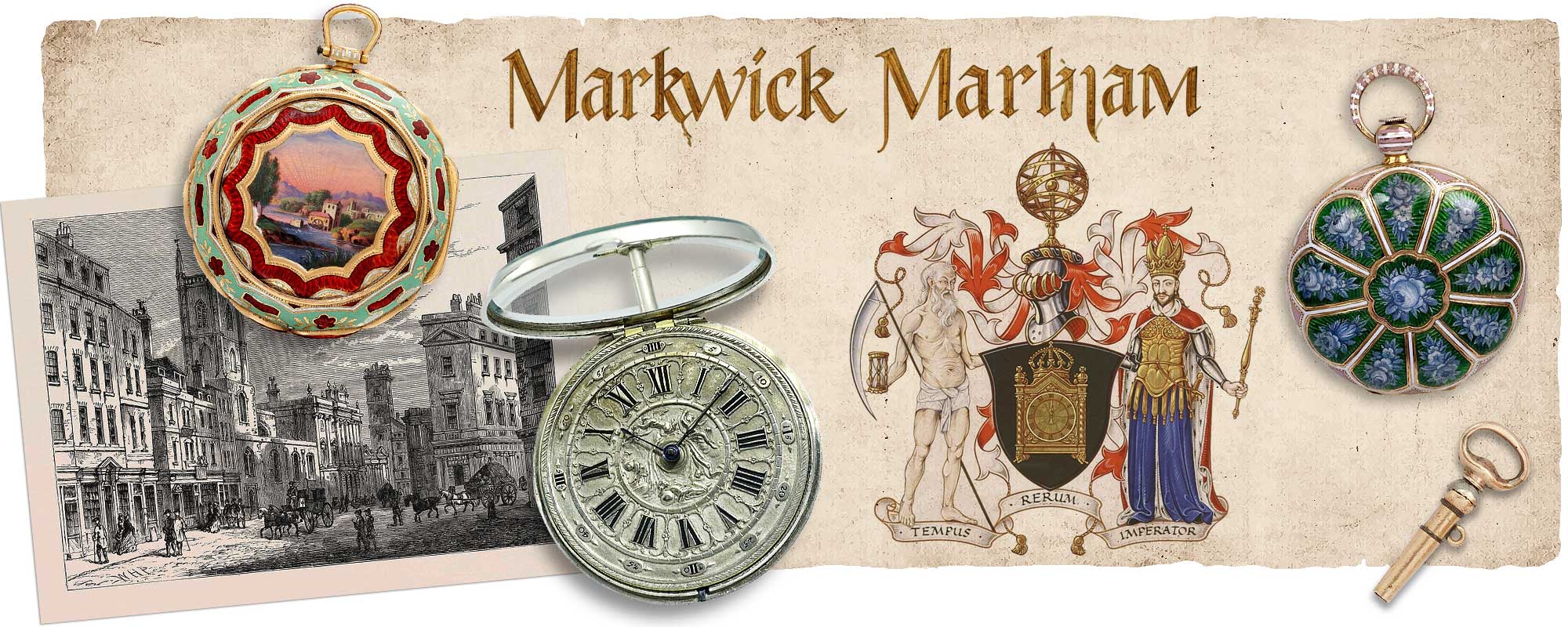
The younger James Markwick was an eminent maker, Master of the Clockmakers’ Company in 1720 and a very early user of jewelled bearings. Later, he was in partnership with his son-in-law Robert Markham, who succeeded him using the trading name of Markwick Markham, which became famous for watches destined for the Turkish market. Not only did this notoriety encourage the appearance of spuriously signed watches, but at the end of the century Markham, or his successor, associated the names of other watchmakers with their products intended for the East. The makers thus found associated are Francis Perigal, Peter Upjohn, H. Story, Borrell, John Johnson, Louis Recordon and Dupont. All were reputable watchmakers in their own right, selling other products under their own names.
E. Marx & Co
E. Marx & Co, a watchmaker based in Paris in 1880, was known for its high-quality timepieces. While specific information about their famous clients or patrons is limited, it is worth noting that during that time, Paris was a hub for luxury and fashion, attracting wealthy individuals from around the world. They produced a variety of watches, including pocket watches, wristwatches and chronometers. Some of their watches were also designed for specific purposes, such as military use or for use in sports timing. Many influential and affluent people, including royalty, aristocrats and celebrities, sought out prestigious watchmakers like E. Marx & Co to acquire their exquisite timepieces. However, without further information or historical records, it is challenging to provide a comprehensive list of famous clients or patrons associated with the company.
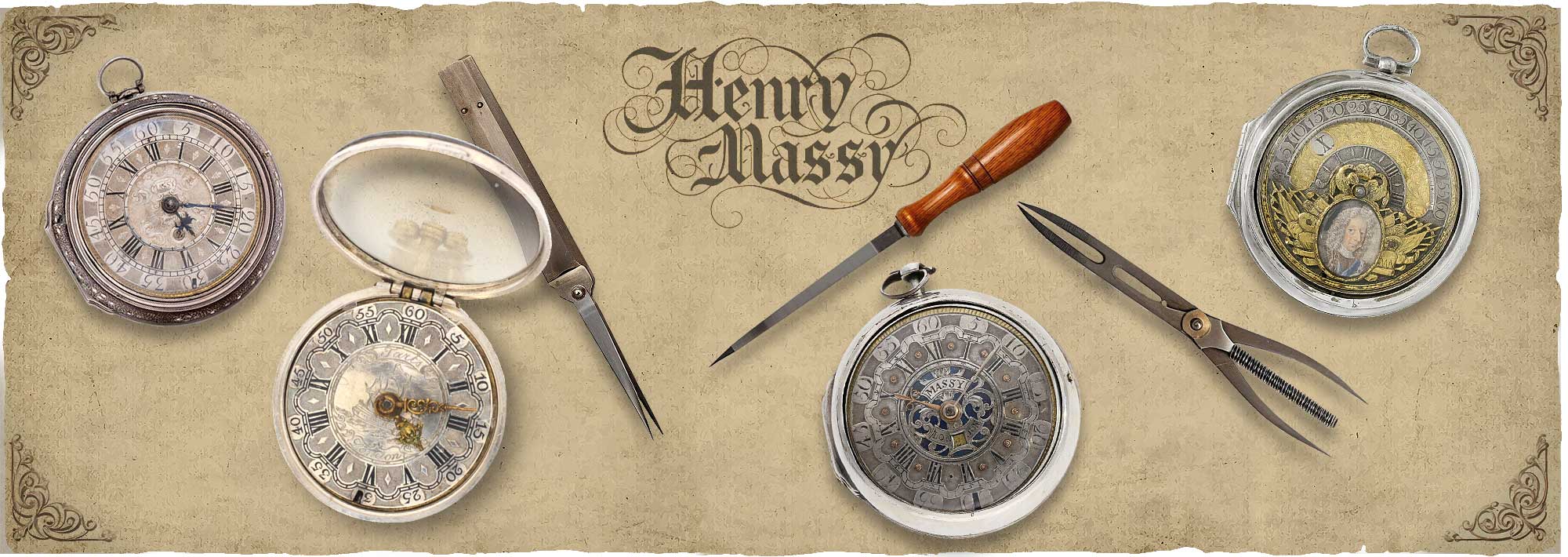
Massy, Henry
Henry Massy, clock- and watchmaker, active from 1692 to 1745 in Charles Street – St. James, London. A member of the Clockmakers’ Company from 1692 to 1745. His father Nicolas Massy II of Blois, France, had come to London as a refugee, where he worked in Cranbourn Street. He had been a member of the Clockmakers’ Company from 1682 on and died in 1698. Nicolas II and Henry were descendants of Nicolas Massy I, a renowned watchmaker in Blois, who became a master in 1623 and married in the same year. He was elected juré of the guild in 1646 and died in 1658. It is assumed that the Massy family never broke their ties to Blois. Source: Brian Loomes, Watchmakers and Clockmakers of the World, London 2006, p. 516
Merceron, Augustin
Augustin Merceron was a French clockmaker, active between 1830 and 1840 in Angoulême. He signed his watches Chronométrier Elève De Breguet (chronometer maker, student of Breguet). From 1824 he completed his apprenticeship at Breguet and then worked for Breguet until around 1830.
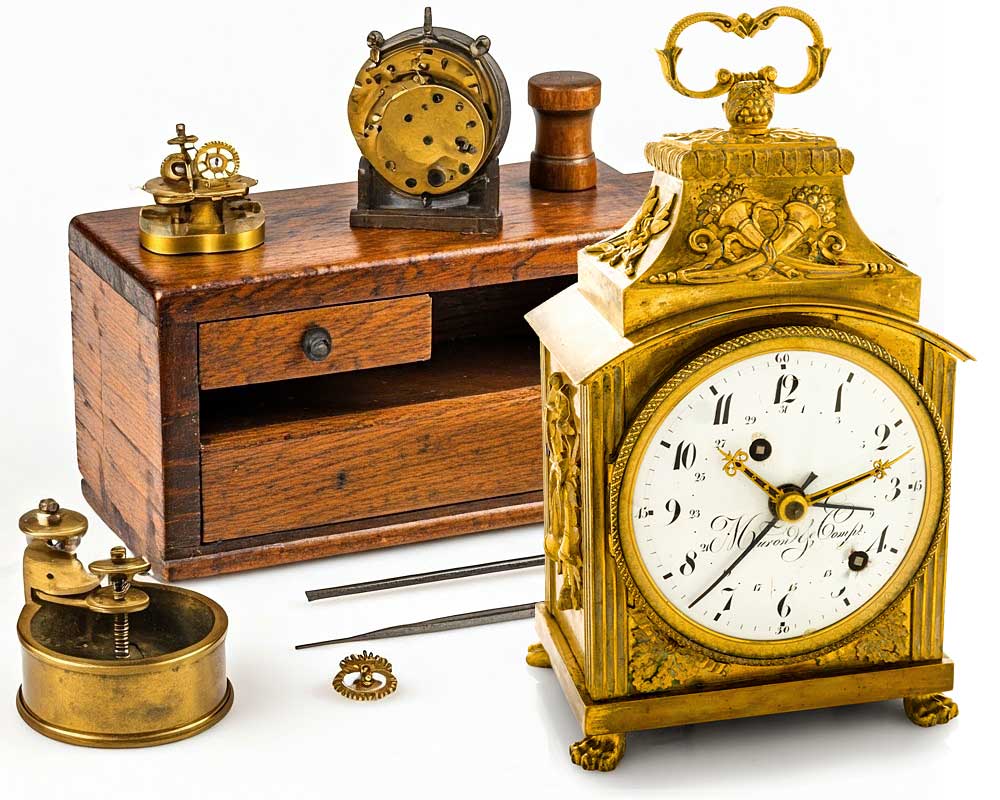
Meuron & Cie
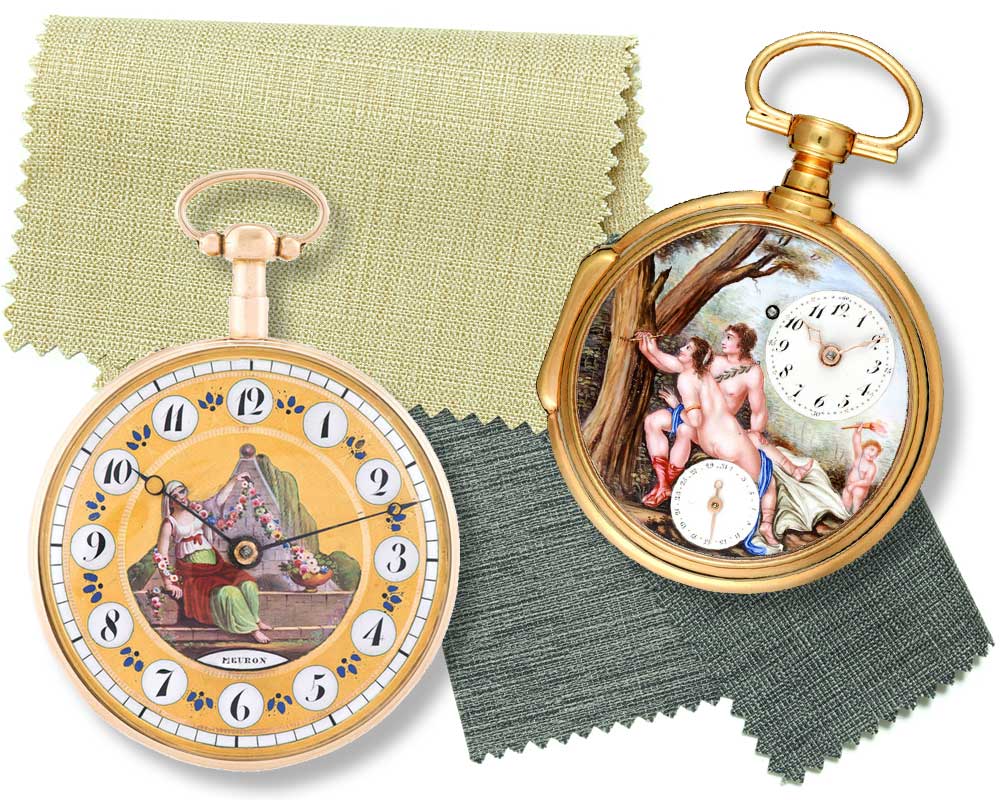
Meuron & Cie was a Swiss watchmaker and dealer active in Geneva, Neuchâtel, La Chaux-de-Fonds, and Paris around 1800. They produced chiming clocks, automatic skeleton clocks and pedometers. They supplied pedometer watches to Jaquet-Droz. Meuron & Cie also supplied pocket watches, clocks and travel clocks. Their watches were usually gold with pearl and enamel decorations. The company suffered a major loss in 1794 when a fire destroyed a collection of valuable Breguet watches in La Chaux-de-Fonds. Meuron & Cie was owned by three business partners: François Meuron, Jean-Jacques Thourneisen and Jacques-Louis Pourtalès. They had representatives in Belgium including Overmann Frères, Charles-Frédéric Dubois in Brussels, JC Lambrechts & Sohn in Liège, watchmakers in Antwerp and Louis Marquis in Luxembourg.
Meylan, Philippe Samuel
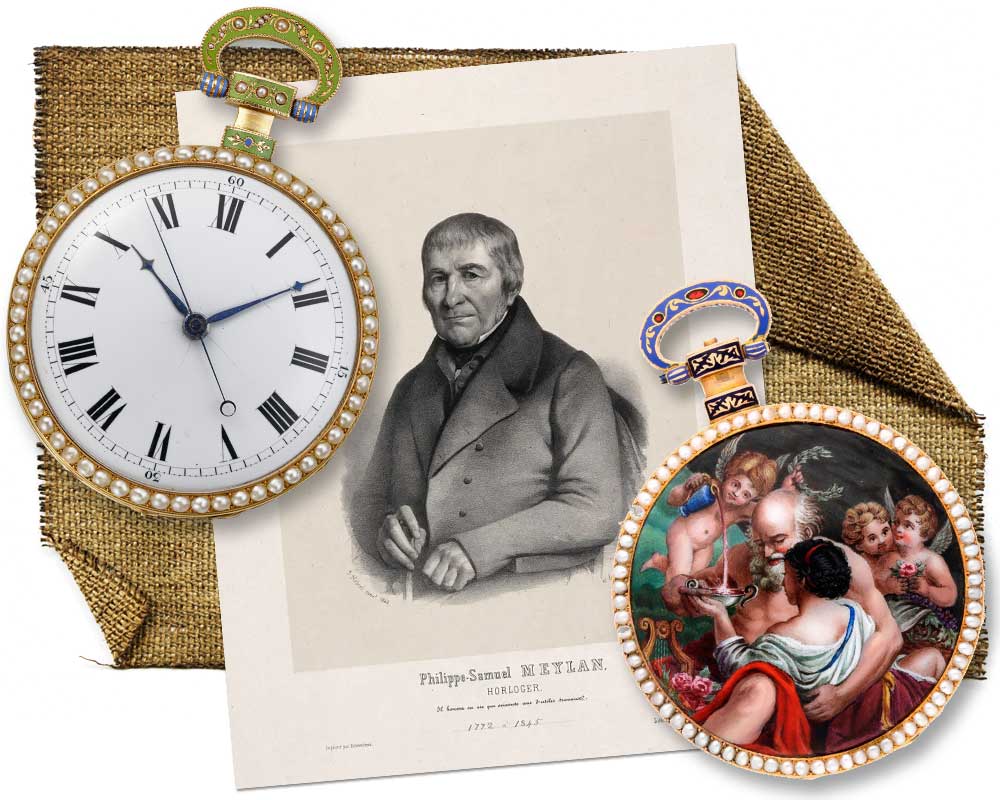
Philippe Samuel Meylan was born February 15th, 1772, in Bas-du-Chenet and died in Geneva in 1845. At 20 years of age, he came to Geneva where he was a master worker for the Godemar Frères. He met another watchmaker from his native region, Isaac Piguet and they entered into a partnership, founding the Piguet & Meylan firm, which was to last from 1811 to 1828.
It specialized in minute creatures, musical watches, skeleton and automaton watches. Meylan is also credited with the invention of the Bagnolet calibre. After Piguet & Meylan was dissolved, Philippe Samuel Meylan continued to work with his sons François and David Auguste.
Molyns, Charles
Charles Molyns was considered a skilled watchmaker in his time. He was a member of the Worshipful Company of Clockmakers, which was a prestigious guild for clock and watchmakers in London. Molyns also had a reputation for creating high-quality watches with intricate designs and features. His work was highly sought after by wealthy clients and he was known to have created watches for members of the British royal family. Overall, Charles Molyns was a respected and accomplished watchmaker during his time in London in the mid-18th century.
Moser, George Michael
George Michael Moser was born on 17 January 1706 in Schaffhausen, Switzerland, and died on 24 January 1783 at Somerset House, London. He was a renowned artist and enameller of the 18th century, father of celebrated floral painter Mary Moser and, with his daughter, among the founder members of the Royal Academy of Arts in 1768. He was the son of Michael Moser, an eminent Swiss engineer and metalworker. Moser trained initially as a coppersmith in Geneva and later learnt additional skills as a chaser, goldsmith and engraver. He moved to London during the 1720s and married Mary Guynier. Surviving metal works by him include elaborate gold snuffboxes and watch cases (including movements by noted watchmakers George Philip Strigel and John Ellicott, among others), and silver candlesticks in the rococo style. He subsequently rose to be head of his profession as a gold chaser, medallist, and enameller and was particularly distinguished for the compositions in enamel with which he ornamented the backs of watches, bracelets, and other trinkets.
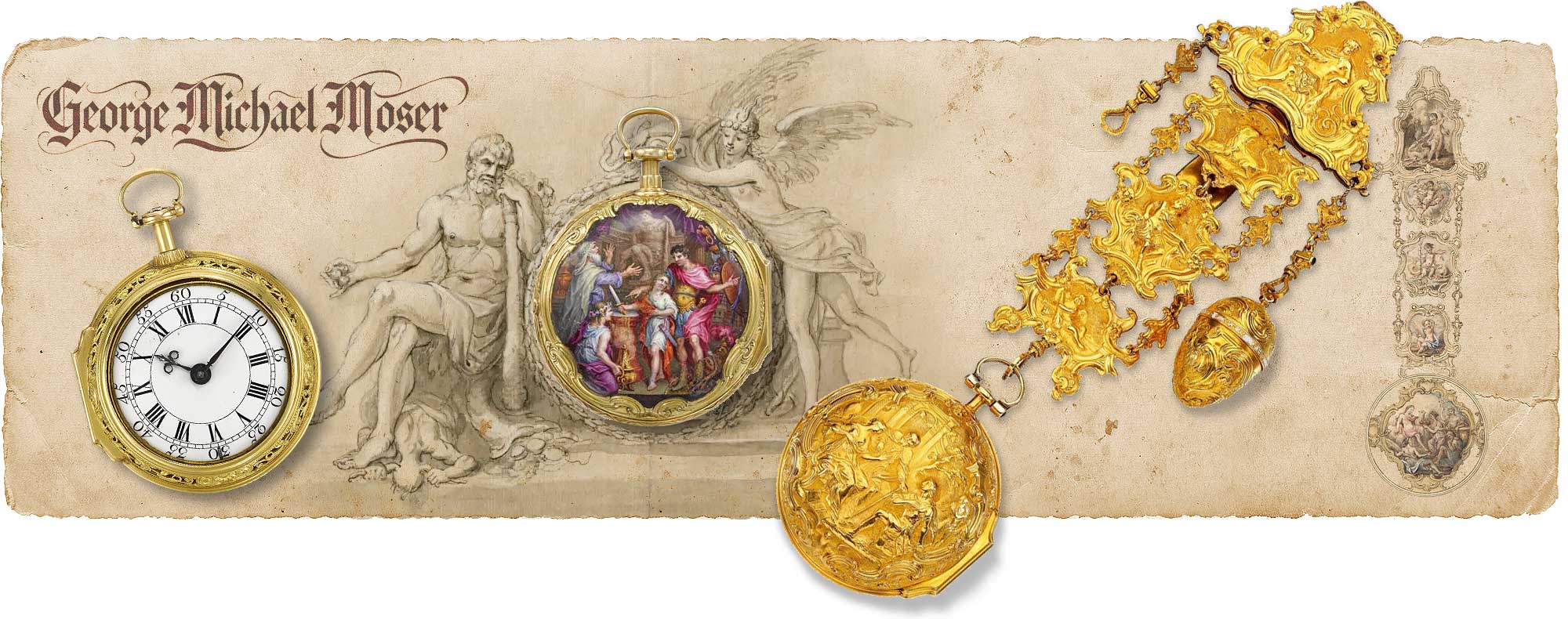
A beautiful example of this work was a watch case executed for Queen Charlotte, adorned with whole-length figures of her two eldest children, for which he received a hatful of guineas. Moser was drawing master to George III during his boyhood, and on his accession to the throne was employed to engrave his first great seal. When the art school afterwards known as the St. Martin’s Lane Academy was established about 1736, in Greyhound Court, Strand, he became manager and treasurer and continued in that position until the school was absorbed into the Royal Academy. When he died he was buried in the churchyard of St Paul’s, Covent Garden his funeral being attended by almost all his fellow academicians and pupils. On the day after Moser’s death, a notice of him from the pen of Sir Joshua Reynolds was published, in which he was described as the first gold chaser in the kingdom, possessed of a universal knowledge of all branches of painting and sculpture, and ‘in every sense the father of the present race of artists.
Moser & Cie, Heinrich
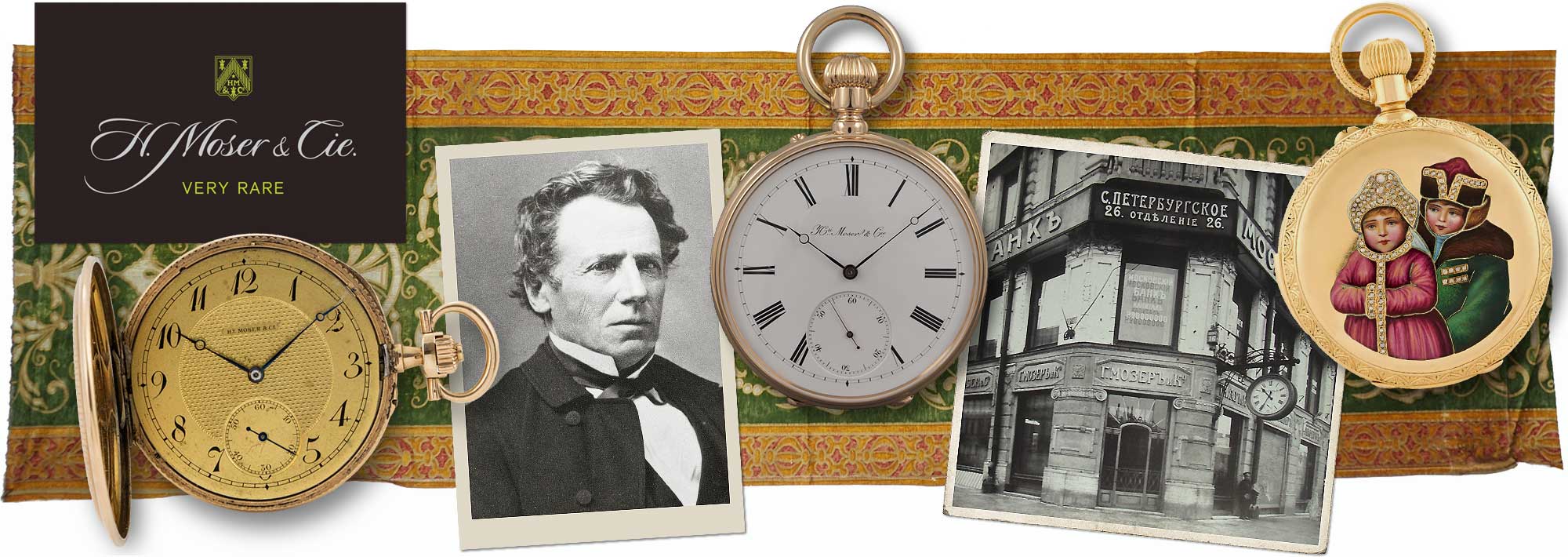
H. Moser & Cie is a trademark of Moser Schaffhausen AG, a Swiss luxury watch manufacturer. The original H. Moser & Cie was founded in 1828 by the independent watchmaker Heinrich Moser in St. Petersburg, Russia. Notable early clients included the Russian princes and members of the Russian Imperial Court. Vladimir Lenin also owned a Moser watch. After Moser died in 1874, the company was sold and its business in Russia was dispossessed in 1918 due to the October Revolution.
In 1953, H. Moser & Cie continued its business in Le Locle, Switzerland where it shifted its focus from pocket watches to wristwatches. Due to the quartz crisis, H. Moser & Cie became a part of the Dixi Mechanique Group and the original brand name was dropped. In 2002, Moser Schaffhausen AG was founded by Dr Jürgen Lange together with Heinrich Moser’s great-grandson Roger Nicholas Balsiger and the brand H. Moser & Cie was formally re-launched in 2005. Since 2012, Moser Schaffhausen AG has been a subsidiary of the MELB Holding Group of the Meylan family in Switzerland.
Motel, Jean-François Henri
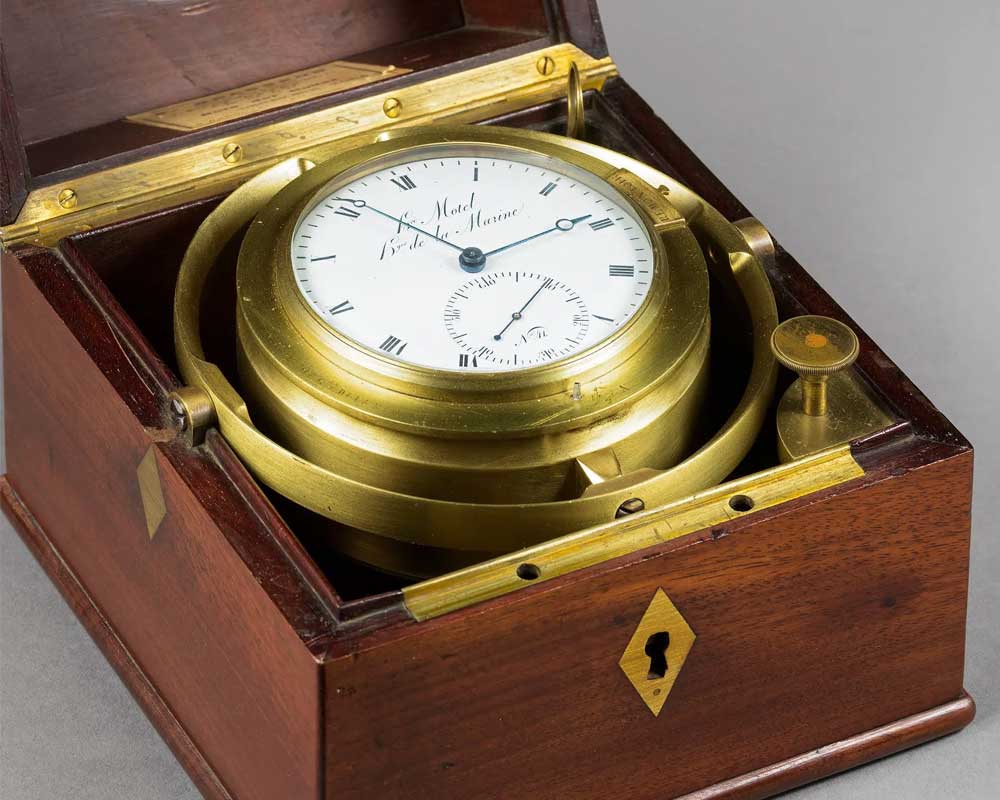
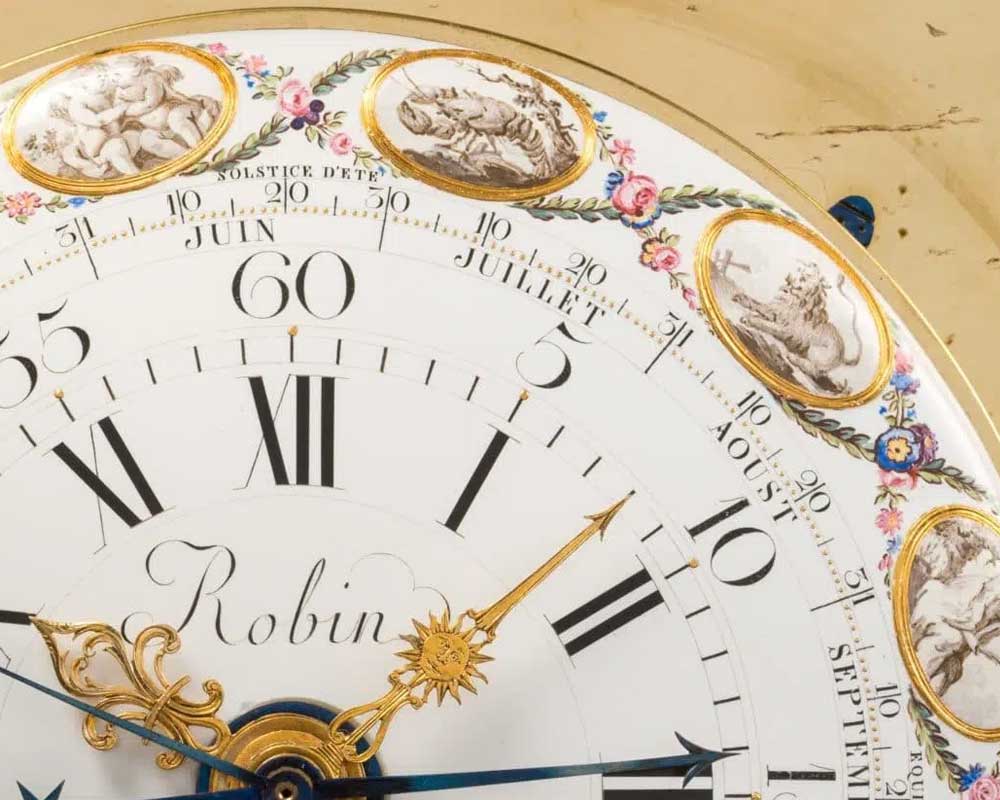
Jean-François Henri Motel (1786-1857) was born in Margny-Lès-Compiègne, France, on December 31, 1786, and is considered the best-known of Berthoud’s pupils. His father, Louis Nicolas Motel, was a farmer and inn owner. Henri went first to school in Prytanée and then to the Ecole des Arts et Métiers in Chalons. In 1806, he received the qualification of candidate and was chosen to study watchmaking in Paris at the state’s expense. His tutor was Louis Berthoud, ‘Horloger Mécanicien de la Marine’ (watchmaker to the French Marine). Motel had barely completed his apprenticeship with Berthoud when Berthoud died suddenly in September 1813. Berthoud’s widow asked Motel to continue Berthoud’s workshop and train his sons further. In August 1819, Motel married Louise Elisabeth Herbet, and in 1823, he settled in the Rue de l’Abbaye. In 1827, he presented his works for the first time and received a silver medal from the jury for his chronometers and astronomical clocks, as well as the comment… nobody keeps time as precisely as Motel.
Moulinié
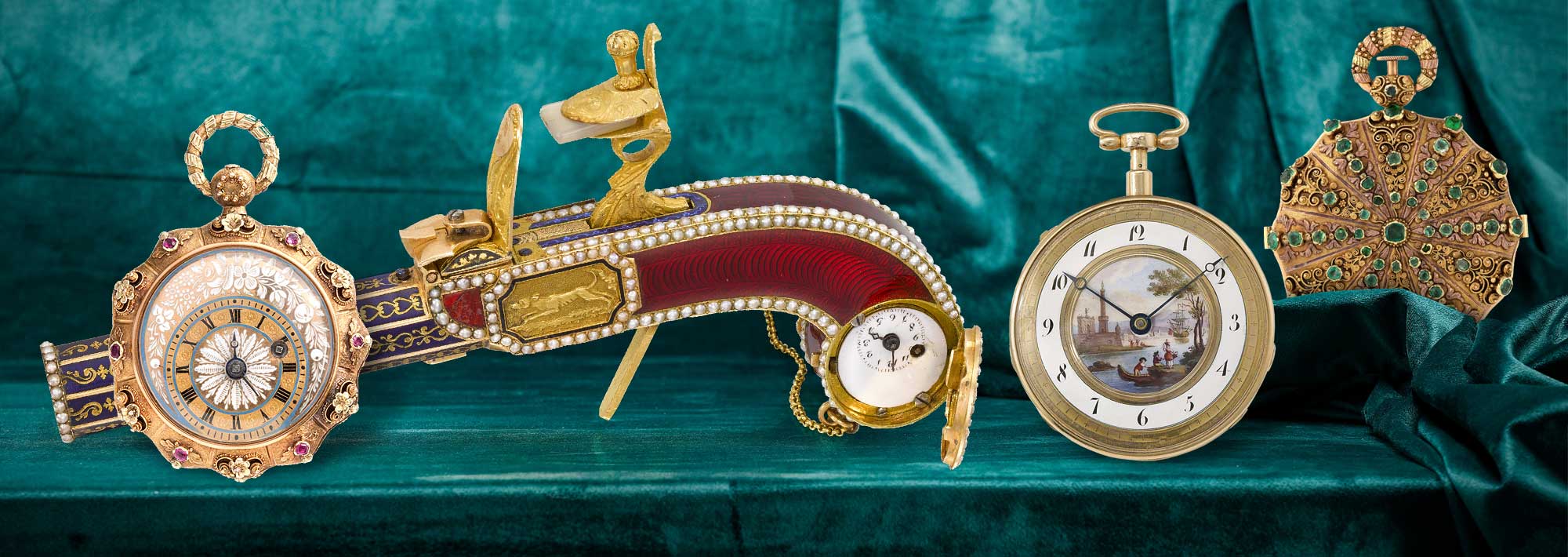
Moulinié (à Genève) was a company founded by Jacques-Dauphin Moulinié in 1795, which was also known as Moulinié Frères & Cie. In 1796, Jacques-Dauphin Moulinié and Jean-François Bautte registered a company with a nine-year contract that existed since August 1, 1793. Later, on October 1, 1804, they founded a new company named Moulinié, Bautte & Co. for four years and added Jean-Gabriel Moynier to the team. This time, the company was a watch case manufacturer and in business with the watch and jewellery trade. From 1808 to 1821, after Moulinié retired, the firm was known as Moulinié, Bautte & Moynier. The company continued as Moulinié Frères & Cie with the sons of Jean-François Moulinié and Jacques-Dauphin Moulinié Jr.
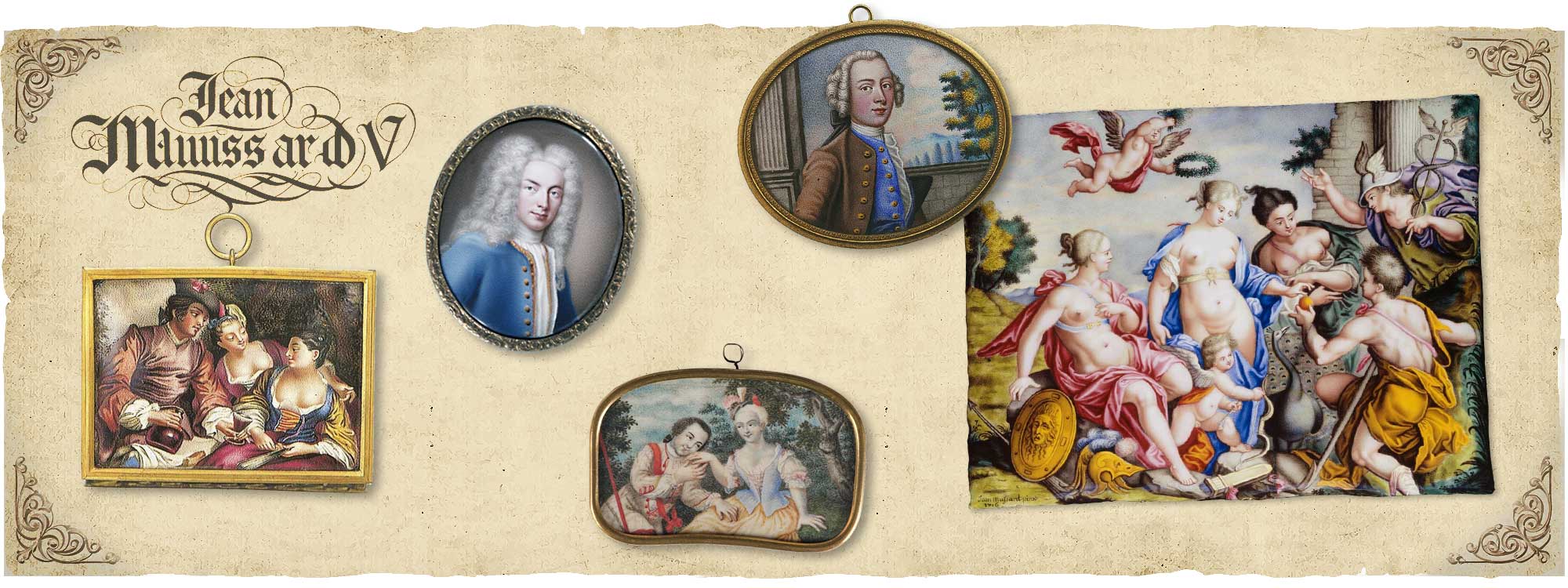
Mussard V, Jean
Jean Mussard V was born and died in Geneva, 1681-1754. He was one of the best enamel painters of the early 18th century, the son of Jean IV and a cousin of the Huauds. He began his career as a goldsmith and became a Master on December 7th, 1699. He later became a painter on enamel, in which discipline he was influenced by the style of Les Frères Huaud. Although he was inspired by their work, his paintings were more according to the taste of the time, they showed religious designs as well as purely secular ones. He went into partnership with his son Jean-Antoine and trained several pupils, among them Gabriel Fontaine, André Oettner, and in 1712, Germain Colladon. The scene ‘The Death of Cleopatra’ can be found on several of his enamel watches, but two of his best-known subjects are ‘Roman Charity’ and ‘Religious Scene’. His signature appears as ‘Mussard’, ‘Jean Mussard pinx’ and ‘Mussard pinx’.