Watchmakers and watch companies starting with the letter R
Review renowned watchmakers and reputable watch companies starting with the letter R. Delve into their legacies, design ingenuity, and expert craftsmanship. Perfect for horology enthusiasts and collectors!
Randall, Anthony G.
Anthony G. Randall was born in 1938 in Beaconsfield (Bucks). Since toys could not be bought during this period, children were forced to invent their amusements using second-hand toys or what they could make for themselves. This contributed to an early fascination with mechanical objects which gradually turned to mend and repair. At the age of nine, Randall was sent to boarding school at Eastbourne. In his mid-teens, still, at school, he was repairing docks and watches regularly and began to pester local jewellers for tools and materials. He was offered a part-time job in Eastbourne, by Geoff Lee. Here he helped to repair clocks, especially carriage docks requiring a great deal of hard work, receiving instruction and tools instead of payment. Unfortunately, at the time, career prospects at the bench in horology were not good, so Randall continued his education at Manchester University, finishing in 1960 with a degree in physics. Thereafter followed short spells in business with his father and then with the Cambridge Scientific Instrument Company working largely on their Scanning Electron Microscope project.
Rigaud, Jean-Pierre
Jean-Pierre Rigaud was born in July 1750 in Geneva, Switzerland. He was the son of watchmaker Lazare Rigaud (1716-1785) and his wife Elisabeth Aubert (circa 1729-1789). In 1775 Rigaud married Marie de Choudens (1751-1828), the daughter of maker Jacques de Choudens (1728-1801). He was appointed maker to the Russian court and henceforth signed his timepieces Pierre Rigaud. He was also mayor of Dardagny from circa 1818 to 1820, which was a small town 11 kilometres to the west of Geneva near the French border. Jean-Pierre Rigaud died at the age of 69 on Saturday, January 11th, 1820 in Dardagny. A pocket watch by Rigaud resides in the Château de Versailles.
Robert, Charles Fredèric
Charles Fredèric Robert was a watchmaker in Geneva during the 19th century. He was known for creating high-quality pocket watches, including chronometers and repeaters. He also produced some wristwatches, but these were not as common during his time. His watches were often highly decorated and featured intricate designs on the dials and cases. Some of his most notable creations include a pocket watch with a perpetual calendar and moon phases, as well as a minute repeater with a striking mechanism that played a melody.
Robert & Courvoisier
Robert & Courvoisier are clock and watchmakers from La Chaux-de-Fonds, Switzerland. The firm was founded in 1795 as a successor to J. Robert & Fils, Courvoisier. In 1770 the firm was originally established by Josué Robert (1691–1771). After Robert’s death, a year after the company was founded, the firm was renamed Josué Robert & Fils and was led by his son Louis Benjamin Robert (1732–1781). They mainly produced large clockworks, but as Benjamin’s son-in-law, Louis Courvoisier became a companion, pocket watches were put into production.
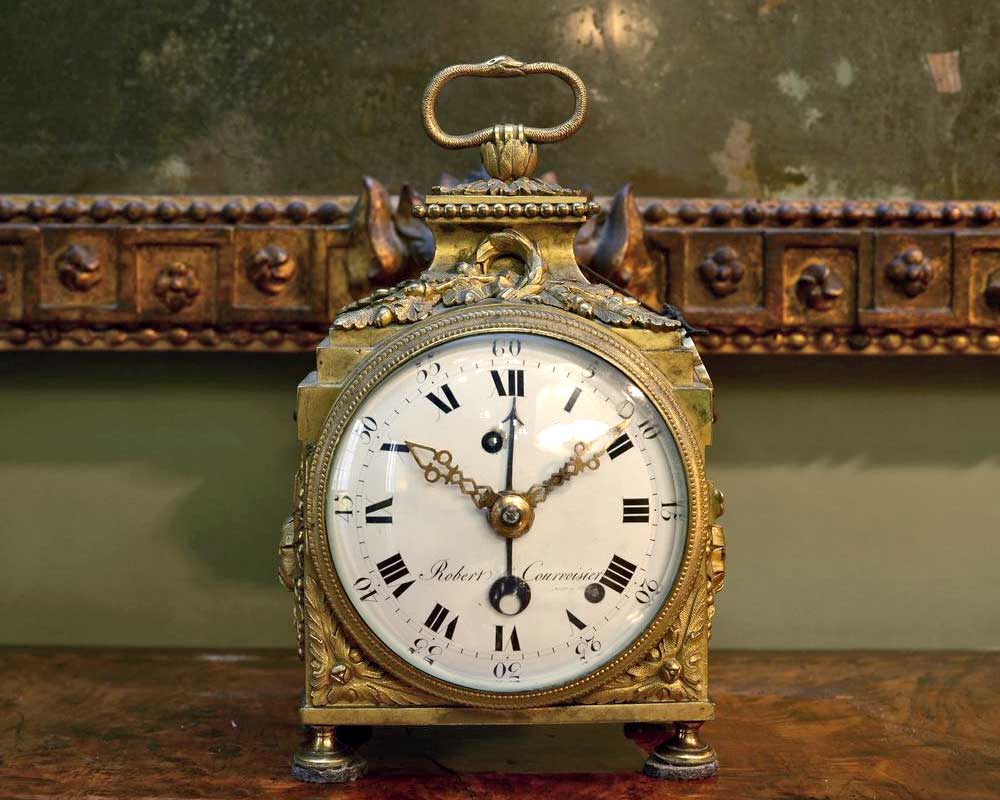
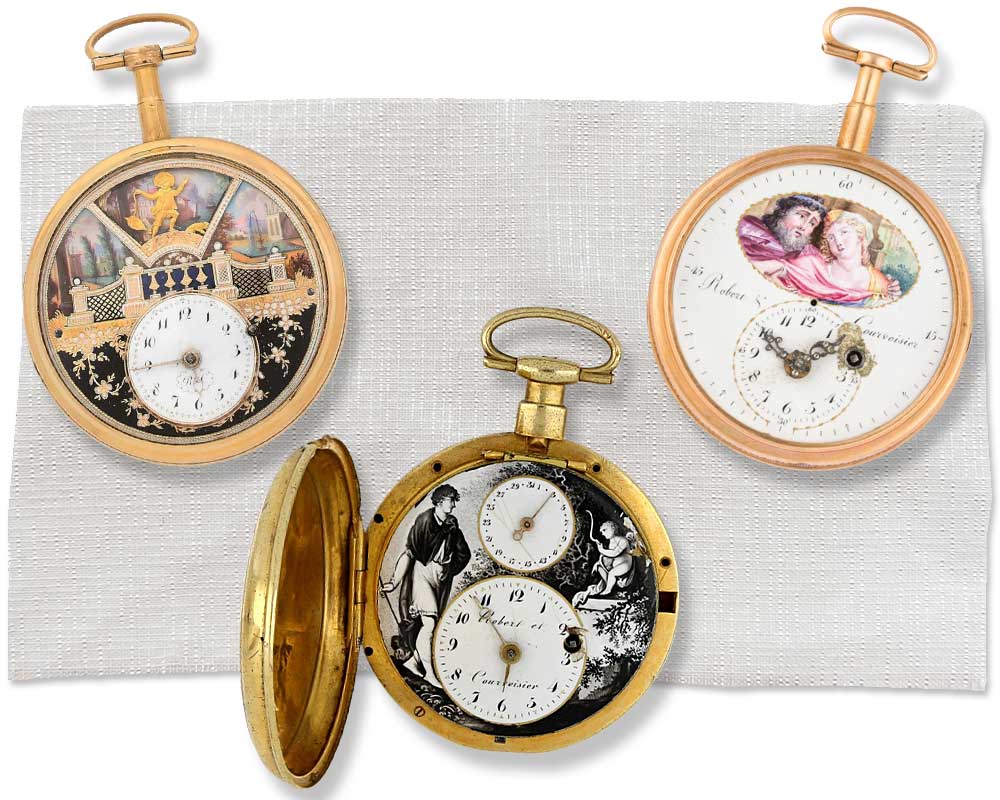
When Louis Benjamin died, Louis Courvoisier became the manager of the firm. From 1787 to 1795 the firm was called J. Robert & Fils, Courvoisier. From 1795 to 1805 it was renamed Robert & Courvoisier. Since 1805 the firm’s name was Robert, Courvoisier & Cie with Philip Grandjean as a business partner. In 1852 it became Courvoisier Frères. The firm continued under the direction of various members of the Courvoisier family until the 1930s. Along with the Jaquet-Droz firm, they were the most important makers of musical clocks and around the turn of the 18th and 19th centuries, their portable officers’ watches were famous.
Robert & Fils, J.
J. Robert & Fils is a Swiss watch manufacturer that was founded in 1771 as the successor to the company Josué Robert, which had been established many years earlier by Josué Robert (1691-1771). After Josué Robert passed away, the company was renamed Josué Robert & Fils and his son Louis Benjamin Robert (1732-1781) took over as the managing director. The company primarily produced large watches, but when Louis Benjamin’s son-in-law, Louis Courvoisier, became a business partner, they began manufacturing pocket watches. After Louis Benjamin’s death, Courvoisier took over management of the company, and from 1787 to 1795, the company was called J. Robert & Fils, Courvoisier.
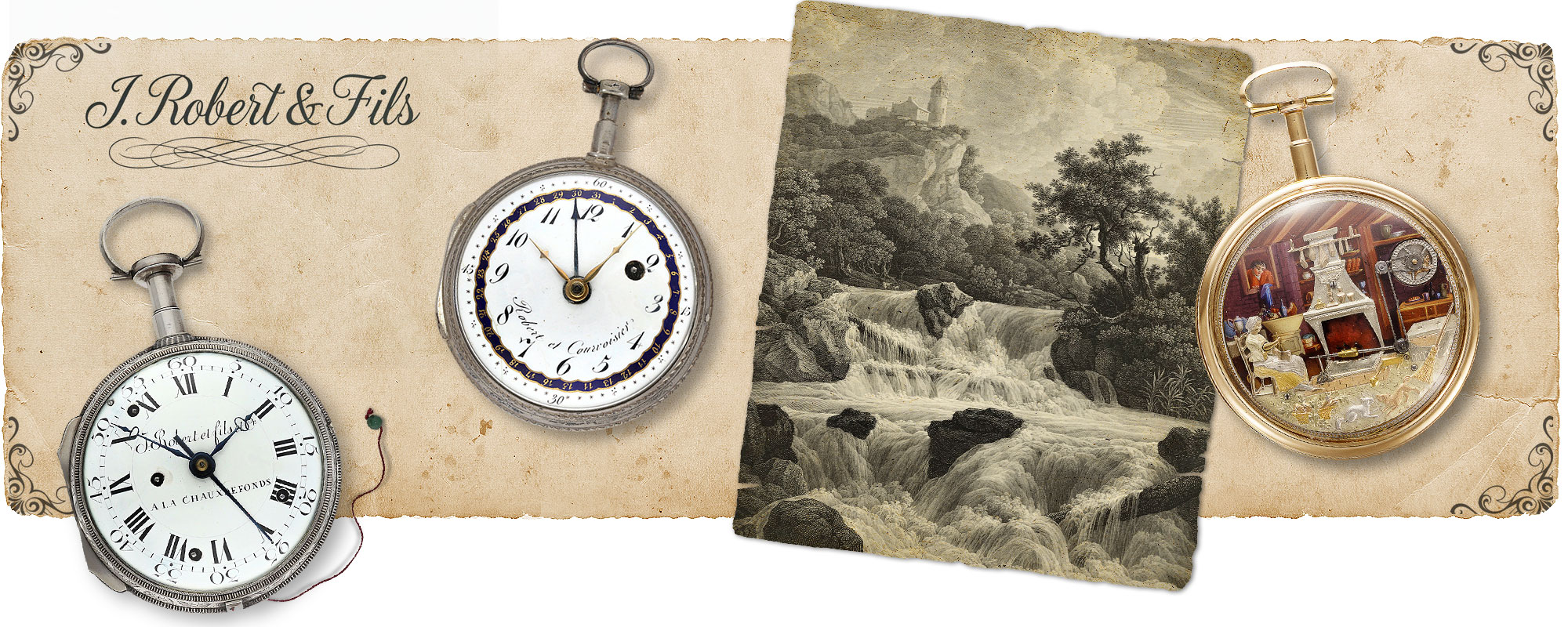
It’s possible that the name J. Robert & Fils already existed before 1771, when Josué Robert worked with his sons David (1717-1769), Jonas-Pierre (1720-1805) and Louis-Benjamin. Aimé Robert (1758-1769), a son of Louis-Benjamin, was also involved in the business. Since Josué and David had passed away, a new listing may have been necessary in 1771.
The book Swiss ‘Timepiece Makers’ by Kathleen H. Pritchard mentions Jean Pierre Robert as a partner, but she doesn’t mention Jonas-Pierre Robert as a son. Jean Pierre Robert and Jonas-Pierre Robert may be the same person.
Robin, Robert
Robert Robin (1741-1799) was a talented and inventive clock and watchmaker who counted among his clientele the French Royal Family. He became Marchand-Horloger Privilégié du Roi on 22 October 1763 and resigned on 13 September 1765 in favour of Jean-Pierre Courtois.
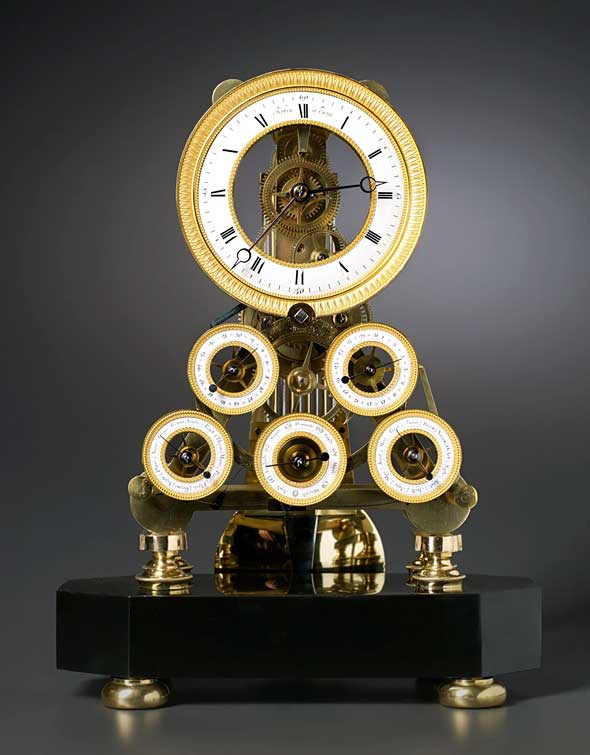
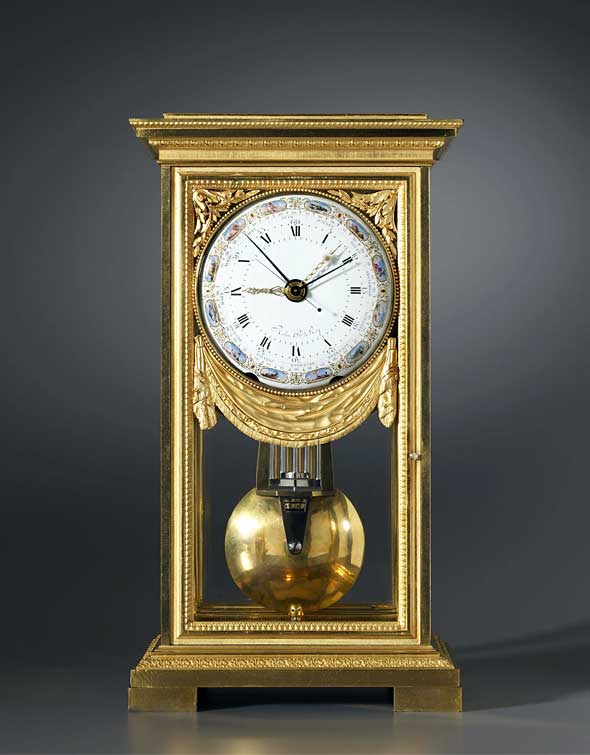
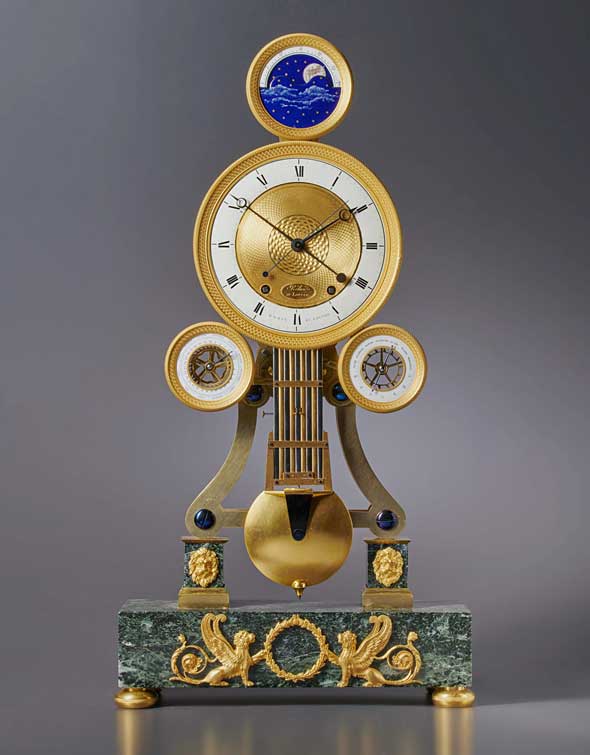
In 1778 the Académie des Sciences approved two of his inventions, one being an astronomical clock representing a meridian drawn on a pyramid, which the Menus Plaisirs acquired that year for Louis XIV, for 30,000 livres. During the same period, he perfected his famous mantel clocks with astronomical indications and compensated pendulums, one of the first owners being the Marquis de Courtanvaux. Robin applied these principles to regulators, the Duc d’Aumont possessed an early model of this kind. He was equally interested in watches, using a special escapement that bears his name from 1786 onwards and in monumental clocks, supplying the Grand Commun at Versailles (1782), the Menus Plaisirs and the Petit Trianon (1785).
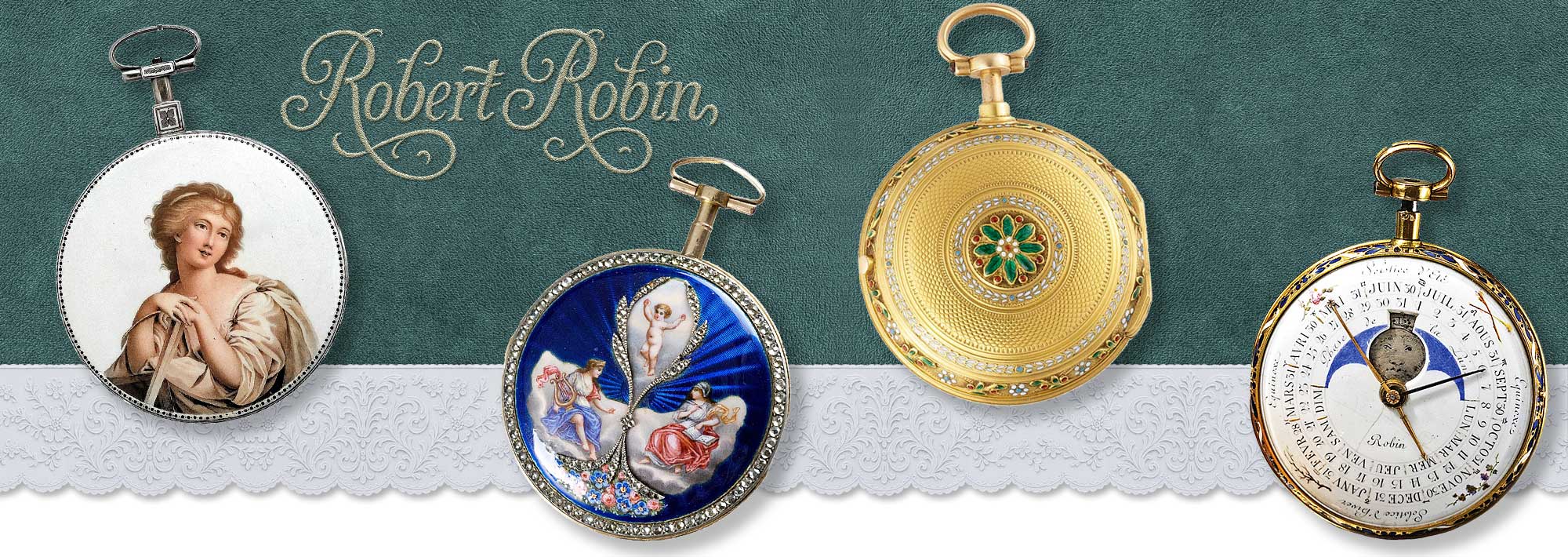
Many members of Parisian high society were clients of Robin, including the maréchaux Ducs of Duras and Richelieu and the Marquis de Sérent, tutor to the dukes of Angoulême and Berry. In 1794, Robin was appointed Horloger de la République. After the French Revolution, he was given the task of making an inventory of the Royal clocks including the 23 that belonged to Marie Antoinette.
Romilly
Romilly, also known as Honoré Pons-Alexandre Romilly, was a watchmaker in Paris during the late 18th and early 19th centuries. He was born in 1758 in the town of Tonbridge, England and received a formal education at a school in Greenwich. Later on, he went to study law at the University of Edinburgh but dropped out to pursue his passion for horology and became known for his exceptional skills and innovations in watchmaking.
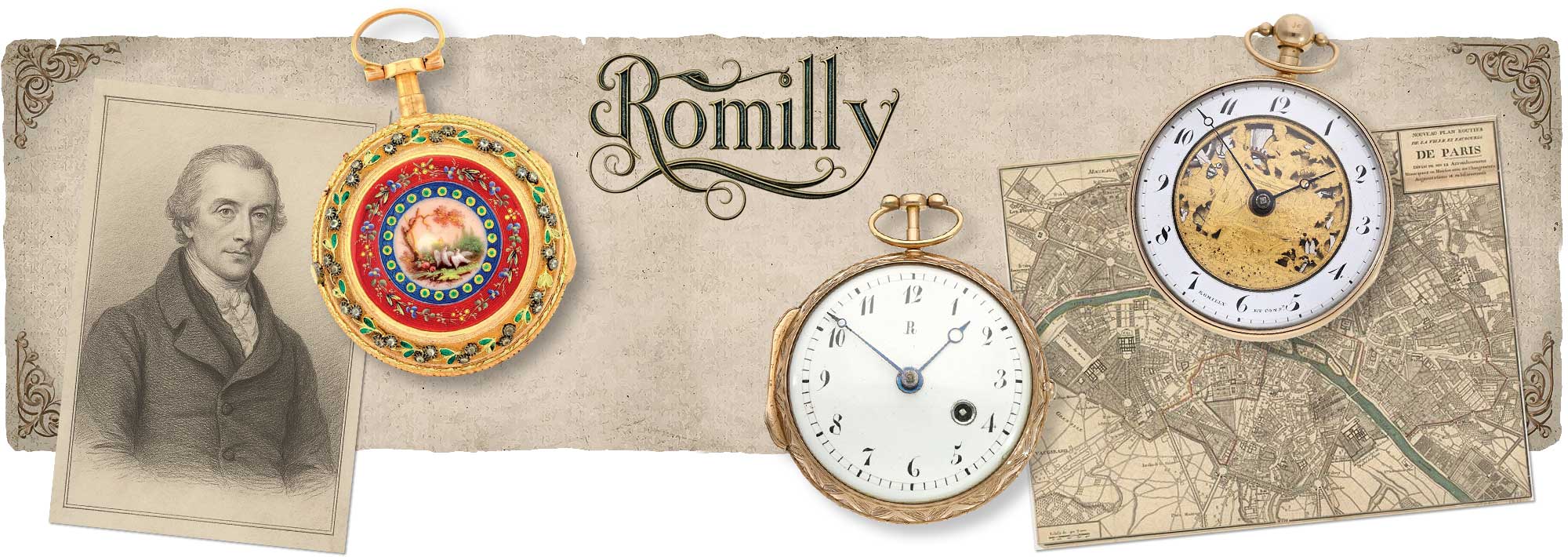
He died in 1835. Some of Romilly’s most notable accomplishments as a watchmaker include:
- Improved escapement design: he made significant contributions to the development of escapements, which are vital components in mechanical watches. His improvements helped increase accuracy and reliability in timekeeping.
- Invention of the detached lever escapement: Romilly is credited with inventing the detached lever escapement, which is a type of escapement mechanism used in watches. This invention improved the accuracy and precision of timekeeping.
- Precision timekeeping: he was known for his ability to create highly accurate timepieces. His watches were sought after by collectors and connoisseurs due to their precision and reliability.
- Influence on watchmaking: Romilly’s innovations and expertise had a significant impact on the watchmaking industry during his time. His designs and techniques were widely adopted by other watchmakers, further advancing the field.
Rosat, Charles
Charles Rosat was born in Le Locle on May 26th, 1874, as the son of watchmaker William-Charles-Frédéric Rosat and Louise Egger. Charles married Rôse-Lucy Bôle and they had five children. He was a Swiss watchmaker and inventor. Around 1896 he was already involved in the ‘Association Ouvrière’ in Le Locle, a collaboration between various watchmakers at the time. He won several first prizes in chronometer competitions. In 1900 he was located at 39 Rue du Progrès in Le Locle. On November 3rd, 1900, he received patent No. CH21639A for ‘Coq avec piton porte-spiraal mobile’ and patent No. 24677 on January 31st, 1903, for ‘Dispositif régulateur pour raquette montée sur un porte-spiral pouvaut tourner autour de l’axe du balancier’. Soon after, this mechanism was used in watches made by Georges Favre-Jacot & Cie, Edward Glauser, H. Moser & Cie and Caesar Racine. In 1901 he was mentioned in the Swiss Government Gazette of Commerce as head of the house Chs. Rosat. Type of company, manufacture and trade of timepieces. On May 8th, 1913, there was a change in the commercial register: the house of Charles Rosat, Le Locle, moved its headquarters to Boudry and for that reason, the successor of the ‘Association Ouvrière’ in Locle added the manufacture and sale of clocks and watches. He also became the workshop manager of the Zenith branch in Boudry.
Roskopf, Fritz Edouard
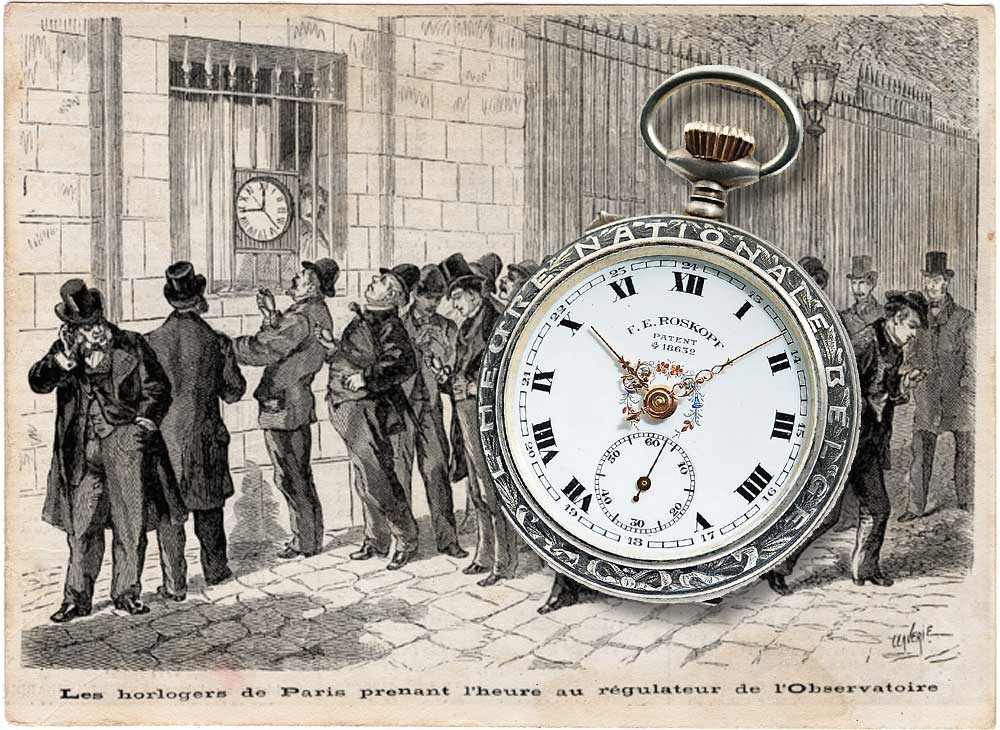
Fritz Edouard Roskopf was born in La Chaux de Fonds on December 13th, 1835 and died in 1927. In 1855 Fritz Edouard and his father Georg Friedrich Roskopf together with Henry Gindraux established the company Roskopf, Gindraux & Co. Two years later he left the company and started his own business in Geneva.
After the death of his father, Roskopf began making his own watches and registered the thistle as his mark in 1897. On January 3rd, 1899, Roskopf received patent CH 18632 for a mechanism that allowed setting the hands with the crown. His watches were produced by the Reconvilier Watch Co SA and signed F.E. Roskopf & Co.