

Watchmakers and watch companies starting with the letter T
Take a look at top watchmakers and trusted watch companies starting with the letter T. Learn about their legacies, innovative designs, and craftsmanship. Essential for horology aficionados and collectors!
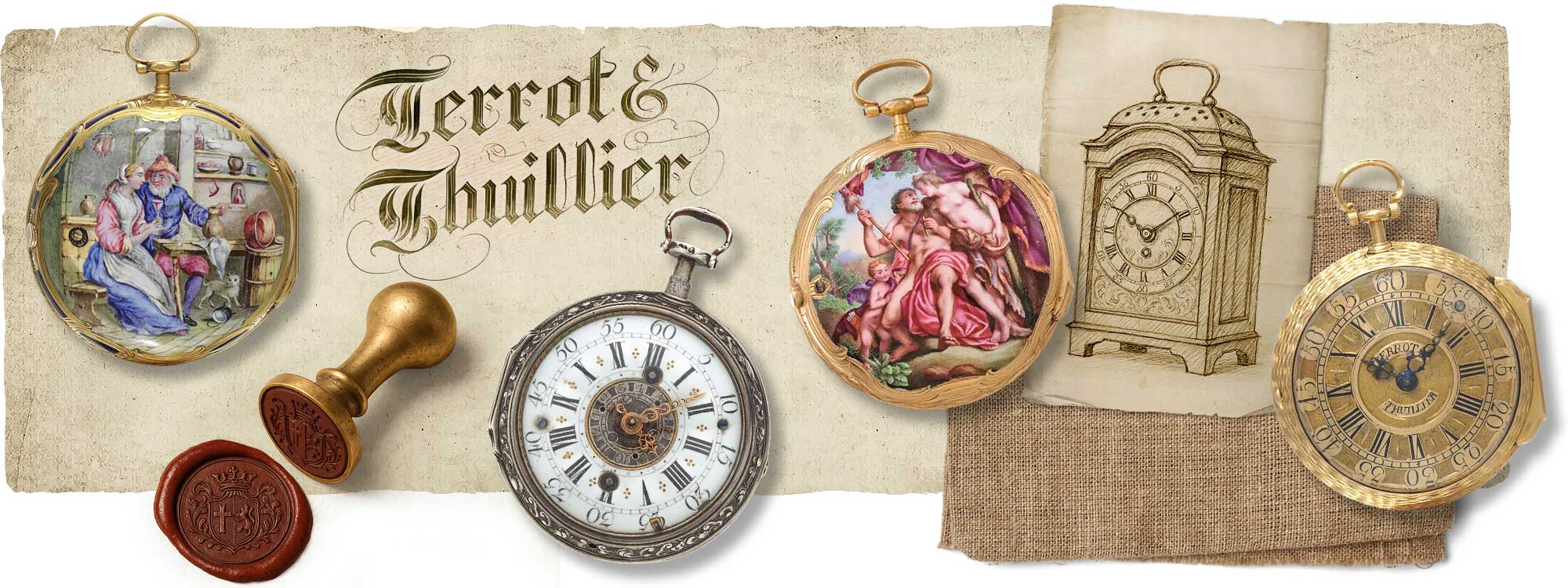
Terrot & Thuillier
Terrot & Thuillier (1735-1750) were master watch- and clockmakers, and Geneva representatives of Jaquet-Droz. They made very high-quality watches which were very often decorated with enamel. Jean Pierre Thuillier (1696-1768), son of Isaac, was made a citizen of Geneva and married in 1722. Philippe Terrot (1696- 1781), originally from Pont-en-Royans in the Dauphiné, France, took refuge in Genève in 1700, was elected citizen in 1732 and married in 1738.
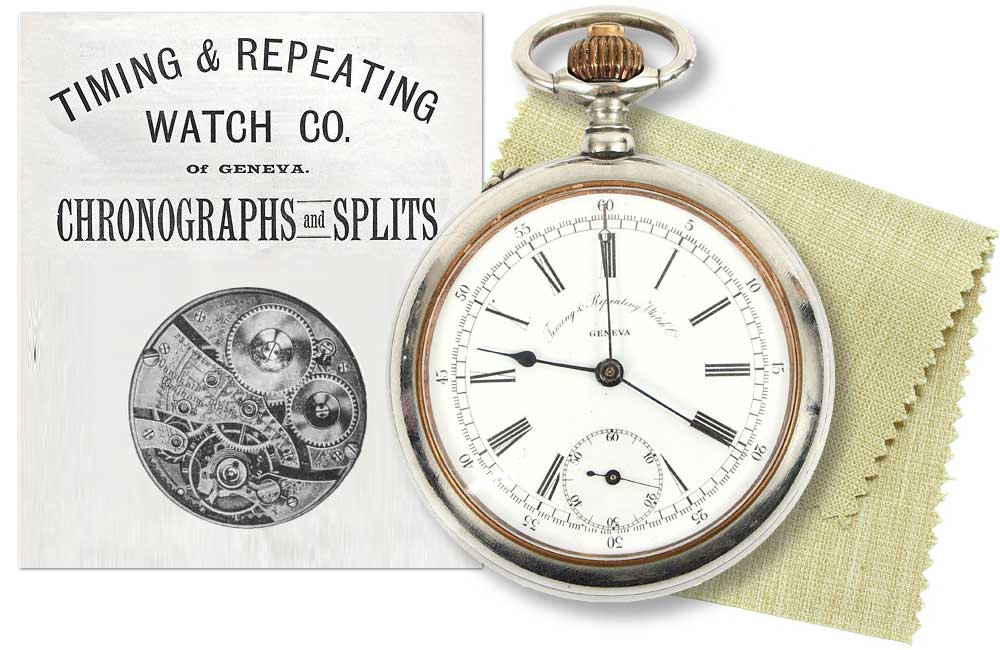
The Timing & Repeating Watch Company
The Timing & Repeating Watch Company was a Swiss manufacturer of chronographs. Kathleen H. Pritchard writes in ‘Swiss Timepiece Makers 1775-1975’ that the Timing & Repeating Watch Co in Geneva manufactured chronographs almost identical to Waltham’s 1884 model with a mechanism by H.A. Lugrin (a patent from 1876 and 1880).
It also mentions the possible connections between Timing & Repeating Watch Company, Henry Alfred Lugrin Sr, Longines and Albert C. Wittnauer.
Thornton, James
James Thornton was a notable watchmaker in London in the late 18th century. He was known for his high-quality watches and was a Worshipful Company of Clockmakers member. While there is limited information available about his specific impact on the watchmaking industry, his work likely helped to advance the craft and improve the reputation of London as a centre for fine watchmaking. His watches are highly sought after by collectors today and his legacy continues to influence the world of horology.
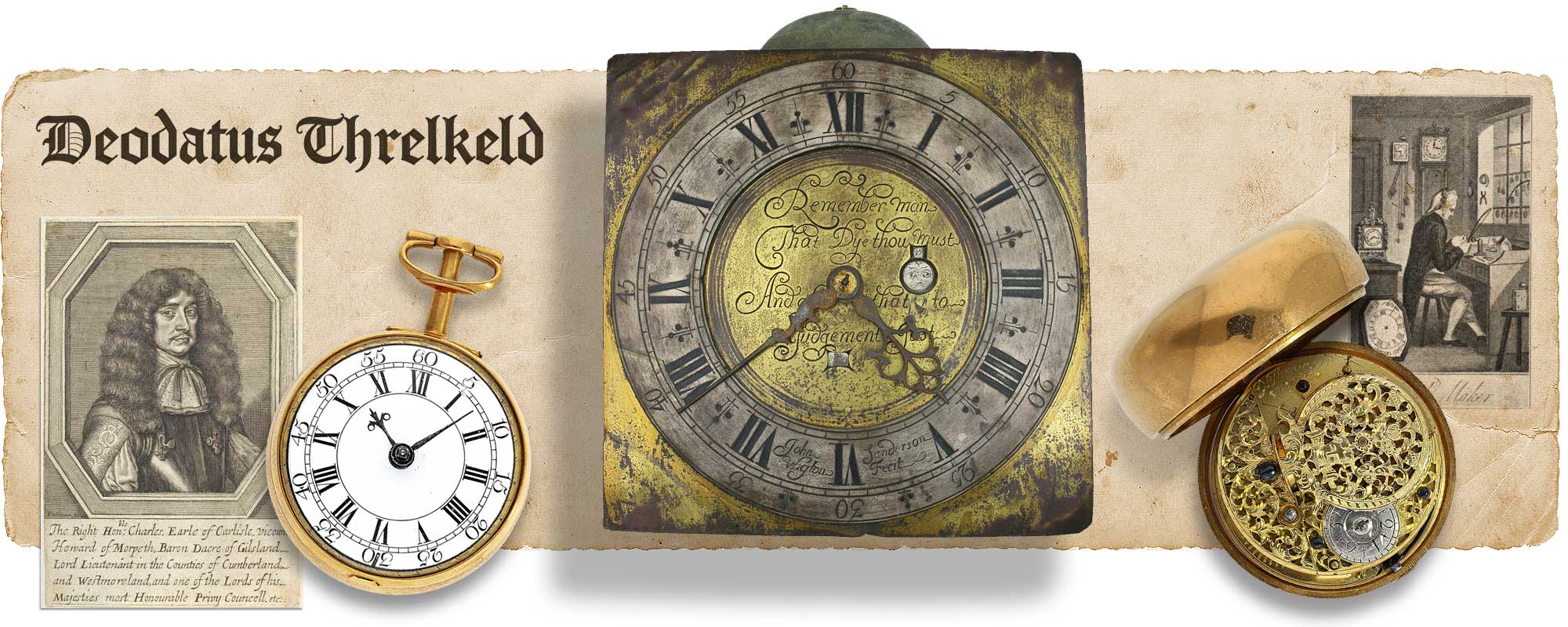
Threlkeld, Deodatus
The English watchmaker Deodatus Threlkeld (or Thirkeld) was recorded working from 1657 to 1737. Deodatus was the son of William Threlkeld . When his father relocated from London to Brancepeth, Durham in the County Durham, northern England, he stayed nearby and worked in Newcastle on Tyne. At the age of 14 Abraham Fromanteel trained him in Newcastle from 1671 to 1678. 21 years old Deodatus became self-employed as a watchmaker. A year earlier, his father William had died and Fromanteel was recalled to London by his family. In 1698, Threlkeld was challenged by William Provost, another well-known watchmaker from Newcastle to a competition to determine who was the better watchmaker. On the jury was the famous Sam Watson, The Mathematician in Ordinary to His Majesty. Threlkeld won!
Tiffany & Co
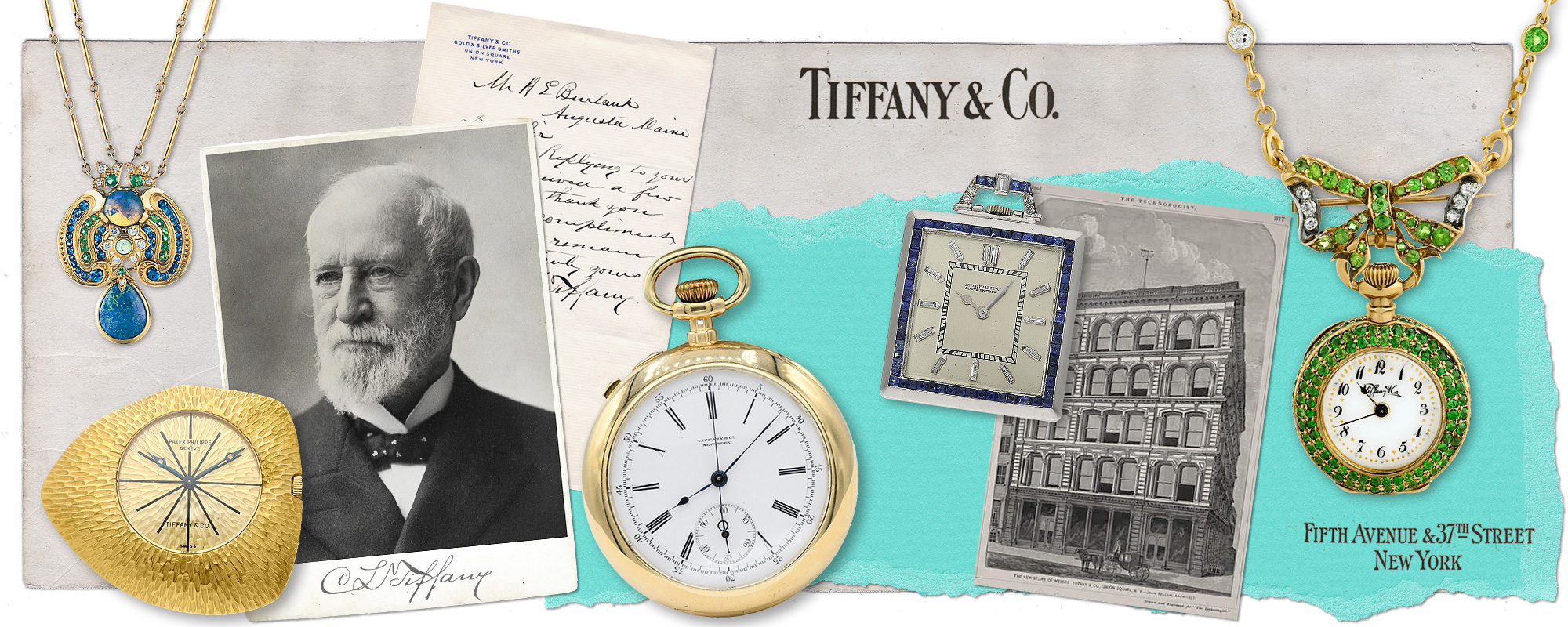
Tiffany & Co, colloquially known as Tiffany’s, was founded in 1837 by the jeweller Charles Lewis Tiffany and became famous in the early 20th century under the artistic direction of his son Louis Comfort Tiffany. It is an American luxury jewellery and speciality design house headquartered on Fifth Avenue in Manhattan, New York.
Tobias & Co, M.I.
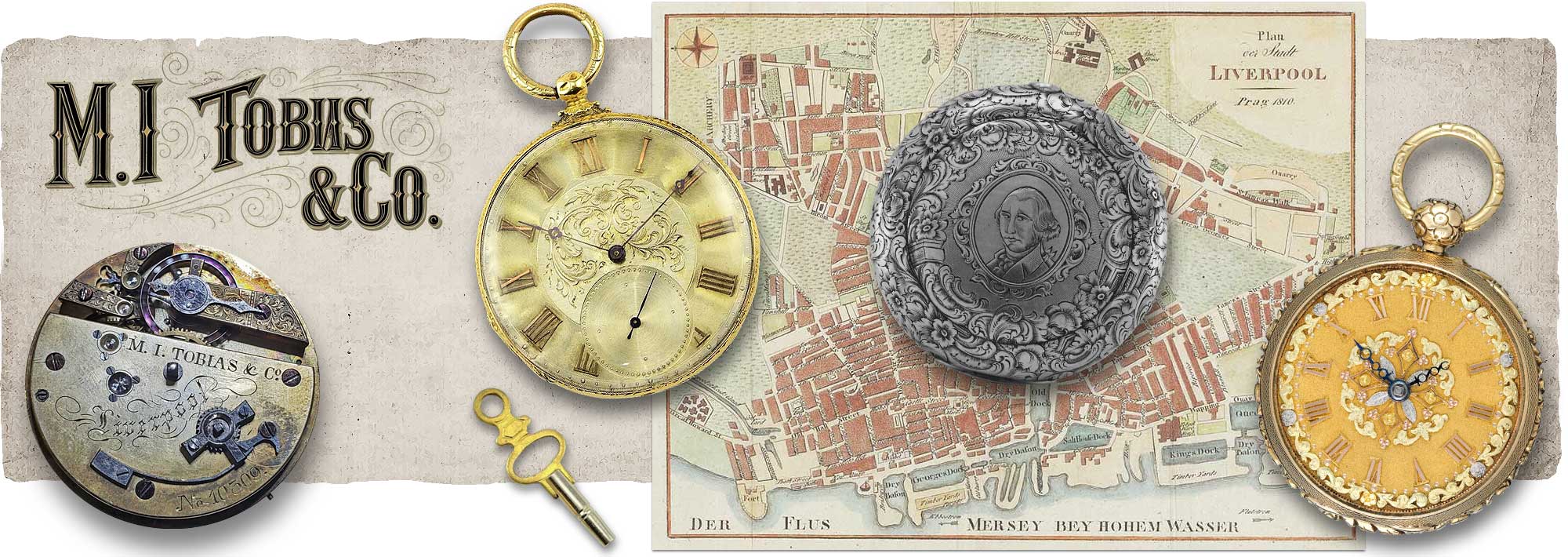
M.I. Tobias & Co was founded by Meyer Isaac Tobias (also known as Michael) in Liverpool in 1810 and existed until 1829. Meyer Isaac was previously a business partner to his uncle, Morris Tobias, at M. Tobias & Co, London and Liverpool. In Liverpool, the company was recorded at No. 5 Poole Lane but there are also watches signed with Lord Street. Watches by M.I. Tobias & Co are based on English construction, often with an escapement invented by Edward John Massey. Many clocks were exported to America. Meyer Isaac died in New York in 1838.
Tompion, Thomas
Thomas Tompion was born in 1639, was baptized on July 25th, 1639 and died in 1713. He was an English clockmaker, watchmaker and mechanic who is still regarded to this day as the ‘Father of English Clockmaking’. His work includes some of the most historic and important clocks and watches in the world.
Tompion was born as the son of a blacksmith at Ickwell Green, a hamlet in the parish of Northill, Bedfordshire. It seems that he was trained, with his younger brother James, in the art of blacksmithing. Very little is known of Tompion’s early life, but he was likely involved at some point in the repair of the local church clock as this was usually blacksmith’s work. Perhaps he developed his passion for horology from this. There is no record of Thomas Tompion serving as an apprentice in a clockmaker’s workshop but on September 4th, 1671, he was admitted to the Clockmakers’ Company and he became master in 1704.
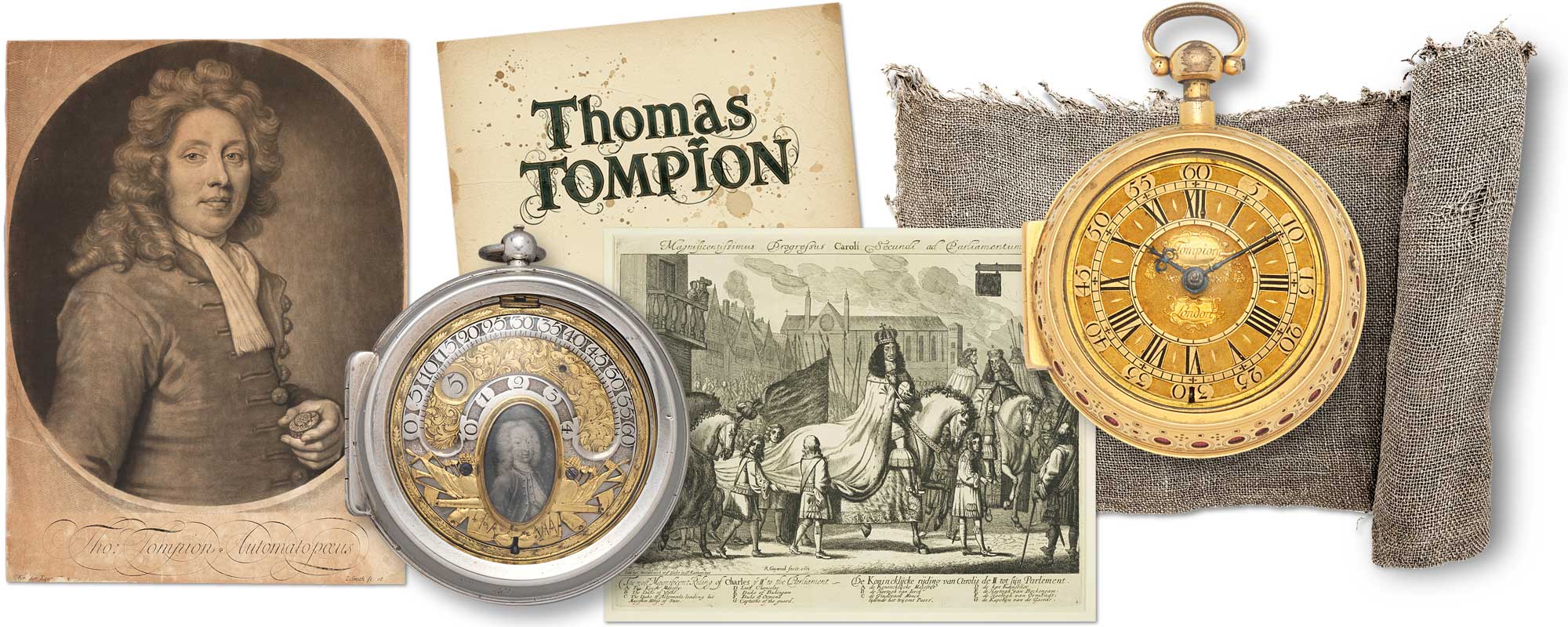
In 1674 Tompion was introduced to Robert Hooke, the most important English experimental physicist of the 17th century. The following year, 1675, Hooke employed Tompion to make a watch with a special double spring on the balance. On April 7th, Hooke, accompanied by Tompion and Sir Jonas Moore, went to Whitehall Palace and showed the watch to King Charles II. The King was so impressed that he ordered a watch from Tompion for his own use.
Tompion employed several apprentices, most notably, Edward Banger who married Tompion’s niece in 1694 and became free of the Clockmakers’ Company in 1695. He formed a partnership with Tompion in 1701 but some years later a serious quarrel appears to have taken place and, after about 1708, they ceased to collaborate. The cause of the quarrel is not known but could have been the result of rivalry between Banger and George Graham. The latter had worked as a journeyman in Tompion’s workshop since 1696 and had married another of his nieces. He was taken into partnership by Tompion in 1710 and succeeded the business on Tompion’s death in November 1713. Tompion was buried in Westminster Abbey, indicating the high esteem in which he was held, during his lifetime.
Touchon & Co
Touchon & Co. A watch manufacturer founded in 1901 that was first established in Sécheron, later in Petit-Saconnex (districts of Geneva) and subsequently at 1, Place de la Fusterie. The trademark was registered on February 2, 1907, under No. 21652. The manufacturer, which produced high-quality watches, merged with Agassiz Watch Co. S.A., to launch extra slim watches on the market of 16 1/2″‘- 17/12th, 15/12th, 10/12th and even 10″‘- 10/12th. This latter movement, fitted in its case, could be concealed into a 20-dollar coin and was awarded the Gold Medal at the Paris Exhibition in 1889 and, in 1910, received the highest distinction in Brussels. The company produced these watches for Tiffany.
In 1921, Touchon entered into a partnership with Wittnauer, under the new company name of Wittnauer & Cie, for the production of watches and spare parts, and moved premises to 4, Rue du Mont-Blanc until 1924.

