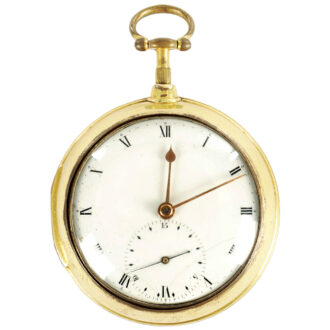
Early important gold English gold clockwatch Circa 1712-1714
- Kenmerk
- SA0039
- Diameter
- 58 mm
- Estimate
- € 80.000 - 120.000
- Price sold
- € 215.000
Important English gold clockwatch by Daniel Quare
–
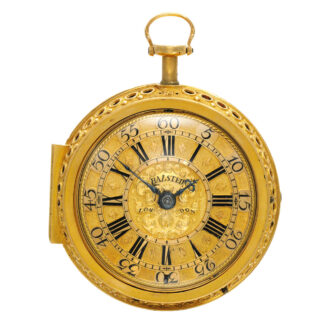
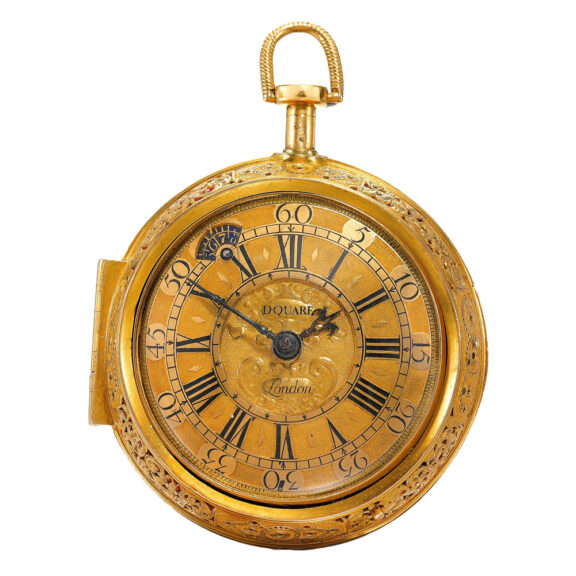
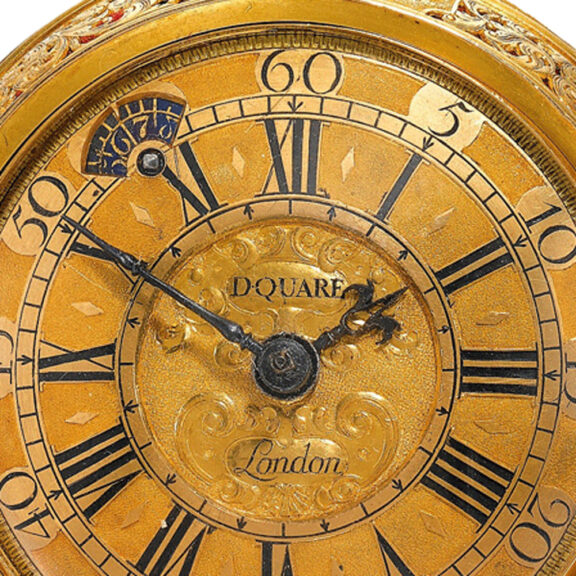
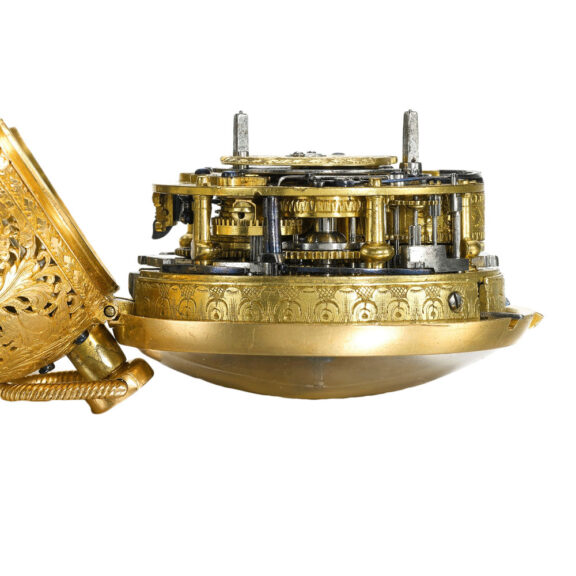
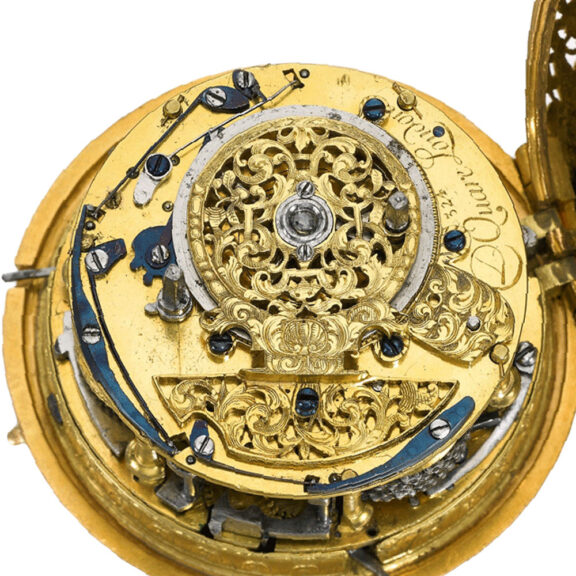
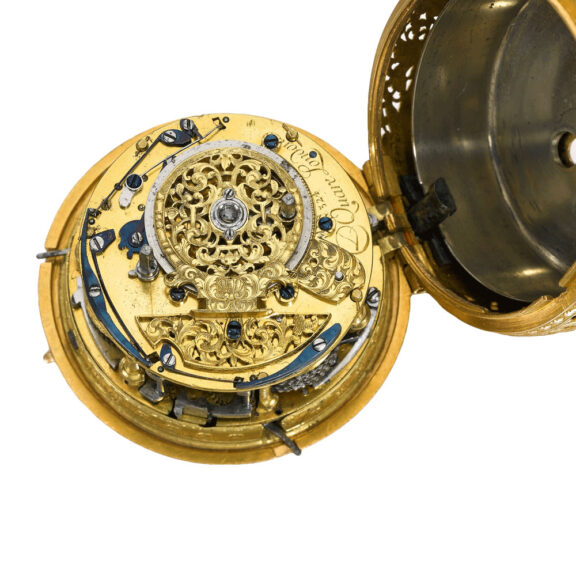
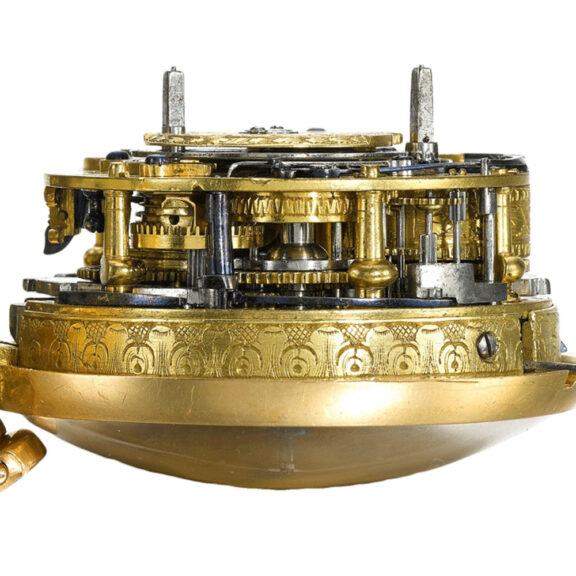
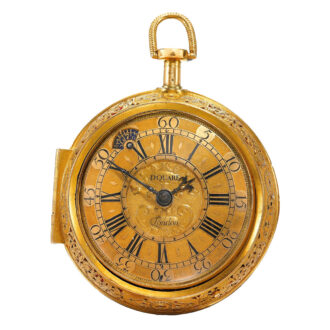
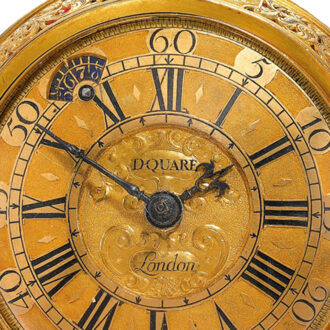
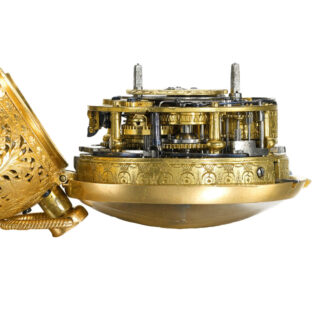
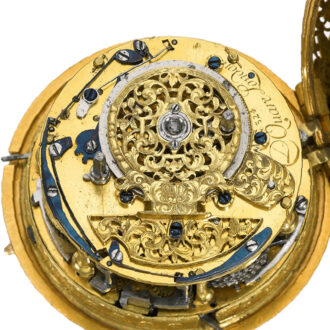
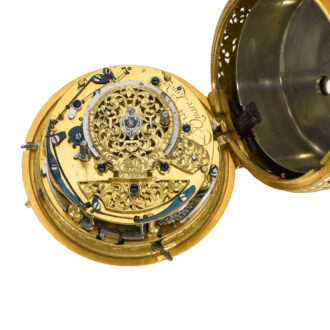
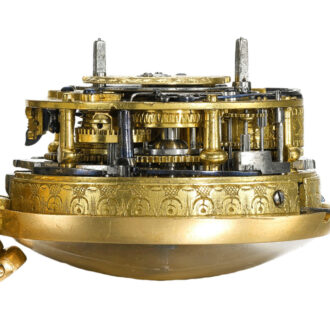
An important English gold two train quarter striking and quarter repeating pair cased clockwatch with regulator aperture, circa 1712-1714, fire gilt full plate movement, verge escapement, pierced and decoratively floral engraved balance cock, flat steel balance, fusee and chain, jeweled escape wheel pivots and verge with diamond end stones, baluster pillars, independent rack quarter strike having a barrel with decorative engraving and two hammers, quarter repeating with two further hammers, all to a bell to the inside case back. Gold champlevé dial with Roman numerals, inner half-hour divisions, outer Arabic minute track, aperture for regulation with square at 11 o’clock, blued steel poker minute hand and tulip hour hand. Gold inner case, pierced and engraved band with floral engraved decoration inhabited by birds, numbered below the pendant, strike silent lever beneath the bezel at 9 o’clock, pulse piece at 5 o’clock, gold outer case, the back centered with a cipher possibly that of John Campbell 2nd Duke of Argyll, flanked by two putti holding aloft a Ducal coronet, both bezels with decorative pierced roundels and pierced scrolling foliage inhabited by birds, square hinge, inner case with maker’s mark WI for William Jaques, outer case with maker’s mark WG probably for William Ginn.
–
Diameter: 58 mm
–
Signed: D. Quare London
–
This is an important and, until recently, unrecorded, early 18th-century watch. On first inspection, the proportions of this watch appear to be relatively standard for the period of its production. However, the case does have a significant depth which is necessitated by the extraordinary complexity of the movement. The rack quarter striking and quarter repeating work are independent from one another, each with their own train, hammers, and spring barrels. Designing and constructing a watch of this complexity within such a limited space would have taken a considerable amount of skill and time, perhaps as much as 2 years. It is also notable that the watch is jeweled with pierced rubies and diamond endstones to the top and bottom of the verge, in addition to the potence and counter potence of the escape wheel. Jewelling of this type, at such an early date, denotes yet another level of refinement and sophistication. Research suggests that no other watch of similar size, with quarter repeating and rack quarter striking has survived from this or any earlier period, indeed, one comparable is a considerably later watch by Windmills, no. 8273 which dates to circa 1725. Furthermore, only one other watch with a jeweled escape wheel, potence and counter potence of similar date (hallmarked 1714-15) and also by Quare, is thought to have survived. The placement of the regulator aperture to the dial at 11 o’clock should also be noted. Remarkably, the regulator arbor runs from front to back without obstruction.
–
Research carried out by the Chester Herald at the College of Arms, suggested that the cipher to the outside of the outer case is likely to be that of John Campbell, 2nd Duke of Argyll (1678-1743). Campbell was a very wealthy and powerful individual who succeeded to his title in 1703, supported the Act of Union (ratified in 1707) fought under Marlborough in the War of the Spanish succession, became a Knight of the Garter in 1710, commanded British forces in Spain in 1711 and was Governor of Minorca 1712-1716. He is buried in Westminster Abbey.
–
Daniel Quare 1649-1724 was born in Somerset. A highly esteemed watchmaker of his day, Quare was admitted to the Clockmakers’ Company in 1671 and became Master in 1708. In 1680 he invented a type of repeating work for watches. In 1718 he went into partnership with Stephen Horseman, after which their work was signed ‘Quare & Horseman’. Known watches signed by Quare have numbers 233 to 4989. Repeating watches had a separate series known from 109 to 857.
Signed: D. Quare London
Share this page: