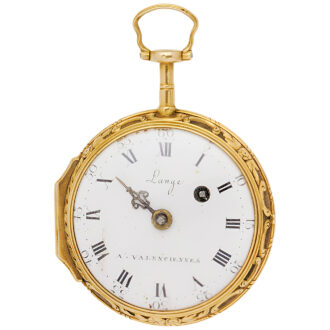
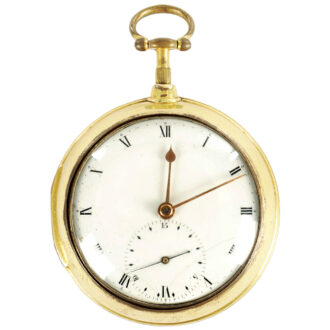
Early English gold verge watch by George Graham Circa 1738
- Kenmerk
- SA0041
- Diameter
- 49 mm
- Estimate
- € 30.000 - 60.000
- Price sold
- € 50.500
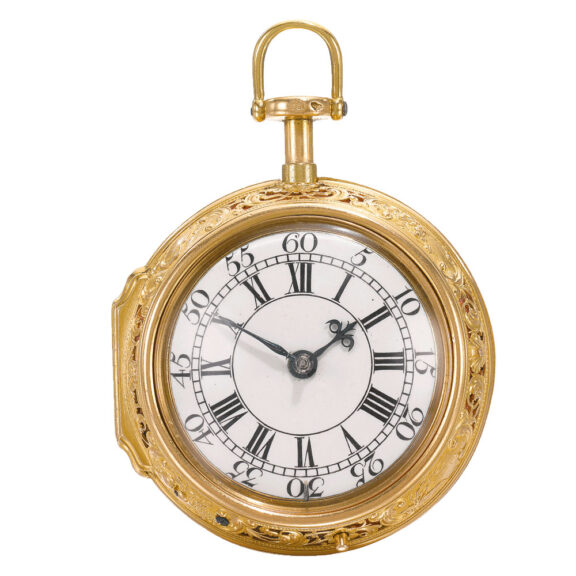
Fine gold quarter repeating verge by George Graham
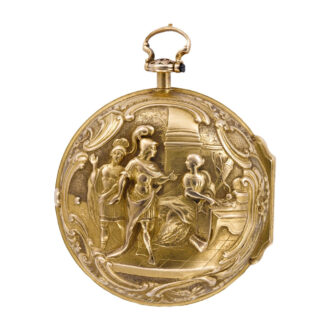
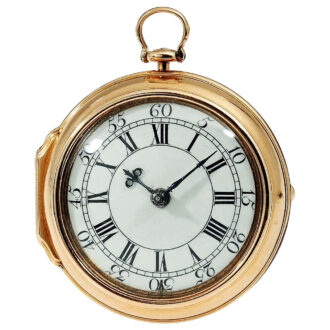
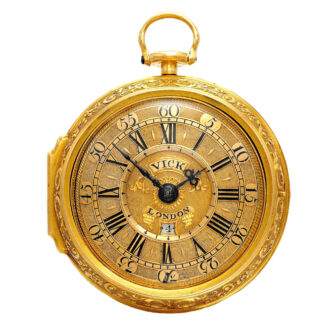
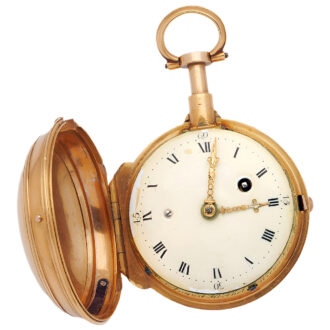
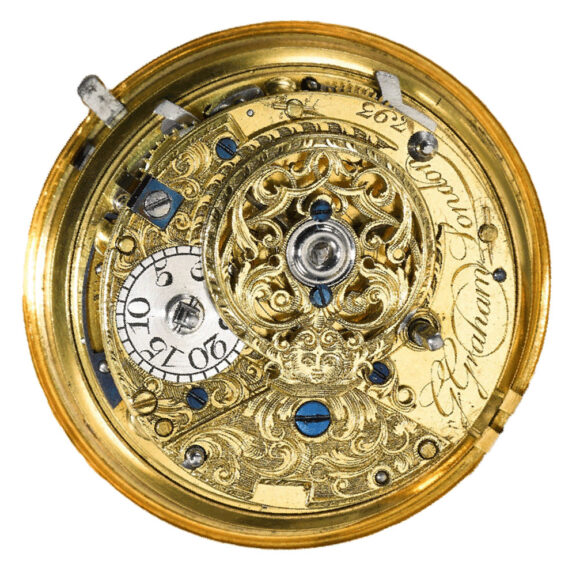
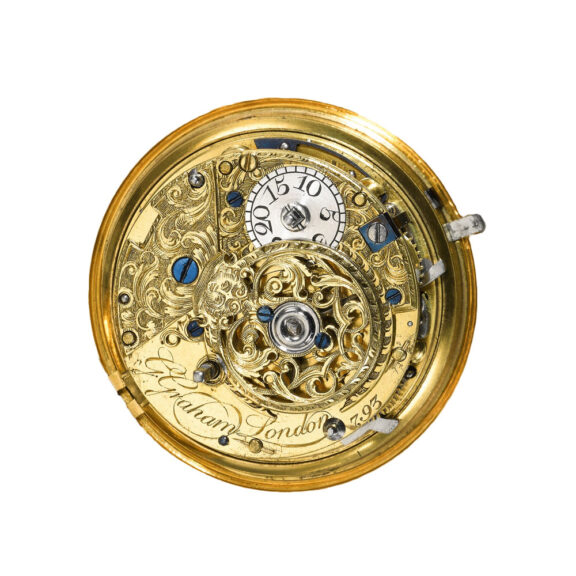
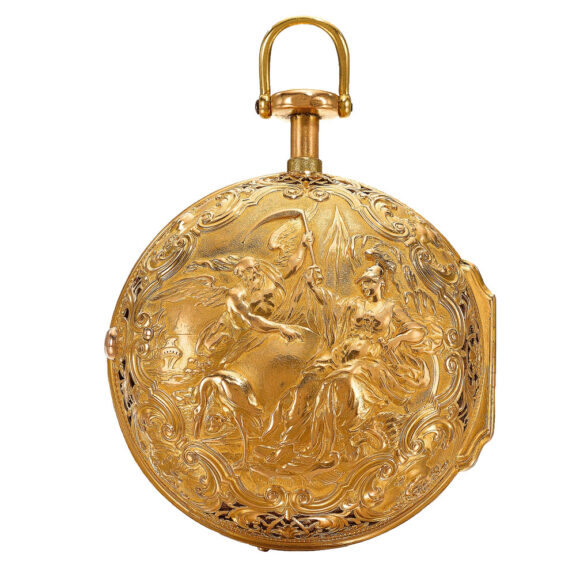
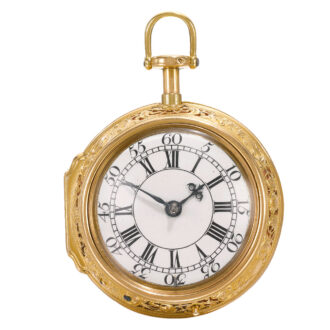
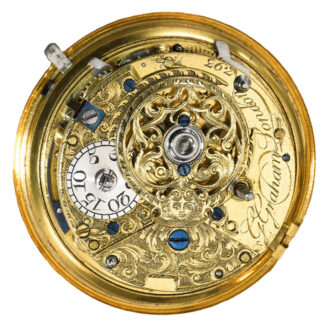
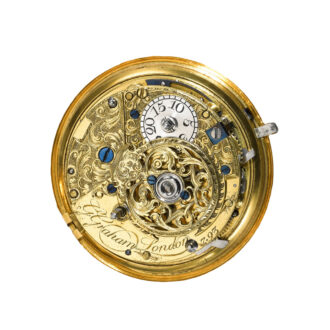
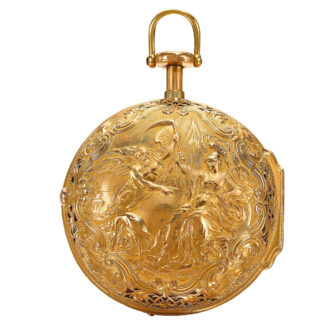
An English extremely fine gold quarter repeating pair cased verge watch with repousse scene by Ishmael Parbury and leather outer protective case , circa 1738, fire gilt full plate movement, balance cock pierced and engraved with foliate scrolls and a cherub mask, diamond endstone, cylindrical pillars, gilt metal dust cap signed and numbered, repeating on a bell to the inside case back, white enamel dial, Roman numerals, blued steel beetle and poker hands, pierced and engraved with foliate scrolls, a grotesque mask at 6 o’clock, the outer case chased with a repoussé scene depicting Father Time and Minerva as Britannia, a Crane representing vigilance in the foreground, the surround pierced and engraved with foliate scrolls and divided by personifications of the four seasons, with corresponding seasonal vignettes to the bezel, pulse piece below 6 o’clock, the case signed Parbury fecit, with a leather-covered outer case.
–
Diameter: 49 mm
–
Signed: G. Graham London
–
Graham no. 793 is a collaboration between George Graham, one of England’s greatest watchmakers and Ishmael Parbury, one of the finest repoussé workers of the 18th century. The central scene to the outside case back illustrates the expansionist ambitions of Great Britain and its desire to master the seas. Hallmarked for the year 1738, it was made just a year after the testing of John Harrison’s legendary first sea clock, the so-called H1. Interestingly, the Astronomer Royal, Dr. Halley, advised Harrison to consult with George Graham when he first came to London, indeed, Graham was later to sponsor his work. The importance of timekeeping to navigation was, of course, well established by this period and it is therefore significant to see Father Time depicted in the central scene of the case back. Father Time points to the globe which is held by a seated Minerva in the guise of Britannia. Britannia lifts a veil from the globe upon which one can see the Americas, England and Africa engraved in fine stipple work. Britannia holds a pair of navigational dividers in one hand whilst lifting a veil from the globe with her other. The intended sense is clear, by mastering time, the English will be able to dominate the seas. Within and surrounding the scene are a number of symbolic attributes. On the ground beside Britannia is a native American headdress, her foot rests on a quiver of arrows, whilst behind her head is a tobacco plant and perhaps a redwood tree. All these elements allude to the Americas and Britain’s presence there. At the far left of the scene are two ships, the one in the foreground with the appearance of a naval ship of the line, and a schooner, emphasizing both the importance of trade and the need to protect both it and the colony. The need for vigilance is also emphasized by the crane which stands in the foreground below the ships. The bird holds one foot raised and holding a stone – according to legend, if the bird fell asleep, it would drop the stone which would thereby fall on its other foot, waking itself – an allegory suggesting the vigilance that Britain would need if she were to protect her trade and support her colony.
Surrounding the central scene are figural representations of the four seasons, whilst opposing them to the bezel are seasonal attributes. They are: Flora as Spring with flowers to the bezel; Ceres as Summer with a sickle and sheaf to the bezel; Bacchus as Autumn with grapes and fruit to the bezel; Winter as an elderly man with a leafless tree to the bezel.
George Graham (1674-1751), was one of England’s most renowned clock and watchmakers. He was an apprentice to Henry Aske in 1688 and then entered the service of Thomas Tompion as a journeyman in 1695. He married one of Tompion’s nieces and became his partner in 1704, succeeding in the business on Tompion’s death in 1713. He was elected a fellow of the Royal Society in 1721 and Master of the Clockmakers’ Company in 1722. It is believed that he improved or perhaps invented the cylinder escapement. He used the verge escapement up to 1726 and then mainly the cylinder after the time. On his death in 1751, as a sign of the great respect in which he was held, Tompion’s grave in Westminster Abbey was opened to receive the body of his former partner.
Ishmael Parbury was born in London in 1698. He was a highly accomplished artist and studied at Christ’s Hospital, perhaps learning by copying the drawings and engravings of Bernard Lens II. By 1724 he had begun to chase cases for George Graham. Parbury died in 1746 and was described by Vertue as “a man in his art of great excellency in the neatness and finishing correctness of his works, which gained him great esteem, above any other Englishman and by that means he obtained the highest prizes for his works.
Signed: G. Graham London
Share this page: