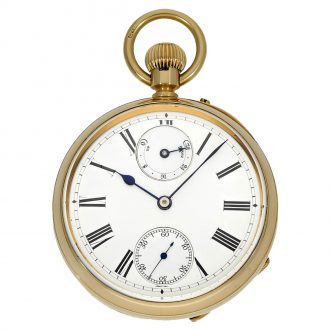
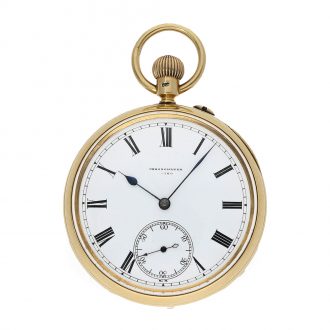
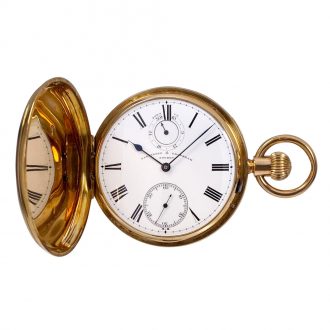
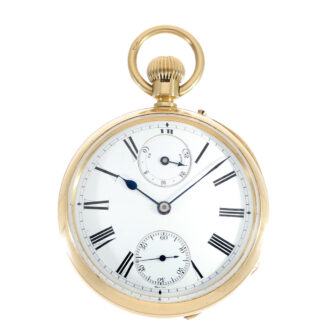
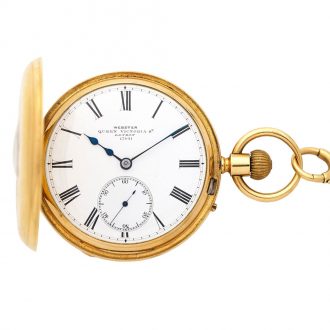
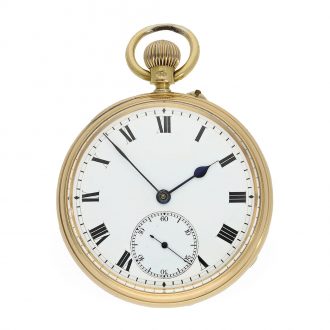
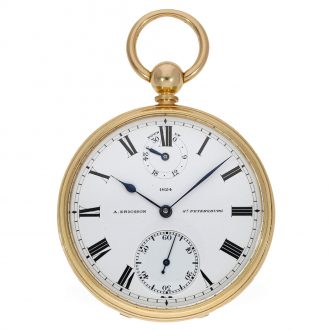
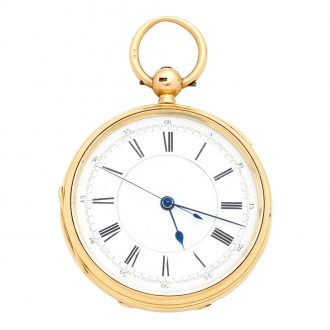
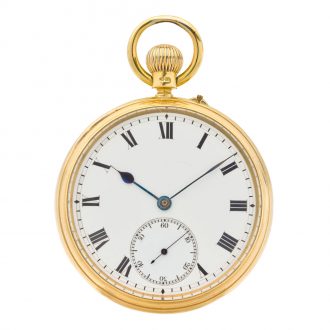
Possibly unique English gold chronometer Circa 1882-1883
- Kenmerk
- BA0254
- Diameter
- 57 mm
- Estimate
- € 35.000 - 50.000
- Price sold
- € 37.450
With Bonniksen 52½ minute carrousel with spring detent escapement
–
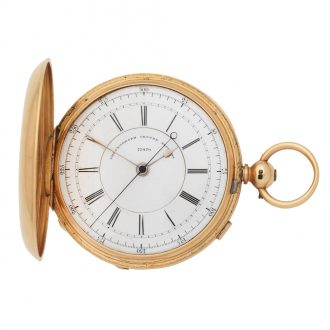
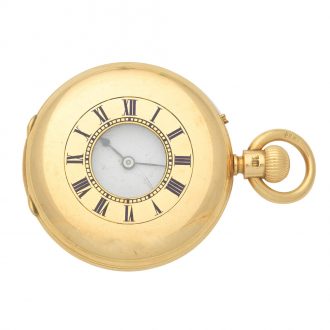
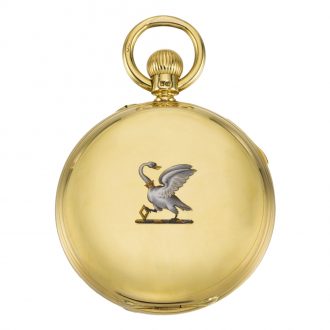
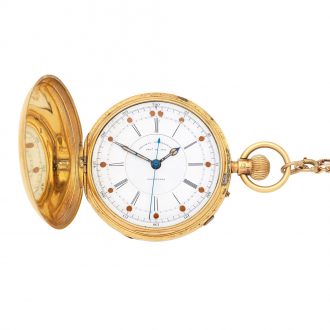
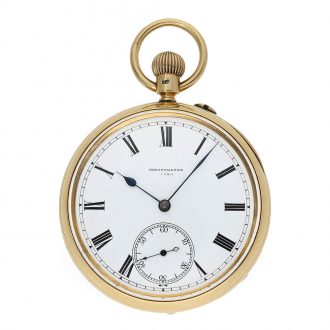
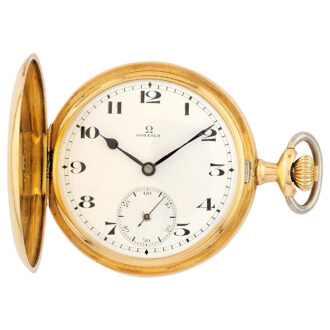
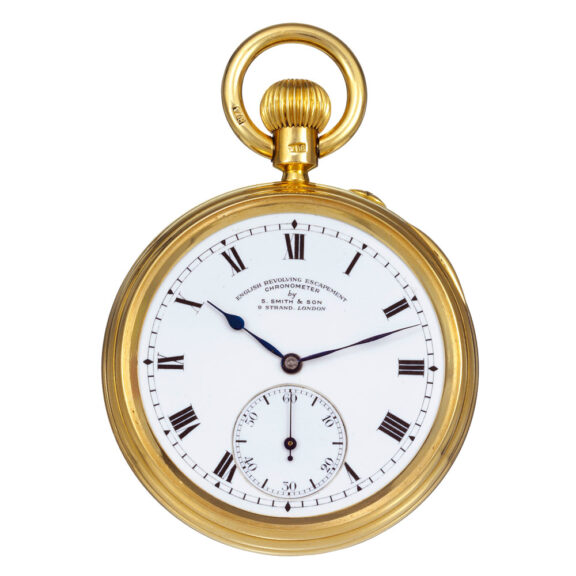
An extremely fine, exceptionally rare and possibly unique English 18 carat gold open faced keyless pocket chronometer with prepatent Bonniksen 52½ minute carrousel with spring detent escapement, circa 1882-1883. This piece is the first watch of this series to be made. Frosted gilt half plate movement, going barrel, 52½ minute carrousel carriage with foliate engraved cock, jeweled Earnshaw type spring footed detent escapement, freesprung cut bimetallic compensation balance, blued steel balance spring with terminal curve, diamond endstone. Hinged gold cuvette. White enamel dial with Roman numerals, outer minute track, subsidiary seconds and original blued steel spade hands. Heavy and large, polished case by Frederick Thoms & Simon, Silverstone (master marks FT & SS). Dial and movement signed, case with London Hallmarks for 1882-1883.
–
Diameter: 57 mm
–
Signed: English Revolving Escapement Chronometer by S. Smith & Son Watchmakers to The Admiralty 9 Strand London
–
This watch is almost certainly the first carrousel watch to be made with a detent chronometer escapement and is certainly the first watch of the famous ‘No. 239’ series that established the record for the number of marks obtained at Kew Observatory for pocket chronometers. The fact that the Bonniksen patent number is absent from this watch indicates that it was made before the patent of thecarrousel in 1893 and is therefore of great historical interest in the development of the pocket chronometer and precision watchmaking. This watch could perhaps be termed experimental in that the series ‘No. 239’ watches did not achieve greatness until close to 1900, whereas the present watch was certainly made before 1893 and in fact the case bears hallmarks for 1883. It is likely that the movement was being experimented upon by Smiths in parallel with Bonniksen’s own development of the carrousel and was then cased using a stock case, making it in effect a prototype piece. The carrousel watches immediately dominated the Kew lists of top performing chronometers as soon as they were sent for trial in 1894. As a result of the phenomenal results using ordinary carrousels, it appears that Smiths decided to try and develop a carrousel that would achieve record marks at testing. The present watch is the progenitor of the watch that went on to achieve 88.1 marks c.1900. Three No. 239 watches went to Kew: 239-2 (1901), 239-4 (1902 and 1903), and 239-6 (1907). In ‘The Watchmaker, Jeweller and Silversmith’ magazine of January 2nd, 1899, the series ‘No.239’ is described thus: “Although it is somewhat premature to forecast the watch that will head the next Kew list, the possibilities are that a carrousel chronometer by Messrs. S. Smith and Son, which has established a record for pocket chronometers with 88.1 marks, will gain this enviable position.”. The carrousel or the ‘Revolving Escapement Pocket Chronometer’ as it was sometimes known, is described in S. Smith & Son’s literature beneath a drawing of a watch numbered ‘239’: “This watch obtained the ‘Record’ number of marks at Kew Observatory for a pocket chronometer, obtaining 88.1 out of a possible 100, the separate awards being 33.1 for variation of daily rate, 37.6 for changes of position and 17.4 for temperature variation. It is hardly necessary to say that in every minute detail this watch is the perfection of watchwork. The cases are very finely made, weighing nearly 4 ozs of 18 ct gold, the dial is also of very special quality, the most careful attention having been paid to the working out of the divisions. We venture to think that this watch will remain at the top of the list of high class English watches. It is thoroughly reliable for everyday wear and is not a delicate piece of work such as many of the foreign made watches have been that have obtained high marks at Kew Observatory. Also it is an ordinary size suitable for carrying, while the majority of the watches that have been distinguished at Kew have been of large size and too thick for portable use, the long period necessary for the production of this class of work increases the cost. Also we pay a bonus to our workmen according to the number of marks obtained, and as will be seen by referring to our prices we have to charge £10 extra if a watch obtains 80 marks, this watch with the Record of 88.1 has been a considerable expense to us, and the price is £ 105.”.
Signed: English Revolving Escapement Chronometer by S. Smith & Son Watchmakers to The Admiralty 9 Strand London
Share this page: