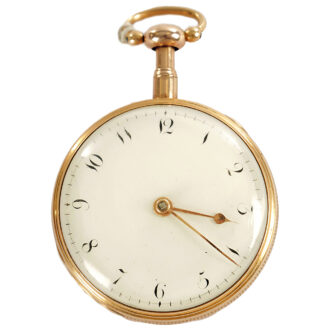
French silver and gold detent lever pocket watch Circa 1791
- Kenmerk
- BA1916
- Diameter
- 56 mm
- Estimate
- € 20.000 - 35.000
- Price sold
- € 22.700
Silver and gold open faced lever by Robin Fils
–
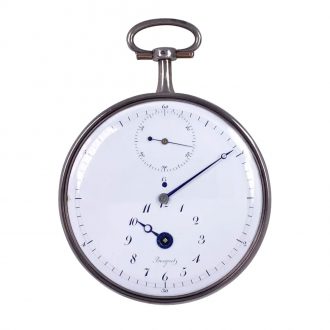
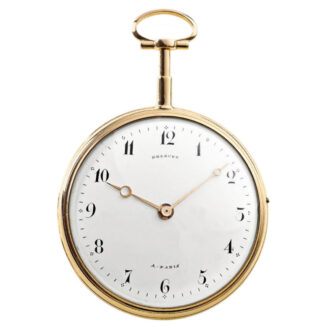
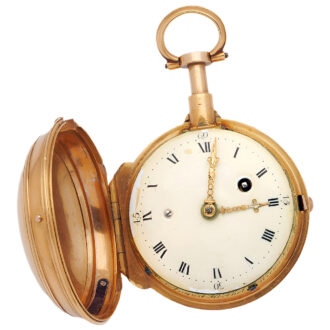
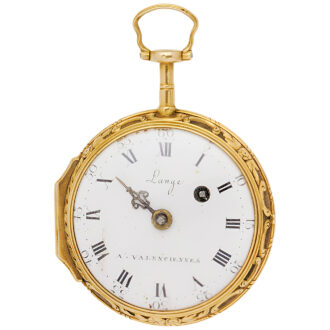
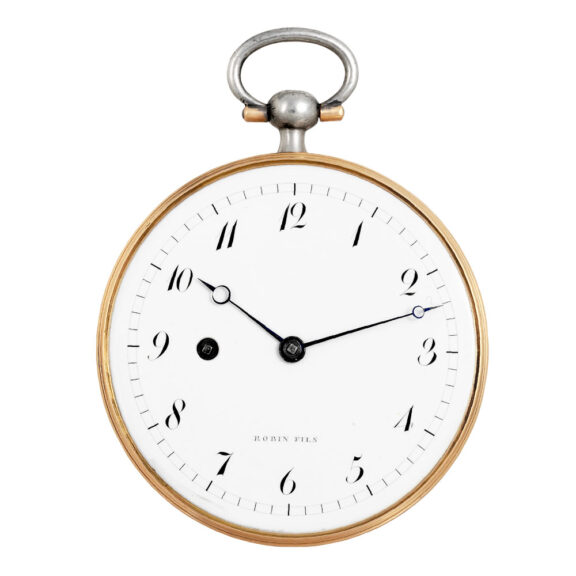
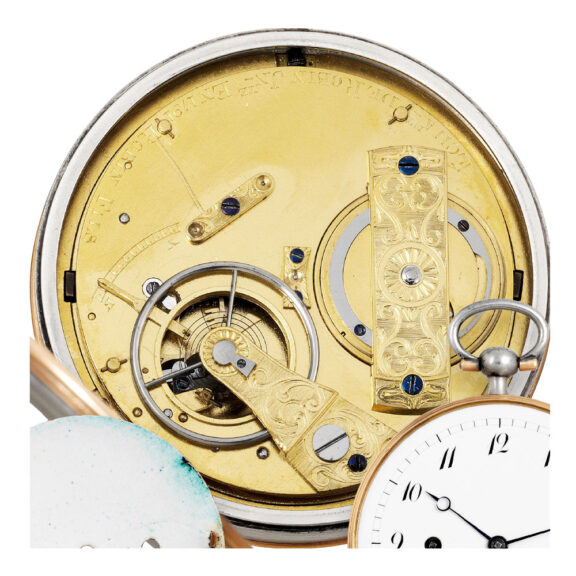
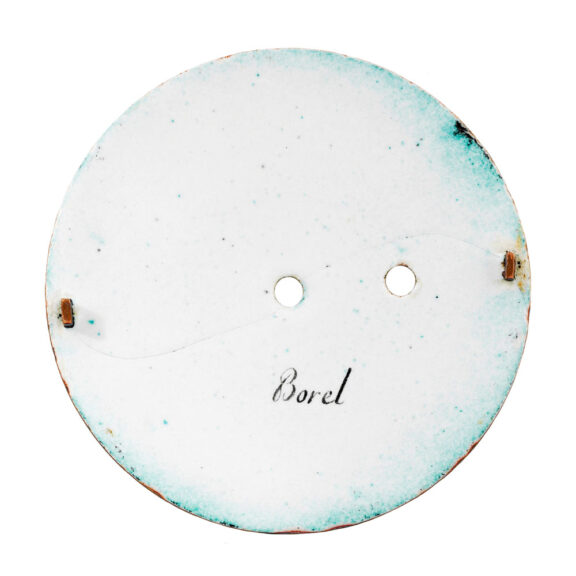
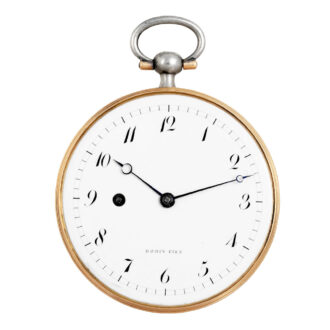
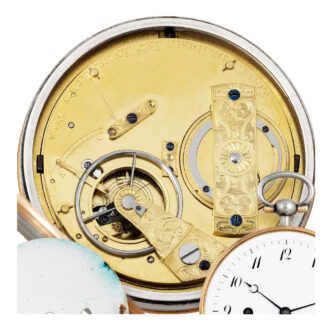
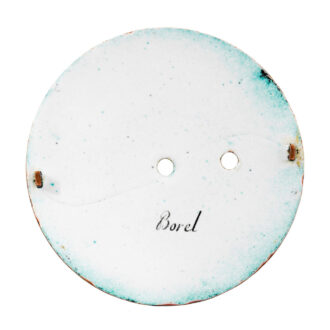
A very fine, extremely rare and important French silver and gold open faced pocket watch with the detent lever escapement invented in 1791 by Robert Robin, the only known complete surviving watch using the Robin escapement and bearing the Robin name. Matte gilt movement with conical pillars, going-barrel passing through the backplate and secured by a gilt-brass bridge engraved with foliate decoration, original Robin detent lever escapement, plain three-arm balance, blued steel flat balance spring, gilt-brass small cock with a single foot only, foliate engraved decoration and polished steel endplate, regulation arm on the edge with an engraved scale on the backplate. Hinged gilt cuvette. White enamel dial by Borel with Breguet numerals, outer minute track, winding aperture at 9 o’clock and original blued steel Breguet hands. Polished case, flat band, the bezels yellow gold, with master mark SG and Paris control marks in use between 1809 and 1819. Dial and movement signed Robin Fils, the backplate engraved Echa.nt de Robin In.te En 1791, dial numbered and signed Borel on the reverse.
–
Diameter: 56 mm
–
Signed: Robin Fils
–
This piece is the only known complete example to survive with Robin’s detent lever escapement and to bear the Robin name. The movement is identical to those made during Robert Robin’s lifetime. The present watch is also signed similarly but with the addition of the signature ‘Robin Fils’. It is, therefore, possible that the ebauche itself was made by Robert and then finished and sold by his son after 1809, or that his son made this watch to the exact design of his father’s of the 1790s. A similar movement, No. 48, from the Courtney Ilbert collection, in the British Museum, is dated 1807.
–
Robert Robin (1741-1799) was a talented and inventive clock and watchmaker who counted among his clientele the French Royal Family. He became Marchand-Horloger Privilégié du Roi on 22 October 1763 and resigned on 13 September 1765 in favour of Jean-Pierre Courtois. In 1778 the Académie des Sciences approved two of his inventions, one being an astronomical clock representing a meridian drawn on a pyramid, which the Menus Plaisirs acquired that year for Louis XIV, for 30,000 livres. During the same period, he perfected his famous mantel clocks with astronomical indications and compensated pendulums, one of the first owners being the Marquis de Courtanvaux. Robin applied these principles to regulators, the Duc d’Aumont possessed an early model of this kind. He was equally interested in watches, using a special escapement that bears his name from 1786 onwards and in monumental clocks, supplying the Grand Commun at Versailles (1782), the Menus Plaisirs and the Petit Trianon (1785). Many members of Parisian high society were clients of Robin, including the maréchaux Ducs of Duras and Richelieu and the marquis de Sérent, tutor to the dukes of Angoulême and Berry. In 1794, Robin was appointed Horloger de la République. After the French Revolution, he was given the task of making an inventory of the Royal clocks including the 23 that belonged to Marie Antoinette.
Signed: Robin Fils
Share this page: