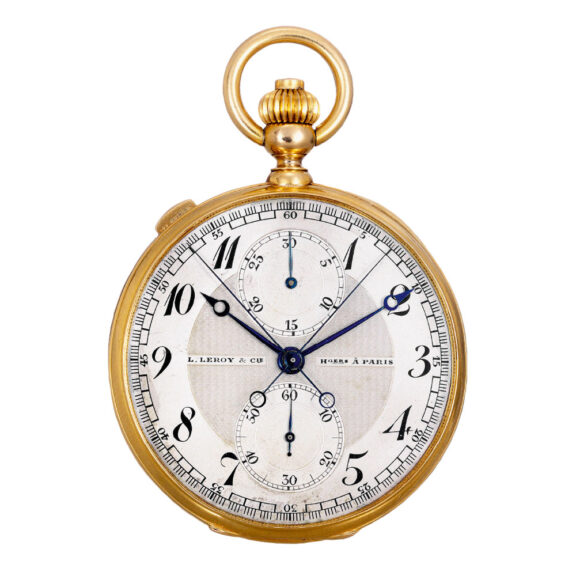
Historically important French 18K gold chronograph Circa 1928
- Kenmerk
- BA1561
- Diameter
- 46 mm
- Estimate
- € 40.000 - 80.000
- Price sold
- -
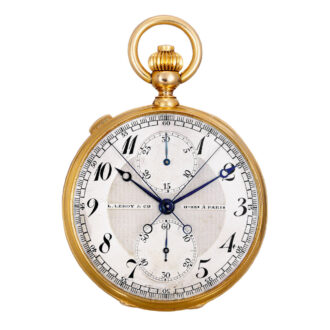
Gold split-seconds lever chronograph with register by L. Leroy & Cie
–
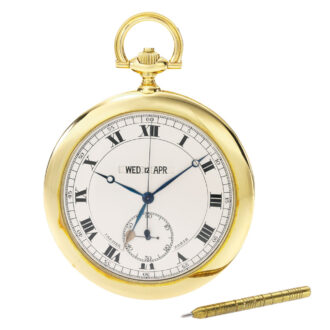
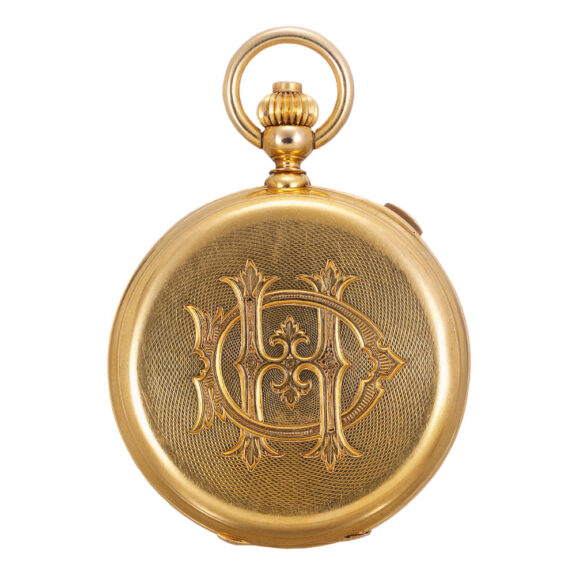
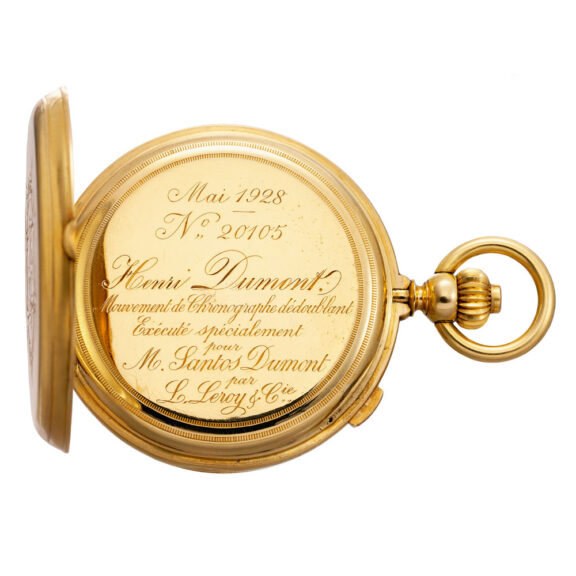
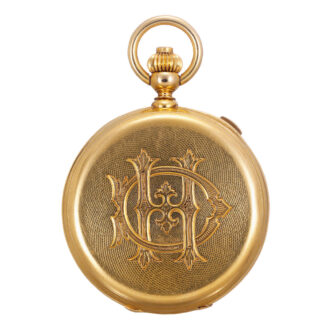
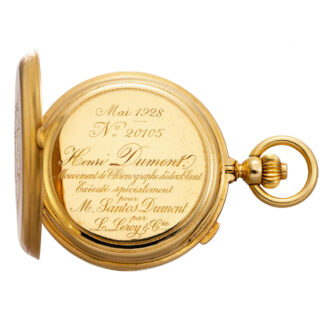
An extremely fine and historically important French 18 carat gold open faced split-seconds chronograph keyless lever pocket watch with progressive 30-minute register, circa 1928. Ordered by Henri Dumont and made especially for Alberto Santos Dumont in 1928. Frosted gilt bar caliber movement, 22 jewels, straight-line lever escapement, large-diameter cut bimetallic compensation balance with gold screws, blued steel Breguet balance spring, index regulator. Gold hinged cuvette inscribed Mai 1928 No. 20105 Henri Dumont Mouvement de Chronographe dedoublant Execute specialement pour M. Santos Dumont par L. Leroy & Cie. Matte silver dial with champlevé Breguet numerals, outer minute divisions, outermost fifths of a second chronograph division, subsidiary 30-minute register at 12 o’clock, subsidiary seconds at 6 o’clock, engine-turned center and original blued steel Breguet hands. Polished band and border, engine-turned case back with engraved foliate monogram HD, a button for start/stop and return-to-zero of the chronograph in the crown, split-seconds pushbutton at 11 o’clock. Dial, cuvette, and movement signed.
–
Diameter: 46 mm
–
Signed: L. Leroy & Cie Hgers à Paris
–
The present watch, with its original leather strap, is evidence of Santos Dumont’s insistence on having a watch that could be easily consulted by a pilot in flight. It was ordered for the airman by his father, Frenchman Henri Dumont.
–
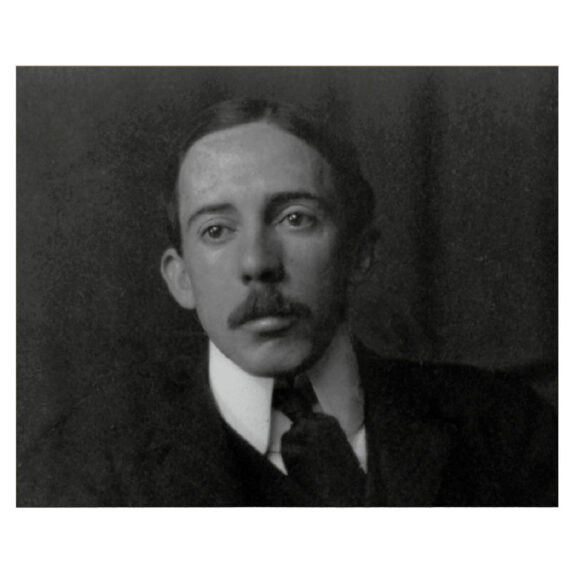
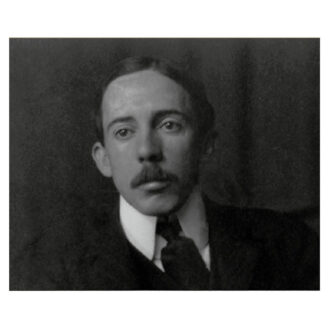
Alberto Santos Dumont (1873 – 1932) was an inventive and imaginative pioneer of aviation, was born to a prosperous coffee-producing family in Brazil. His father, Henri Dumont, was an engineer of French extraction. Santos Dumont designed, built, and flew the first practical dirigible balloons. On October 19, 1901, he won the Deutsch de la Meurthe prize for a flight that rounded the Eiffel Tower. He gave away the prize money to his mechanics and to the poor people of Paris. On October 23, 1906, Santos Dumont made the first public European airplane flight. Having become an international hero, in 1904 he was invited to the White House by President Theodore Roosevelt. Santos Dumont designed his first airplane in 1905. His dream of flying came true on October 23, 1906, when he flew his 14-bis airplane 60 meters (200 ft) at a height of 2 – 3 meters (10 ft). Santos Dumont’s final design was the Demoiselle monoplane. Convinced that aviation would inaugurate a new and prosperous era for all mankind, Santos Dumont generously made the plans of the Demoiselle available for free. Santos Dumont played a major role in the popularization of the wristwatch, having asked his friend Louis Cartier to design a watch for a sportsman, that could be consulted without removing one’s hands from the controls. This resulted in the creation of the famous 1904 Cartier wristwatch. After having been diagnosed with multiple sclerosis, Santos Dumont returned to Brazil. In 1918 he built a house on a hillside in Petrópolis, in the mountains near Rio de Janeiro. He called it A Encantada (The Enchanted), after its street, Rua do Encanto (Enchantment Street). Seriously ill, and depressed over the use of aircraft for warfare rather than the good of mankind, Santos Dumont is said to have committed suicide on July 23, 1932. Alberto Santos Dumont is considered by many to be the father of aviation. His house in Petrópolis, Brazil, is now a museum.
Signed: L. Leroy & Cie Hgers à Paris
Share this page: