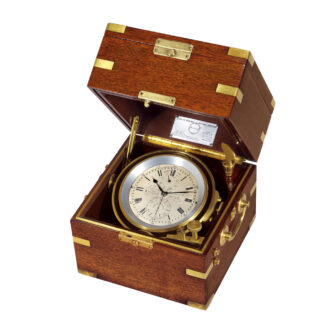
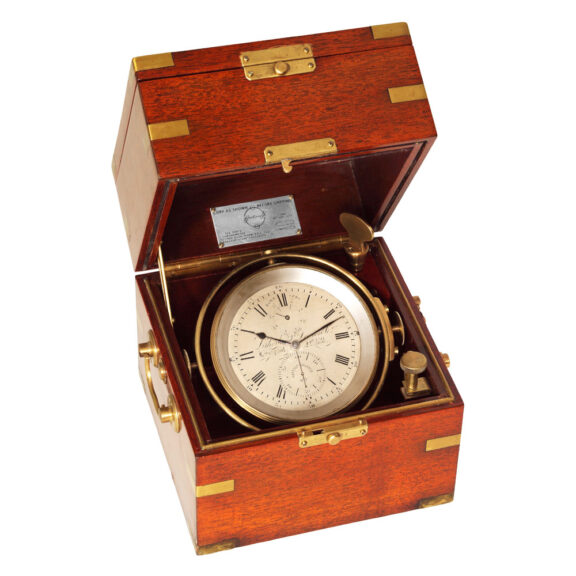
English marine chronometer with power reserve Circa 1870
- Kenmerk
- BA1965
- Diameter
- -
- Estimate
- € 3.000 - 5.500
- Price sold
- -
Two day marine chronometer in mahogany box by Litherland Davies Co
–
A fine English two day marine chronometer with power reserve indication, Hartnup’s continuous auxiliary compensation balance No. 2 and ratchet key, circa 1870. Brass full plate movement, ‘spotted’ decoration, relieved for the barrel with separate bridge, ring turned cylindrical pillars, fusee with chain and Harrison’s maintaining power, Earnshaw type spring detent escapement, jewelled locking stone, free sprung Hartnup’s auxiliary compensation balance, blued steel helical balance spring with terminal curves, diamond end stone. Silvered dial with Roman numerals, outer minute track and Arabic five minute numerals, subsidiary seconds and power reserve scale and original blued steel pear hands. Three tier mahogany box with external brass handles, glazed upper section with hinged lid, brass bowl and gimballed suspension.
Dial signed.
–
Diameter dial: 102 mm
–
Dimensions square: 19.5 cm
–
Signed: Litherland Davies Co Liverpool
–
The dial side of the pillar plate is stamped T & JH who were the movement suppliers. The layout and design of the movement with the foot of the balance not inset from the edge of the plate is a typical feature of a movement made in Prescot or certainly Lancashire.
–
The Hartnup balance. John Hartnup, the inventor of the continuous auxiliary compensation balance was Superintendant of the Liverpool Observatory and during the course of his work would have tested many chronometers. This made him acutely aware of the middle temperature error. In an attempt to solve the problem he designed his balance in about 1847 assisted by William Shepherd, a Liverpool chronometer maker. Hartnup did not patent his balance and publicised it widely starting in 1849 in the June issue of ‘Monthly Notices of the Royal Astronomical Society’. Whilst the Hartnup balance works well, it was a difficult and expensive balance to produce and suffered from instability due to the parts being held together by screws.
Signed: Litherland Davies Co Liverpool
Share this page: