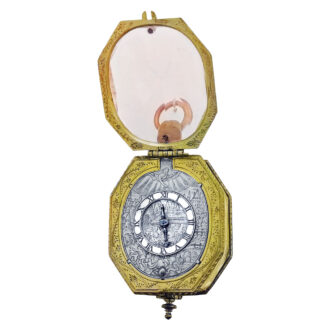
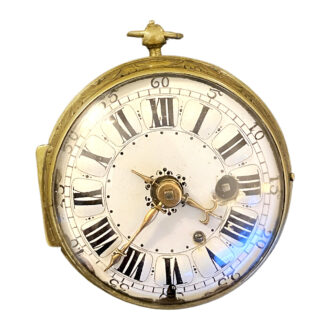
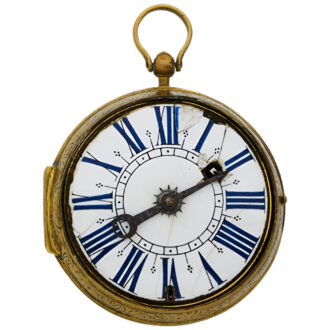
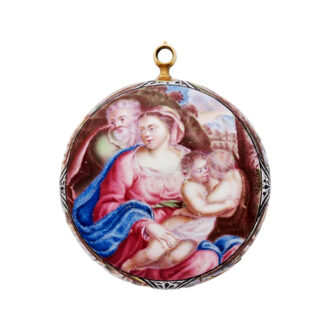
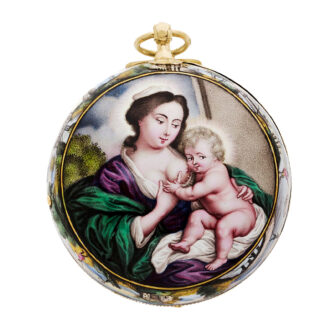
German/French gilt and rock crystal pendant watch Circa 1635
- Kenmerk
- BA0772
- Diameter
- -
- Estimate
- € 15.000 - 30.000
- Price sold
- € 16.400
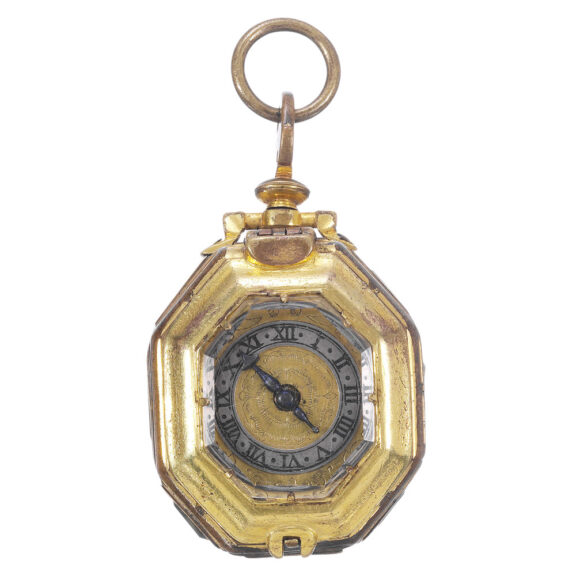
Gilt metal and rock crystal octagonal verge watch by Conradt Kreizer
–
A fine, very rare German or French gilt metal and rock crystal pendant watch, circa 1635. Octagonal gilt-brass movement, full plates with turned urn pillars, six turn fusee with gut line, three wheel train, verge escapement with plain two armed steel balance without spring, irregular florally pierced and engraved balance cock secured by a screw, the ratchet wheel set up cock with similar decoration, secured in the case by a double spring clip. Octagonal gilt brass dial plate with locating lugs, engraved with flowers and foliage, applied silver chapter ring with black enameled Roman numerals, the center engraved with a rosette and original single baluster turned blued steel hand. Case to the centre section inset with eight faceted rock crystal panels, the hinged back and front with similar inset panels, flat section loose ring pendant double pivoted on a bar. Movement signed.
–
Dimensions: 52 x 30 mm
–
Signed: Conradt Kreizer (probably IV) (Augsburg or Strasburg)
–
The Kreizer family became a veritable dynasty of watchmakers, with at least four apparently bearing the same Christian name. Some uncertainties exist as to whether Conrad III and IV were not in fact the same person, but certainly one of the Kreizers occupied the position of clockmaker to the Knights of the Grand Cross of Malta and indeed several watches signed by Kreizer use their characteristic cross as the form for the pendant. The present watch has a pendant of similar construction, perhaps the form used for watches destined for ‘secular’ clients, but in all other aspects it is typical of his work. Accurately dating certain watches by Kreizer can be difficult, as he appears to have continued to produce pieces of 16th century design long after they were superseded, perhaps due to the requirements of his important clients, which would certainly have brought him wide recognition. Certain interesting features of the movement tend to support a date from the second quarter of the 17th century, for the stackfreed has been abandoned in favor of a fusee.
Signed: Conradt Kreizer
Share this page: