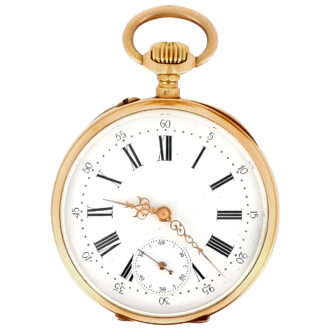
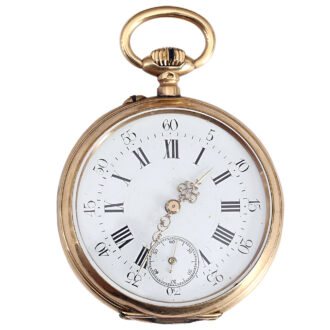
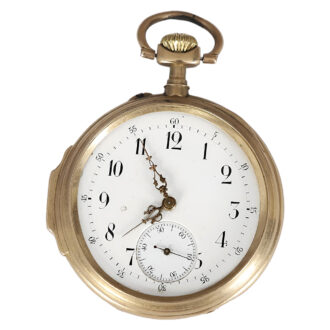
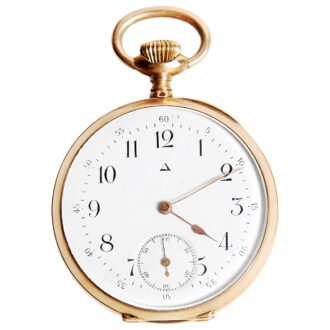
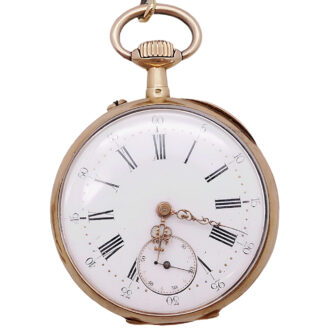
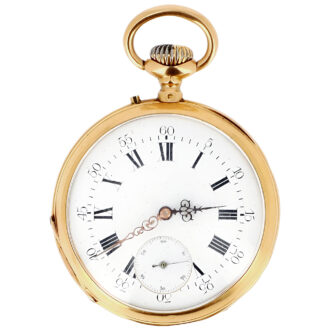
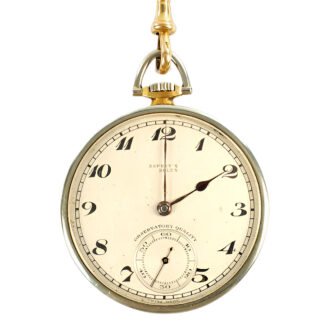
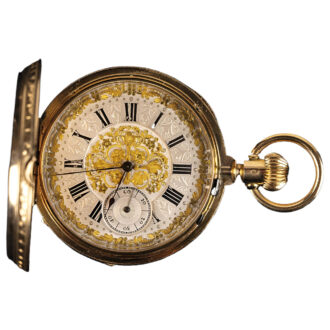
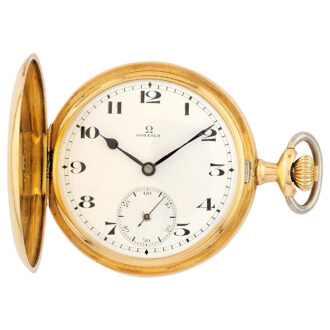
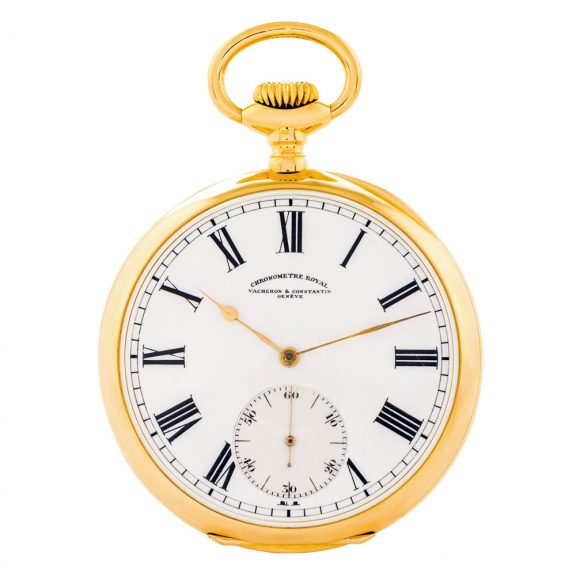
Large-size Swiss 18K gold keyless lever chronometer Circa 1900
- Kenmerk
- BA3104
- Diameter
- 57 mm
- Estimate
- € 3.500 - 7.000
- Price sold
- € 3.100
Gold lever chronometer by Vacheron & Constantin
–
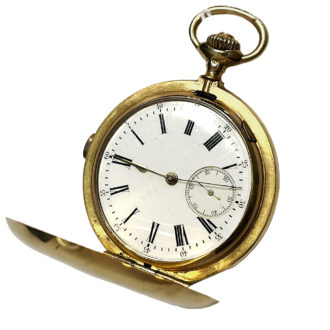
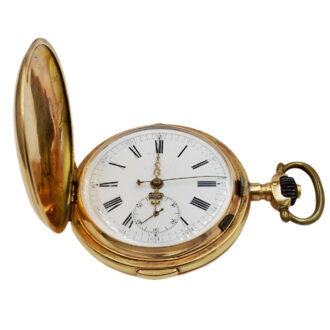
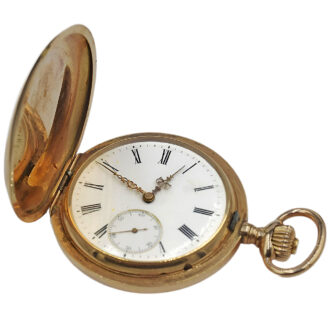
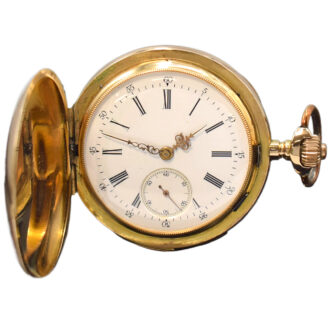
A very fine and rare Swiss large-size 18 carat gold open faced keyless lever chronometer, circa 1900. Frosted gilt movement, 18 jewels, wolf’s tooth winding, a straight-line lever escapement, cut bimetallic compensation balance, blued steel Breguet balance spring and swan-neck micrometre regulator. A hinged gold cuvette with engraved dedication. White enamel dial with bold Roman hours, outer minute divisions, large subsidiary seconds at 6 o’clock and gold spade hands. The polished case with a sunray engine-turned back and engraved name in a cartouche. Dial and cuvette signed, case and movement signed and numbered.
–
Diameter: 57 mm
–
Signed: Chronomètre Royal Vacheron & Constantin Genève
–
The name Chronomètre Royal was registered on May 28, 1907, under the number 22193. Royal Chronometer, the name for the English-speaking market, was registered on May 8, 1908, under the number 23872. The first of these was a series of pocket watches delivered to Brazil. A. Campos, one of Vacheron & Constantin’s agents, had organized a lottery system in which subscribers would pay a monthly fee to take part in a series of draws. The holders of the winning tickets would be given a watch and the other subscribers would be entered into the next draw. This system proved to be so successful that Campos delivered a total of 3.022 watches between October 22, 1907 and December 31, 1911. An amazing 80% of the production of the Chronomètre Royal, utilizing the calibre RA22″‘ 73 made during this period. The Chronomètre Royal was made in several sizes, from 12 to 22 lines, it was housed mostly in gold cases and rarely in silver ones.
–
Vacheron Constantin SA is a highly regarded Swiss luxury watch and clock manufacturer founded in 1755 by Jean-Marc Vacheron. It is one of the oldest watch manufacturers in the world in continuous operation since its foundation. Jean-Marc Vacheron was an independent watchmaker in Geneva, Switzerland. At the age of 24, he signed on his first apprentice, thus founding a business by clarifying his intention to pass on his skills. In 1770 the company created the world’s first horological complication and nine years later it designed the first engine-turned dials.
The son of Jean-Marc Vacheron, Abraham Vacheron (1760-1843) took over the family business in 1785. In 1810, Jacques Barthélemi Vacheron (1787-1864), the grandson of the founder, became the head of the company. He was the first to initiate the company’s exports to France and Italy. Later, Jacques-Barthélemy realized that he needed a partner to travel overseas and sell the company’s products. Therefore, in 1819, François Constantin became his associate. The company continued its activities under the name Vacheron & Constantin. Both men shared the same interest in sophisticated and complicated watches. François Constantin had a keen eye for business, opening several new markets during three decades of travelling for the company. On July 5, 1819, he wrote to Jacques Barthélémi Vacheron from Turin. In his letter the phrase that became the company’s motto: “Do better if possible and that is always possible.”
In 1833, Vacheron and Constantin hired Georges-Auguste Leschot to supervise the manufacturing operations. Leschot was an inventor and his creations turned out to be a success for the company. His inventions had a significant impact on the watchmaking industry in general. He was the first person to standardize watch movements into calibres. In 1844, Leschot was awarded a gold medal from the Arts Society of Geneva, which highly appreciated his pantographic device, a device that was able to mechanically engrave small watch parts and dials.
After François Constantin died in 1854 and Jacques-Barthélemy Vacheron’s death in 1863, the company was taken over by a series of heirs. In 1862, the company became a member of the Association for Research into non-magnetic materials. Vacheron & Constantin, Fabricants, Genève became the official name of the company in 1877. In 1880, the company started using the Maltese cross as its symbol until today. This was inspired by a component of the barrel, which had a cross-shape and was used for limiting the tension within the mainspring. In 1887, Vacheron & Constantin was reorganized into a joint-stock company. The first Vacheron & Constantin boutique in Geneva was opened in 1906. During the Great Depression, the company found itself in a difficult situation. In 1936, Charles Constantin became the head of the company, for the first time since the 1850s a representative from the Constantin family became the president of Vacheron & Constantin. However, in 1940, Georges Ketterer acquired the majority portion of the stock of Vacheron & Constantin from Charles Constantin. George Ketterer died in 1969, and his son, Jacques Ketterer, succeeded as the head of Vacheron & Constantin. In 1970, the company officially changed its name to Vacheron Constantin. The company was affected by the quartz crisis during the 1970s and 1980s. When Jacques Ketterer died in 1987, Vacheron Constantin changed hands. Sheik Ahmed Zaki Yamani the former Oil Minister of Saudi Arabia and eager watch collector, became the company’s majority shareholder. Since 1996, it has been a subsidiary of the Swiss Richemont Group. In 2004, Vacheron Constantin opened its new headquarters and manufacture in Plan-les-Ouates, Geneva.
Signed: Chronomètre Royal Vacheron & Constantin Genève
Share this page: