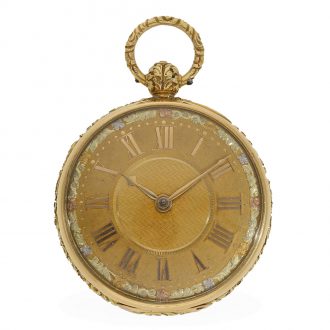
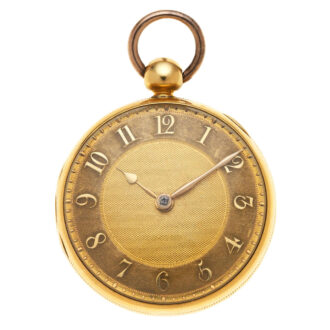
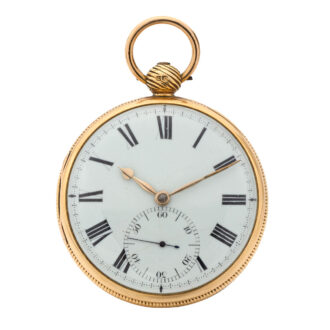
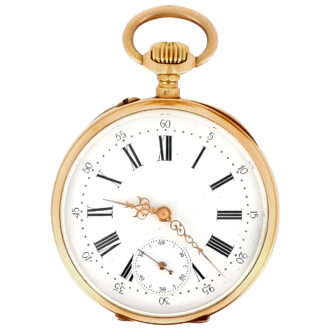
English cylinder watch for the Chinese market Circa 1821
- Kenmerk
- BA0823
- Diameter
- 56 mm
- Estimate
- € 30.000 - 60.000
- Price sold
- -
Gold, enamel and pearl set centre seconds watch by David & William Morice
–
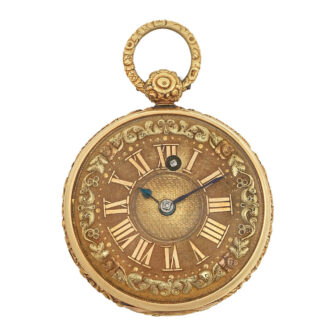
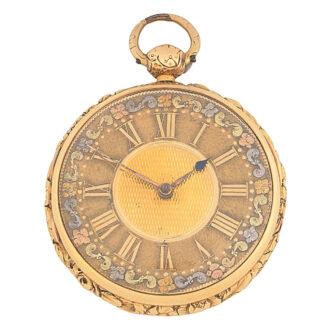
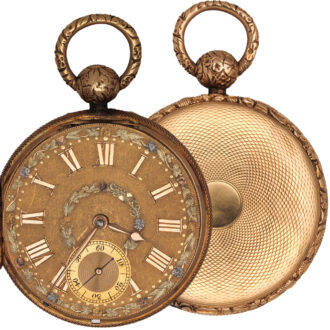
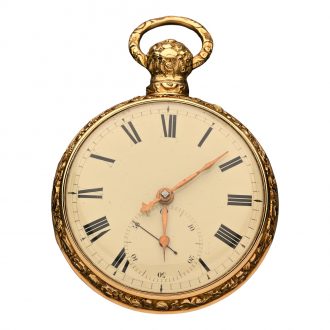
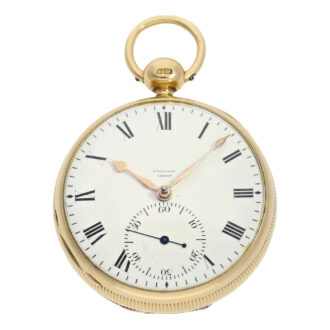
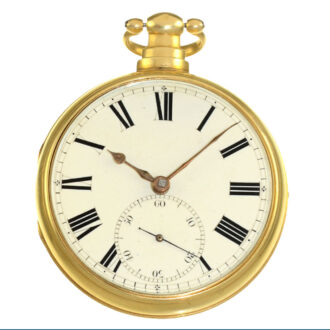
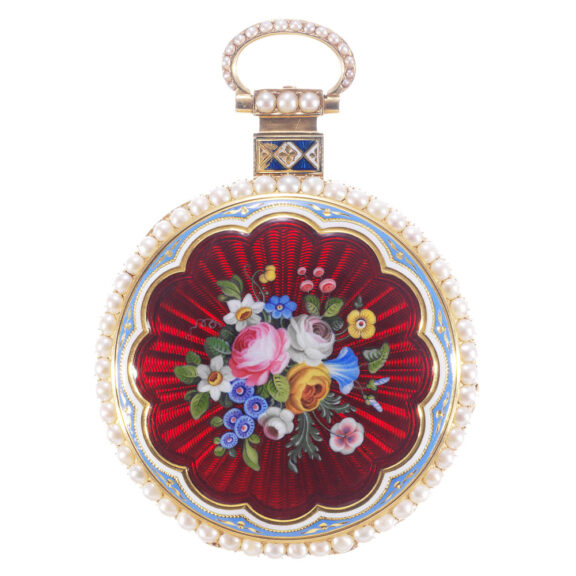
A very fine, rare, large and heavy English 18 carat gold, enamel and pearl set open faced centre seconds cylinder pocket watch made for the Chinese market, London Hallmarked 1821. Hinged full plate movement, matte gilt, fusee and chain, ringed cylindrical pillars, cylinder escapement, brass three armed balance, the balance and the brass escape wheel jeweled, flat balance spring with Joseph Bosley patented regulator, gilded cock engraved with scrolling foliage, diamond endstone. Fixed gold cuvette. White enamel dial with Roman numerals, outer minute and seconds divisions and original gold Breguet hands. The case back painted on enamel with a fine bouquet of summer flowers against translucent red enamel over sunburst engine turning, scalloped border decorated in white and light blue champlevé enamel, matte band with repeated circle pattern, split pearl set bezels, pendant and bow, spring loaded back opened by a push piece in the pendant, master mark TW, gilt dust cap. Dial, cuvette and movement signed, case and movement numbered.
–
Diameter: 56 mm
–
Signed: David & William Morice Fenchurch Street London
–
During the early 19th century, there was a great deal of competition between English and Swiss watchmakers for the lucrative Chinese market. One can distinguish between watches made in Switzerland for this market and those made in London. The English style, by such makers as Anthony, Ilbery, Morice and Charman, can be identified by the finish of the movement and the way it is fitted into the case (usually with a fixed cuvette), the case itself is much heavier and thicker gold then its Swiss counterpart. Some watches were made in Switzerland mimicking the English style, due to the prestige attached to a London signed watch.
–
David & William Morice working in Fenchurch Street, London between 1805 and 1825.
–
Flowers have great symbolic importance for the Chinese. By their form, aspect, and fragrance, they are considered to be highly spiritual, reflecting the profound nature of the Chinese people. Poems and proverbs show the cultural importance of flowers: “There is no flower without beauty in the world”, “A flower gives us a glimpse of paradise”. Certain flowers have a particular significance. The lotus symbolizes purity, the chrysanthemum perseverance, the plum blossom integrity, etc. The peony, with its generous forms, brilliant colors, and heady fragrance, became the most important flower for the Chinese. It is considered to symbolize wealth, nobility, power, and happiness. Known as the ‘queen of flowers’, the peony symbolizes wealth and distinction. Paintings of flowers are often hung in Chinese homes for good luck and in offices to bring success in business. Since red is regarded as a life giving colour, red flowers are admired and valued. The deep and rich symbolism the Chinese attached to flowers made them an ideal subject for expensive watches and those destined for exalted patrons, even for the Emperor himself. The symbolism of each flower would have been immediately recognized and appreciated by China’s elite, who would have seen in them a flattering reference to their own wealth and power.
Signed: David & William Morice Fenchurch Street London
Share this page: