Historically important Swiss silver cylinder watch Circa 1876
- Kenmerk
- BA1161
- Diameter
- 47 mm
- Estimate
- € 10.000 - 20.000
- Price sold
- € 12.650
Silver watch by Patek Philippe
–
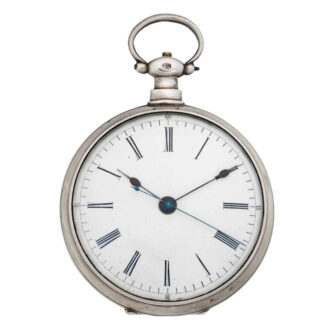
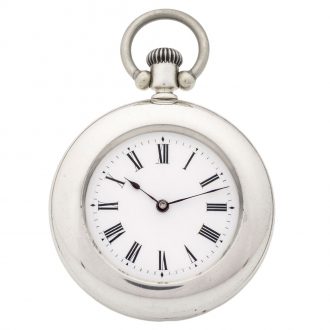
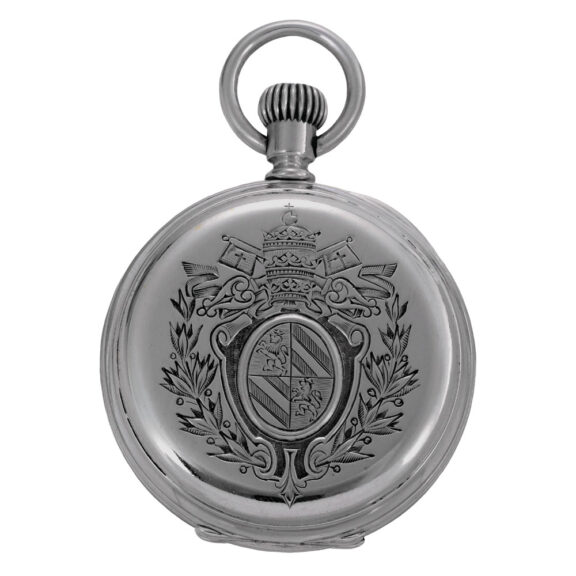
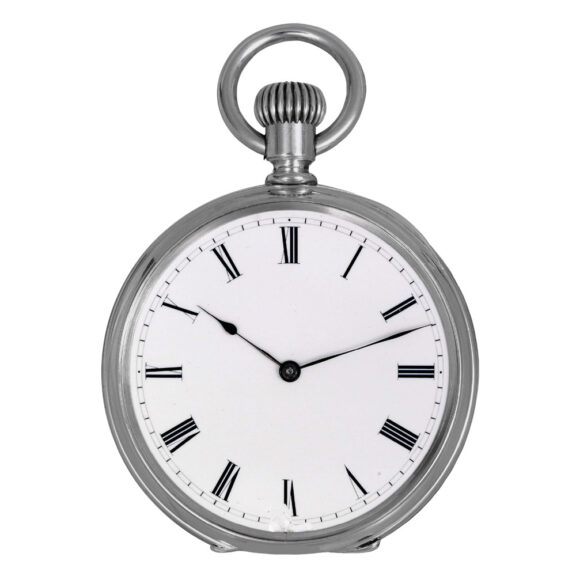
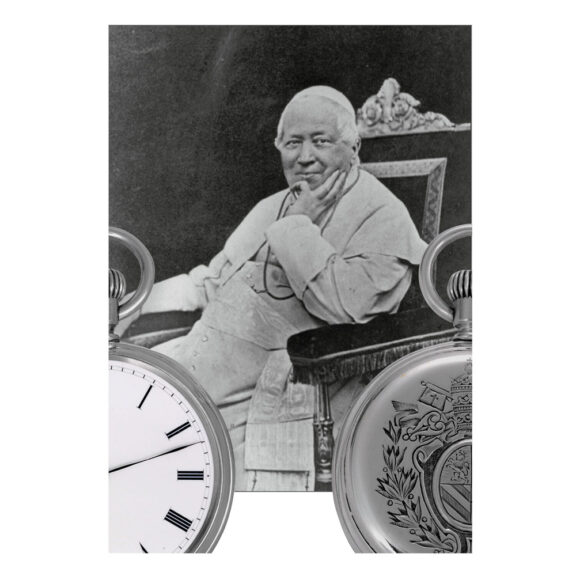
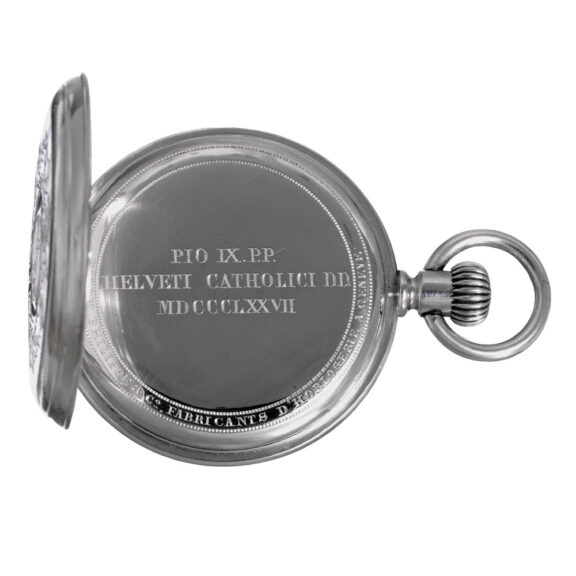
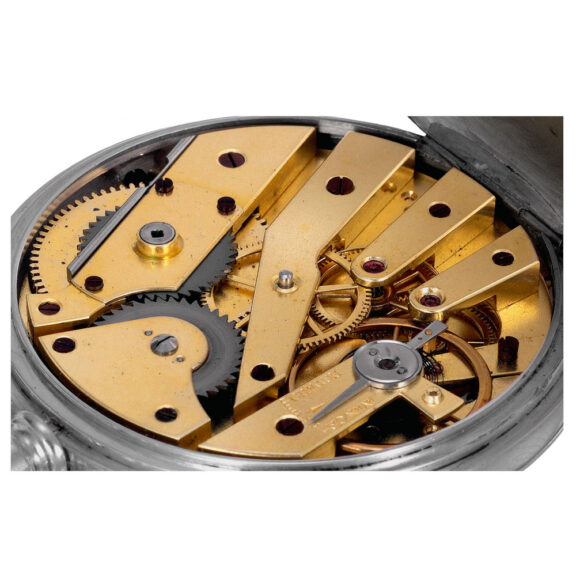
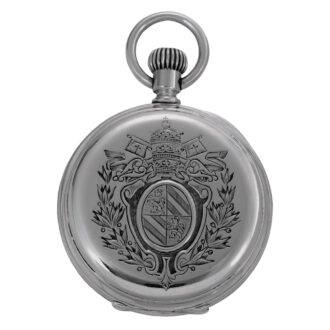
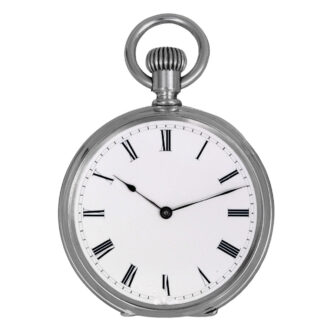
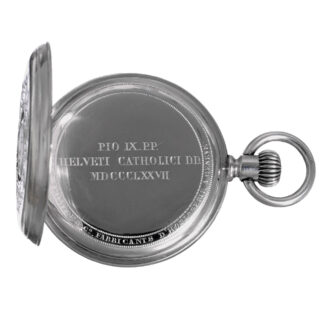
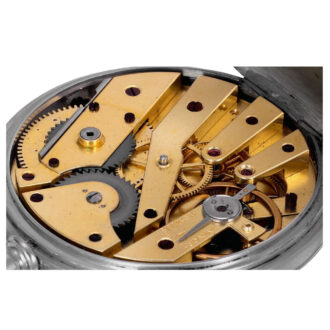
A fine, extremely rare and historically important Swiss silver open faced keyless cylinder pocket watch, circa 1876. Sold on May 14th, 1877 and presented by Swiss Catholics to Pope Pius IX in 1877. Frosted gilt movement, bar caliber, 8 jewels, wolf’s tooth winding, cylinder escapement, plain three armed gold balance, blued steel flat balance spring, index regulator. Hinged silver cuvette engraved Pio IX. P.P. Helveti Catholici D.D. MDCCCLXXVII. White enamel dial with Roman numerals, outer minute track and original blued steel spade hands. Polished case, the back engraved with the Papal arms beneath the Papal crown. Case and movement numbered, cuvette signed and numbered. Accompanied by the Extract from the Archives.
–
Diameter: 47 mm
–
Signed: Patek, Philippe & Co Fabricants d’Horlogerie à Genève
–
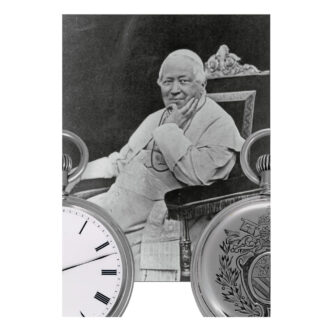
The watch was presented to Pope Pius IX by the Swiss branch of the Catholic organisation Piusverein in 1877. Subsequently Pope Leo XIII gave the watch to Cardinal Francesco Salesio della Volpe, who was ‘Camerlengo’ of the Holy Roman Church. Cardinal Francesco Salesio della Volpe gave the watch to his cousin, Count Giuseppe Ginnasi Poggiolini di Imola. Count Giuseppe Ginnasi Poggiolini di Imola gave the watch to his daughter, Countess Nadia Ginnasi Poggiolini, the mother of the present owner.
–
The initials ‘PP’ following the Pope’s name stand for the words Pastor Pastorum (Shepherd of Shepherds). The Piusverein, or the Pius Association, named after Pope Pius IX, was a conservative association founded in 1848 in Mainz, Germany by Adam Franz Lennig and Professor Caspar Riffel, to defend Catholic rights and interests throughout Europe. A Swiss branch of the Pius Association was founded in 1855 by Count Theodore Scherer-Boccard.
–
An other pocket watch for Pope Pius IX, bearing his coat-of-arms, like the present watch, is known and illustrated in Timepieces for Royalty, 1850-1910 by Patek Philippe.
–
Pope Pius IX (1792-1878, Pope 1846-1878) was born Giovanni Maria Mastai-Ferretti, Pius IX was one of the most influential popes in the entire history of the Catholic Church. His reign lasted 32 years. During his pontificate, he convened the First Vatican Council in 1869, which decreed Papal infallibility. He defined the dogma of the Immaculate Conception of the Virgin Mary, meaning that Mary was conceived without original sin and that she lived a life completely free of sin. In June 1846, after the death of Gregory XVI, Cardinal Mastai-Ferretti was elected Pope. He took the name Pius IX in memory of his benefactor, Pius X. His election was greeted with joy, for his charity towards the poor, his kindness and his ready wit had made him very popular. At a time of revolution and social upheaval in Europe, Pius IX represented a compromise choice for the papacy. In his early years he was considered to be a liberal, popular Pope, who was sympathetic to political reformers. Later, however, and notably after a mob riot forced him to leave Rome until the French restored him to the Vatican in 1850, he became much more politically conservative. In 1854 he issued the Bull Inneffabilis stating that Mary was ‘exempt from all stain of original sin’ from the time of her conception, thus raising the notion of the Immaculate Conception to a dogma. His Vatican Council (1869-1870) supported the notion of papal infallibility. The pontificate of Pius IX was one the longest in Church history. In 1871 he celebrated his twenty-fifth anniversary as Pope, in 1876 his thirtieth, and the year 1877 marked his golden Episcopal jubilee. At the 50th anniversary of his Episcopal consecration, people the world over came to visit and pay homage to the pontiff, from April 30, 1877 to June 15, 1877. This piece was no doubt ordered and presented to Pius IX in honor of that occasion. Pius IX was beatified by Pope John Paul II in 2000. Pius IX was a great patron of the arts. He exempted Rome’s two theaters from any papal censorship. He was a generous supporter of art, architecture, painting, sculpture, music, as well a s appreciating the work of fine goldsmiths, coppersmiths etc. During his reign, much was done to restore historic buildings, streets, fountains, and bridges. His interest in archeology led to the excavation of many ancient Roman sites, and thus to several major discoveries. He ordered the reinforcement of the Coliseum, at the time under risk of collapse, and supported the excavation of the Christian catacombs, for which purpose he created an archaeological commission in 1853. During his pontificate the Callisto catacombs were discovered, including previously unknown texts, paintings and tombs. His education began with the study of theology at the Roman seminary from 1814-1818. He was then appointed director of the ‘Tata Giovanni’ orphan asylum in Rome by Pope Pius VIII. Several years later, in 1823, the Pope sent him to Chile as auditor of the Apostolic delegate, Mgr Muzi. After his return in 1825 he was made canon of Santa Maria in Via Lata, Leo XII named him director of the San Michele hospital. He was created Archbishop of Spoleto by the same pope in 1827. In 1831 he convinced 4000 Italian revolutionists fleeing from the Austrian army, to lay down their arms. He persuaded the Austrian commander to pardon them and gave them money so that they could return home. In February 1832, he was transferred by Gregory XVI to the larger Diocese of Imola and was created cardinal priest in 1840. He retained the Diocese of Imola until his elevation to the papacy. His great charity and kindness won him the people’s love, while his sympathy with some of the revolutionists earned him the reputation of a liberal.
Signed: Patek, Philippe & Co Fabricants d’Horlogerie à Genève
Share this page: