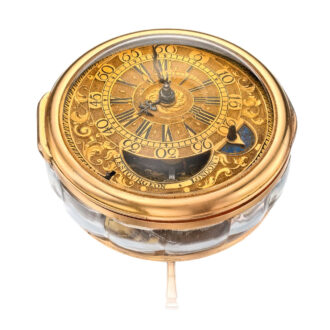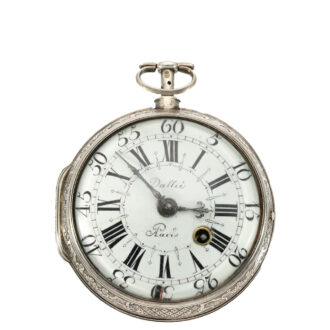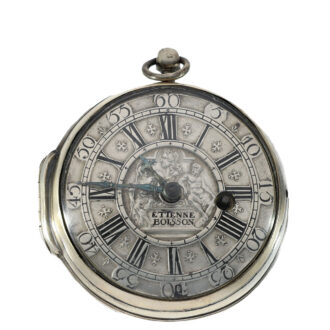
Important English 20K gold and enamel verge watch Circa 1680
- Kenmerk
- TA4832
- Diameter
- 40 mm
- Estimate
- € 12.500 - 25.000
- Price sold
- € 8.150
Gold enamelled open faced pocket watch
–
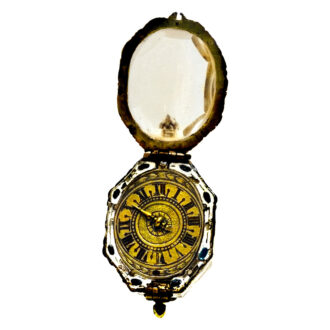
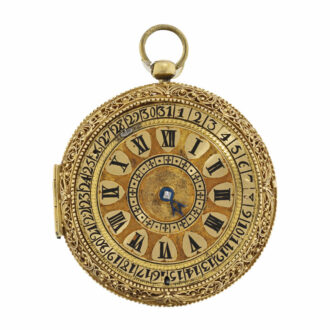
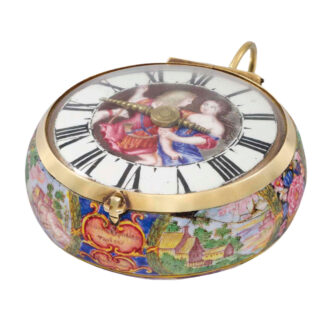
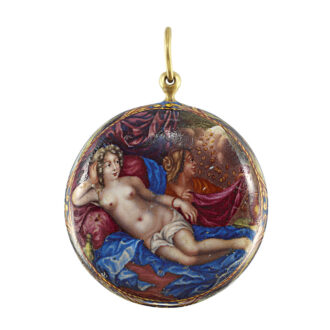
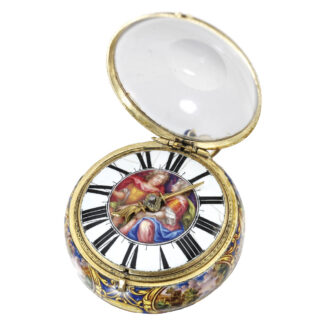
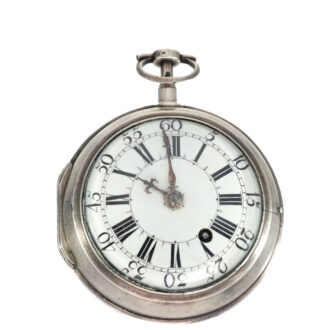
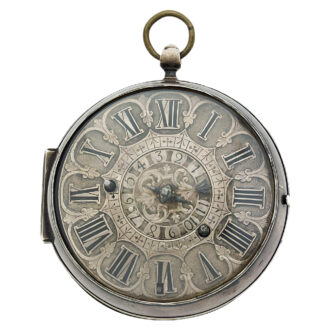
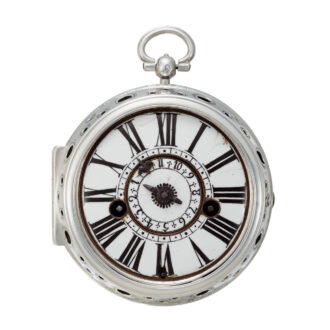
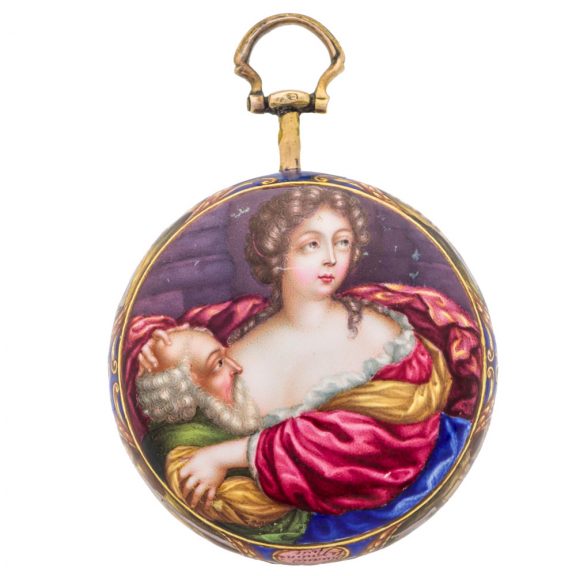
An important English 20 carat gold and enamel open faced key wind pocket watch made by Cabrier in London, circa 1680-1685. The later movement, dial and bezel from circa 1730. The solid polished case with a fine polychrome enamel scene on the reverse depicting Roman Charity after a painting by Simon Vouet, four vignettes on the band, each showing a rural scene, and the inside back painted with a house by a river and a tree in the foreground. Silver champlevé dial with Roman hours, an outer minute track, outermost Arabic five minute numerals and steel beetle & poker hands. Frosted gilt full plate movement with baluster pillars, fusee and chain, a verge escapement, steel balance with flat balance spring and silvered single footed cock. The enamel is signed Huaud le puisné fecit.
–
Diameter: 40 mm
–
Signed: Cabrier London
–
Today, the painting from approximately 1626 by Simon Vouet (1590-1649) is in the Musée des Beaux-Arts Bonnat-Helleu in Bayonne, France. The work was also engraved by Claude Mellan (1598-1688). The painting shows the influence of Caravaggio (1571-1610) on the young Simon Vouet. Its dark background composition highlights the face of Pero and the harmony of colours.
–
The enamelled subject comes from the historian Valere Maxime, first century AD.
–
Condemned to die of hunger in his cell, the old Cimon is visited daily by his daughter, Pero. Intrigued by his survival despite his hunger strike, his captor discovers that Pero breastfeeds her father daily. The judges, faced with her devotion, set her father free.
–
In the 18th century, iconography of free acts of charity, such as Roman Charity and Cleopatra’s Suicide, often is the subject of the enamelling on pocket watches.
–
Similar watch cases signed or attributed to the Frères Huaut can be found at the Patek Philippe museum and in the New York Metropolitan Museum of Art.
–
Les Frères Huaut (or Huaud). The cases painted on enamel by ‘Les deux Frères Huaut’ were among the finest examples of their kind from the Geneva School and were not only highly valued when originally made, but remained as art treasures in the centuries that followed. Pierre I was the founder of the Huaud dynasty. He was born in 1612 in Geneva as the son of a French goldsmith Jean Huaud. He settled in Geneva in 1630 and three of his 11 children became famous enamellists like their father: Pierre II (1647-1698), Jean-Pierre (1655-1723) and Ami (1657-1724). The brothers were most likely trained by their father and worked with him. Pierre II started his own business around 1680. Jean-Pierre and Ami became partners in 1682 and were appointed painters to the Prussian court in 1686 when they moved to Berlin and started working for Elector Frederick William of Brandenburg (1620-1688). Among their most well-known works are Diana and Actaeon, The Judgement of Paris, The Holy Family, St. John the Baptist, The Nativity and The Adoration of the Shepherds.
Signed: Cabrier London
Share this page: