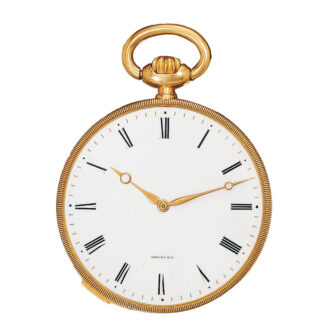
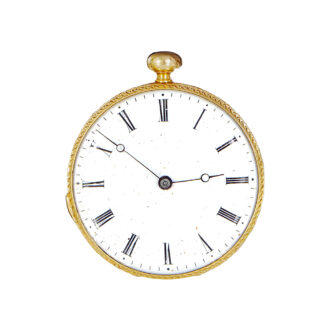
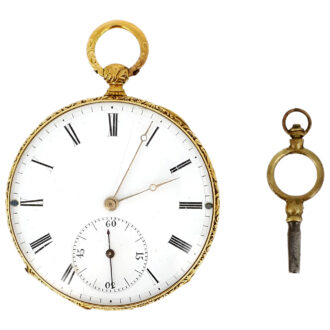
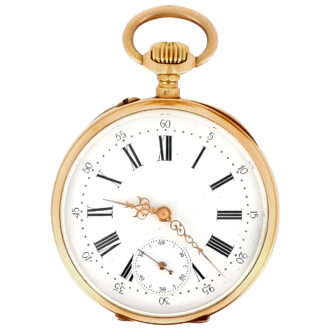
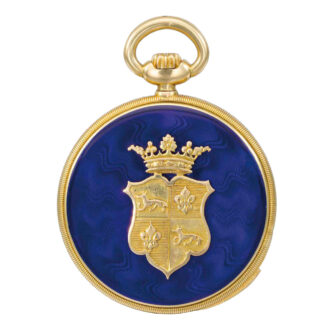
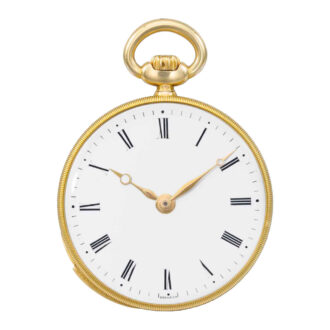
French lever with keyless winding and hand setting Circa 1847
- Kenmerk
- CH1583
- Diameter
- 45 mm
- Estimate
- € 12.500 - 25.000
- Price sold
- € 19.500
Gold and enamel open faced quarter repeater by Breguet
–
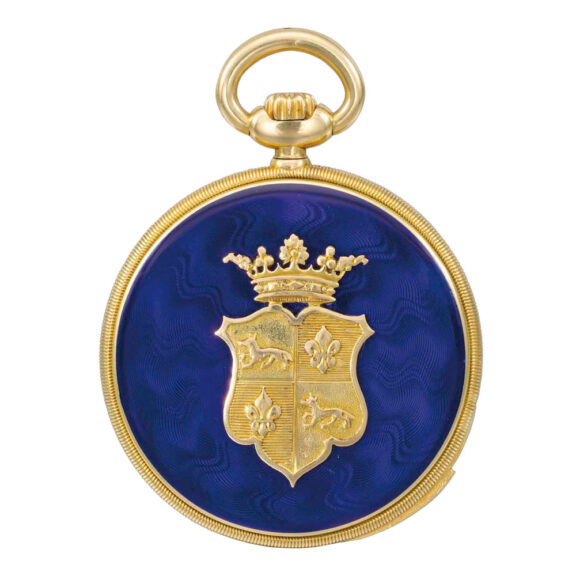
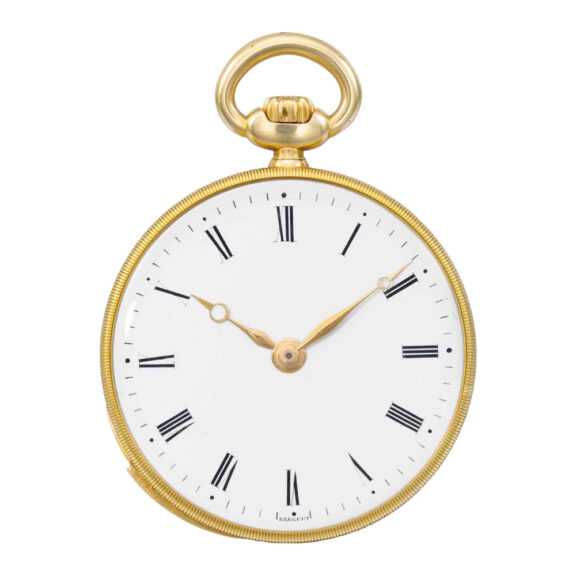
A fine and rare French 18 Carat gold and enamel open faced quarter repeating lever watch with keyless winding and hand setting, circa 1847. Sold to the Count of Campo Alegre on 2 October 1847 for 3,500 Francs. Early gilded brass bridge calibre lever movement, 21 jewels, two armed bi metallic compensation balance with platinum poising screws, quarter repeating on two hammers onto a gong. White enamel dial with Roman numerals and gold Breguet hands. Case with ribbed bezel and rim, snap on back centred by the applied gold coat of arms of the Condes de Campo Alegre on translucent Royal blue enamel over engine turned background, repeating and advance/retard slides in the laurel wreath decorated band, movement wound and time set through the Crown in the pendant.
Case numbered 569 B and 75 P, dial signed.
–
Diameter: 45 mm
–
Signed: Breguet
–
A masterpiece from the workshop of the celebrated master watchmaker Abraham-Louis Breguet (1747-1823), ‘Watchmaker of the Kings, King of Watchmakers’. This pocket watch is one of Breguet’s early timepieces fitted with the keyless stem winding and hour setting system marketed by Abraham Louis’s son Antoine-Louis in 1830, the ancestor of all modern winding mechanisms.
–
Pedro José Joaquín de Cardenas Velez de Guevara and Chacon, 1st Count of Campo Alegre, Gentilhomme of the Chamber of Isabel II, Grand Cross of the Order of Carlos III, born in Havana, Cuba, on 11 May 1786, died in Paris on 29 March 1846, presumably a doctor and physician who had emigrated to France.
–
The 19th century Spanish Empire saw much of its power weakened by rival countries, notably Great Britain and France. It also saw many of its colonies in America were influenced by the republican ideologies of the recently independent United States. The Spanish Crown decided to grant titles of nobility to much of the colonial aristocracy to strengthen its holdings. This bestowing of royal grace made the recipients loyal to the Crown and more assimilated to the Iberian titled nobility. No other Spanish colony received as many grants of noble titles as Cuba, the jewel of the Spanish Empire.
–
The Cuban aristocracy had always attempted to create a second Paris or Madrid in its main cities of Havana, Matanzas and Santiago de Cuba. Elegant, rich, decorated manors, governmental buildings, opera houses, playhouses, and palaces covered the streets of the capital. The Spanish Crown was not the only entity to award titles of nobility; the Catholic Church used its authority also to award titles on the island. Families, through marriage and inheritance, also bore European titles, such as those from France, Italy (including the former Kingdom of Naples and the Two Sicilies) and Germany. The non Royal titles issued in Cuba followed the Spanish designation. They resembled those of continental Europe: Duke (Duque), Marquis (Marqués), Count (Conde), Viscount (Vizconde), Baron (Barón), Lord (Señor) – in that line of importance and social standing. Titles bestowed often had the name of a place in Cuba, such as the Conde de Campo Alegre.
Signed: Breguet
Share this page: