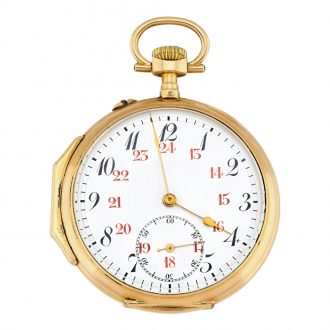
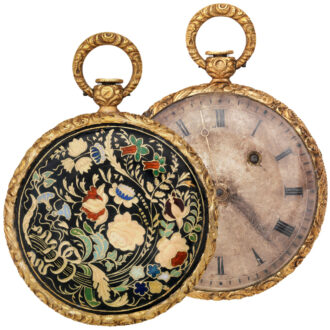
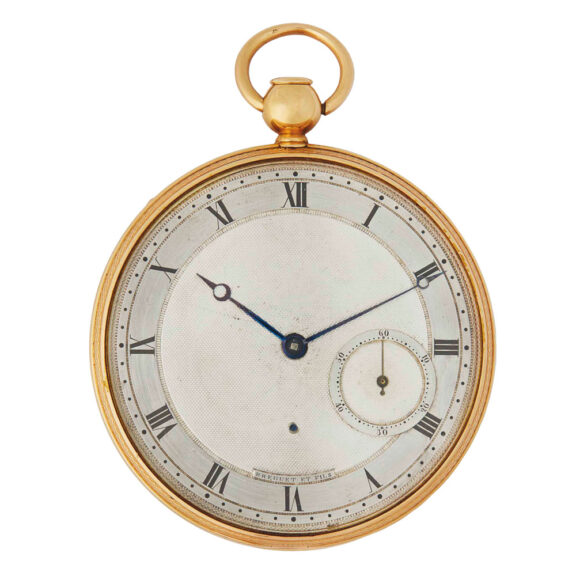
Historically important French half quarter repeater Circa 1838
- Kenmerk
- CH1722
- Diameter
- 58 mm
- Estimate
- € 110.000 - 240.000
- Price sold
- € 212.200
Gold open faced repeating cylinder watch by Breguet
–
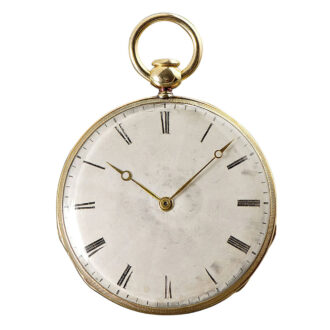
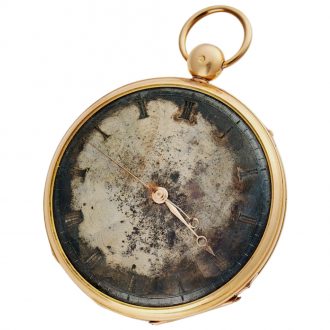
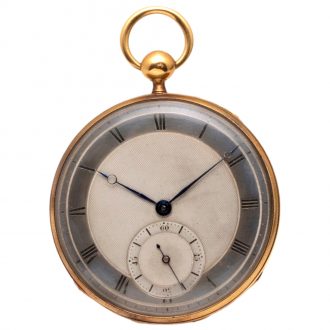
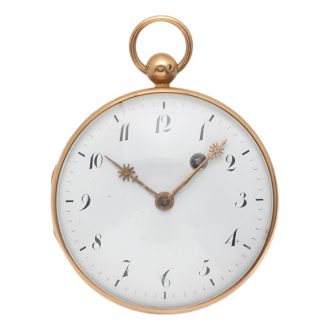
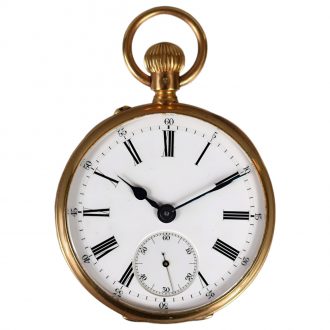
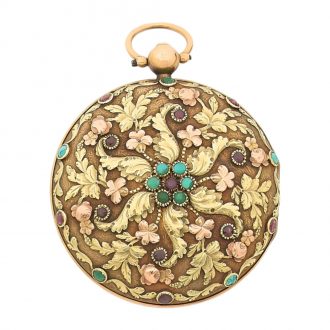
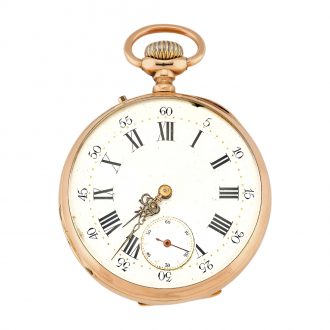
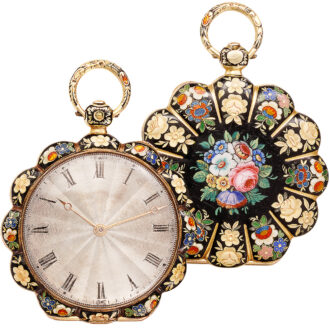
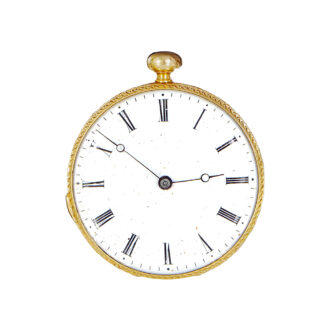
A very fine, rare and historically important French 18 carat gold open faced half quarter repeating cylinder watch with secret portrait compartment, circa 1838. Montre plate à répétition des demi-quarts. Sold to Pauline Bonaparte, Princess Borghese on 25 October 1813 for the sum of 2,400 Francs. Gilded ruby cylinder movement, plain three armed brass balance with parachute suspension on the top pivot, blued steel flat balance spring with bimetallic compensation curb on the regulator, half quarter repeating on two polished steel hammers onto a gong. Gold cuvette secured by a screw. Silver engine turned dial with Roman numerals on blank chapter ring, remnants of the secret signature 2539 Breguet visible to both sides of XII, blued steel Breguet hands, engine turned sunken eccentric subsidiary seconds. Large engine turned case ingeniously fitted with a secret hinged inner gold cover devised to contain a portrait, hinged back cover opened by a push piece in the band, quarter repeating pull-twist push piece in the pendant. Case no. 1838 by Jean-Louis Joly, cuvette signed Breguet No. 2539, dial signed Breguet et Fils and with secret signature to both sides of XII.
–
Diameter: 58 mm
–
Signed: Breguet et Fils
–
A superb example of timepieces made by the workshops of Abraham-Louis Breguet (1747-1823) and his successors, widely acknowledged for having set the standard by which all fine watchmaking has been judged ever since. Abraham-Louis Breguet was born in Neuchâtel, Switzerland, but it was in Paris that he spent most of his productive life. No aspect of watchmaking escaped his study, and his inventions were as fundamental to horology as they were varied. His career started with a series of breakthroughs: the development of the successful self winding perpétuelle watches, the introduction of the gongs for repeating watches and the first protection for balance pivots. Louis XVI and his Queen, Marie-Antoinette, were early enthusiasts of Breguet’s watchmaking. Each watch from his workshops demonstrated the latest horological improvements in an original movement, mostly fitted with lever or ruby cylinder escapements that he perfected. Breguet took refuge in Switzerland from the excesses of the French Revolution. He returned to Paris overflowing with the ideas that produced the Breguet balance spring, his first carriage clock (sold to Napoleon Bonaparte), the ‘sympathique’ clock and its dependent watch, the tact watch and finally the tourbillon, patented in 1801. Breguet became the indispensable watchmaker to the scientific, military, financial and diplomatic elites of the age. His timepieces ruled the courts of Europe. For his most celebrated clients, Breguet designed exceptional timepieces. For Caroline Murat, queen of Naples, conceived in 1810 the world’s very first wristwatch. Honours saluted his enormous contribution to horology. Appointed to the Board of Longitude and as chronometer maker to the navy, he entered the Academy of Sciences and received the Legion of Honour from the hands of Louis XVIII. When he died in 1823, all mourned the architect of the greatest revolution in the science and art of timekeeping.
–
Pauline Bonaparte, Princess Borghese, first sovereign Duchess of Guastalla, an imperial French Princess and the Princess consort of Sulmona and Rossano (20 October 1780 – 9 June 1825). Née Maria Paola Buonaparte she was the sixth child of Letizia Ramolino and Carlo Buonaparte, Corsica’s representative to the court of King Louis XVI of France. Her elder brother, Napoleon, was the first Emperor of France. She married Charles Leclerc, a French general, a union ended by his death in 1802. Later, she married Camillo Borghese, 6th Prince of Sulmona. Her only child, Dermide Leclerc, born from her first marriage, died in infancy. Of all his siblings, Pauline was the most liked by Napoleon Bonaparte. A woman of great beauty and a notoriously promiscuous seductress, she was the subject of considerable scandals. She accompanied her husband, General Leclerc, on the expedition to Haiti. After Leclerc’s death, Napoleon arranged her marriage (1803) to Camillo Borghese, a member of the Roman nobility, but they soon separated. Pauline, made princess of Guastalla in 1806, fell into temporary disfavour with her brother because of her hostility to Empress Marie Louise, but when Napoleon’s fortune failed, Pauline, the only sibling to join him in exile on Elba, showed herself more loyal than any of his other sisters and brothers. Pauline Bonaparte’s beauty is immortalized in the famous marble statue depicting her as ‘Venus Victrix’ (Venus the Conqueror), on permanent display at Rome’s Villa Borghese. Commissioned in 1804 by her husband, Prince Camillo Borghese, it was made by the celebrated sculptor Antonio Canova (1757-1822) who also created a number of other Bonaparte portraits. The statue of Pauline, one of his most famous works, was notable for the shocking near-nudity of its subject as well as for its elegance and artistry. Pauline is depicted as the Roman goddess of love, Venus, holding in her hand the apple which marked her as the winner in the divine beauty contest known as the Judgment of Paris.
–
Breguet and the Bonaparte family. The first member of the Bonaparte family to own a timepiece made by the celebrated watchmaker was General Charles Victor Emmanuel Leclerc. He was promoted to the rank of brigadier-general on 6 May 1797 and acquired a repeating watch only a few days later, before marrying Pauline Bonaparte on 14 June. It is most likely through him that General Napoleon Bonaparte, commander of the Army of Italy, heard of the workshop at the Quai de l’Horloge in Paris. April the following year, one month before setting out on his Egyptian campaign, General Bonaparte acquired three pieces which were particularly representative of Breguet’s production: a repeating watch ‘garde-temps with insulated escapement’, No. 38, a repeating and calendar travelling clock, No. 178, the first of its kind, and a ‘perpétuelle’ repeating watch, No. 216. Between 1798 and 1801, the Bonaparte family made numerous purchases, including acquisitions made by Pauline Bonaparte, now the widow of General Leclerc, and her second husband Prince Borghese. Between 1797 and 1814, the Bonaparte family bought about a hundred timepieces from Breguet, or the equivalent of his entire annual production for the year 1798.
–
The scale of these purchases by the imperial family underlines the extraordinary demand for watches made by Breguet among the most powerful and influent personalities of the period (Breguet – Watchmakers since 1775 by Emmanuel Breguet, pp. 185 – 189).
Signed: Breguet et Fils
Share this page: