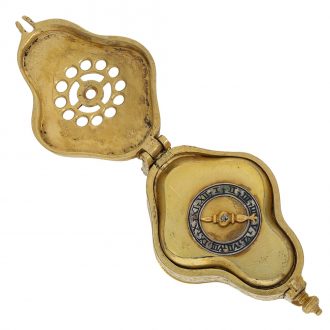
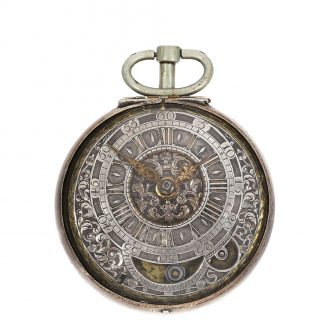
Early German hour striking clock watch with alarm Circa 1575

- Kenmerk
- AS1610
- Diameter
- 119 mm
- Estimate
- € 60.000 - 120.000
- Price sold
- € 102.400
Unsigned gilt brass watch with astrolabic dial
–
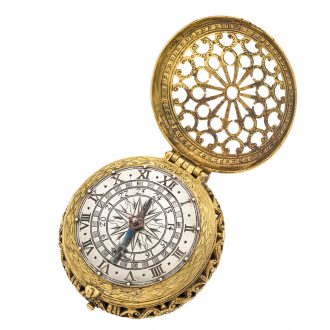
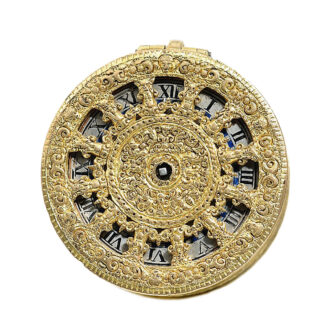
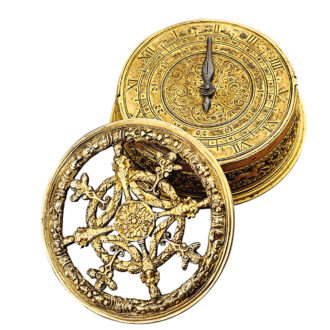
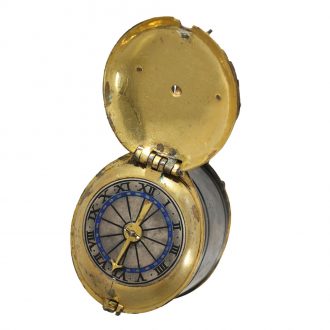
An important and massive early German gilt brass hour striking clock watch with stack freed, alarm and astrolabic dial, circa 1575. The watch is equipped with an iron movement featuring a verge escapement, brass barrels, dumb bell foliot, hog’s bristle regulator, brass count wheel, brass dial with alarm setting disc, brass contrate wheel and an iron strack freed mounted to the backplate with decoratively engraved and gilded cam. It also has straight iron chamfered pillars and strikes a bell to the inside case back. Additionally, it includes a locking gate for striking, decoratively pierced and engraved in the form of a half horse/half dragon and a backplate stamped CK within a shield
–
The gilded astrolabe dial features solar and lunar indicators, Roman numerals running twice in succession from 1-12 and touch pins above. The rate includes months and dates, as well as a selection of fixed named stars. The engraved plate beneath the rete is calibrated for 50 degrees north and includes the ecliptic with zodiac names and degrees. At the center, there is a lunar indication showing the age and phases of the moon and at the very centre, there is an aspectarium.
–
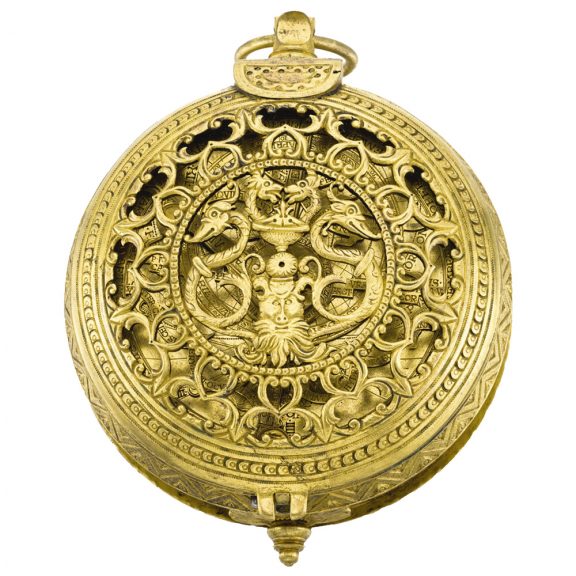
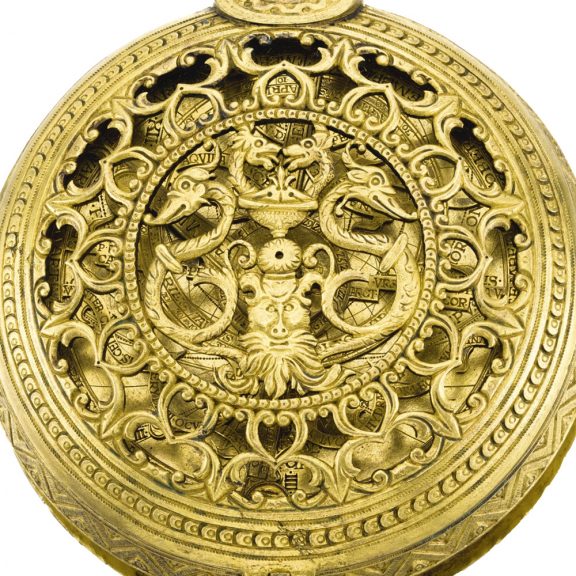
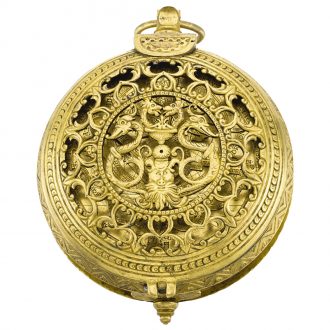
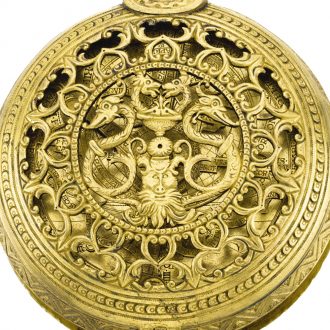
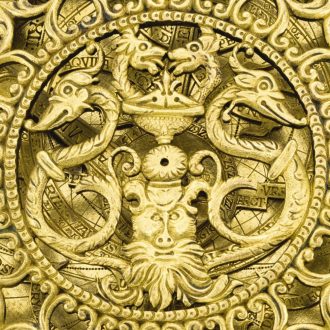
The gilt brass case has a pierced and engraved lid with heart shaped openings, a bizarre mask in the center and fantastical bird heads. The back of the case is adorned with a half figure wearing armour and a helmet in the center, surrounded by mythical creatures including dragon heads and bird heads, all amidst swirling foliage. The band is pierced with stylized pillars and has bezels with geometrically engraved decorations above and below.
–
Diameter: 119 mm
–
Signed: No name
–
During the 16th and 17th centuries, complex scientific instruments were highly sought after as they symbolised their owners’ status and education. Portable instruments, especially those combining an astrolabic dial with a striking watch movement, were particularly valued. While this watch was likely made in Germany, identifying the exact maker is challenging. Many early stack freed watches were either unsigned or only stamped with the maker’s initials, some of which remain unidentified. The backplate of this watch is stamped ‘CK’ within a shield, similar to a mark found on a watch from the Fränkel Collection now at the Horological Museum in Le Locle, Switzerland. The Fränkel watch also bears a stamp in the form of a horse, which is the town mark of Stuttgart in Germany. Interestingly, the distinctive pillars on the case sides of this watch closely resemble those on two watches in the British Museum, one of which is a case only and the other with an unsigned movement. The pillars of these two pieces are illustrated in H. Tait and P.G. Coole’s Catalogue of Watches in the British Museum: I, The Stackfreed, 1987, plate 45.
Share this page: