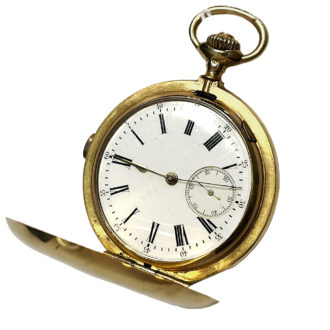
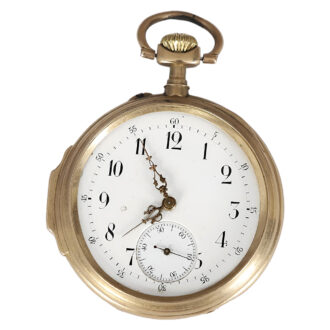
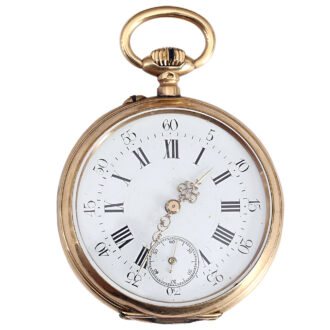
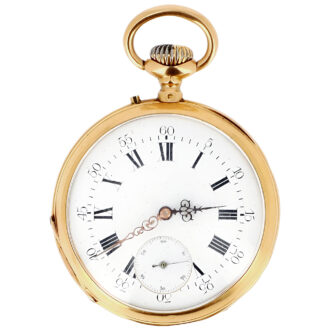
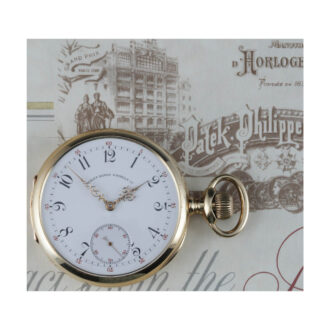
Swiss gold Observatory chronometer Extra special Circa 1900
- Kenmerk
- EB0056
- Diameter
- 49 mm
- Estimate
- € 10.000 - 20.000
- Price sold
- € 19.680
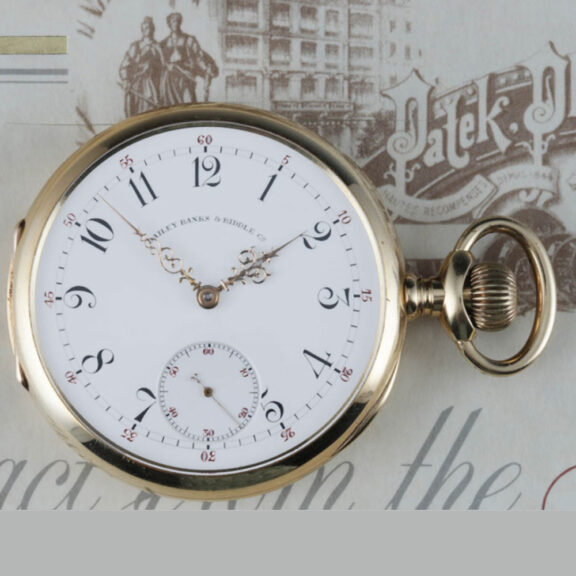
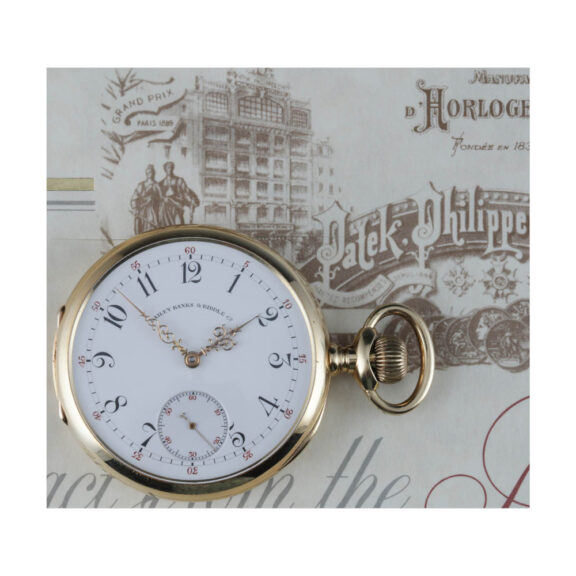
Gold open faced Observatory chronometer Extra special by Patek Philippe
–
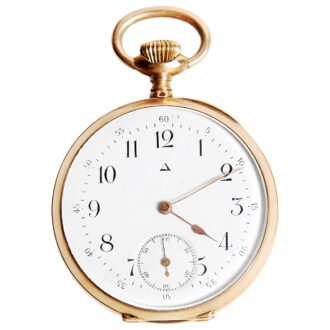
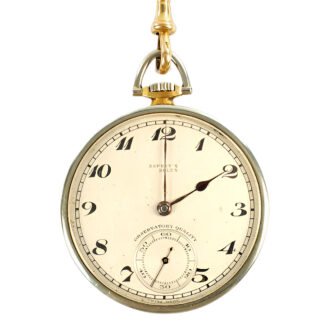
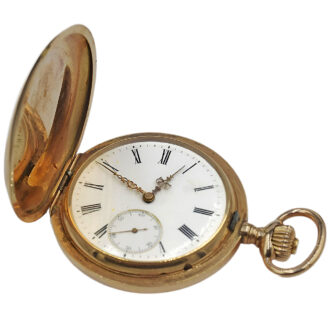
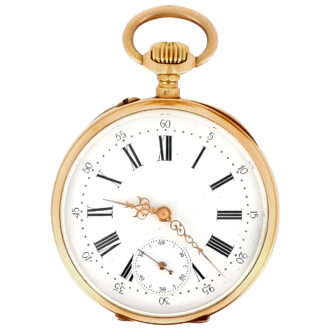
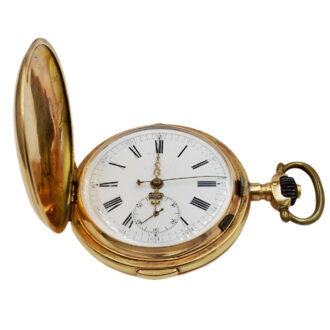
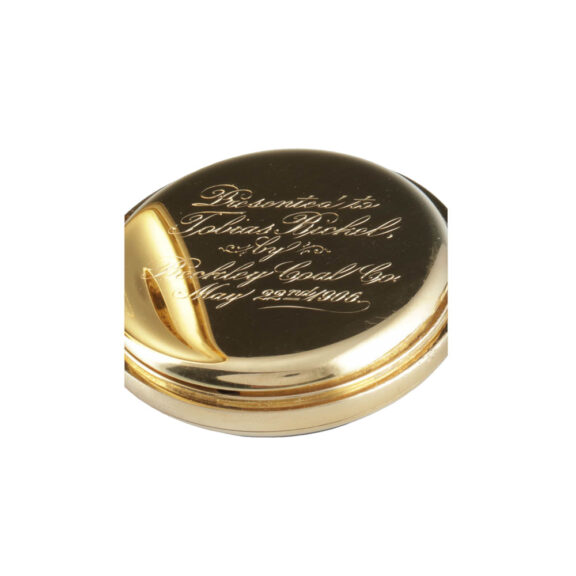
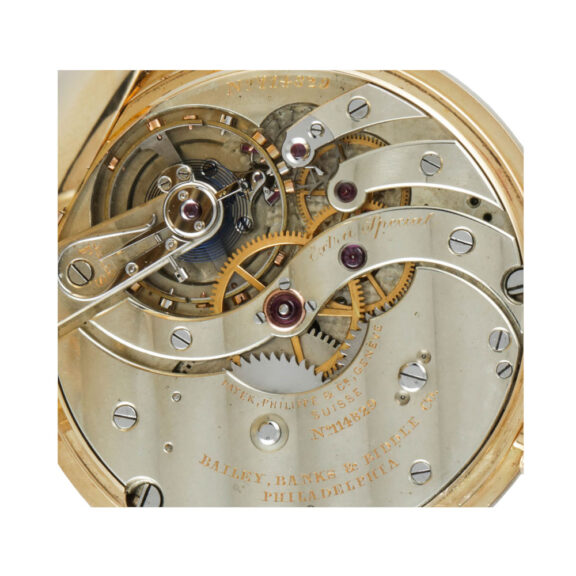
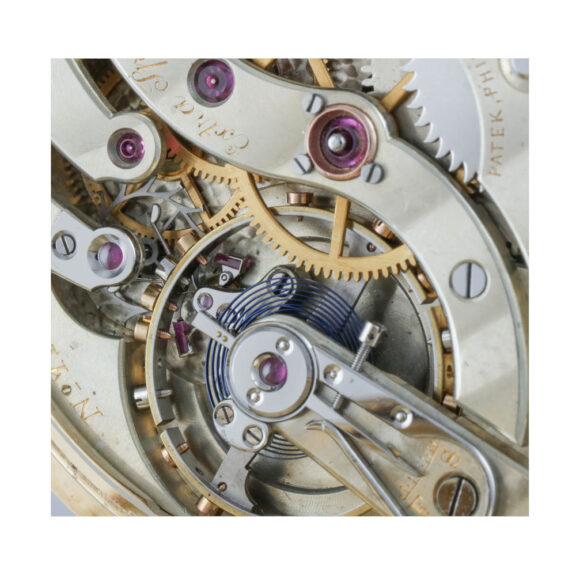
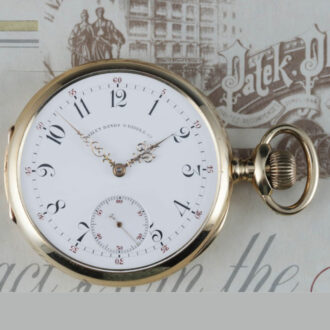
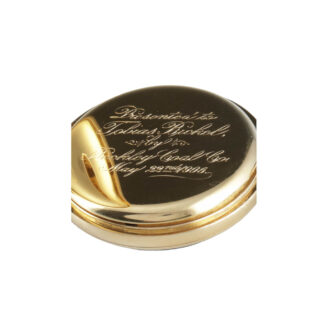
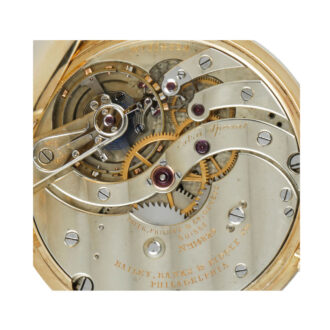
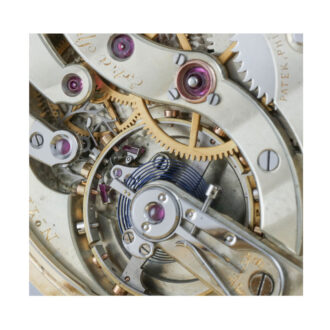
A Swiss 18-carat gold open faced Observatory chronometer Extra special, circa 1900. Exquisite anchor chronometer movement of the highest class, signed by retailer and watchmaker, numbered, both EXTRA and SPECIAL designation, Guillaume Anibal-nickel-brass chronometer balance with so-called winged arms and weights of gold and platinum, adjustable special anchor with compensation balance in the form of beetle feelers, blued Breguet steel spring with double end curves, wolf tooth mechanism, swan neck regulator, polished steel parts and screws. White enamel dial with black Arabic numerals, red minute ring and red seconds, beautiful Louis XV hands made of red gold, signed. Plain case. Cuvette with gift dedication from the year 1906. Comes with an extract and a copy of the bulletins of the Observatory in Genève 1903.
–
Diameter: 49 mm
–
Weight: 105 g
–
Signed: Bailey, Banks & Biddle Co Philadelphia – Patek, Philippe & Cie Genève Suisse
–
The movements of Patek Philippe watches made specifically for observational tests received two serial numbers. The inscription ‘Extra’ on the bridge of the movement refers to the highest completion of all parts; it was regulated by J. Golay-Audemars, a legendary and multi-award-winning watchmaker. Watches with the double quality mark ‘Extra’ and ‘Special’ are extremely rare. Only the best Patek Philippe chronometers have been awarded with the ‘Extra’ quality seal.
–
The movement of this watch was made in 1900 and tested in 1903 at the Observatory in Geneva. Regulated by J. Golay-Audemar. It was sold in 1904. Resold by Bailey, Banks & Biddle Co., Philadelphia.
–
‘Extra’ quality watches have been manufactured to the highest standards and specially adjusted by masters such as Henri Wehrli, J. Golay-Audemars, F. Modoux and C. Batifolier. They were the highest-paid precision mechanics in the watch industry. The watches they regulated were many times more expensive than the regular ones. Every detail, for example, the specially adapted Guillaume balance with small ‘wings’ on the arm, served to use the balance ‘in rough state’ (before screwing in the screws) to ensure the temperature compensation has no effect on the balance. Further, the high-quality polish of the steel parts or the gelled holes for the ruby jewels shows that the watch was an absolute peculiarity.
–
The Anibal (Acier au Nickel pour BaLanciers) is a by Nobel Prize winner Dr Ing. Charles Edouard Guillaume invented alloy with unusual characteristics, both in terms of thermal expansion and in a change of elasticity. These characteristics are very different from those of two other famous alloys invented by Guillaume, Invar and Elinvar. Around 1900, Guillaume attempted to eliminate the so-called mean temperature error caused by the fact that the change in speed of a timepiece with a steel brass bimetallic balance is a linear function of temperature, while the rate of change due to the change in the elasticity of a balance spring is approximately a quadratic function. Therefore, it is zero at only two temperatures, leading to a secondary error. Countless attempts have been made to eliminate the average temperature error, usually with the help of auxiliary compensators. In 1899, Guillaume found that steel with an addition of 44.4% nickel had a negative coefficient of thermal expansion. This alloy, combined with brass in bimetallic lamellae, makes their expansion nearly square. Balances with Anibal and brass bi-metal rims are commonly referred to as Guillaume balances or, as inventors call them, integral balances. In combination with special coil springs, they have remarkable temperature stability, which occasionally does not exceed 1/50 second per day at 1 ° C.
Signed: Bailey, Banks & Biddle Co Philadelphia – Patek, Philippe & Cie Genève Suisse
Share this page: