Fine and rare English 20k gold and enamel watch Circa 1695

- Kenmerk
- FA9243
- Diameter
- 46 mm
- Estimate
- € 12.500 - 30.000
- Price sold
- € 11.600
Gold and enamel watch
–
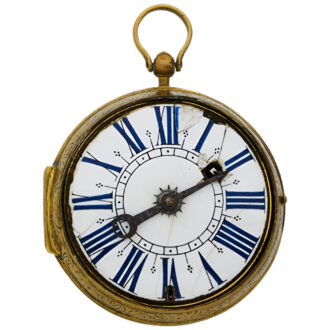
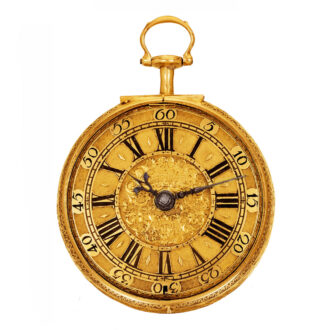
An English very fine and rare, 20K gold and enamel watch with painting on enamel by Vauquer P(inxit), circa 1660, watch made circa 1695. Gilt brass full plate movement, elaborate tulip pillars, fusee and chain, verge escapement, plain steel three-arm balance, blued steel flat balance spring, one-footed cock pierced and engraved in symmetrical scrolling foliage, flower blossom in the center, worm and wheel set-up, rack and pinion regulator with silver plate.
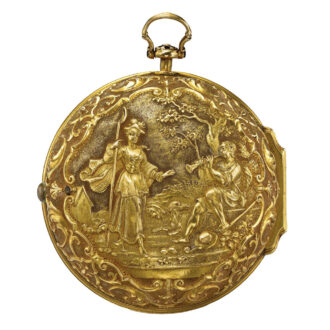
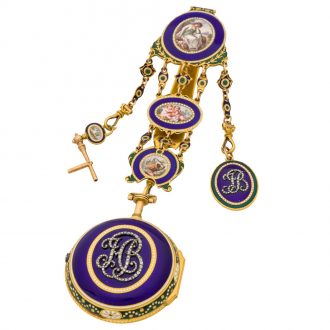
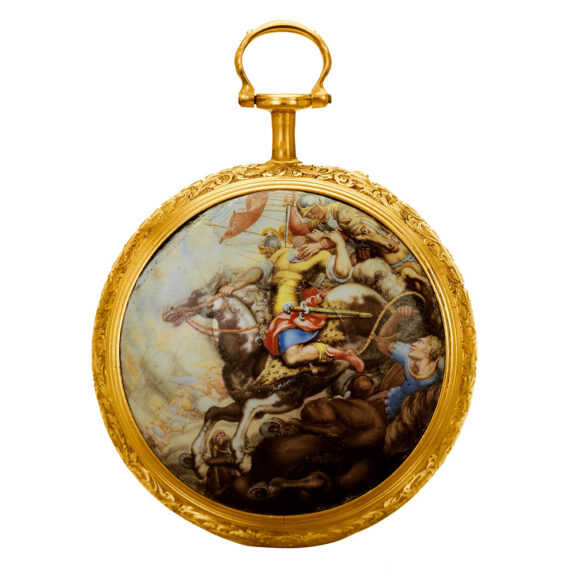
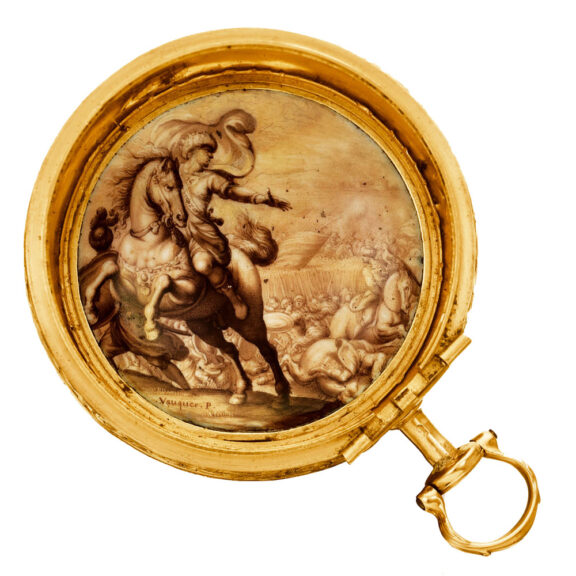
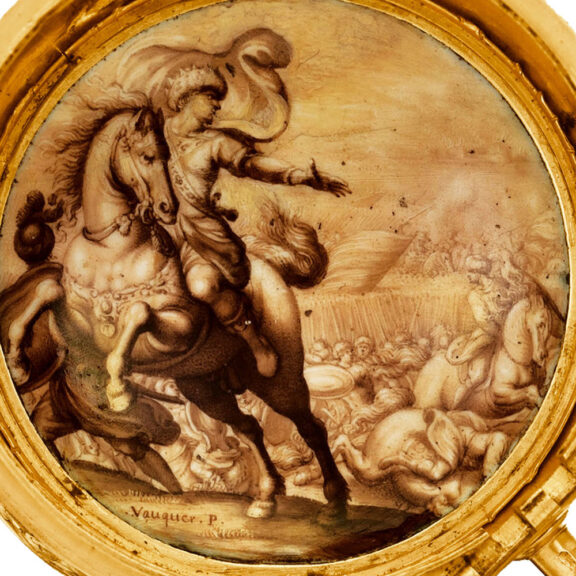
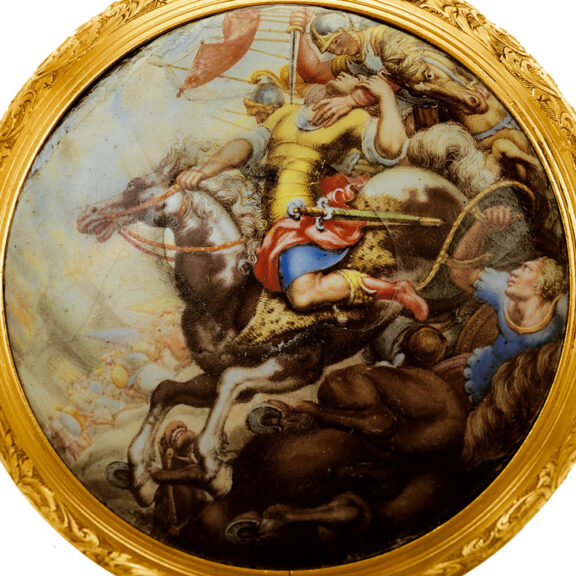
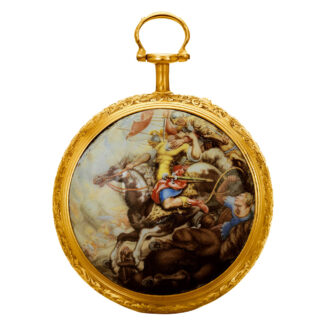
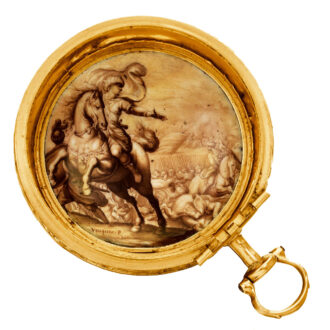
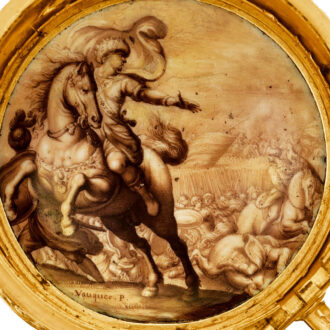
Case painted on both sides with battle scenes, the enamel plaque is by Robert Vauquer (1625-1670) who worked in Blois. The battle scene on the back is biblical, while that on the inside, painted en grisaille and signed, is of Alexander destroying the Persian Cavalry. The body of the gold case has two bands of foliate engraving and a swivel pendant.
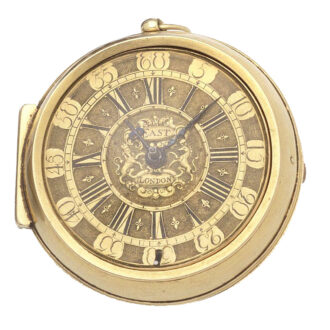
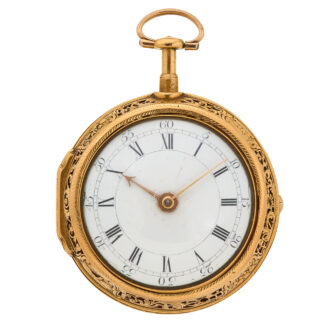
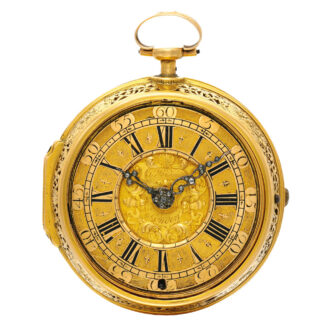
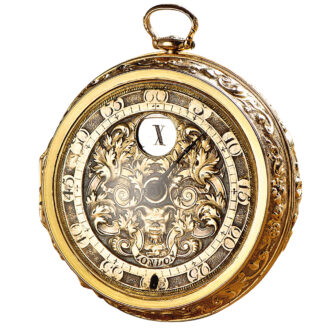
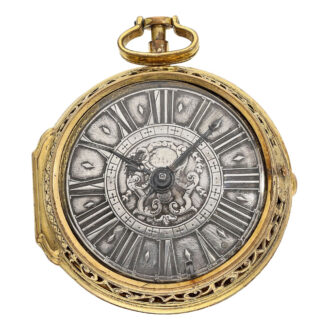
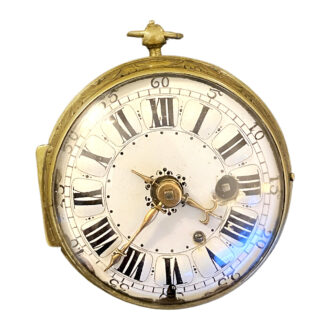
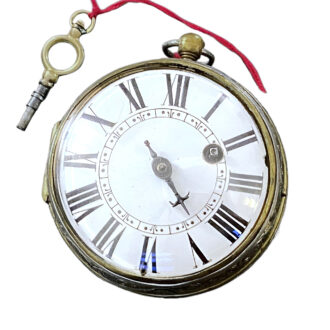
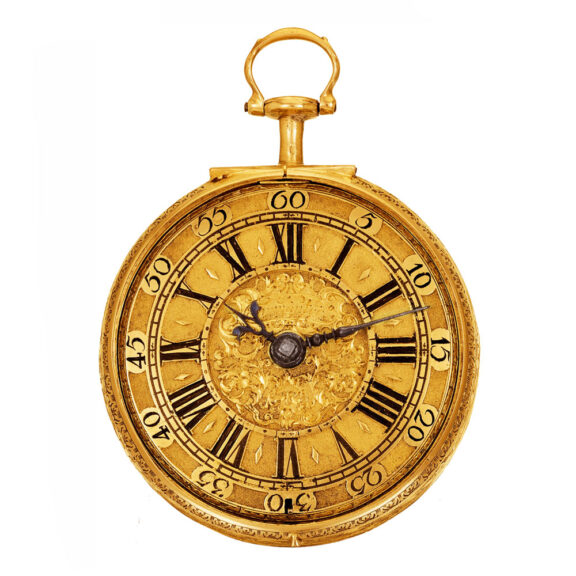
Gold champlevé dial, Roman hour chapter ring with half-hour lozenges, outer minute ring with five-minute Arabic numerals. Blued steel tulip and poker hands. Signed on the movement and the dial, the number engraved on the band in a special cartouche by the pendant. Enamel signed on the inside back.
–
Diameter: 46 mm
–
Signed: Fromanteel
–
The scenes derive from prints after engravings by Antonio Tempesta (1555-1630). The level of mastery which painting on enamel had reached in 17th century France had declined by the turn of the century. Yet owners treasured old cases whose movements had become obsolete after the introduction of the balance spring in 1675. As a result, many Blois watch cases were fitted with “modern” movements or converted into snuff boxes. Many backs and covers were preserved for their beauty alone. There is a record in Ferdinand Berthoud’s registers of a client who requested that an old enamel watch be fitted with a newer movement. The fact that Berthoud obliged the man demonstrates to what extent people treasured their fathers’ enameled cases. A beautiful example was an early Blois enameled case fitted with a custom made movement by William Webster. Some watchmakers, like Johanes van Ceulen Le Jeune of Hague, made a business of replacing movements in older, painted enamel cases.
–
An English very fine and rare, 20K gold and enamel watch with painting on enamel by Vauquer P(inxit), circa 1660, watch made circa 1695. Gilt brass full plate movement, elaborate tulip pillars, fusee and chain, verge escapement, plain steel three-arm balance, blued steel flat balance spring, one-footed cock pierced and engraved in symmetrical scrolling foliage, flower blossom in the center, worm and wheel set-up, rack and pinion regulator with silver plate.
Case painted on both sides with battle scenes, the enamel plaque is by Robert Vauquer (1625-1670) who worked in Blois. The battle scene on the back is biblical, while that on the inside, painted en grisaille and signed, is of Alexander destroying the Persian Cavalry. The body of the gold case has two bands of foliate engraving and a swivel pendant.
Gold champlevé dial, Roman hour chapter ring with half-hour lozenges, outer minute ring with five-minute Arabic numerals. Blued steel tulip and poker hands. Signed on the movement and the dial, the number engraved on the band in a special cartouche by the pendant. Enamel signed on the inside back.
–
Diameter: 46 mm
–
Signed: Fromanteel
–
The scenes derive from prints after engravings by Antonio Tempesta (1555-1630). The level of mastery which painting on enamel had reached in 17th century France had declined by the turn of the century. Yet owners treasured old cases whose movements had become obsolete after the introduction of the balance spring in 1675. As a result, many Blois watch cases were fitted with “modern” movements or converted into snuff boxes. Many backs and covers were preserved for their beauty alone. There is a record in Ferdinand Berthoud’s registers of a client who requested that an old enamel watch be fitted with a newer movement. The fact that Berthoud obliged the man demonstrates to what extent people treasured their fathers’ enameled cases. A beautiful example was an early Blois enameled case fitted with a custom made movement by William Webster. Some watchmakers, like Johanes van Ceulen Le Jeune of Hague, made a business of replacing movements in older, painted enamel cases.
Signed: Fromanteel
Share this page: