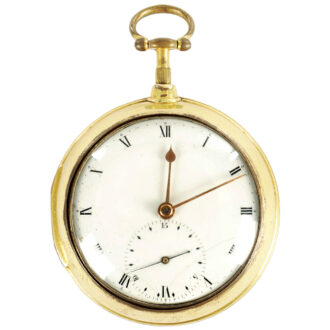
English fine silver quarter repeating cylinder watch Circa 1755
- Kenmerk
- SA0430
- Diameter
- 50 mm
- Estimate
- € 4.000 - 8.000
- Price sold
- -
Fine silver pair cased quarter repeating cylinder watch
–
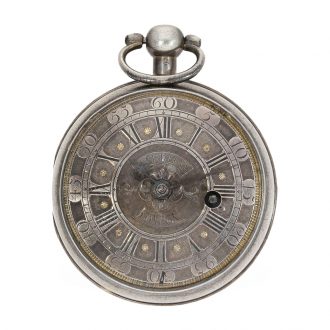
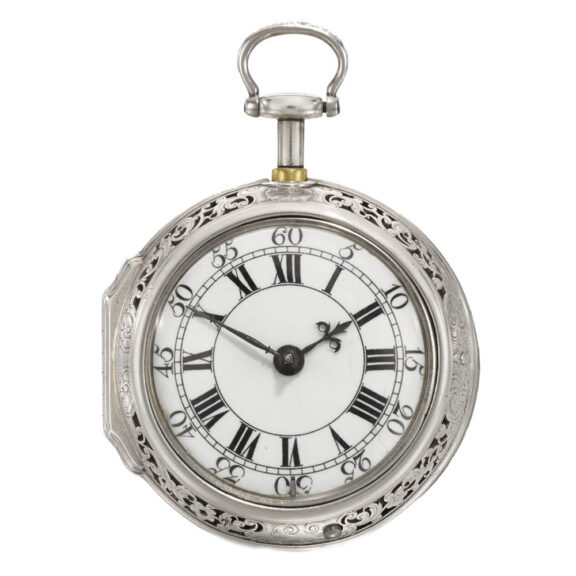
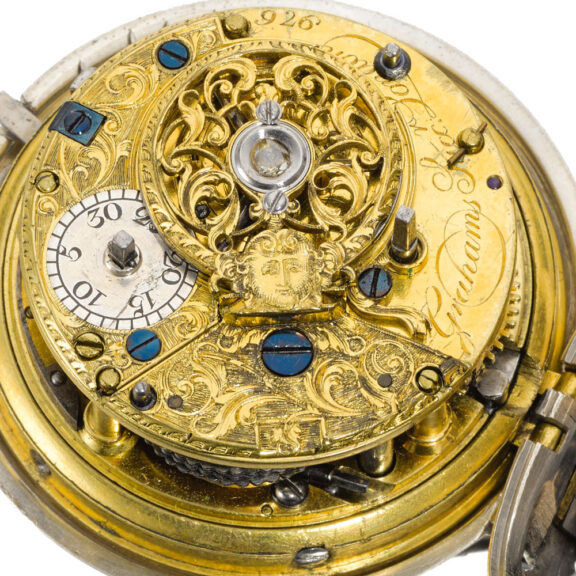
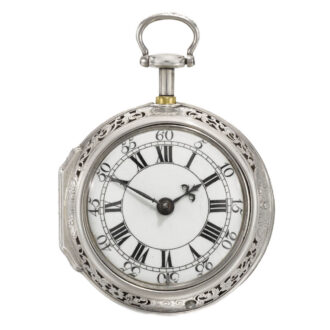
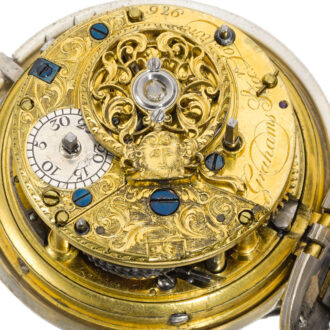
An English fine silver pair cased quarter repeating cylinder watch, circa 1755, gilded full plate movement, cylinder escapement, steel escape wheel, decoratively pierced balance cock engraved with foliage, a head at the neck, diamond endstone, fusee and chain, cylindrical pillars, striking a bell to the inside case back, signed Graham Succr., London, bellscratch signed Drury.
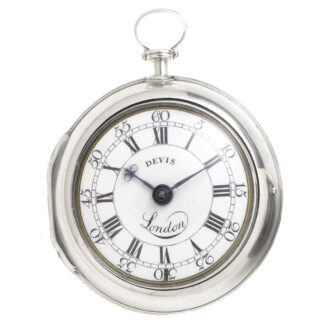
White enamel, Roman numerals, outer Arabic minute ring, blued steel beetle and poker hands,
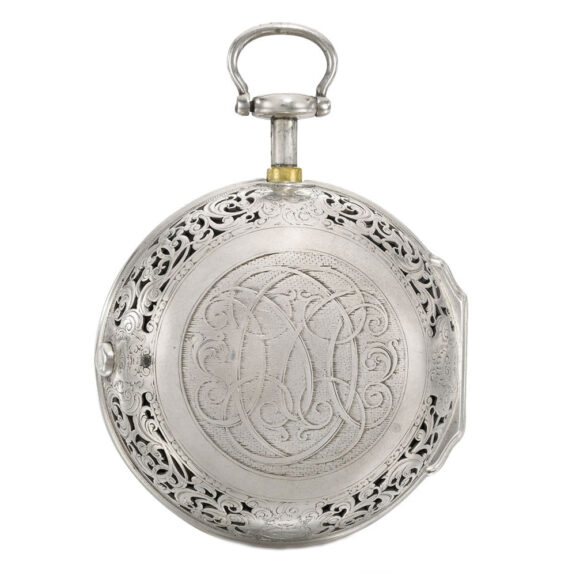
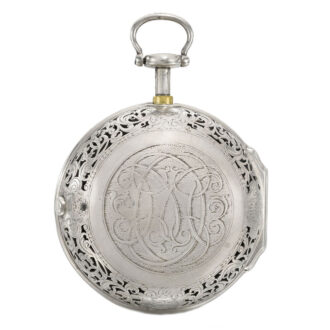
Silver inner case, the band pierced and engraved with scrolling foliage, a grotesque mask at the base, outer case with similarly pierced and engraved decoration to the bezels, pulse piece to the bezel between 5 and 6 o’clock, the back centred with elaborately engraved monogram, bezel with grotesque masks N, E, S and W, both cases with maker’s mark TC in rectangular cameo for possibly Thomas Colley or Thomas Carpenter Senior.
–
Diameter: 50 mm
–
Signed: Graham Succr. London
–
When George Graham died in 1751, his business was continued by two of his workmen, Samuel Barkley and Thomas Colley. Barkley died in 1753 leaving Colley to continue alone until he was joined about 10 years later by a new partner, John Priest. The watches were initially signed ‘Graham Succrs.’ then, for a while, ‘Graham Succr.’, as is the case with this watch.
George Graham (1674-1751) was one of England’s most renowned clock and watchmakers. He served his apprenticeship with Henry Aske in 1688 and then entered the service of Thomas Tompion as a journeyman in 1695. Graham married one of Tompion’s nieces and became his partner in 1704, succeeding to the business on Tompion’s death in 1713. He was elected a fellow of the Royal Society in 1721 and Master of the Clockmakers’ Company in 1722. It is believed that he improved or perhaps invented the cylinder escapement. He used the verge escapement up to 1726 and then predominantly the cylinder thereafter. On his death in 1751, as a sign of the great respect in which he was held, Tompion’s grave in Westminster Abbey was opened to receive the body of his former partner.
Signed: Graham Succr. London
Share this page: