English gilt astronomical pocket watch with tide indicator Circa 1790
- Kenmerk
- HC1804
- Diameter
- 65 mm
- Estimate
- € 20.000 - 50.000
- Price sold
- € 48.100
Gilt extremely rare verge watch
–
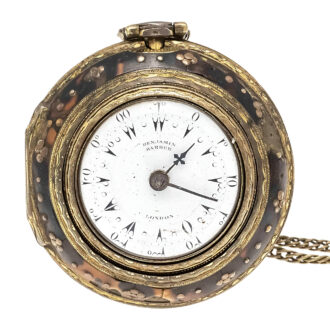
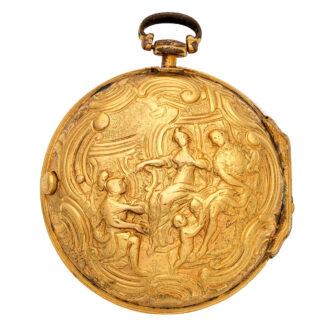
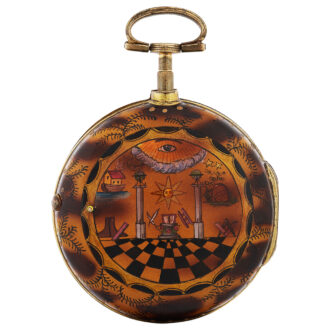
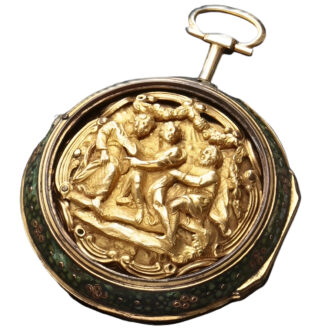
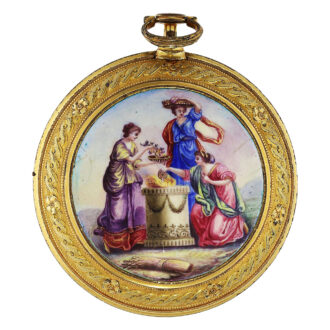
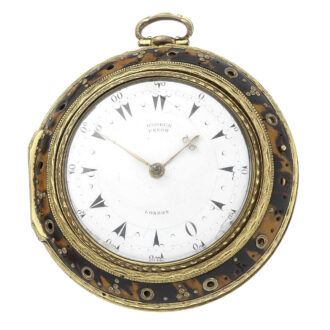
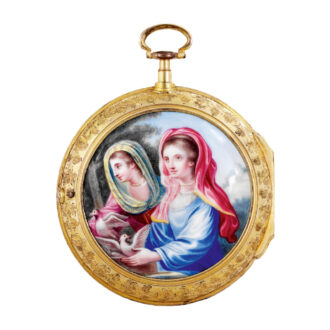
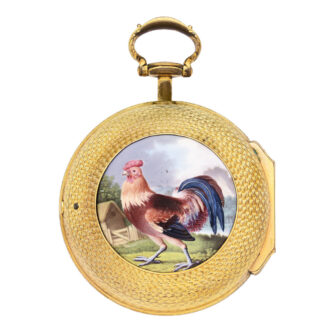
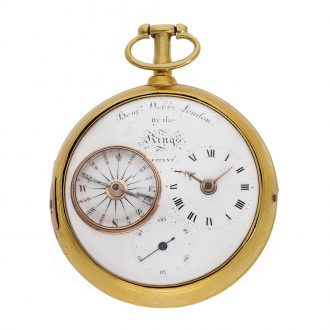
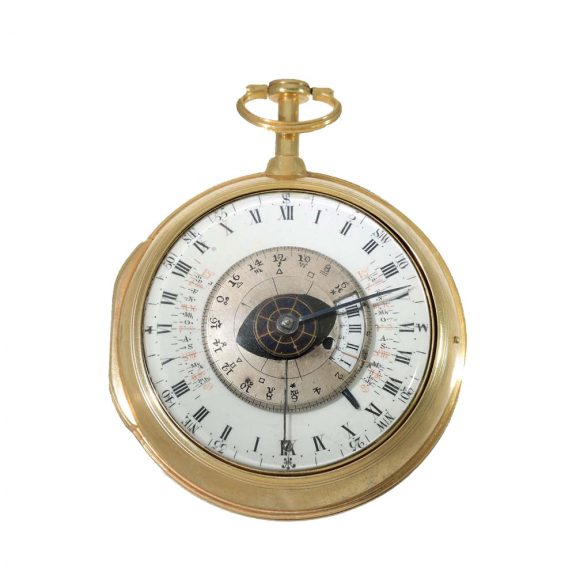
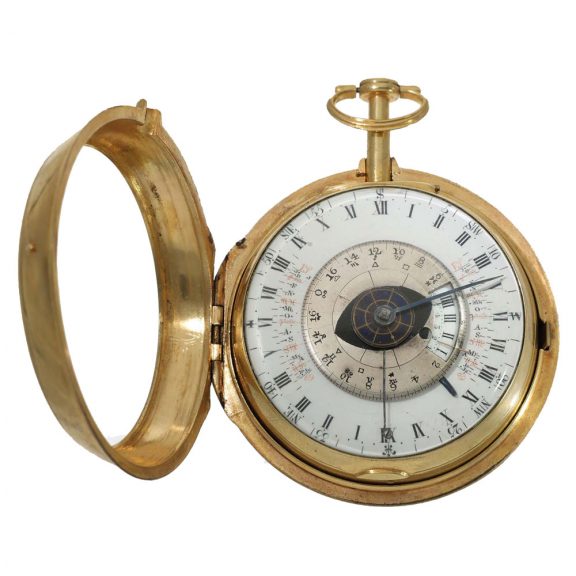
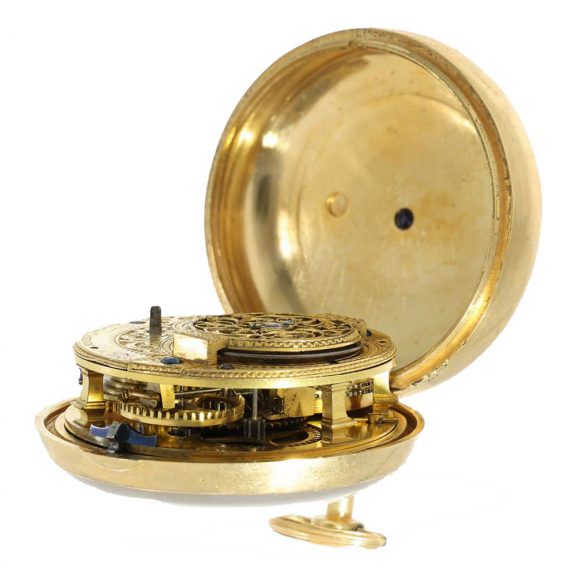
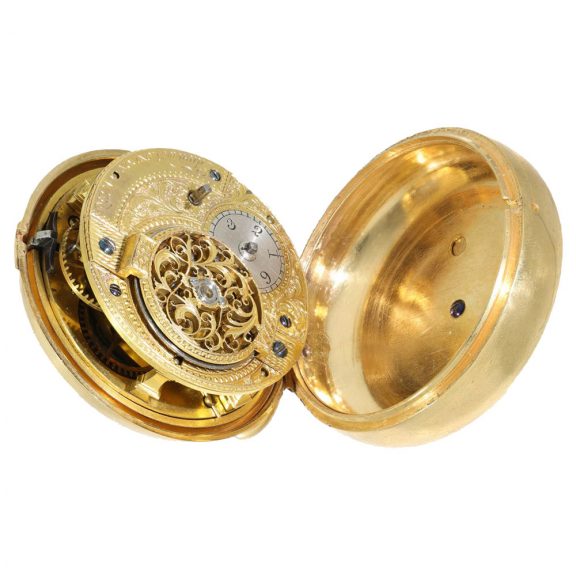
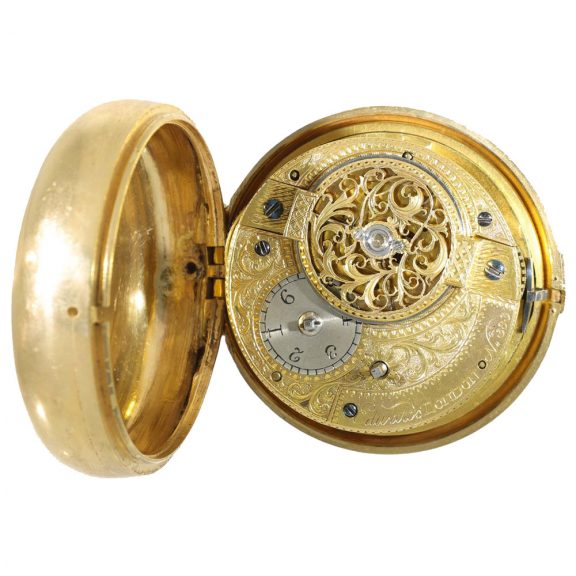
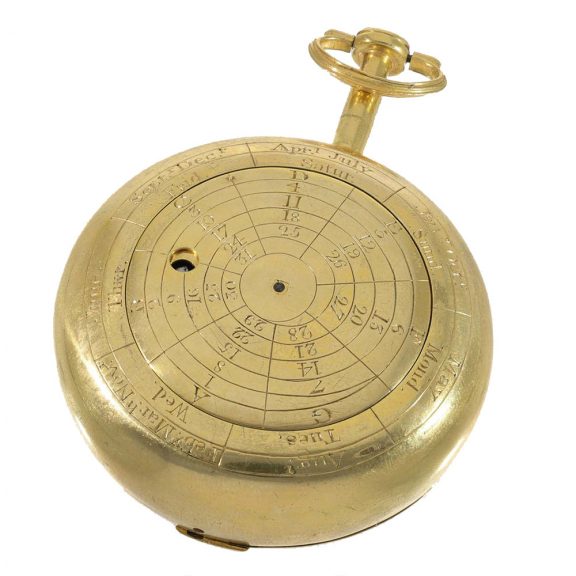
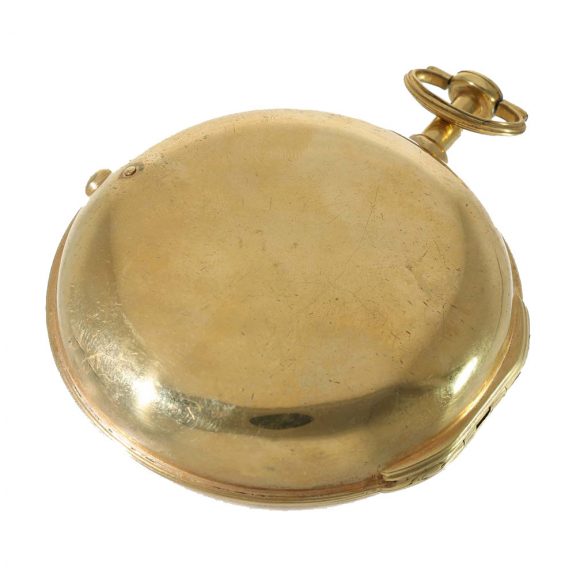
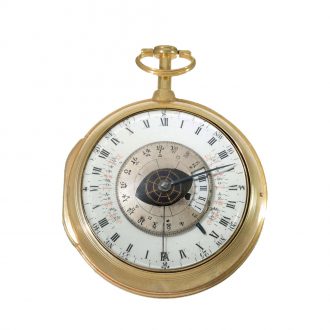
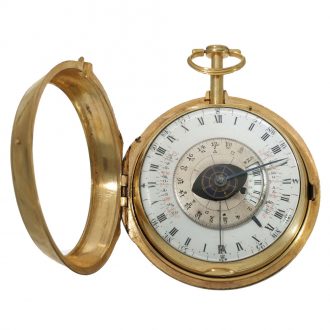
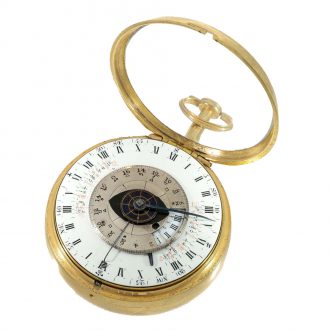
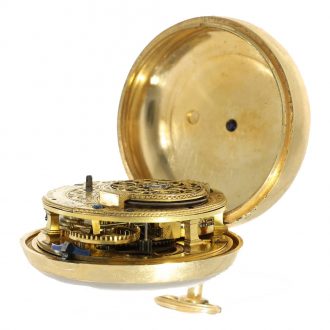
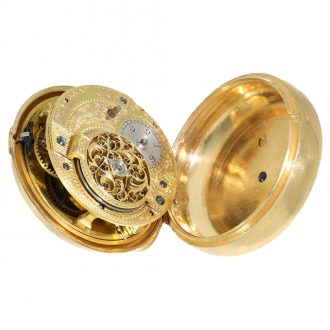
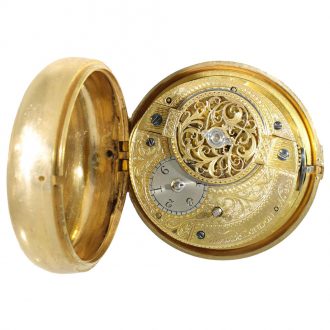
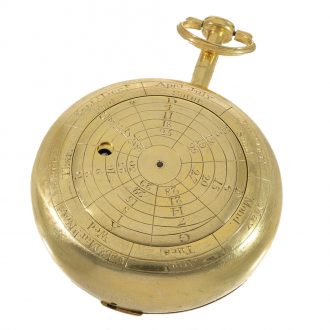
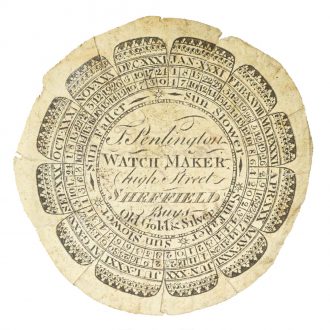
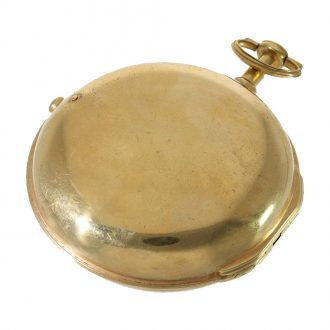
An astronomical pocket watch with tide indicator made by James Edwards in London, England, circa 1790. This watch features very fine gilt pair cases, of which the outer is plain and the back of the inner case is engraved with a manual perpetual calendar. It further features an extremely rare Ferguson dial. The numbered movement is fitted with a verge escapement, an exceptionally large balance and a diamond endstone.
The movement is signed.
–
Diameter: 65 mm
–
Weight: 218 g
–
Signed: Edwards London
–
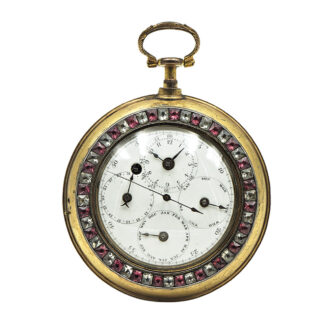
The watch presented here is one of the rarest astronomical pocket watches, comparable to the famous pieces by George Margetts. It features a James Ferguson dial, which is otherwise only found in clocks.
–
Margetts
George Margetts, born on June 17th, 1748, in (Old) Woodstock, Oxfordshire, and died somewhere between 1804 and 1808, was in the fullest sense a mathematical practitioner, describing himself as ‘a maker of astronomical clocks and watches with other apparatus used in the Science of Astronomy and the Art of Navigation’. He made fine astronomical watches for which he is best known today.
–
Ferguson
James Ferguson, born on April 25th, 1710, and died on November 17th, 1776, was a Scottish astronomer and mechanic. He is known as the inventor and improver of astronomical and other scientific apparatus, as a striking instance of self education and as an itinerant lecturer. Ferguson was a close friend of John Ellicott and lived with his friend, the famous watchmaker Thomas Mudge. He worked to create an astronomical clock that was as accurate as possible and that indicated ebb and flow in the harbour.
–
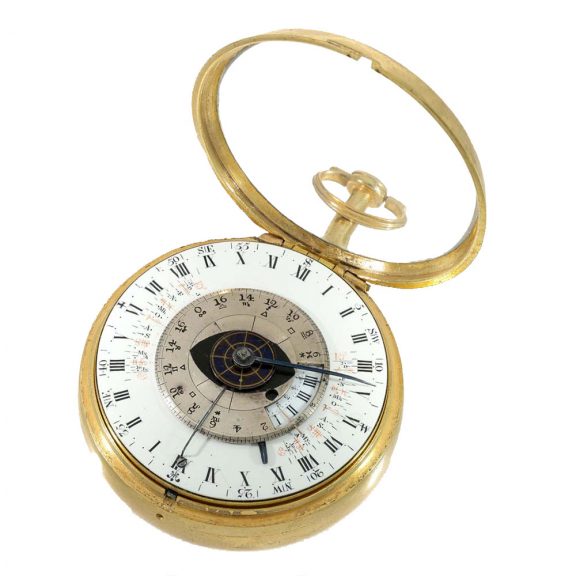
The complex dial displays the following:
Solar time indicated by the hour hand and a Roman 24 hour chapter ring, while the minute hand rotates normally per hour.
The central silver disc shows the following lunar indications through a window: moon age, the time of the moon’s southward pull and the time of high tide at London Bridge. For this purpose, a fixed wire was attached to the 6 o’clock position with an elliptical mark at the center of rotation.
The central blued steel disc illustrates the earth as seen from the North Pole and shows the latitude and longitude position of London. The phases of the moon are indicated along with the age of the moon through a small aperture in the edge of the disc. This is indicated by the retrograde motion of the enamel dial under the square aperture in the central disc and is achieved with the help of a differential gear.
The moon’s positions in relation to the sun are shown as miniatures and are indicated by 2 x 60 degrees next to the edge of the disc on the main dial along with the central aspects. These are – contrary to 180˚ sextile, trine and quartile.
There are markings on either side of the solar disc showing the sunrise and sunset times over the course of the year, together with the astrological signs for each month. This is read against the hour hand.
On the outer edge of the dial are the compass points north, south, east and west. South is at the top at 12 because the moon points south when it is at its highest point, which is exactly what you see when you observe the moon. By combining this with the perpetual calendar engraved on the inner case, which tells you the date, this watch allows you to directly read certain astronomical data.
–
In addition to the watches by George Margetts, which have already been mentioned and which repeatedly achieve sensational prices at auctions, this watch is probably one of the most complicated and valuable astronomical pocket watches. It is in a very beautiful condition and in working order. It comes from one of the most important collections of early pocket watches and comes with extensive, very detailed documentation that explains how the watch works.
Signed: Edwards London
Share this page: