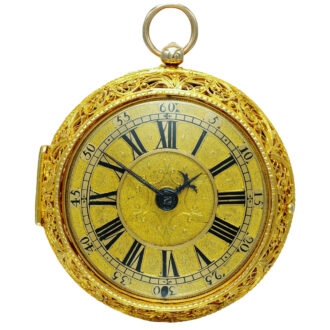
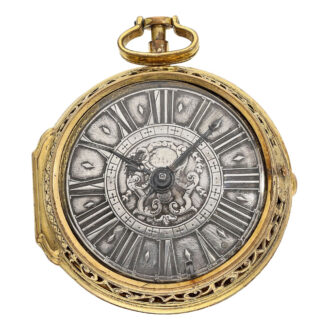
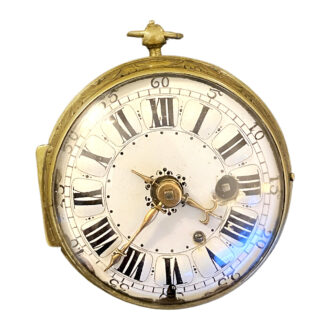
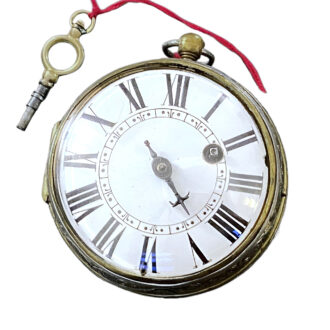
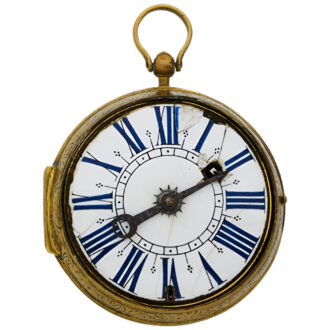
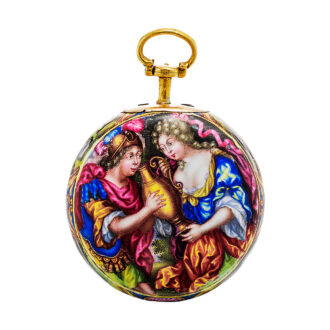
English gold and enamel double cased verge watch Circa 1685
- Kenmerk
- AA0239
- Diameter
- 40 mm
- Estimate
- € 30.000 - 60.000
- Price sold
- € 35.300
Gold and enamel pocket watch by Joseph Norris
–
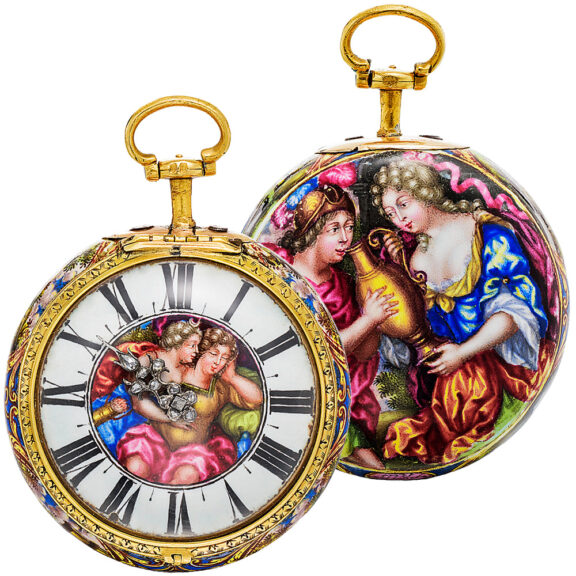
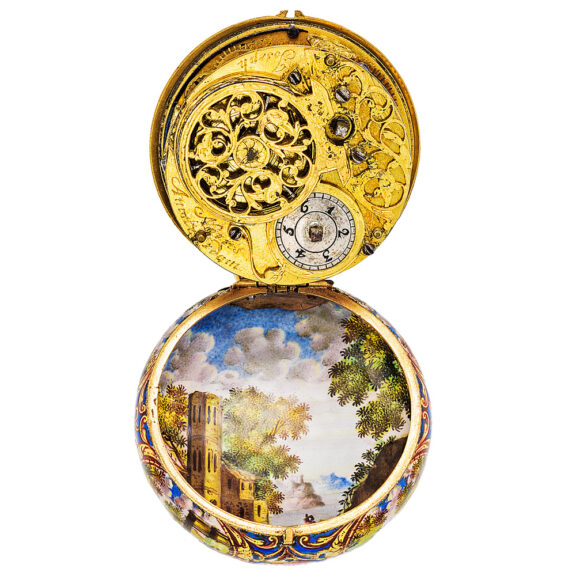
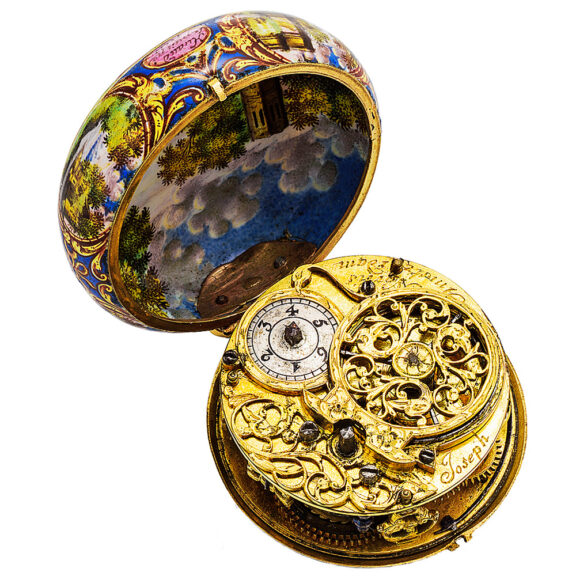
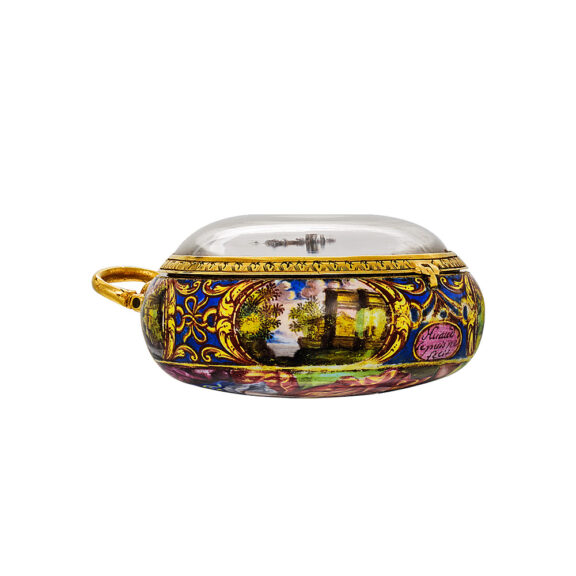
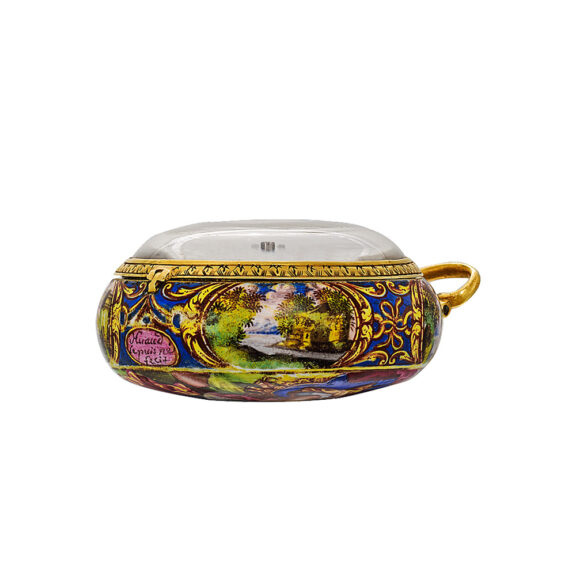
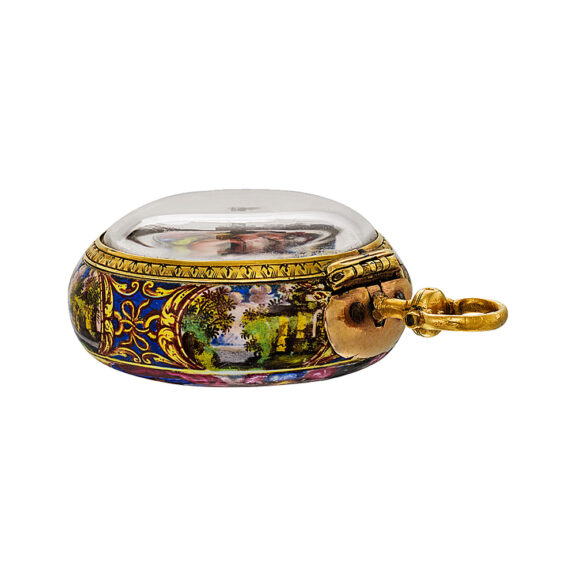
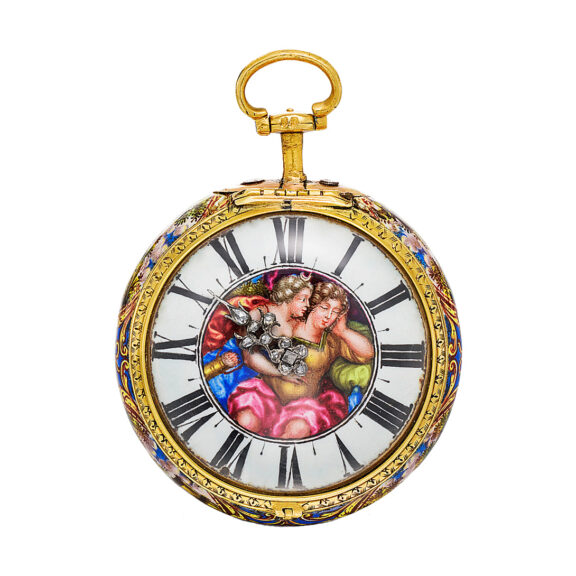
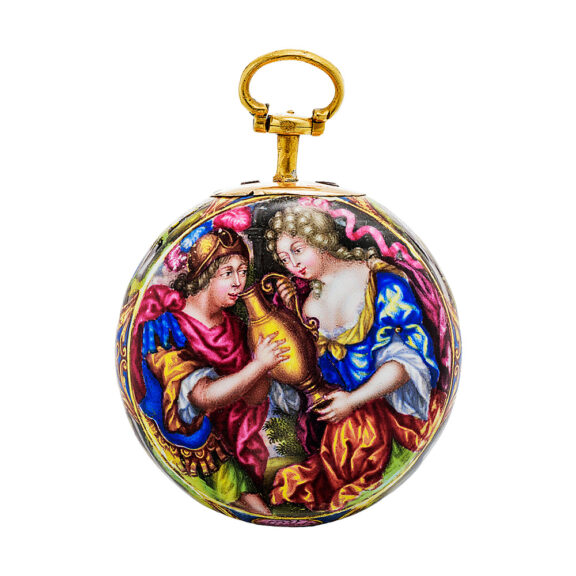
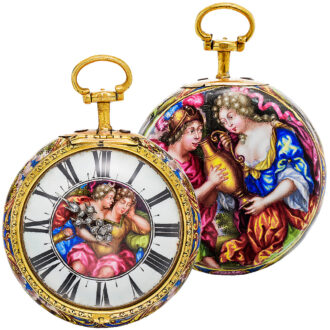
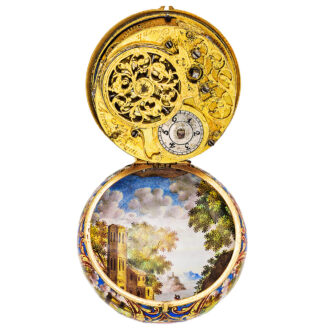
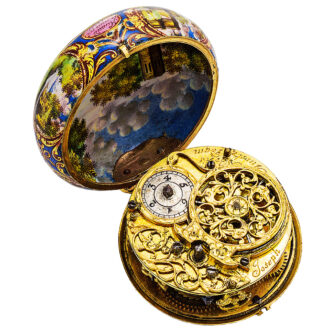
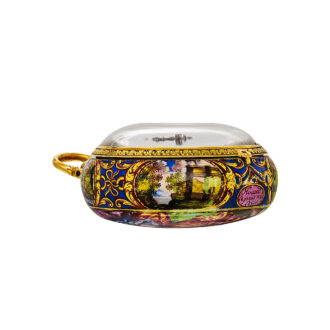
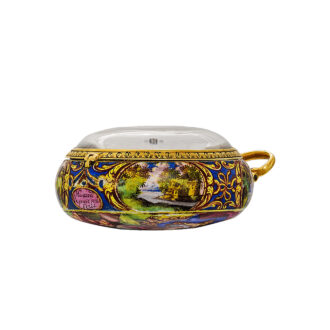
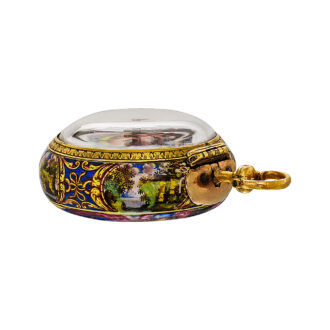
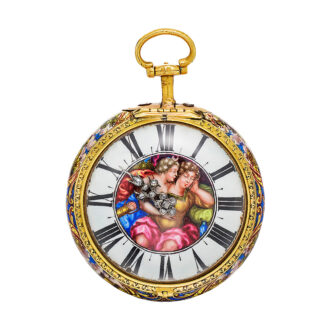
An English 21 Carat yellow gold and enamel pair cased single handed pocket watch with an early hairspring, circa 1685. Bassine shaped case, the back painted on enamel showing a young woman who makes a young warrior drink using an ewer so that he can refresh himself, …unless it is wine in order to inebriate him, the enamel is signed Huaud le puis né fecit, the inside of the reverse with a scene that can be inspired by an engraving of Gabriel Perelle. White enamel dial with Roman hours, a polychrome enamel scene in the centre showing Diana, the Roman goddess of the hunt, moon and nature, who, after going down to earth, looks at Acteon, a young sleeping hunter, kisses him and falls in love with him (after Ovid’s Metamorphoses) unless it is the story of Diana and Endymion the shepherd, a single diamond set silver hand. Gilded brass full plate movement, fusee and chain, verge escapement, steel monometallic balance, blued steel flat hairspring, pierced and engraved gilded continental cock.
Case and movement signed.
–
Diameter: 39.5 mm
–
Signed: Joseph Norris
–
Joseph (or Josephus) Norris, 1649-1727, was born in Abington, England. He was apprenticed to his older brother Edward Norris, towards 1668, he leaves for Amsterdam with Ahasuerus Fromanteel (1607-1693). He becomes the best English watchmaker in Holland. He returned in 1692 to his hometown, where he died in 1727. He was part of the Anabaptist sect and was a member of Lothbury’s watchmaking group in London, which appears to have been anti royalist. Norris became known for producing a small movement of only 13.7 mm, proving that he could be counted amongst a very small number of watchmakers including Johann Ulrich Schmidt of Augsburg, whose mechanical miniaturisation skills were unequalled at the time.
–
This is one of the earliest watch cases painted by Jean-Pierre Huaud and one of the few surviving works in such exceptional condition. If the movement was signed in Amsterdam, it was made in Geneva. There are several indications of this. First, the extreme sophistication of the movement, for which Genevan watchmakers were famous. Secondly, the movement features elements common to other Genevan watches, very unusual pillars and a typical manner of finishing the wheels and the fusee, as well as the characteristic shape of the cock. It was a common practice for watchmakers to order complete watches from the Genevan masters and to be signed by the one who was going to market them.
–
Les Frères Huaut (or Huaud). The best known and most prolific family of enamel painters of their day. They descended from a family of goldsmiths in Châtellerault, France. The father, Pierre I (1612-1680), was a protestant who emigrated to Geneva, where he became an habitant in 1630. He finished his apprenticeship as a goldsmith with Laurent Légaré in 1634 and soon became a master goldsmith. In 1661, he served an apprenticeship in enamel painting with Jean André (1646-1717). Three of his 11 children became enamel painters as well. Pierre II (1647-c.1698) was apprenticed to his father. In 1685-1686 he went to Berlin to work in the service of the Brandenburg Elector. After a brief stay there, he returned to Geneva in 1686 and went back to Germany at the end of 1689. In 1691 he was named painter-miniaturist to Frederick I of Prussia (1657-1713), who was (as Frederick III) Elector of Brandenburg (1688-1713), first King of Prussia (1701-1713) and from 1707, prince of the Principality of Neuchâtel, Switzerland. Jean-Pierre Huaud (1655-1723) and his brother Ami (1657-1724) became partners from 1682 to 1688. As was their older brother, they were also appointed painters to the Court of the Brandenburg Elector in 1686 and went to Berlin, where they lived and worked until 1700, at which point they returned to Geneva. Although much of their work was done in partnership, they often worked alone. Their work was sought after by watchmakers from all over Europe. Some examples of watches signed by the Huauds are kept today in the Patek Philippe Museum and the Musée de l’horlogerie et de l’émaillerie in Geneva and other museum around the world, as the Musée international de l’horlogerie in La Chaux-de-Fonds, Le Louvre in Paris, the British Museum in London, etc.
–
Gabriel Perelle was born in 1604 in Vernon, Eure and died in 1677 in Paris. He was a French draftsman and printmaker of topographic views and landscapes. Perelle specialized in classical landscapes. He founded an etching workshop, and his sons Nicolas and Adam assisted him. Perelle produced several hundred engravings both from his own drawings and from those of other artists. These engravings in the etching and intaglio (a technique in which the image is incised into a surface and the incised line or sunken area holds the ink) mainly depict landscapes of the Paris region, including views of castles, where he introduced variety by adding ruins and various accessories.
Signed: Joseph Norris
Share this page: