English gold and enamel half quarter repeater Circa 1756
- Kenmerk
- SA0332
- Diameter
- 50 mm
- Estimate
- € 15.000 - 30.000
- Price sold
- -
Half quarter repeating cylinder watch with polychrome enamel scene
–
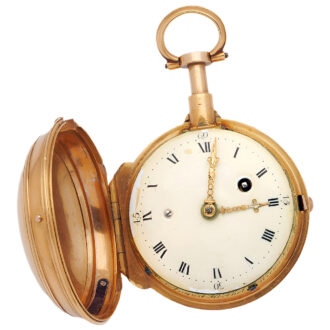
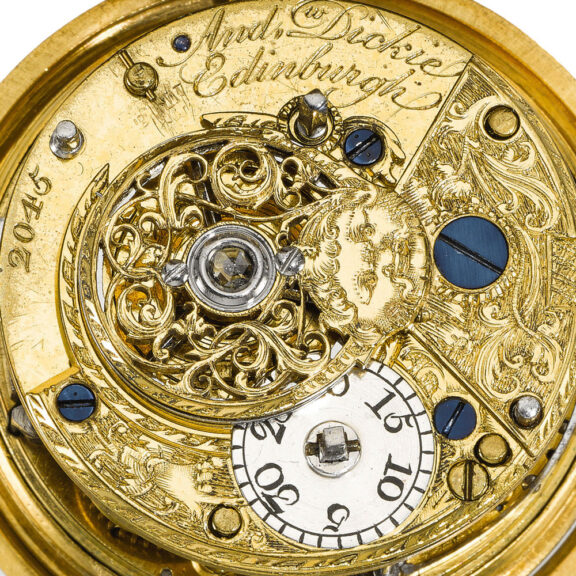
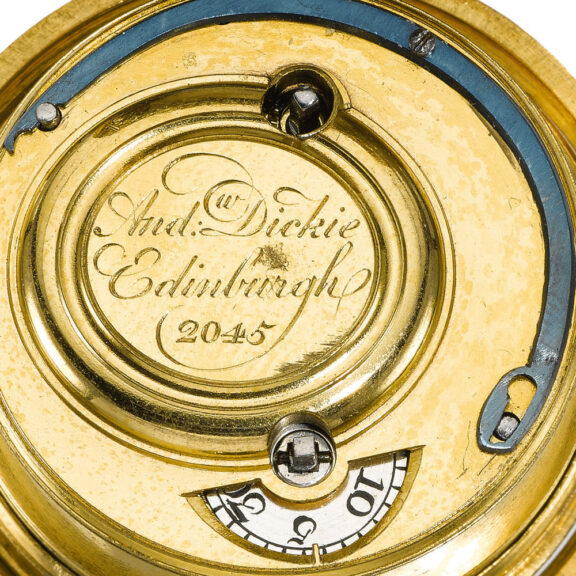
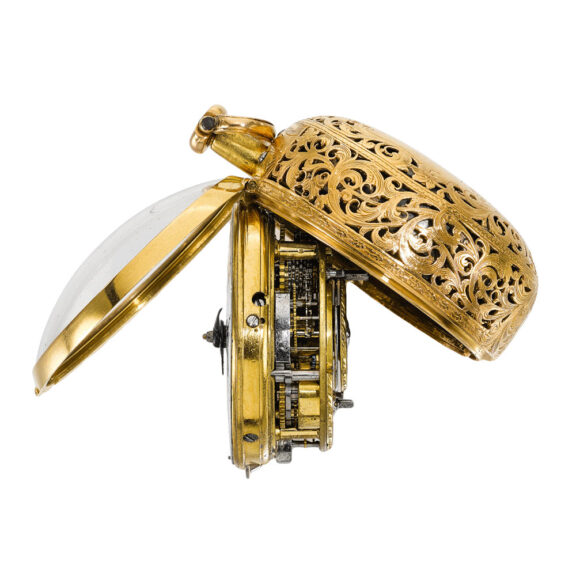
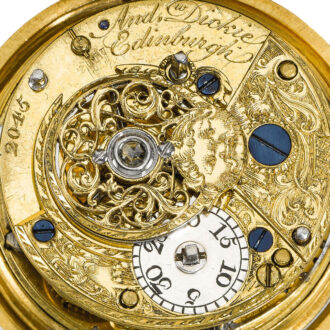
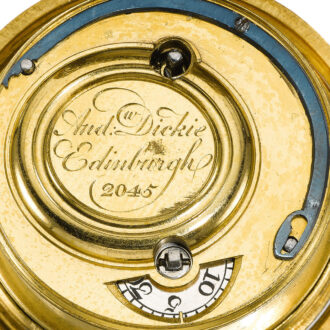
An English rare gold half quarter repeating cylinder watch with a magnificent associated outer case with polychrome enamel scene attributed to George Michael Moser, circa 1756. Gilded full plate movement, cylinder escapement, decoratively pierced and engraved masked balance cock, diamond endstone, fusee and chain, cylindrical pillars, two polished steel hammers repeating on a bell to the inside back, gilt metal dust cap, movement and dust cap signed Andw. Dickie, Edinburgh.
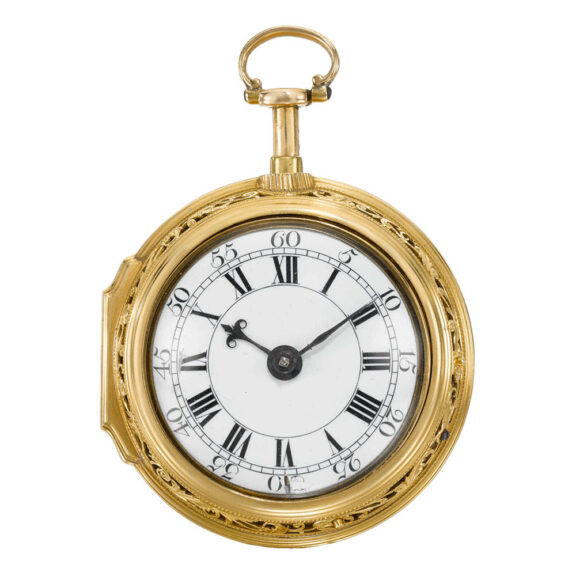
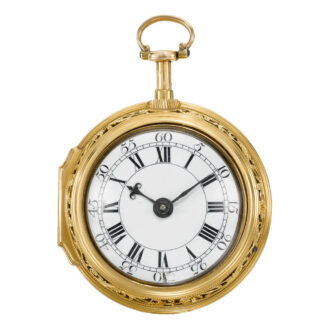
White enamel dial, Roman numerals, outer Arabic minute ring, blued steel beetle and poker hands.
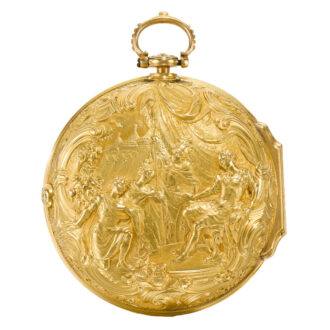
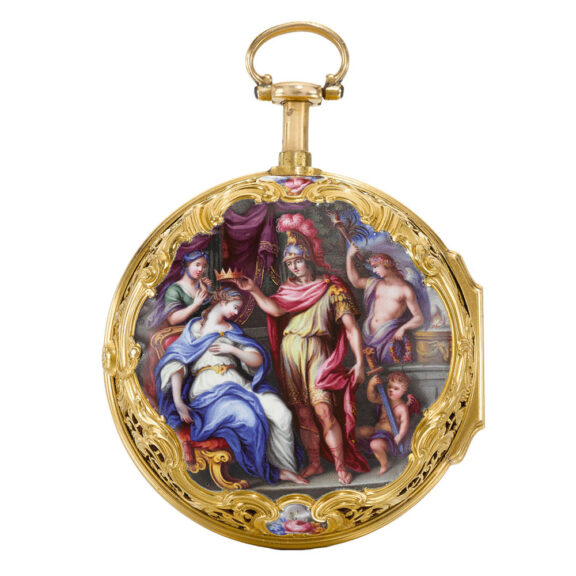
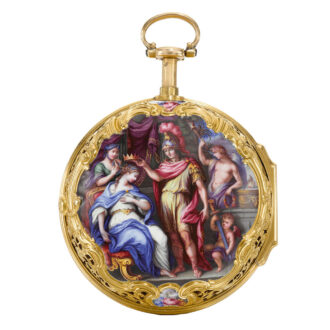
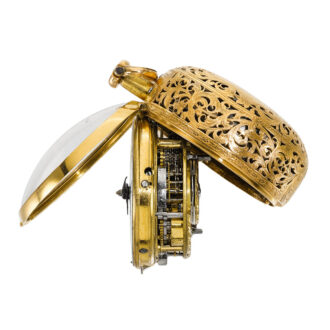
Gold inner case, the back with winding aperture, an engraved lily flower to the centre, the band pierced for sound emission and engraved with scrolling foliage, a grotesque mask to the base, a pastoral scene beneath the pendant, the associated gold outer case with polychrome enamel painted scene depicting Alexander the Great Crowning Roxana, surrounded by an embossed cartouche, the band and bezel pierced for sound emission and engraved with scrolling foliage, a snake wound around the push piece.
–
Diameter: 50 mm
–
Signed: Andw. Dickie Edinburgh
–
This rare watch has spent many years in a variety of important horological collections, including those of Atkinson, Nyburg and Burton. Although associated, the magnificent outer case is in wonderful condition and, while the pulse piece is located on the opposite side of the bezel, otherwise fits seamlessly to, and dates contemporaneously with the inner case. Whilst unsigned, the outer case features a number of stylistic similarities to the work of G. M. Moser. The enamel scene is one of two versions that Moser employed and its composition is very similar to a repoussé signed by Moser, which was sold at Sotheby’s London. That watch, with movement signed by Ellicott, is also illustrated in Richard Edgcumbe’s book, The Art of the Gold Chaser. Stylistically, the painting can also be attributed to Moser and it is interesting to note the snake winds around the push-piece, a feature that Moser was often fond of incorporating. The enamel scene depicts the Crowning of Roxana. Alexander the Great (356-323 B.C.) married Roxana, the daughter of a chieftain of Sogdiana, a conquered region of Asia. In the scene, Alexander is shown in a cloak and helmet, holding the crown above a seated Roxana. To the right in the background, is the figure of Hymenaeus, the god of marriage, who holds a torch and a nuptial crown.
George Michael Moser, born in January 1706 in Switzerland, was one of the most prominent chasers and enamellers of his day. He worked for his father, also a chaser, until he moved to London in 1726, where he worked for a coppersmith and then a cabinet maker. His skill was such that he became a drawing master to King George III and designed the great seal for him. Throughout his career, Moser worked mainly with Thomas Mudge, George Graham, William Webster, and John Ellicott. He specialized in figural renderings and often used classical origines for his scenes. He was widely known and respected in the artistic field, was one of the original founders of the Royal Academy along with Sir Joshua Reynolds, and was elected Keeper of the Academy by King George III in 1768. Moser died in January of 1783, and was honoured by Sir Joshua Reynolds in his obituary as “the father of the present race of artists” see, Edgcumbe, The Art of the Gold Chaser.
The movement, signed by Andrew Dickie, is of high quality. Andrew Dickie of Edinburgh did not generally number his movements, however, Andrew Dickie of London (who may have been the former’s son) did and the number, 2045, fits with the latter’s known sequence; although of course, this may be a coincidence, it is possible that the watch was supplied by Dickie of London.
Signed: Andw. Dickie Edinburgh
Share this page: