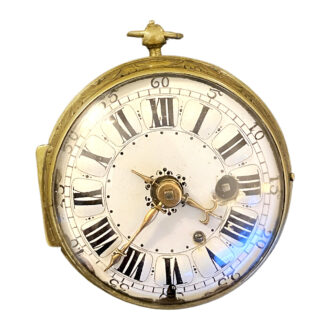
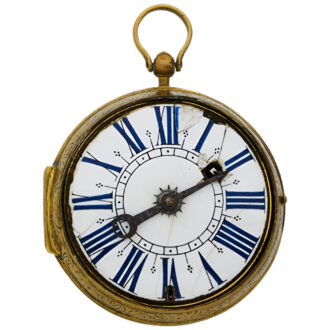
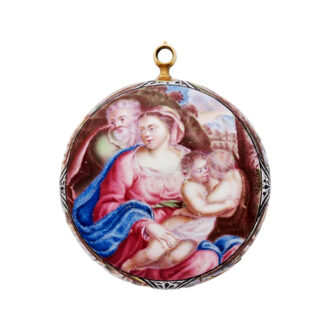
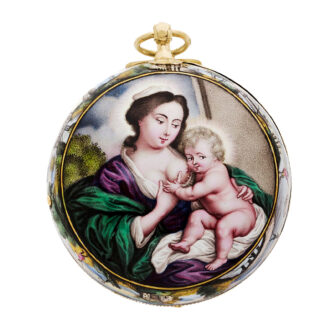
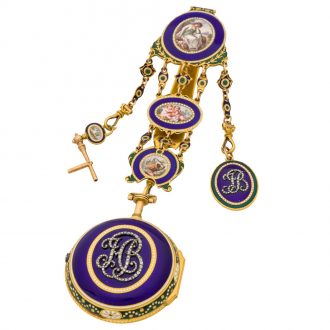
English gold miniature enamel verge pocket watch Circa 1630
- Kenmerk
- FA0247
- Diameter
- 29 mm
- Estimate
- € 80.000 - 160.000
- Price sold
- € 123.500
Outstanding single hand verge pocket watch by William Clay
–
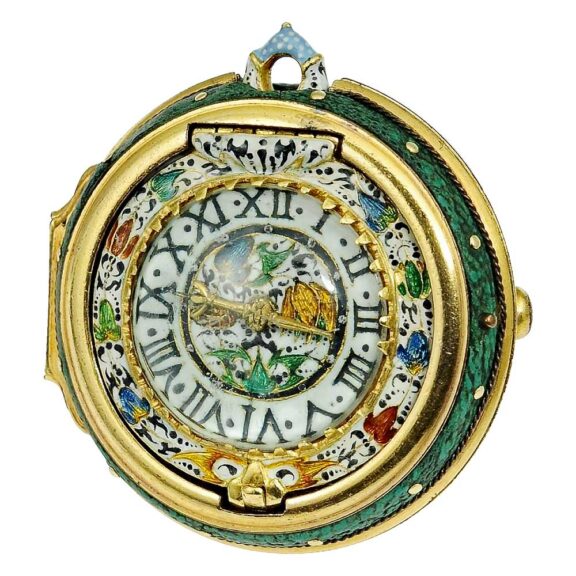
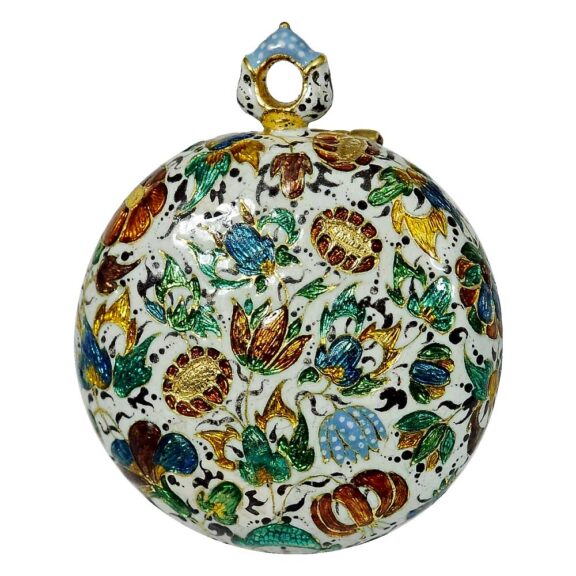
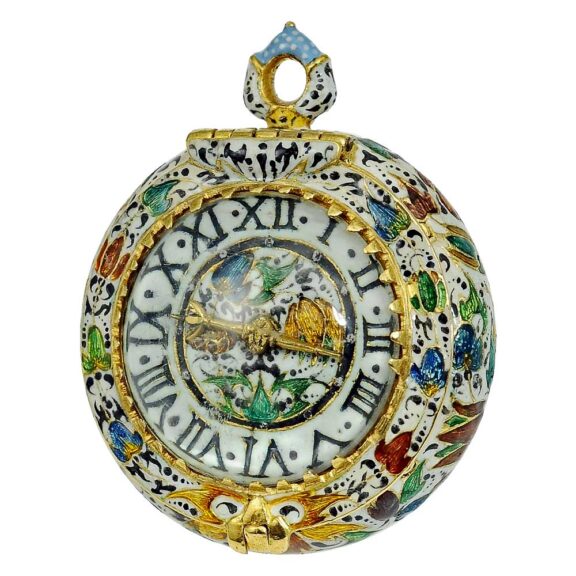
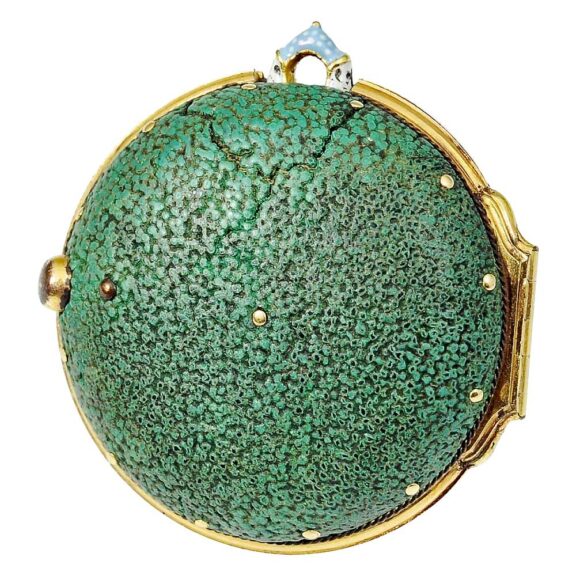
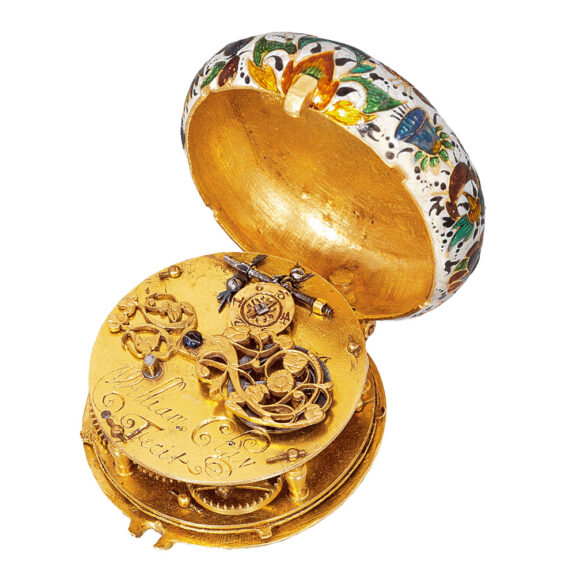
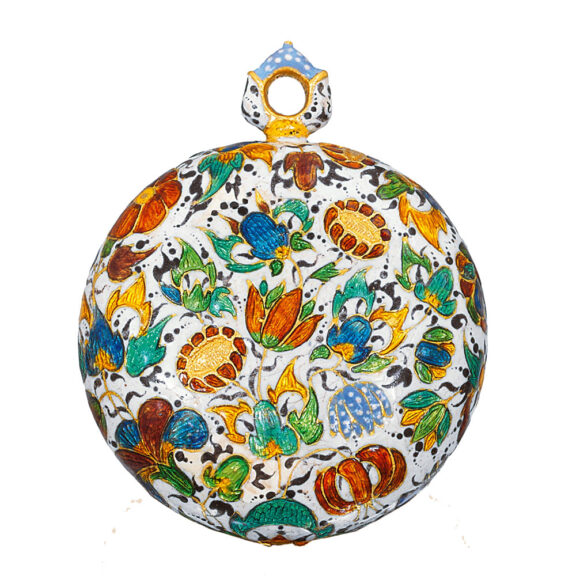
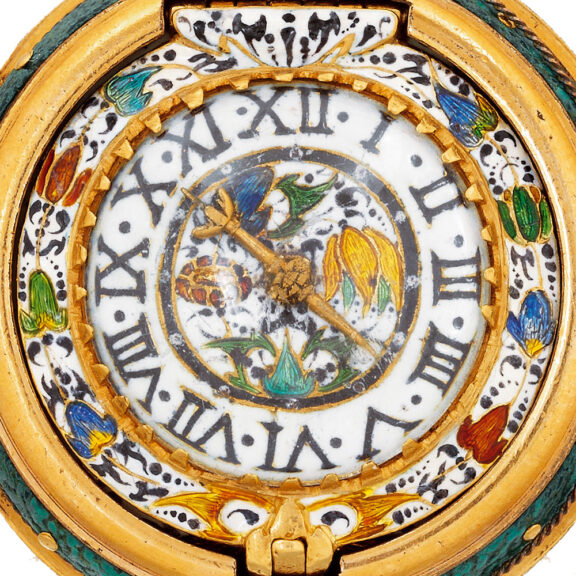
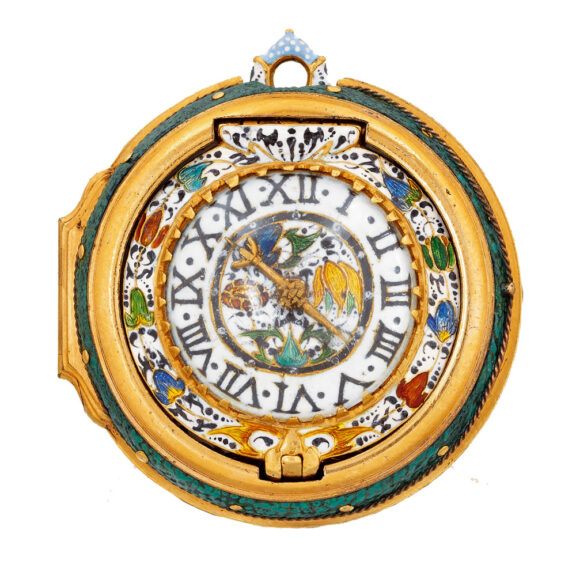
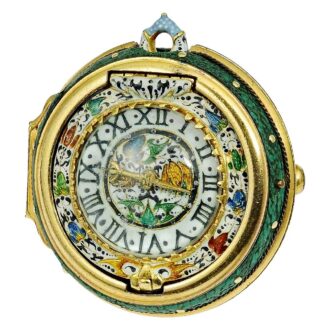
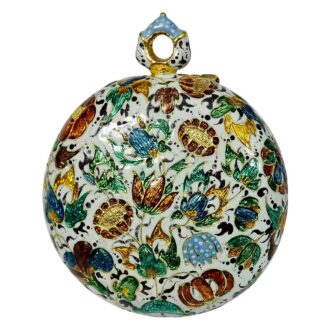
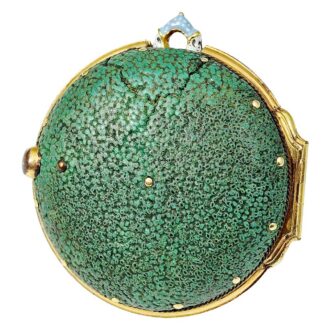
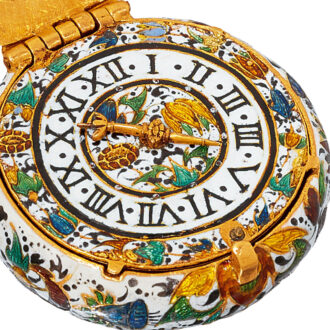
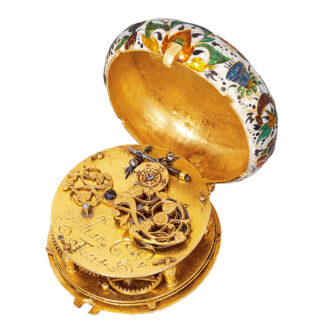
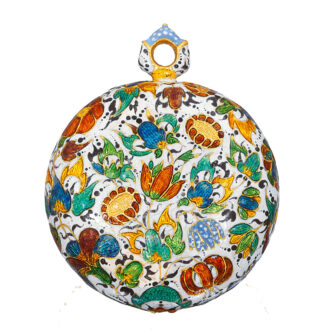
An English outstanding single hand gold and enamel miniature verge pocket watch, circa 1630, with flower decoration created in Blois and very likely based on the illustrations in the “Florilegium” by Emanuel Sweerts; with shagreen leather outer case dating from the 18th century.
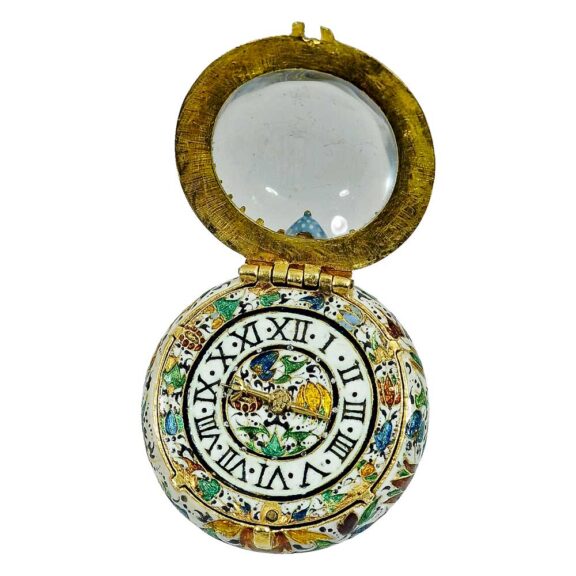
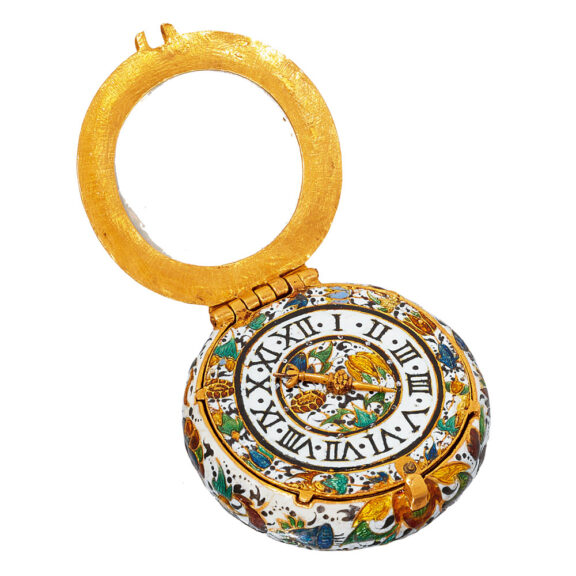
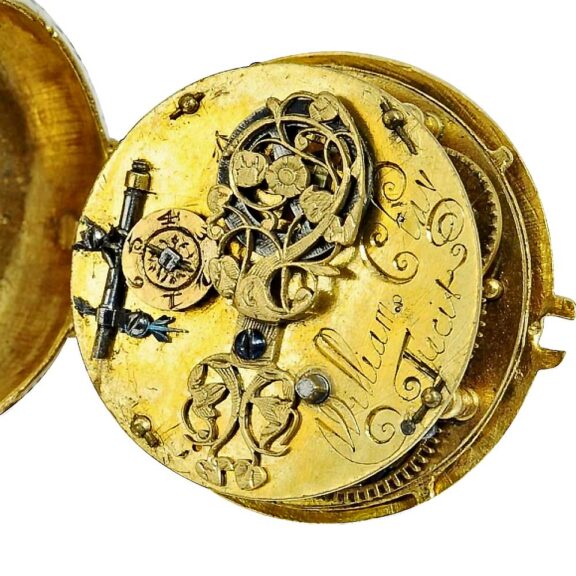
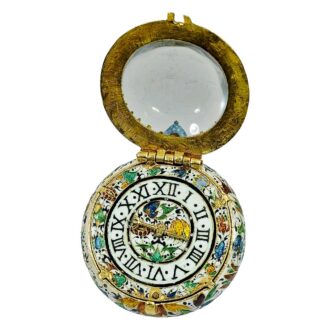
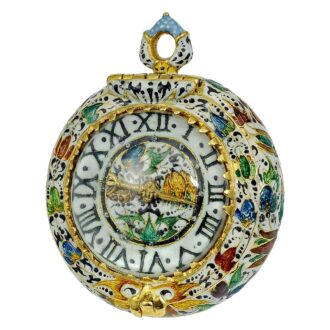
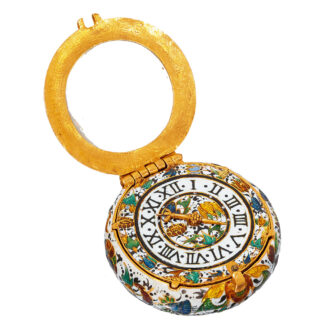
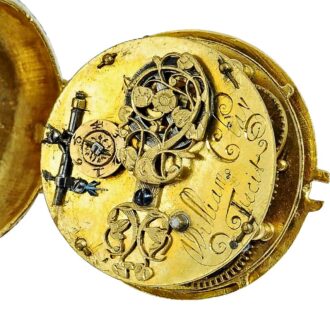
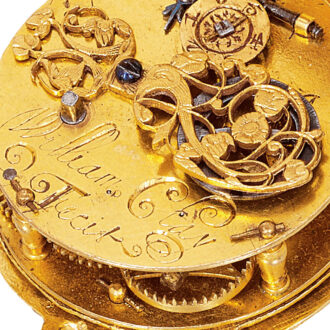
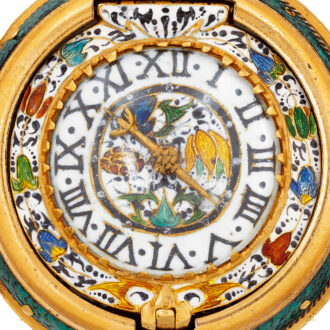
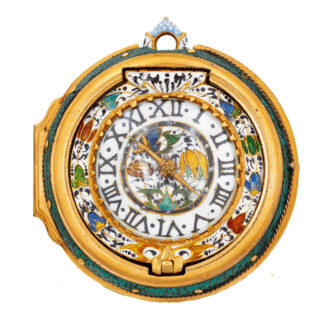
22 carat gold case, opaque white and translucent polychrome enamel. Gold and white enamel dial with polychrome flowers in the centre. Full plate movement, gut/fusee, applied blued pierced click work, verge escapement, plain two-arm steel balance without balance spring.
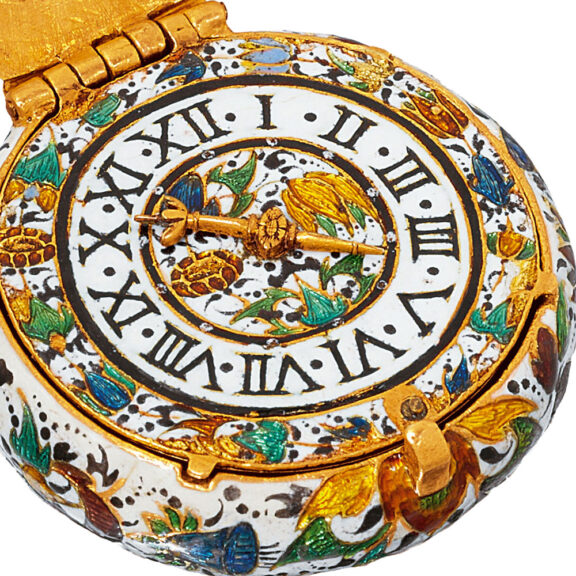
This fine and rare treasure is allover enamelled in opaque white and ornamented with colourful, translucent champlevé flowers. Some tiny black cosse-de-pois tendrils sit between the tulips and anemones. The ornamentation is repeated in the centre of the dial and around the edge. A white chapter ring with black Roman hours indicates the time. The motif was most likely inspired by Emanuel Sweerts’ “Florilegium”. Signed on the backplate.
–
Diameter: 29 mm
–
Weight: 29 g
–
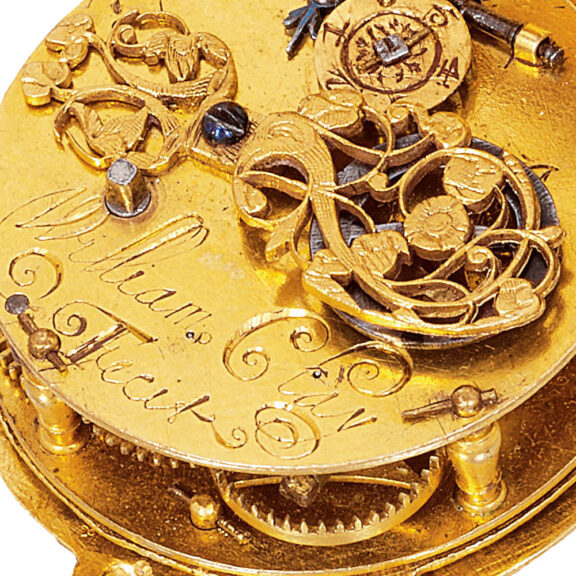
Signed: William Clay Fecit London
–
The movement is signed by English maker William Clay. This case was imported from France and then fitted with an English movement, a practice that applied to most enamel watches in the 17th century. Unlike with gold and silver timepieces, it was customary at the time to create these cases first and then have the movement fitted by a watchmaker.
The translucent enamel colours suggest a French origin. It is likely that the case either came from Blois or was produced somewhere near there – in the early 17th century Blois was the birthplace as well as the hub of miniature enamel painting and there were hardly any artists outside France who had the skills for it. An unusually extensive range of translucent colours was used to create the most realistic and detailed Champlevé flowers and leaves. Only one single flower has been painted in an opaque light-blue colour, which is also repeated on the pendant.
–
More recent records on William Clay state that he was active as a watchmaker in King’s Street in London around 1646 and that he died in 1662. He was never a formal member of the Clockmakers’ Company, which makes it difficult to know much about him and his work. There is a high quality lantern clock and also a timepiece that was presented to a Colonel Bagley by Cromwell after the siege of Clonmel.
–
Emanuel Sweerts’ “Florilegium”
Sweerts dealt in bulbs and rare plants and regularly traveled to the fair in Frankfurt with his catalogue to offer flowers and rare plants he grew in his large garden in Amsterdam. He used his catalogue as a guideline for his “Florilegium amplissimum et selectissimum (1612)”. Sweerts’ work shows 330 bulbs in the first and 243 flowering plants in the second part. The “Florilegium” is filled with etchings and was very popular with 17th century artists who used it as inspiration for their work. Many still life scenes dating from this time show a growing appreciation and popularity of flowers.
–
Traditionally by family descent from the contemporary Bishop of Hereford. There can be no doubt that the uniquely decorated case of this watch is a product of the Blois school of enameling. Most likely it was actually made in Blois, since there is little evidence that trained craftsmen set up in business outside France much before 1650, and anyway the techniques were a closely guarded secret. Felibien des Avaux, writing in 1676 ascribes the technique of painting in enamel on enamel to Jean Toutin, a goldsmith from Chateaudun, with a date of 1632. Contemporary records would indicate an earlier date, probably the end of the 1620s. What makes this case such an interesting survival is the fact that it appears to bridge the gap between the earlier extant techniques of simple matt and translucent enameling which can be traced back to the 16th Century, and the fully fledged painting in enamels that characterized the Blois school in the mid-17th Century. The palette of translucent colors is extensive for the period, with six different colors employed to decorate the champlevé flowers and foliage that cover the case and dial. These are laid over an engraved or flinqué gold ground. Four opaque enamels complete the palette, with the white background being further decorated with motifs painted in black. A single flower (fritillary) is picked out in white and powder blue, with the same color being used on the pendant.
Painting on enamel in enamel, for which the Blois school is most famed, involved the construction of an exceptionally thin gold framework which was enameled on all surfaces, the inside or counter enamel being an integral part of the structure. This case was made using a different technique. Initially the shell would have been cast or drawn up in considerable thickness, sufficient to support the stresses involved in firing the enamels without distortion. Afterwards, the excess gold would have been recovered by scraping away the interior until only a thin skin remained. Pierre Vilar in his classic work “A History of Gold and Money 1450 ” 1920″, provides an indication of the enormous value of gold at the time. By his calculation, in 1500, if all the gold in Europe were combined into a block, it would have only measured two meters cube. Although watches of this period are rare by any account, it is certain that many would have been scrapped in subsequent years simply on account of their precious metal content.
William Clay Probably working before 1632, and died circa 1662. Never officially elected to the Clockmaker’s Company but was accepted by them. Recorded address ” King’s Street, Westminster ” and took three apprentices, Charles Duffa in 1646, George Fullum in 1649 and Arthur Dove in 1659. Known work includes a superior lantern clock and watches. William Clay is listed in all the leading works covering the period, but since he never became an official member of the nascent Clockmakers Company, opinions as to his exact working dates vary. He was a brother of the Company between 1640 and 1680 and the maker of a watch presented by Cromwell to a certain Colonel Bagley after the siege of Clonmel. Britten makes record of the fact that certain clock and watchmakers (William Clay included) were accepted as members (brothers) of the Clockmakers Company after its establishment in 1631. Usually they were already members of another company, most notably the Blacksmiths. The Early English Clockmakers of Great Britain, confirms that Clay was never officially admitted to the Company, but records that he supported them in their dispute of 1656. It would be logical to assume that membership of any City Company, with its rights and privileges, would be an honour that every craftsman would aspire to. However, there were disadvantages, mainly in the form of financial contributions, known as quarterage, and many attempted to avoid this if reasonable excuse could be found.
Signed: William Clay Fecit London
Share this page: