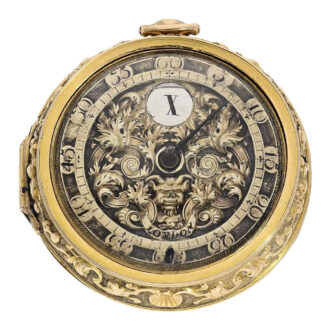
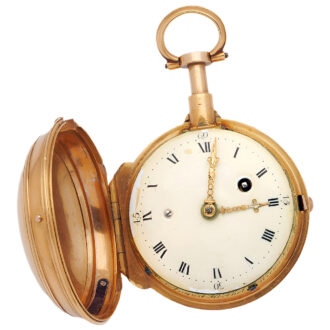
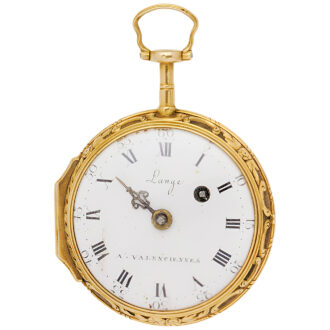
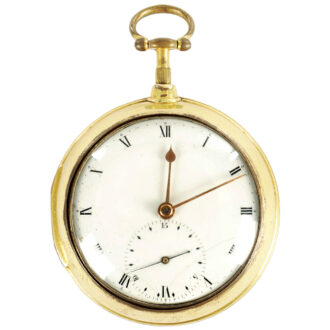
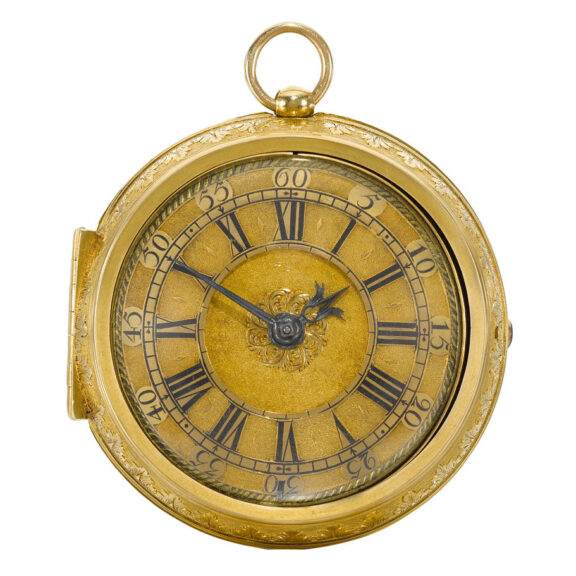
English 20K gold verge with replaced outer case Circa 1690
- Kenmerk
- SA0316
- Diameter
- 50 mm
- Estimate
- € 6.000 - 10.000
- Price sold
- -
Gold verge watch with cotemporary replacement outer case
–
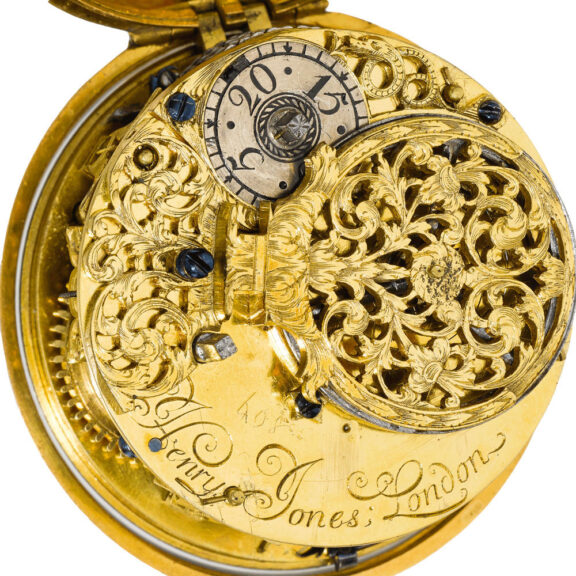
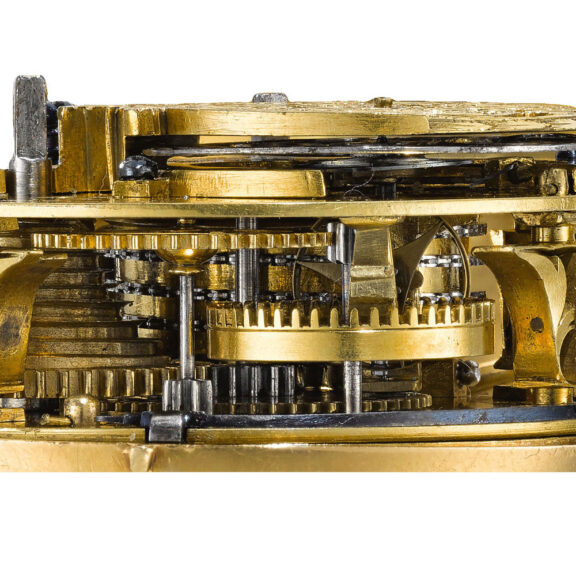
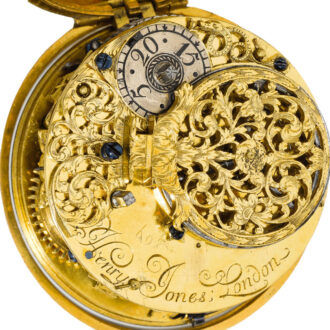
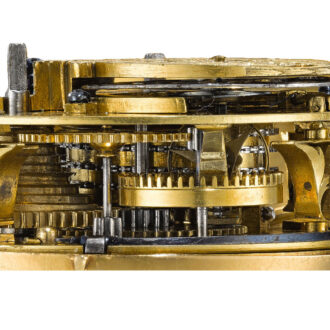
An English fine gold verge watch with contemporary replacement outer case inner case, circa 1690 outer case 1699, gilded full plate movement, verge escapement, decoratively pierced and engraved balance cock, balance with spring, serpent indication to regulator scale, fusee and chain, tulip pillars, signed Henry Jones, London.
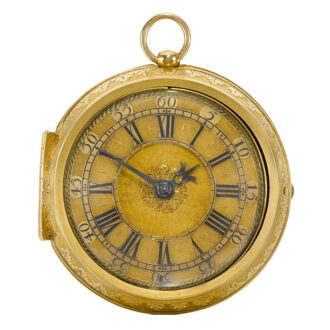
Gold champlevé dial, Roman numerals, inner half-hour divisions, outer Arabic minute ring, central spiral of leaves, blued steel tulip hour hand, and tapered poker minute hand.
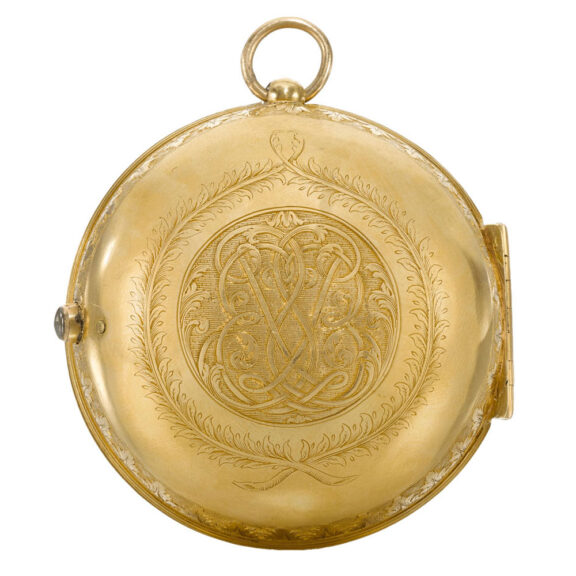
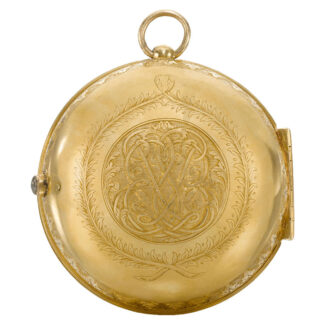
Plain gold inner case, the back with shuttered winding aperture, London hallmarks for 1690 and with maker’s mark ID incuse for James Delander, outer case a contemporary replacement with monogram to the back, bezels with stylized leaf form decoration, hallmarked 1699 and with maker’s mark incuse WI with coronet above for John Wightman.
–
Diameter: 50 mm
–
Signed: Henry Jones London
–
This handsome watch has a wonderful champlevé dial with an attractive spiral of leaves embossed and chased to the center. The blued steel hands are finely executed and the minute hand is relatively unusual with its tapered, straight sides of almost triangular section. Although not uncommon, the coiled serpent used to indicate upon the movement’s regulation disk is a charming feature.
Henry Jones (c.1642-1695) was an outstanding clock and watch maker who flourished during the last quarter of the 17th century. Born in Southampton, Jones moved to London and was briefly apprenticed to Benjamin Hill in 1654, before advantageously transferring to the workshop of Edward East. He obtained his freedom from the Clockmakers’ Company in 1663 and served the company in a variety of capacities, becoming Master in 1691. After completing his apprenticeship, Jones continued to work with East until 1672, when he took premises in the City of London, off Fleet Street, in the area known as The Temple. It is clear that he took a keen interest in the introduction of the balance spring. Henry Jones died in 1695 and was buried at St. Dunstan in the West, Fleet Street, London.
Signed: Henry Jones London
Share this page: