English important ship’s watch of museum quality Circa 1802
- Kenmerk
- AD6317
- Diameter
- 124 mm
- Estimate
- € 200.000 - 350.000
- Price sold
- € 275.000
Important chronometer with 50 hour power reserve
–
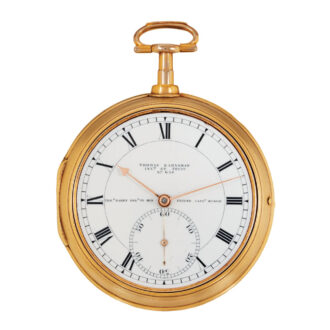
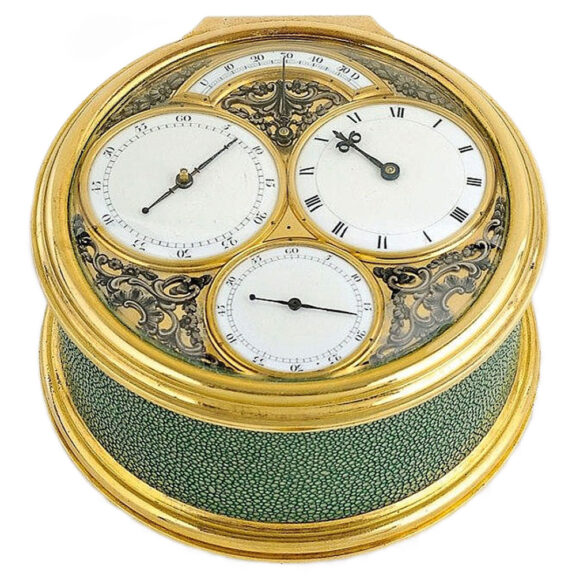
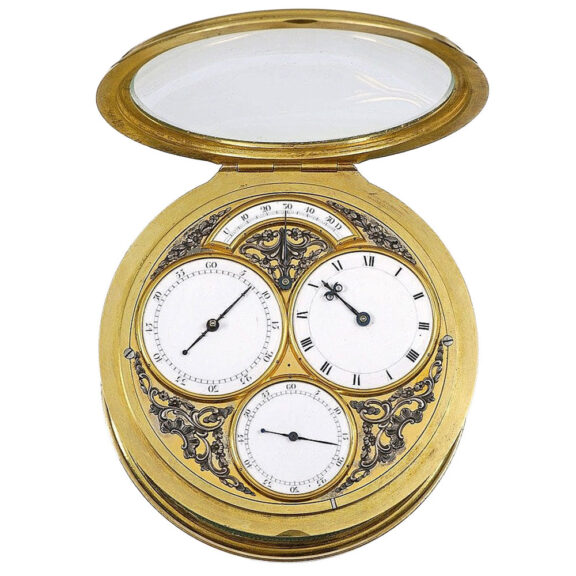
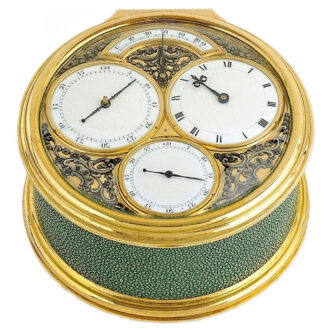
This is an important ship’s chronometer of museum quality, made in London around 1802 by Paul Philip Barraud after the designs of Thomas Mudge. It runs for 50 hours on a full wind.
–
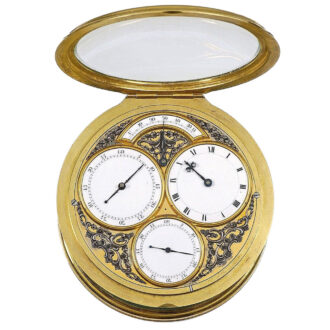
The fire-gilt brass case is covered in green shagreen, a polished ray or shark skin, and has a domed crystal. Separate enamel dials in gilt frames show the hours in Roman numerals and the minutes and seconds in Arabic numerals. A retrograde power reserve indicator, whose hand jumps back to the start when the chronometer is wound, shows the 50 hours of running time. The dial is decorated with very fine applied scrolls of leaves, and the blued steel hands are in the “beetle and poker” style.
–
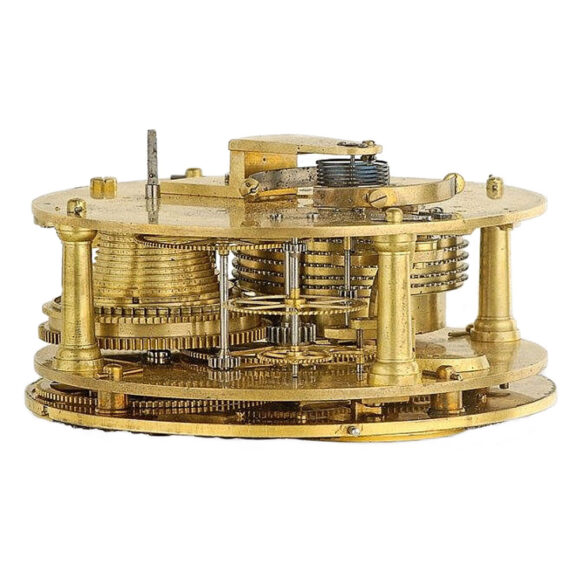
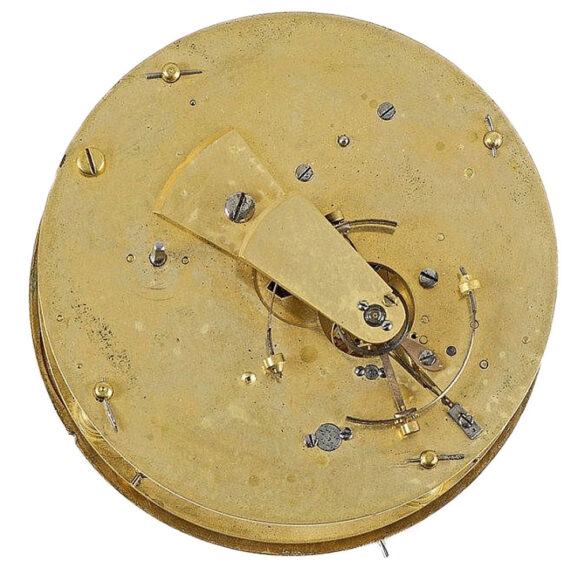
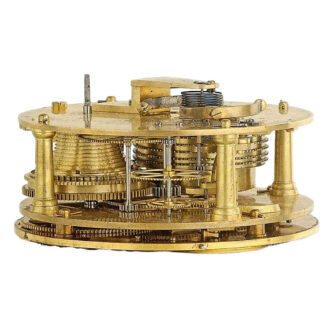
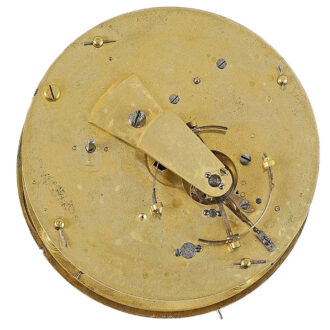
The brass movement has moulded pillars and a chain and fusee to keep the power steady. It has Arnold’s spring detent escapement and a Z-shaped balance with two weights and two screws.
–
Dimensions: 124 x 75 mm
–
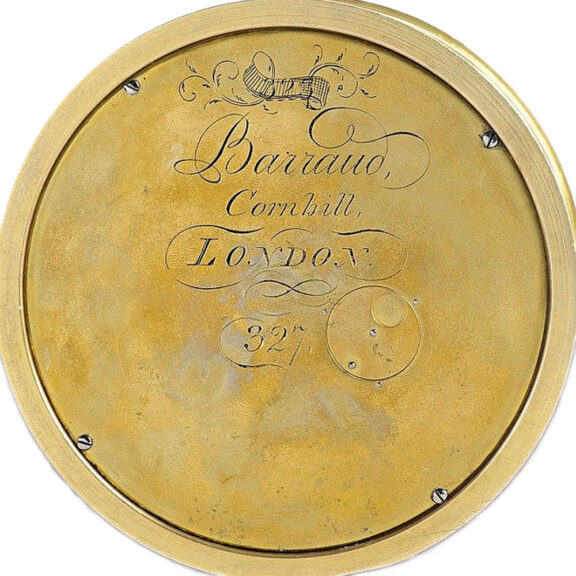
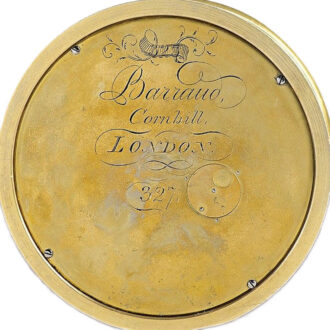
Signed: Paul Philip Barraud, Cornhill, London
–
Paul Philip Barraud 1750-1820
Paul Philip Barraud worked in Cornhill, in the City of London. His parents were Francis Gabriel Barraud and Magdalen Benine Crespin, whose father, Paul Crespin, was a well-known Huguenot silversmith. Barraud joined the Clockmakers’ Company in 1796 and served as its Master from 1810 to 1811. He worked in partnership with George Jamieson and William Howells.
–
He married Marriet Chapman (1753–1798), and they had seven children. Three of his sons also trained as watchmakers.
–
Thomas Mudge 1715-1794
Thomas Mudge built his first timekeeper with a constant-force escapement in 1774. He hoped it would win the £20,000 longitude prize offered by the British Parliament. He later made two more of the same type, but he felt his work was never properly recognised or rewarded, and he died a bitter man.
–
Shortly before his death, his son, Thomas Mudge Jr., went into partnership with William Howells and Robert Pennington. The plan was to make timekeepers to his father’s designs in a workshop. Mudge supervised the work until he died, and the first pieces were signed “Howells and Pennington for Thomas Mudge”.
–
Only eight chronometers were finished in the first 18 months, so in 1796 Mudge Jr. hired more staff to speed things up. Howells disagreed, and the partnership ended. Because the workshop belonged to Howells, Mudge Jr. had to find new premises. There he hired the escapement maker Richard Pendleton to work with Robert Pennington on chronometers made to his father’s designs. Howells, meanwhile, teamed up with Paul Philip Barraud and George Jamison, and they began making simpler versions of Mudge’s original designs.
–
Both teams saw themselves as the true heirs to Mudge’s work, so from number 9 onward there are two separate series. Neither did well. Mudge Jr. had to close his workshop in 1798 after making only 19 more chronometers, bringing the total to 27. Howells’ business made even fewer, only seven, and closed in 1799.
Signed: Paul Philip Barraud, Cornhill, London
Share this page: