English quarter repeater by George Graham Circa 1739
- Kenmerk
- SA0327
- Diameter
- 47 mm
- Estimate
- € 7.500 - 15.000
- Price sold
- -
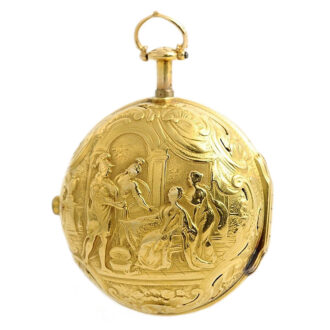
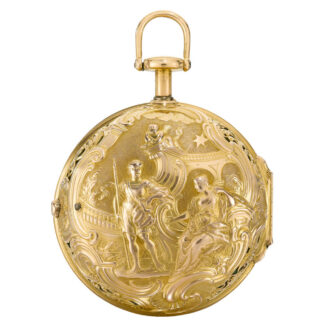
Gold quarter repeating watch with later repousse outer
–
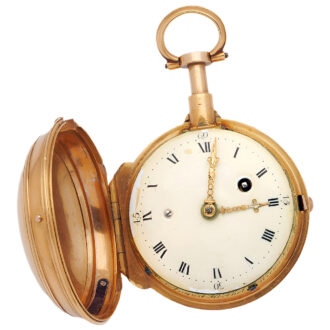
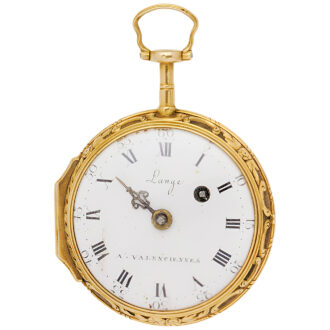
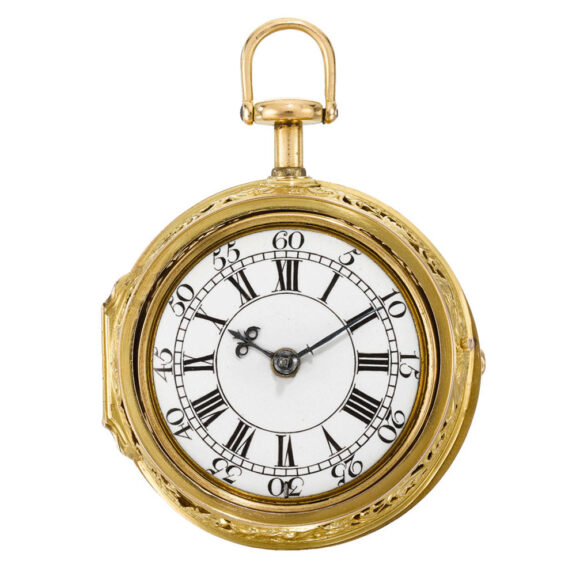
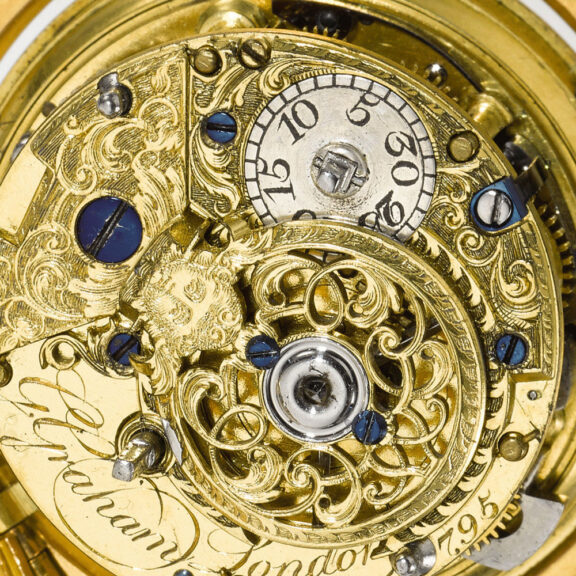
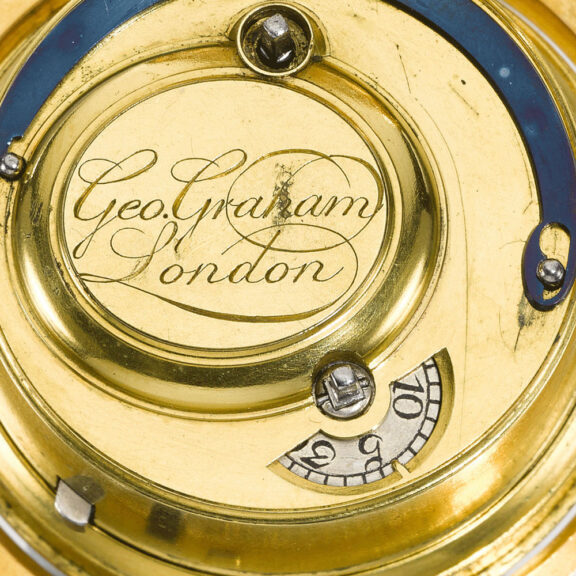
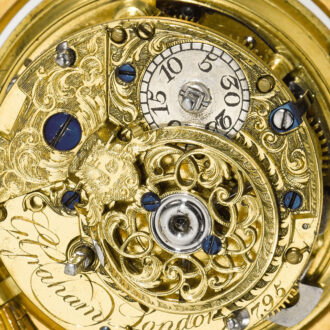
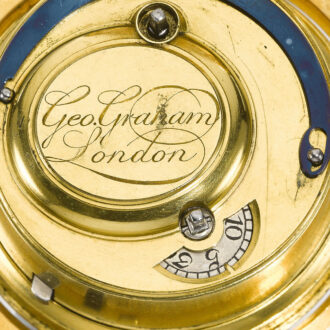
An English fine gold quarter repeating watch with later repousse outer, circa 1739, gilded full plate movement, cylinder escapement, pierced winged masked balance cock engraved with foliage, flat three-arm balance, fusee and chain, cylindrical pillars, two polished steel hammers repeating on a bell to the inside case back, signed G. Graham London.
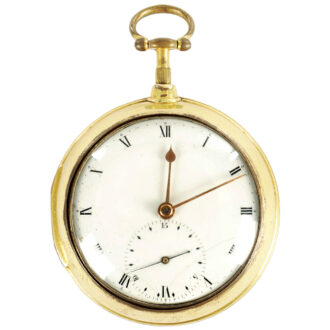
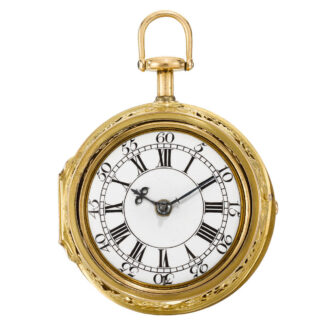
White enamel dial, Roman numerals, outer Arabic minute ring, blued steel beetle and poker hands.
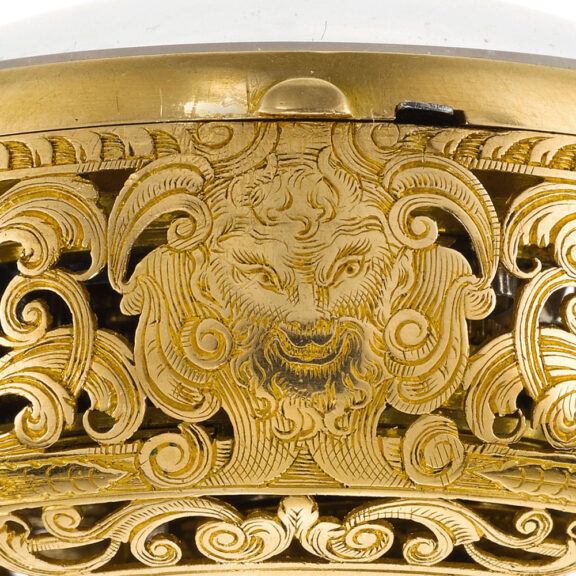
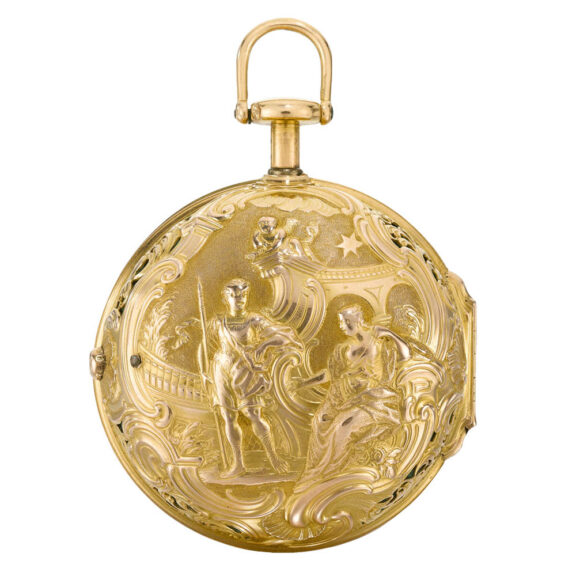
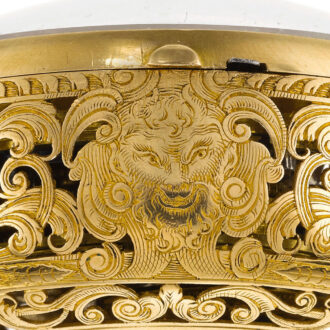
Gold inner case the back with winding aperture and center with an engraved rosette, pierced band for sound emission engraved with scrolling foliage and flowers, a grotesque mask to the base, pulse piece to the bezel between 5 and 6 o’clock, hallmarked 1739 with maker’s mark JW script with an incuse star above for John Ward, later gold outer case with repoussé scene of Aeneas departing from Dido, the bezels pierced and chased with shell and scrollwork between panels of pierced and engraved foliage.
–
Diameter: 47 mm
–
Signed: G. Graham London
–
The outer case is such a perfect fit to the inner that it is more than likely that it was specially made for it. The repoussé scene depicts Aeneas departing from Dido. Cupid is shown above, reading what was fore-ordained by Jupiter, that in her love-torn grief, Dido would kill herself. The repoussé scene on a watch by Isaac Alexander (see: Sotheby’s, Celebration of the English Watch, part II, lot 25) depicts the Death of Dido from an engraving by Michel Dorigny (1617-1655) of 1643, made after a painting of about 1640 by his father-in-law, Simon Vouet (1590-1649), now in the museum of Dole, France. It is possible that the inspiration for the present repoussé case is taken from other work by the same artists.
George Graham (1674-1751), was one of England’s most renowned clock and watchmakers. He apprenticed with Henry Aske in 1688 and then entered the service of Thomas Tompion as a journeyman in 1695. He married one of Tompion’s nieces and became his partner in 1704, succeeding to the business on Tompion’s death in 1713. He was elected a fellow of the Royal Society in 1721 and Master of the Clockmakers’ Company in 1722. It is believed that he improved or perhaps invented the cylinder escapement. He used the verge escapement up to 1726 and then predominantly the cylinder thereafter. On his death in 1751, as a sign of the great respect in which he was held, Tompion’s grave in Westminster Abbey was opened to receive the body of his former partner.
Signed: G, Graham London
Share this page: