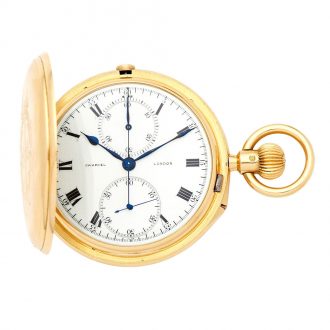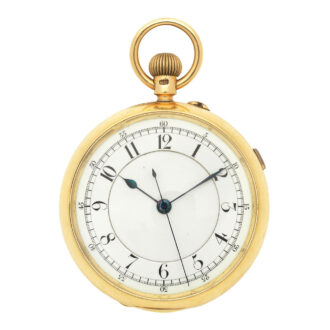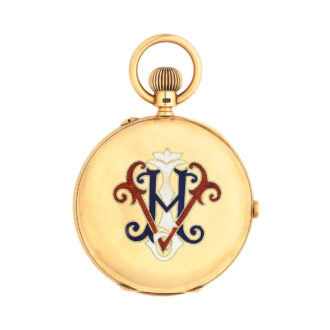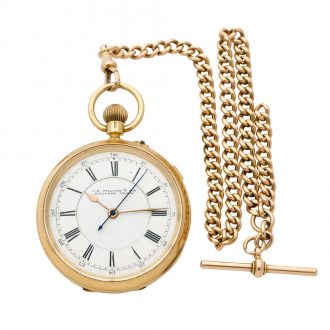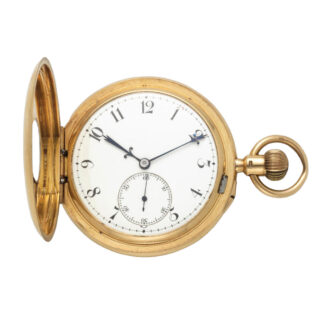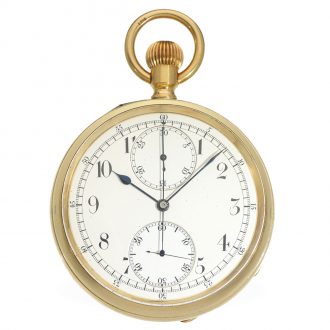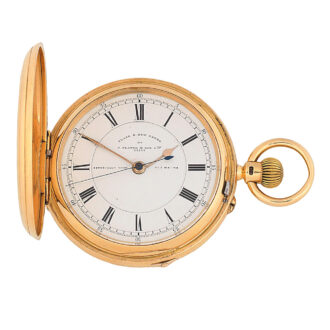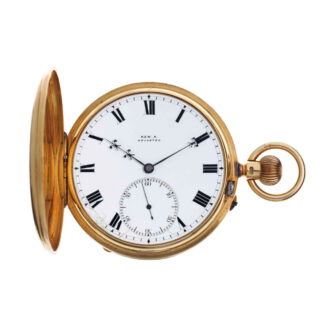
English complicated repeating chronograph clockwatch Circa 1903
- Kenmerk
- AS1700
- Diameter
- 77 mm
- Estimate
- € 200.000 - 350.000
- Price sold
- € 256.000
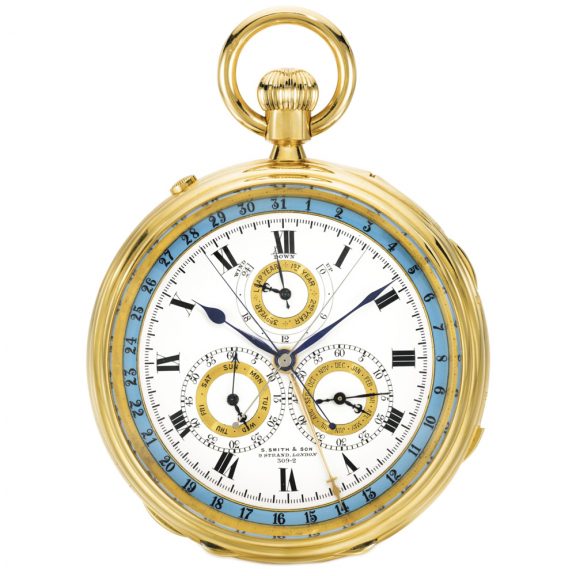
Gold astronomical lever clock watch by S. Smith & Son
–
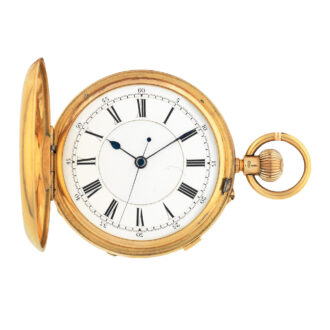
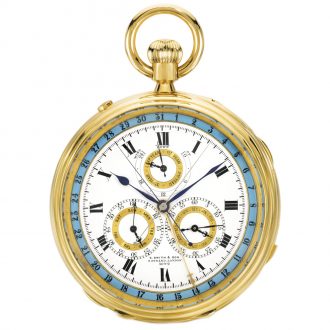
An important and large English gold grande and petite sonnerie clockwatch, circa 1903, with minute repeater, perpetual calendar, split-seconds chronograph and three-colour dial
–
The gilt three-quarter plate movement has two trains, a lever escapement, a bimetallic compensation balance and a fine regulator. The chronograph mechanism can be seen on the backplate. The watch strikes on two coiled gongs. The movement is signed “S. Smith & Son, Watchmaker to the Admiralty, 9 Strand, London” and numbered 309-2.
–
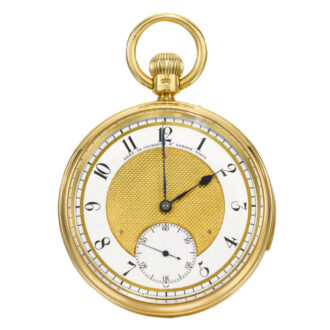
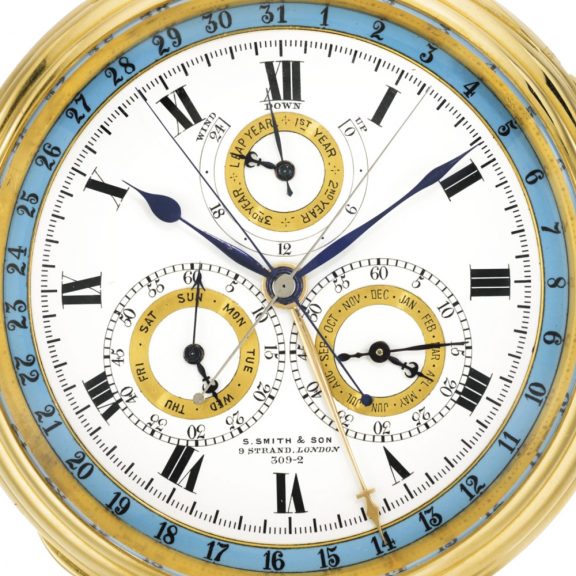
The dial is in white and turquoise enamel and gold, with Roman numerals and three subsidiary dials:
Upper: power reserve (up-and-down) indicator, with a gold ring showing the leap year
Lower: seconds, with a gold ring showing the month
Third dial: 60-minute register, with a gold ring showing the day of the week
–
The outer turquoise enamel ring shows the date, which is read by a central gold hand. The hour and minute hands are blued steel spade hands, and the split-seconds hands are also blued steel. A black outer ring marks the minutes and chronograph seconds.
–
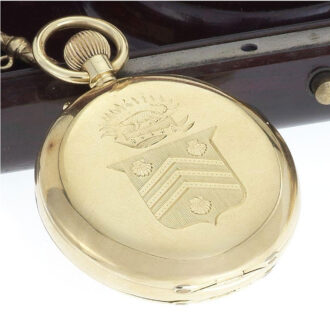
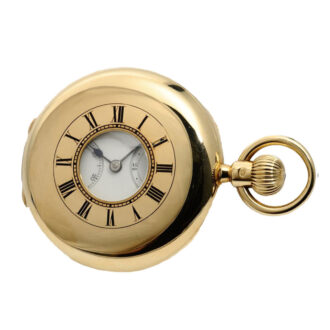
The heavy 18-carat gold case has rounded bezels, a plain polished inner cover, and a gold pendant and bow. The slides on the right side of the case operate the repeater and switch the striking between grande and petite sonnerie. Another slide on the lower left, between 7 and 8 o’clock, switches between strike and silent. The case also has an oval push-piece (olivette) with protective shoulders. The chronograph is worked by a pusher in the crown, with a large split-seconds pusher to its left. The back is hallmarked for 1903. The case, back and inner cover each carry the case maker’s mark “SS” for Samuel Smith and the number 309-2.
–
Diameter: 77 mm
–
Height including pendant: 106 mm
–
Depth including crystal: 31.5 mm
–
Signed: S. Smith & Son, London
–
Condition
The dial is in good overall condition, apart from a very small hairline crack between the two lower subsidiary dials. The case is large and impressive, with strong hinges and crisp bezels. All the slides, switches and pushers appear to work well. The movement runs and repeats. There are some light scuffs and scratches on the gilt plates.
–
S. Smith & Son
Around 1900, S. Smith & Son was one of London’s leading makers of complicated watches. The jeweller and watchmaker Samuel Smith founded the firm in 1851, and it worked with Nicole, Nielsen & Co. on making watches. It also made excellent marine chronometers, which led to it becoming a supplier to the Admiralty. The business grew under Herbert S. A. Smith and stayed in the family for generations. Later, alongside clocks and watches, it moved into instruments for cars and aircraft. This watch is one of the largest the firm ever made and shows the skill of this leading English maker.
–
Comparable watches
Another complicated watch of similar size is a double-dial astronomical watch made to order by Audemars Piguet. It was completed in 1920 and has 15 complications. No. 309-2 is also close to a watch by E. Dent that measures 72 mm across and has an almost identical dial layout. The Dent watch has a white enamel dial, however, rather than a three-colour dial like this one. Dent made that watch for the famous collector James Ward Packard of Warren, Ohio.
–
An astronomer’s watch?The watch may have been made for an astronomer, who would have needed a clear, easy-to-read dial for taking measurements. The dial looks like the famous astronomical watches of Jacob Auch, who worked in Stuttgart in the early 19th century, and may have been inspired by them. Its colours are especially close to some of Auch’s pieces.
Signed: S. Smith & Son, London
Share this page: