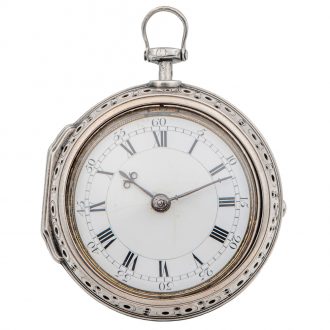
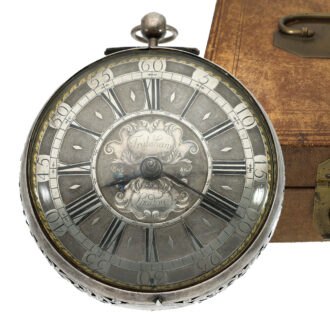
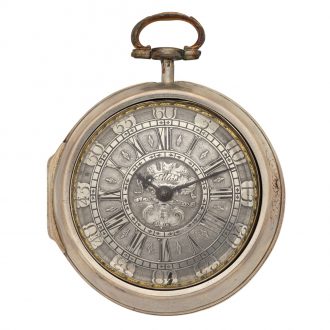
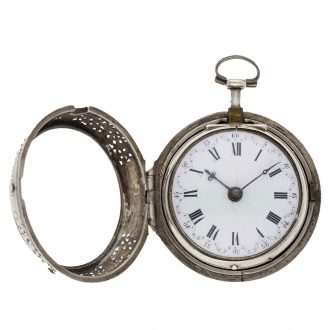
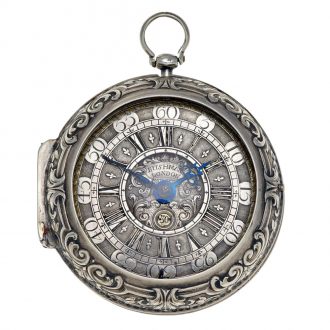
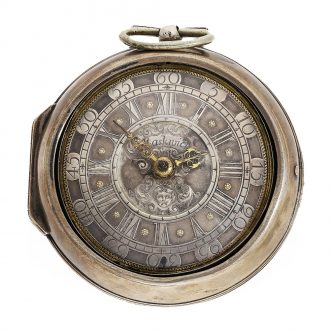
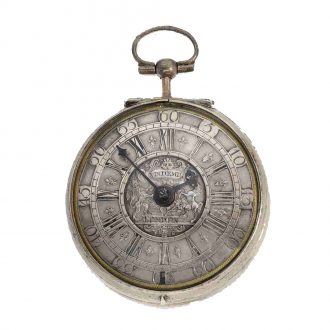
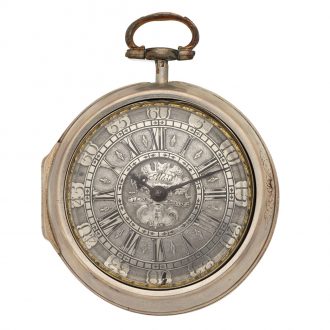
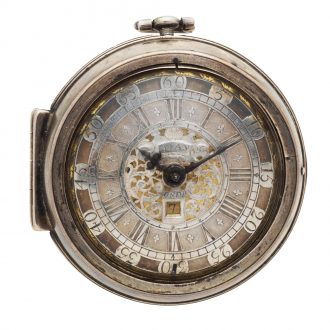
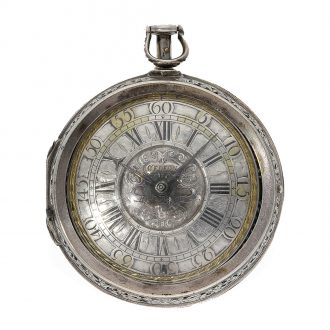
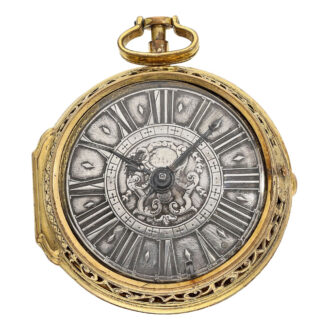
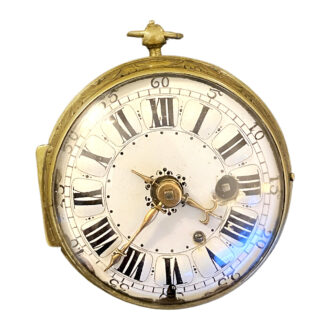
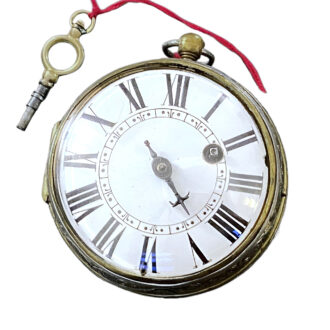
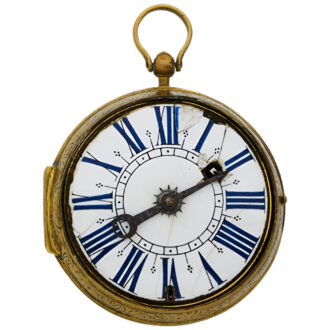
English silver pocket watch with mock pendulum Circa 1700
- Kenmerk
- HC1107
- Diameter
- 50 mm
- Estimate
- € 3.000 - 6.000
- Price sold
- € 3.450
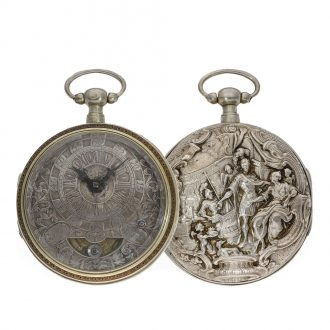
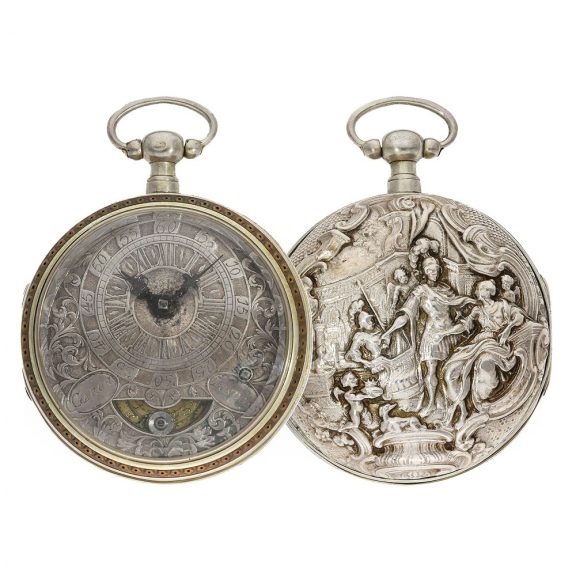
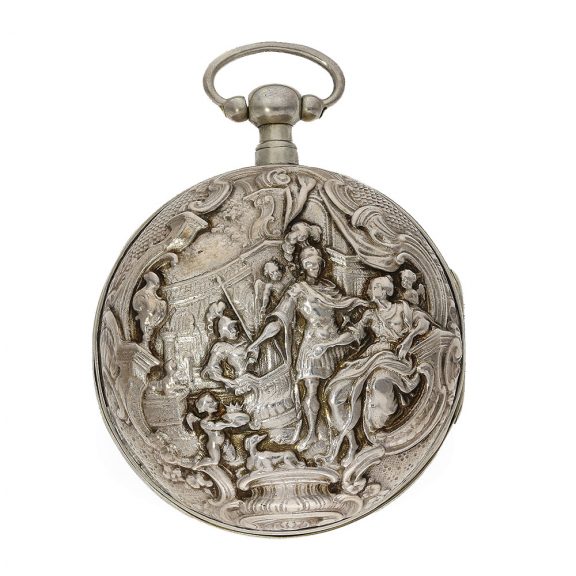
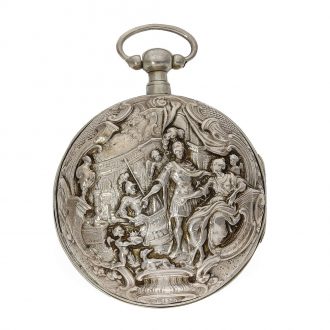
Pocket watch with repoussé case
–
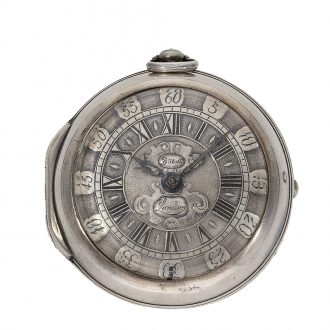
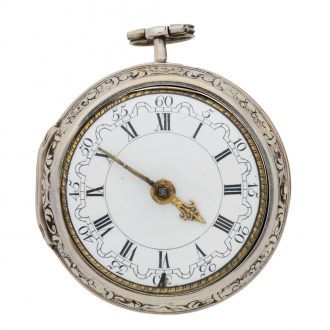
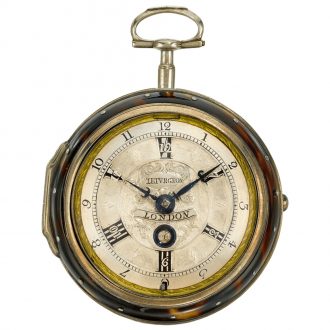
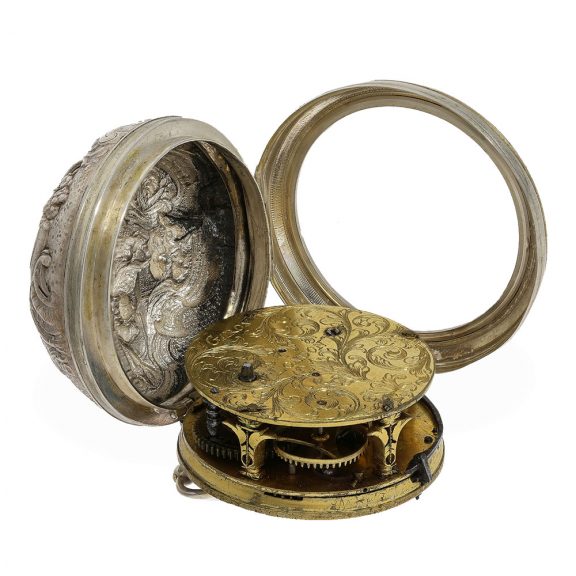
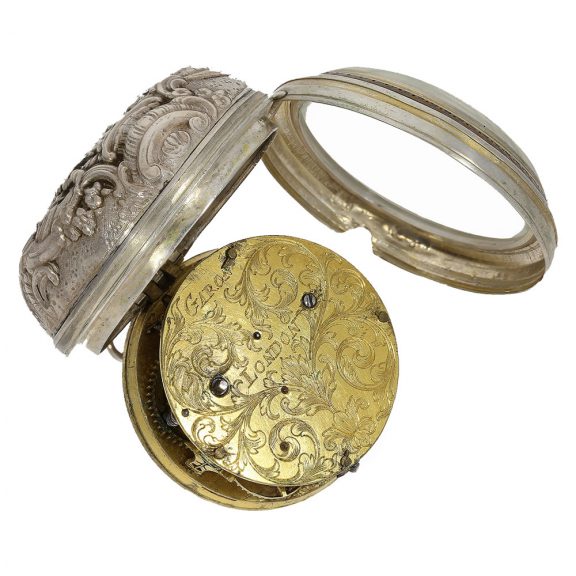
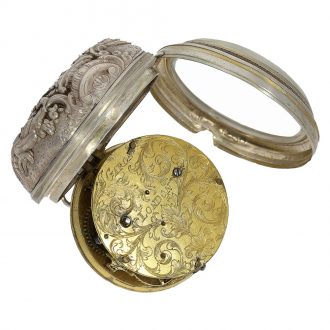
A very rare English pocket watch with mock pendulum, made by Peter Garon in London, England, crica 1700. The open faced case of this watch was crafted from silver and has reverse repoussé work of special quality and a watch paper. The original champlevé dial has a decentralized time display and black lacquered brass hands. The highly interesting movement has an early English verge escapement with a very narrow and steep fusee, tulip pillars, an unusual construction with full plate on the reverse and a balance wheel under the dial that drives the mock pendulum.
Dial and movement are signed.
–
Diameter: 50 mm
–
Weight: 103 g
–
Signed: Garon, London
–
Watch paper
Watch papers are small printed round paper inserts that were placed in pocket watches to protect their inner workings from dust. They were printed on one side with the names and addresses of the watchmaker or fixer, and a manufacturing or repair date was often handwritten on the paper. Some bore intricate illustrations, often showing allegorical figures and even timepieces. Despite their importance as a practical complement to watches and examples of printing art, a modern Webster’s dictionary slights them, proclaiming that a watch paper is “an old fashioned ornament for the inside of a watch case made of paper fancifully cut or printed”.
–
Peter Garon
Peter Garon was born circa 1673 to Hugenot parentage and apprenticed to Richard Baker until 1694. Brian Loomes in his book, The Early Clockmakers of Great Britain, notes that Garon was initially refused freedom of the Clockmakers’ Company as he was deemed an ‘alien’, but was later granted freedom of the City by the Lord Mayor and finally made a Freeman of the Clockmakers’ Company in August 1694. Garon appears to have worked at St. Bartholomew’s Lane End and later at St. Giles Cripplegate [op. cit. pp. 243-244]. F.J . Britten notes that Garon was declared bankrupt in the London Gazette of 1706 but he continued to work and his son, also called Peter, was apprenticed to him in 1713. Garon’s career finally ended in insolvency in 1723.
Signed: Garon, London
Share this page: