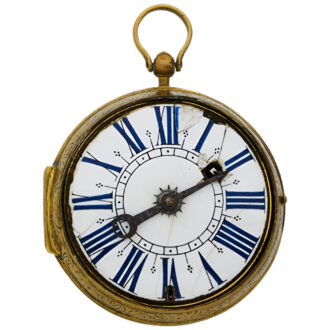
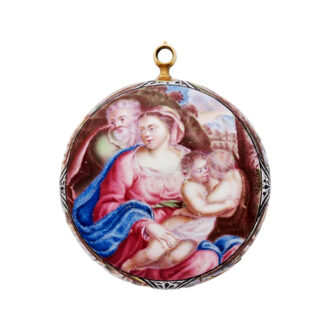
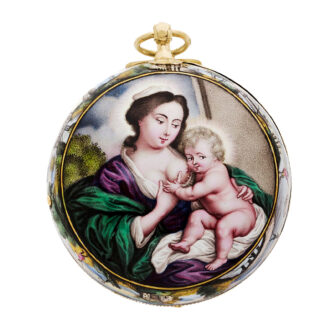
Small English gold and enamel verge pocket watch Circa 1640
- Kenmerk
- SA0303
- Diameter
- 29 mm
- Estimate
- € 30.000 - 60.000
- Price sold
- € 55.000
Gold and enamel verge watch by William Partridge
–
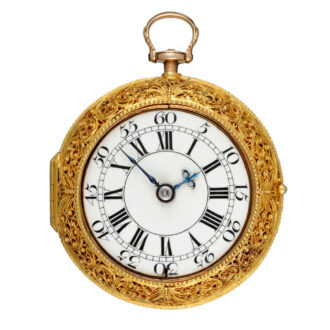
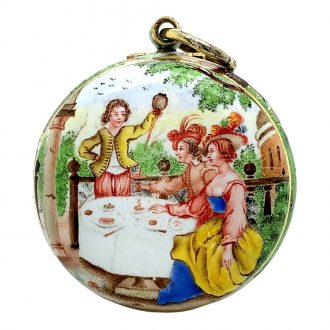
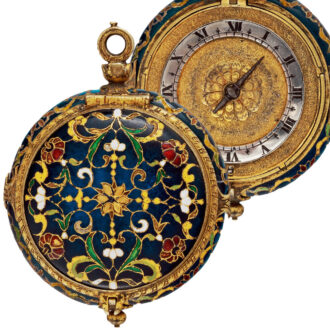
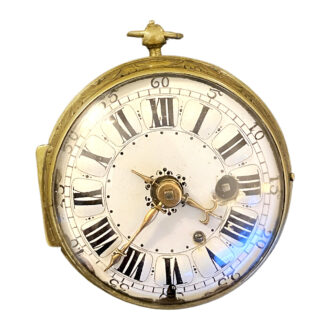
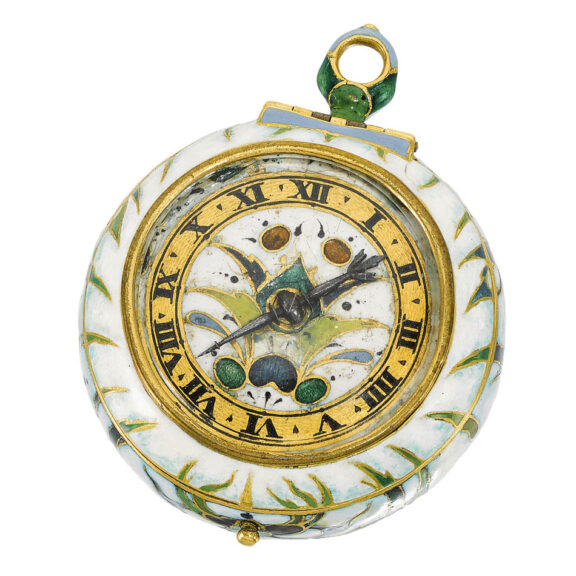
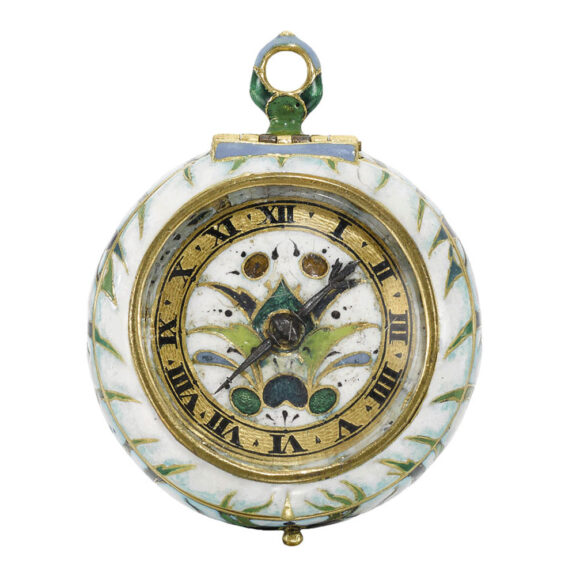
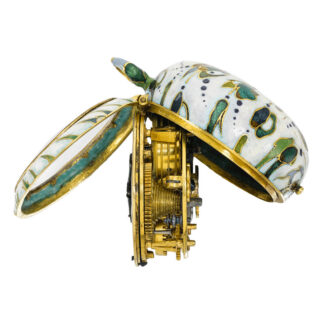
A fine, rare and very small English gold and enamel verge pocket watch, circa 1640.
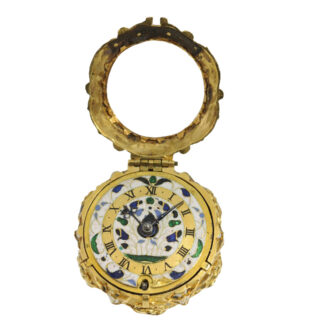
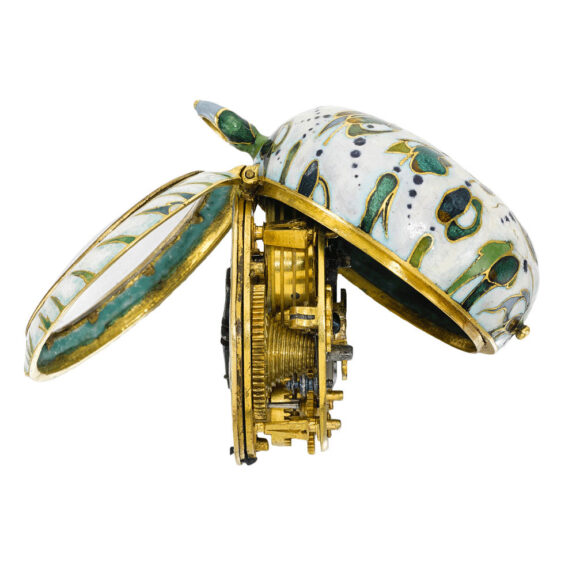
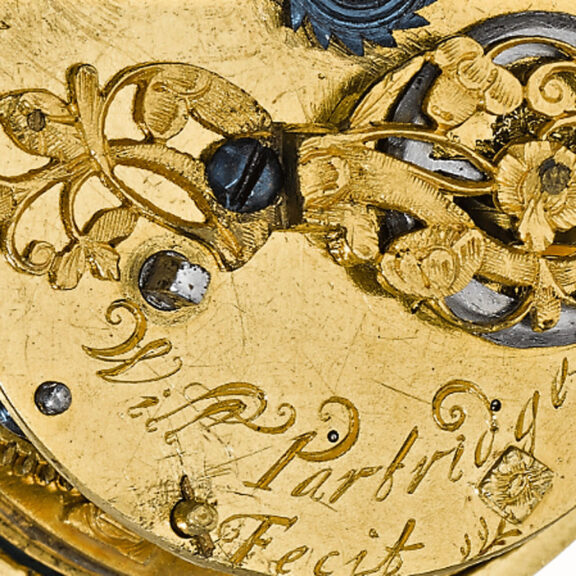
Gilded full plate movement, decoratively pierced and engraved screwed on balance cock, ratchet and click set up, plain balance, fusee and gut line, Egyptian pillars.
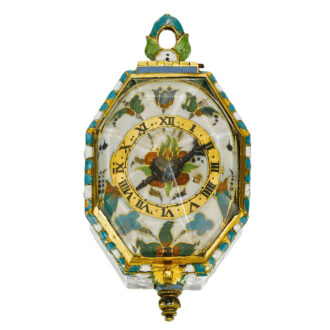
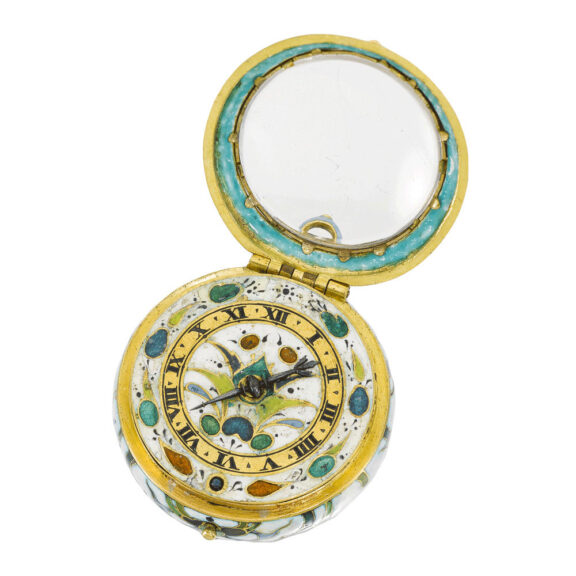
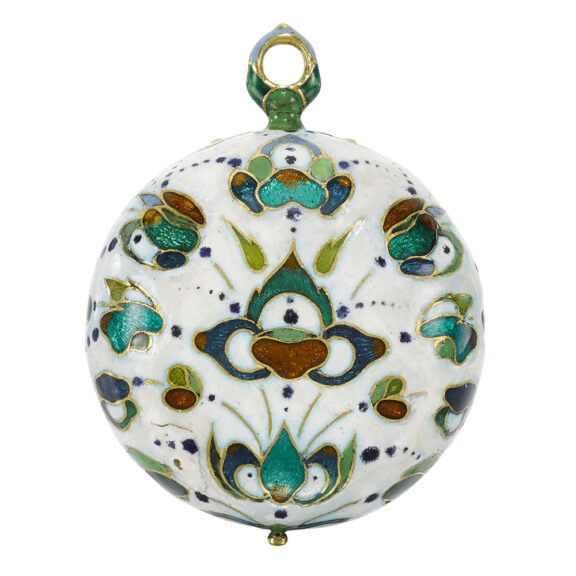
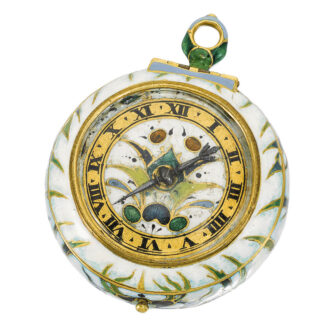
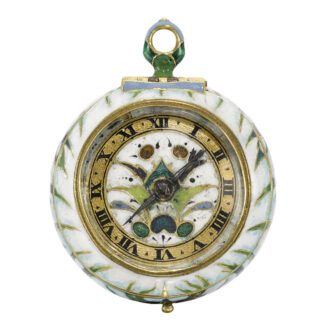
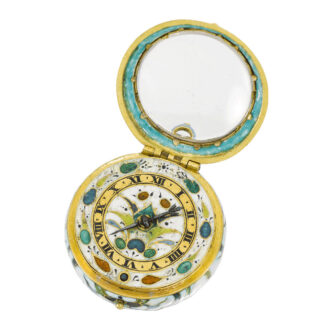
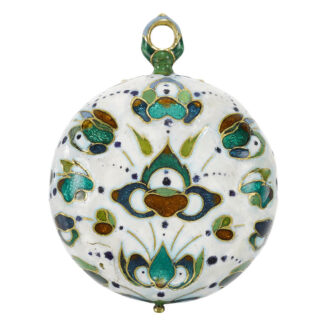
Gold dial, decorated with cloisonné and champlevé enamel flowers, foliage and geometric motifs against a white ground, chapter ring with Roman numerals and half hour divisions, double ended blued steel hand with a foliate head, the case and bezel similarly decorated, the pendant with green and blue enamel highlights.
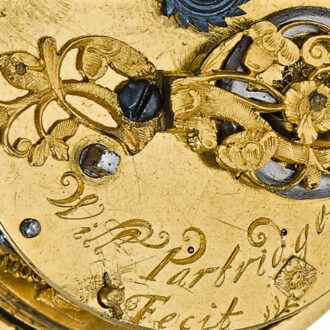
Movement signed.
–
Diameter: 29 mm
–
Signed: Will. Partridge Fecit
–
William Partridge became a Freeman of the Clockmakers’ Company on 1st September 1640. In May 1660, shortly after the Restoration of the Monarchy, William Partridge, supported by his wife Sarah, petitioned the King “that he, Partridge, may be restored unto his said place of Clockmaker to your Majesty with all such privileges and Impunities as belong unto it according to his warrant” (see: Calendar of State Papers, Domestic Series, May 1660). The petition seems to suggest that Partridge had been appointed as Clockmaker to King Charles II, whilst the latter was Prince of Wales at Oxford in 1645. Within the petition, Partridge is keen to point out his Royalist credentials and is at pains to demonstrate the cost of his loyalty, having served Charles I’s father within the King’s “Life Guards of Foot” and later raising his own Company. Partridge notes that he had suffered greatly as a consequence of “plundering, imprisonments and expulsions”. In her supporting petition, William’s wife Sarah states that her husband was ‘bred under Mr Esté, which both Brian Loomes and Cedric Jagger have suggested is likely to refer to Edward East. Sadly, for William and his wife, their passionate entreaties to the King were unsuccessful and it seems that William was not heard of again.
–
Sumptuously decorated with cloisonné and champlevé enamel against a white ground, this wonderful small watch has a jewel-like quality. The watch bears close similarities to contemporary French work of the Blois school, particularly in the enamel case and the style of the balance cock. Indeed, William’s wife noted in her petition mentioned above, that her husband had ‘improved’ his trade in France and Flanders and so it is unsurprising to find such stylistic influences. No other watch by William Partridge appears to be recorded.
–
Cloisonné is an ancient technique for decorating metalwork objects with coloured material held in place or separated by metal strips or wire, normally of gold. In recent centuries, vitreous enamel has been used, but inlays of cut gemstones, glass and other materials were also used during older periods, indeed, cloisonné enamel very probably began as an easier imitation of cloisonné work using gems. The resulting objects can also be called cloisonné.
Signed: Will. Partridge Fecit
Share this page: