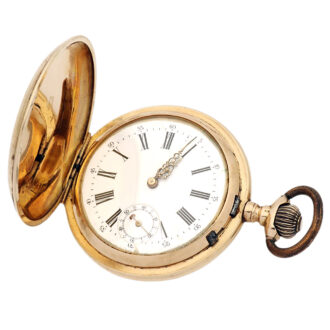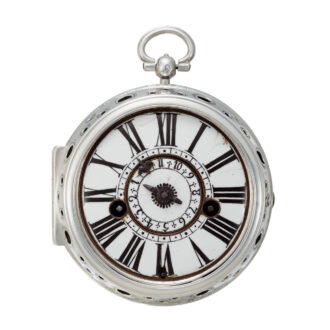
Splendid French gold, enamel and diamonds watch Circa 1801
- Kenmerk
- DT0395
- Diameter
- 54 mm
- Estimate
- € 200.000 - 350.000
- Price sold
- € 250.000
Gold cylinder pocket watch
–
Breguet “Montre Médaillon de Souscription à Tact à Diamant”, circa 1801
–
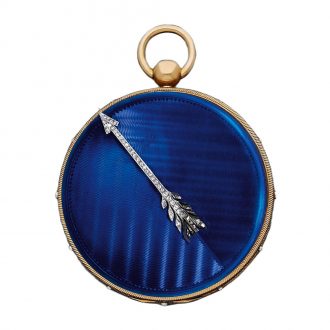
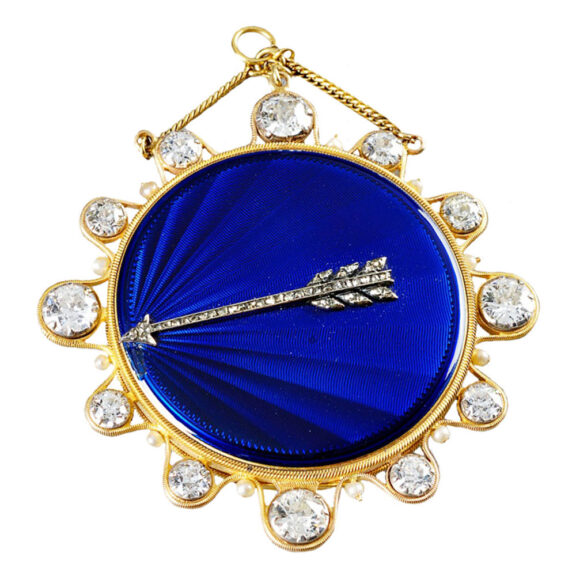
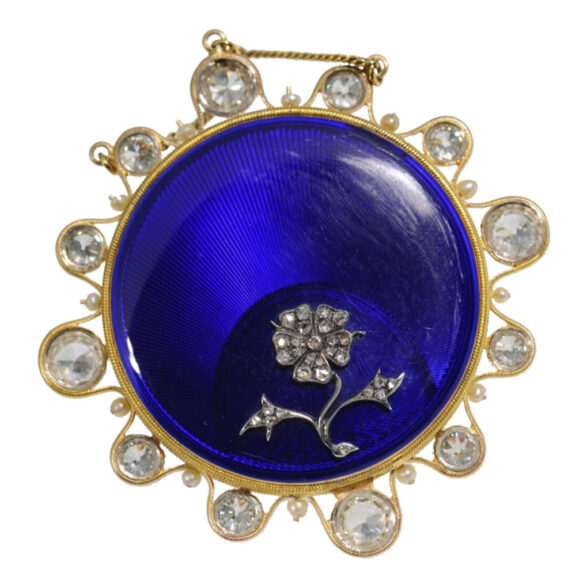
This is an important, museum-quality pocket watch in gold and enamel, set with large diamonds and pearls.
–
Provenance
According to the original Breguet records, the watch was sold on 13 Prairial, Year IX (June 2, 1801), for 2,760 francs to “Monsieur Niteau.” This was Marie-Étienne Nitot, official jeweller to Emperor Napoleon and founder of the House of Chaumet. It comes with Breguet certificate no. 4022, issued in 1993 as a copy of the original certificate no. 2449.
–
Case
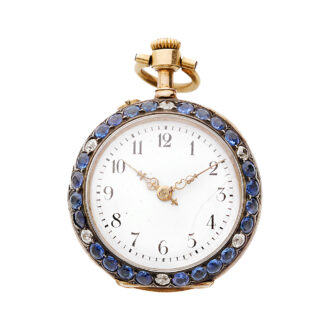
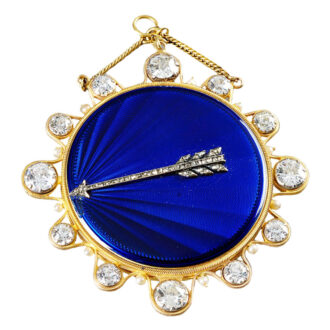
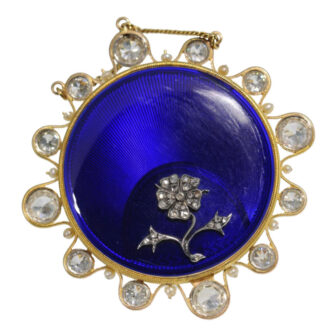
The 18-carat gold “Forme Collier” case is by Pierre-Benjamin Tavernier and carries his maker’s mark “PBT.” It is decorated with enamel, rose-cut diamonds and pearls. Both sides have rich radial engine-turning under translucent cobalt-blue enamel. The front cover turns, and a diamond-set arrow under the enamel lets you tell the hour by touch. The back has a small flower set with diamonds. Around the edge are diamond touch-pieces in two sizes, along with pearls.
Dial and movement
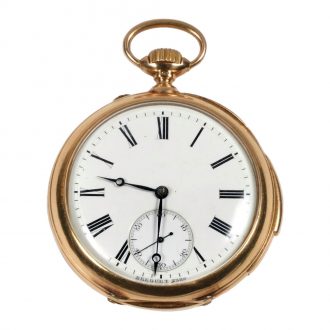
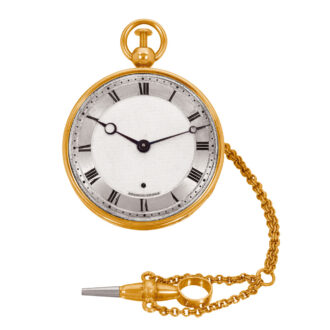
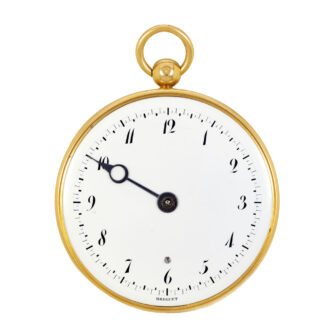
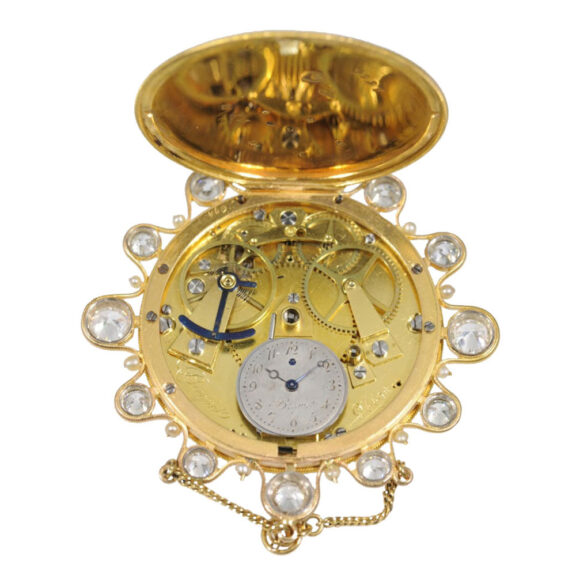
- Small off-centre silver dial with engine-turned decoration and Arabic numerals, signed Breguet
- Blued Breguet hands
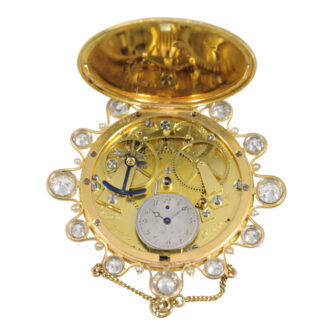
- Small “Souscription” movement with a gilt plate, wound with a key
- Ruby cylinder escapement and three-arm gold balance
- Breguet’s “parachute” shock protection
Diameter: 54 mm
–
Weight: 51 g
–
Signed: Abraham Louis Breguet Paris
–
Marie-Étienne Nitot
The certificate names the buyer as “Monsieur Niteau.” This is the same person: Nitot’s name was recorded in two spellings. The same thing happened with other craftsmen of the period. In the Vever exhibition catalogue (Antiquorum, vol. II), for example, the goldsmith Petitot also appears as Petiteau.
–
Nitot’s family came from Château-Thierry, but he was born in Paris on April 2, 1750. In 1780 he became an apprentice to Aubert, court jeweller to Queen Marie Antoinette. He survived the French Revolution, and in 1802 he was appointed jeweller to Napoleon.
–
Working with his son, François Regnault (1779–1853), Nitot created jewellery that expressed the splendour and power of Napoleon’s empire. This included the wedding jewels of both of Napoleon’s wives, Joséphine de Beauharnais and Marie Louise of Austria. Nitot also designed Napoleon’s imperial crown, his ceremonial sword and many other pieces for the court.
The “Montre Médaillon à Tact”
Breguet invented this type of watch. He sold the first one in early 1799 to Madame Betancourt, the wife of his best friend. He went on to make it in several versions, some with large touch-pieces, like this watch, and some with small ones.
–
These watches were made for Breguet’s wealthiest clients and cost between 1,500 and 3,000 francs. That was an enormous sum in the early 19th century, yet they were in high demand. One reason was etiquette: checking the time in public was considered impolite. With a tact watch, the owner could feel the time without taking the watch out of the pocket.
–
Almost no other maker produced these watches. One exception was Le Roy, “Horloger de S.A.I. et R. Madame” in Paris, who made a few. The most expensive of them, made for the Prince of Hesse, had diamond touch-pieces like this one. The present watch, however, is by Abraham-Louis Breguet, probably the most famous watchmaker of the 18th century.
Signed: Abraham Louis Breguet Paris
Share this page: