Important French gold minute repeating pocket watch Circa 1818
- Kenmerk
- TA4750
- Diameter
- 63 mm
- Estimate
- € 75.000 - 150.000
- Price sold
- € 180.100
Gold cylinder watch with jump hours
–
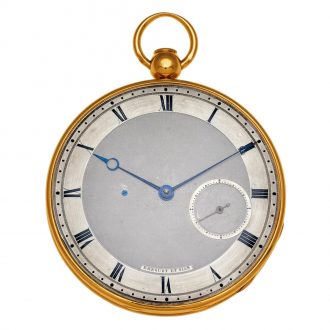
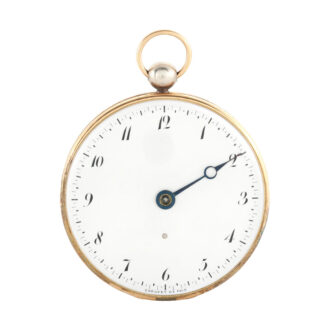
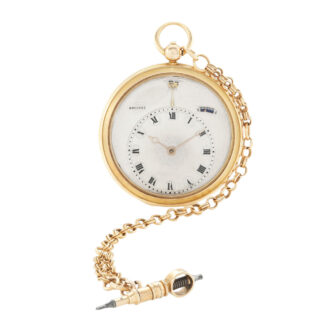
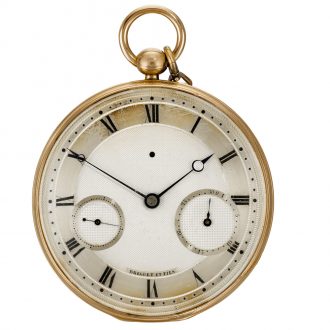
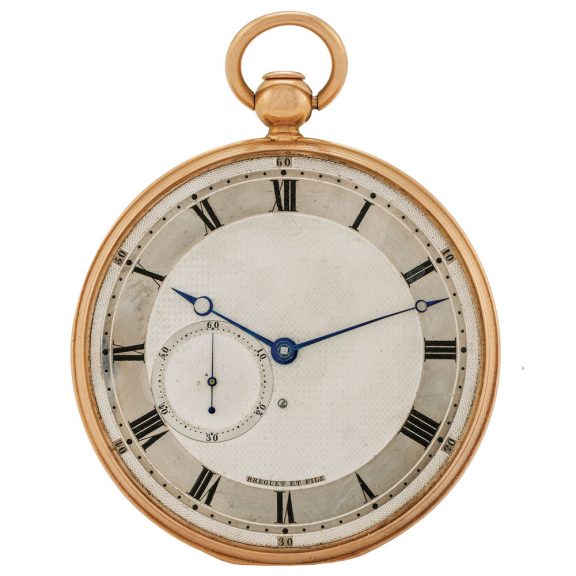
An important French, 18 carat gold minute repeating pocket watch with jump hours and Breguet’s intermediary hammer repeating, circa 1818. Sold to Son Altesse L’Infant d’Espagne, Comte de la Moratalla par de Matschado, on April 21st, 1818, for the sum of 2,980 Francs. An engine turned case made by Pierre Benjamin Tavernier, with a hinged gold cuvette. Silver, two piece dial by Tavernier, radial champlevé Roman numerals on a brushed chapter ring. Outer minute divisions, outermost Arabic ten minute numerals in square reserves within an engine turned border. Matte engine turned centre, applied offset large subsidiary seconds ring at eight fixed by two blued steel screws from the back. Secret signatures on each side of the XII numeral, secured by a single screw. Blued steel Breguet hands.
–
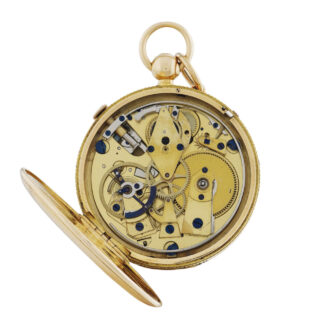
Gilded brass, full plate movement, going barrel with separate bridge secured by two blued steel screws, jewelled train, visible inverted cylinder escapement with steel escape wheel, three arm brass balance mounted on the dial plate. Blued steel flat balance spring, parachute suspension on the top pivot, index regulator with bimetallic compensation curb controlled via a blued steel index on the back plate with engraved scale, exposed spring for the repeating on two gongs with two hammers, each with an intermediate fixed hammer, centrifugal governor, activated by a pull and twist piston in the pendant. Dial and cuvette signed, cuvette, reverse of dial and movement numbered 3104, case numbered 3566 and punched with Tavernier’s mark.
–
Diameter: 63 mm
–
Signed: Breguet et Fils
–
The silver dial is of the two piece type whereby the subsidiary seconds ring is made as a separate part and secured to the main dial by two blued steel screws from the reverse. The ten minute divisions in square reserves are an unusual feature. It is made by the same maker as the case, Pierre Benjamin Tavernier and is punched with his mark and bears the watch’s number 3104. Newly discovered after remaining in the same family for over 140 years, watch NO. 3104 is one of Breguet’s very rare minute repeating watches amply demonstrating his mechanical ingenuity with repeating work. It is also large and has survived in very good condition.
–
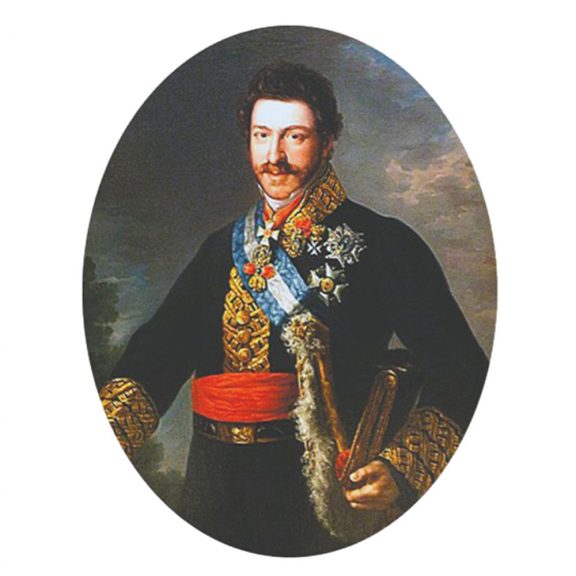
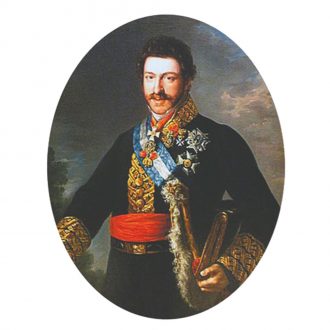
The Breguet archive confirms that this watch was sold to Línfant of Spain, come de la Moratalla and Matschado on 21st April 1818 for the large sum of 2,980 Francs. Infante is the title and rank given in the kingdoms of Spain to the sons and daughters of the king, sometimes except the heir apparent to the throne who usually bears a unique princely or ducal title. Infante Francisco de Paula of Spain (10 March 1794 – 13 August 1865) was the youngest son of Charles IV and Maria Luisa of Parma. He was a brother of Ferdinand VII, as well as an uncle and father in law of Isabella II. His education at the Spanish court was derailed by the Napoleonic intervention in Spain. The departure of the fourteen year old Infante to exile in May 1808 provoked a popular uprising that was violently suppressed by French troops.
–
For the next ten years, Infante Francisco de Paula lived in exile with his parents, first in Marseille and later in Rome. Infante Francisco de Paula returned to Spain in 1818, being called by his eldest brother, King Ferdinand VII, who showered him with honours and privileges. Interested in artistic pursuits, Francisco was an amateur singer and painter. In 1819, he married his niece, Princess Luisa Carlotta of Naples and Sicily, the eldest daughter of his older sister Maria Isabella. The couple had eleven children and were very active in political affairs. Luisa Carlotta was instrumental in securing the succession for their niece, Queen Isabella II. As father in law to his niece the Queen, Infante Francisco de Paula occupied a prominent position at court during Isabella II’s reign.
–
The repeating work: The construction used for the hammers to strike the gongs in this watch is Breguet’s most sophisticated, when the repeating is activated neither hammer makes direct contact with the coiled gong. Placed between each hammer and gong is an intermediary solid hammer fixed to the plate by screws, the primary hammers in fact make contact with the fixed hammers which in turn strike the gongs. This system was developed by Michel Weber, Breguet’s chief craftsman in June 1793 and was intended to improve the sound of the gong. The intermediate hammer was intended to form a connection between the hammer and the gong so that the main hammer would strike against the intermediate hammer to deliver the impulse to the gong no matter what spring tension the main hammer was under therefore the sound would be undistorted. Breguet said; we will equip all our best watches with this system in future.
–
See: Thomas Engel, A.L. Breguet, Watchmaker to Kings, 1994, p. 46. For a full description of Breguet’s minute repeating mechanism. See: George Daniels, The Art of Breguet, 1975, p. 341-342. Of the small number of Breguet minute repeating watches known, the majority are from the perpetual series, after 1810 almost all his other repeating watches are either quarter or half quarter repeating. No. 3104 is one of the only examples known of a minute repeater by Breguet without additional complications. In studying watch No. 3104 it is evident that the style and design of the movement layout from the back is developed from Breguet’s early minute repeating movements of 1795-1800 with a full plate, a separate bridge for the barrel and a visible escape wheel. Some of those early movements were mothballed at the time and not sold until much later, however, No. 3104 has Breguet’s fully developed minute repeating system quite different to the chain and pulley system used in his early repeating watches.
–
A feature found in several of Breguet’s repeaters is the jump hour. The handstands are stationary until about three minutes to the hour when it begins to move. By the time it is halfway to the next hour the minute hand will be at the hour and the hour hand will jump the remaining distance to the hour. Mechanically this works because the usual motion work for the hands is dispensed with and the hour hand is mounted on a wheel geared directly to another wheel on the hour snail star wheel. Because the hour hand is driven from it the hand jumps with the star wheel to each successive hour.
Signed: Breguet et Fils
Share this page: