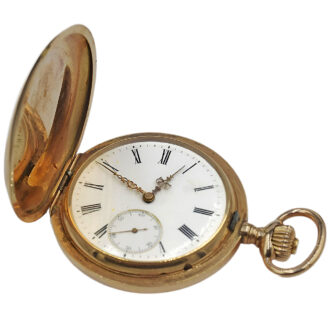
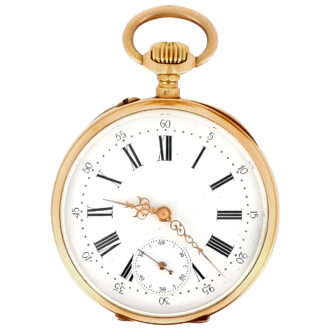
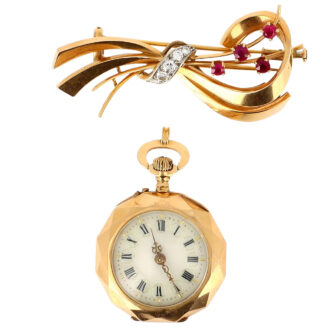
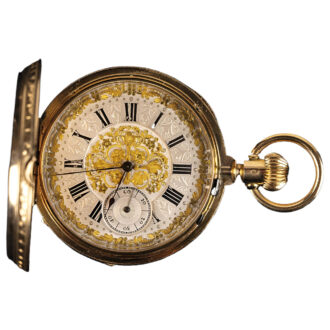
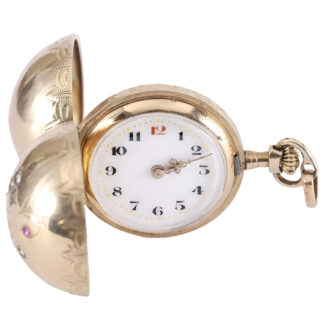
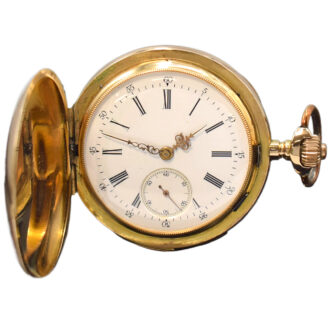
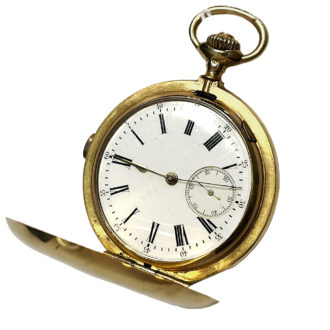
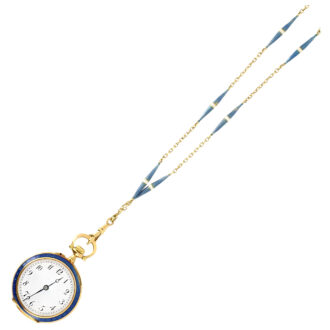
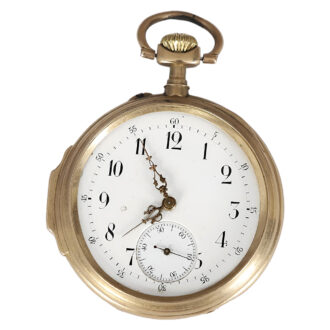
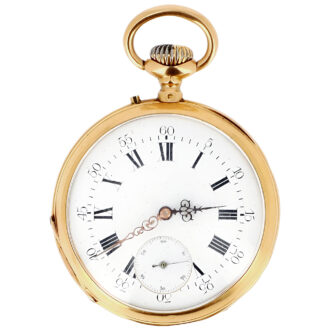
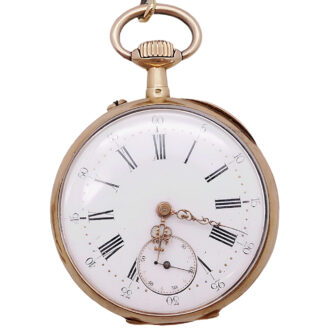
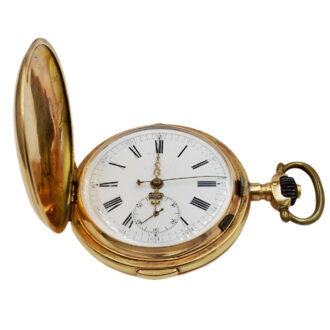
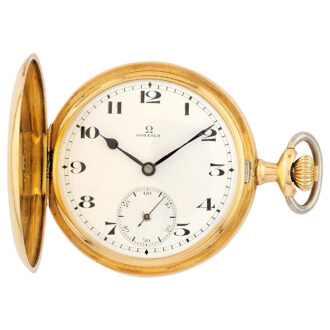
Swiss gold half-hunter made for the Indian market Circa 1900
- Kenmerk
- TA2616
- Diameter
- 54 mm
- Estimate
- € 17.500 - 32.500
- Price sold
- € 24.000
Gold grande and petite sonnerie striking watch
–
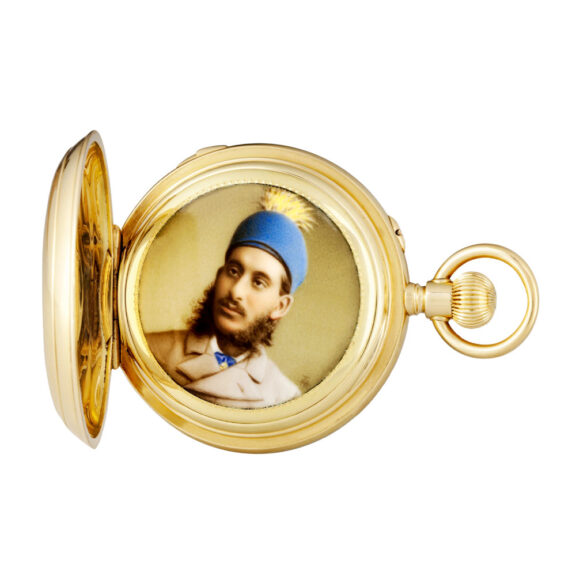
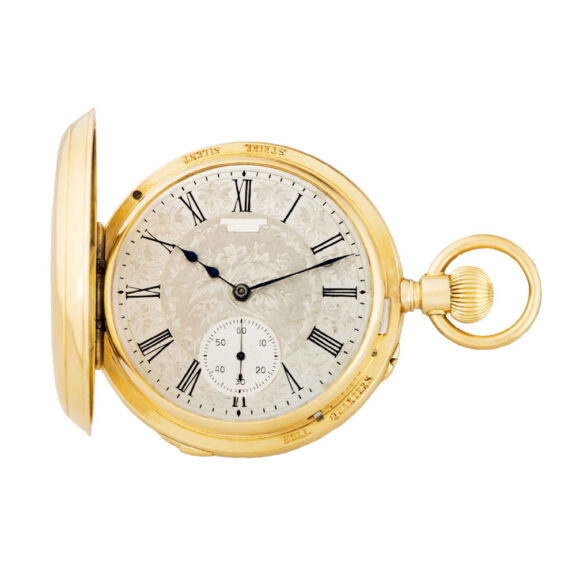
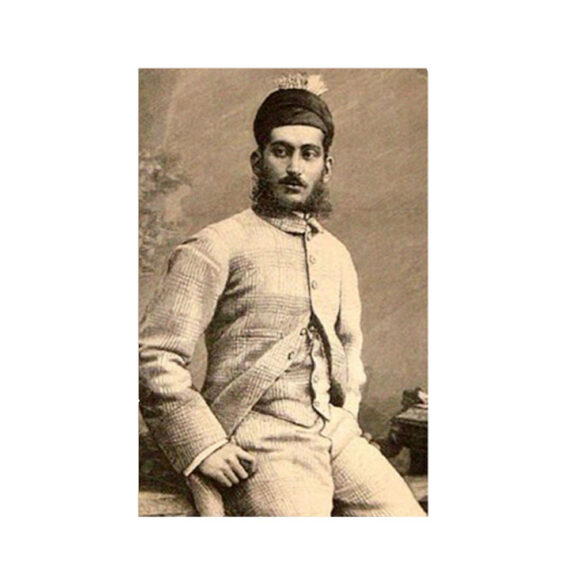
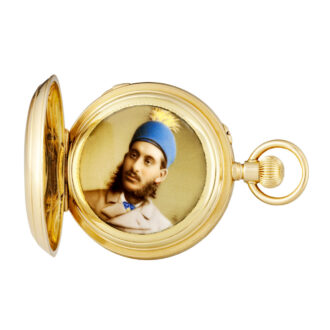
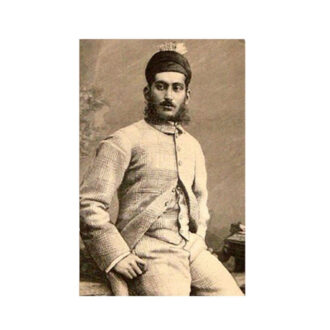
A fine, extremely rare and heavy Swiss 18K gold and enamel half-hunting cased grande and petite sonnerie striking two-train keyless lever clock watch made for the Indian market with trip-minute-repeat and concealed polychrome enamel portrait of the Sixth Nizam of Hyderabad, Mahbub Ali Khan who reigned from 1869 to 1911, circa 1900. Attributed to Henri Grandjean & Cie, Le Locle. Retailed by P. Orr & Sons, Madras.
–
A polished case, the front cover with blue champlevé enamel radial Roman numerals, inner minute track and glazed aperture. Hinged gold cuvette decorated with a finely painted enamel portrait of the sixth Nizam of Hyderabad signed TM. Silver dial numbered on the reverse, narrow radial Roman numerals, outer minute divisions, subsidiary seconds, engraved with foliage and blued steel double-spade hands.
A frosted gilt movement, three-quarter plate, two-train with tandem winding, jewelled to the centre wheel, lateral lever escapement, cut bimetallic compensation balance, blued steel Breguet balance spring, index regulator, striking the hours and quarters and repeating on gongs via a trip-slide in the band, strike/silent, quarters/full strike levers in the bezel. Movement signed P. Orr & Sons, Madras.
–
Diameter: 56 mm
–
Signed: No name
–
The Nizams of Hyderabad The seven Nizams of the Asif Jahi dynasty ruled the Deccan for nearly 224 years, right up to 1948. During the Asif Jahi period, Persian, Urdu, Telgu and Marathi developed simultaneously. The highest official positions were given to deserving persons irrespective of their religion. Persian was the official language up to 1893 and then Urdu up to 1948. When the British and the French spread their hold over the country, the Nizam soon won their friendship without relinquishing his power. The title “Faithful. Ally of the British Government” was bestowed on Nizam VII. The British stationed a Resident at Hyderabad, but the state continued to be ruled by the Nizam.
–
The collection of jewels of the Nizams of Hyderabad is one of the finest in the world. In addition to turban ornaments, gem-set and enamelled necklaces, earrings, armbands, bracelets, belts and other items of jewellery, it includes twenty-two unset emeralds and the fabled 184.50 carats Jacob Diamond – a magnificent South African gem believed to have been used by the last Nizam as a paperweight! After the integration of Hyderabad state into the Union of India in 1950. Nizam Mir Osman Ali Khan instituted a jewellery trust to which he assigned the most important items from the Hyderabad treasury, with the stipulation that they could only be sold after his death. In the nearly three decades since 1972 (when the collection was first offered to the government of India), the unfolding drama of the Nizam’s jewels entailed court cases, intrigue, conflicting decisions and colossal expenses.
–
The present watch was made for presentation by one of India’s wealthiest and most flamboyant princely rulers, the Sixth Nizam of Hyderabad. During the second half of the 19th century, several artists in Geneva painted enamel portraits to be mounted in gold watches for the Indian market. The Genevan artists worked from photographs sent from India and managed to create extremely good likenesses. In India P. Orr & Sons, Madras was a prestigious luxury goods store. The major supplier of complicated Swiss watches to India was Henri Grandjean. The company specialized in “Grande Complication” watches, watches with perpetual calendar, independent seconds with diablotine, chronographs, repeaters, clock watches, and tourbillons. Henri died in 1879 but it appears that the company continued for the next twenty years until 1899, the year in which Rossel & Fils registered their name as successors.
Share this page: