Extremely rare Swiss gold World Time dress watch Circa 1948
- Kenmerk
- AS2154
- Diameter
- 45 mm
- Estimate
- € 100.000 - 500.000
- Price sold
- € 638.800
World Time watch with a Map of North America dial by Patek Philippe
–
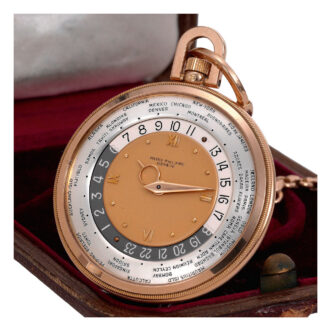
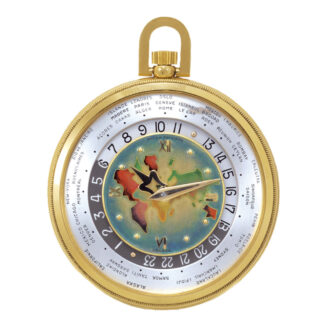
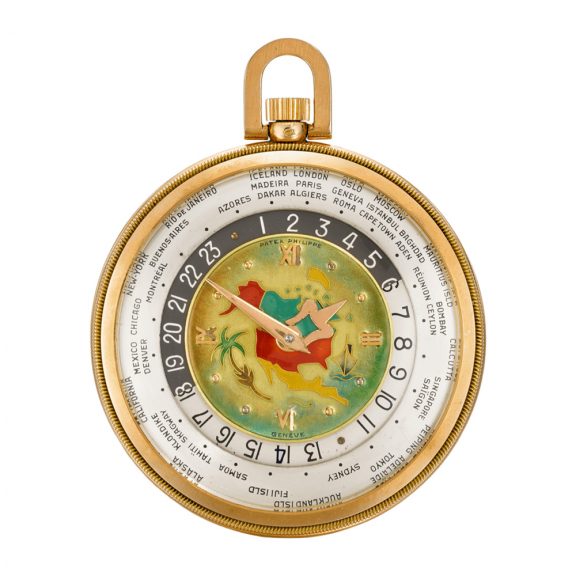
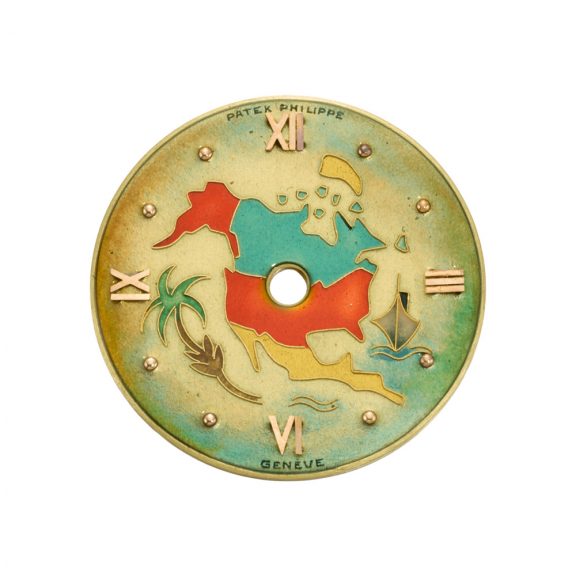
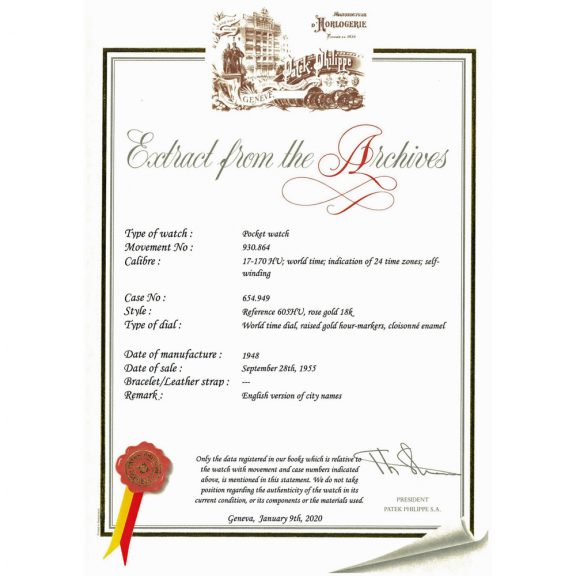
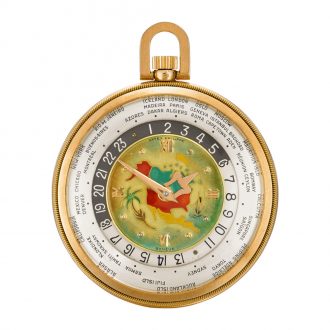
An excellent and rare Swiss world time pocket watch in pink gold, made by Patek Philippe around 1948. It features an open face, keyless winding, and a cloisonné enamel map of North America on the dial.
–
Movement
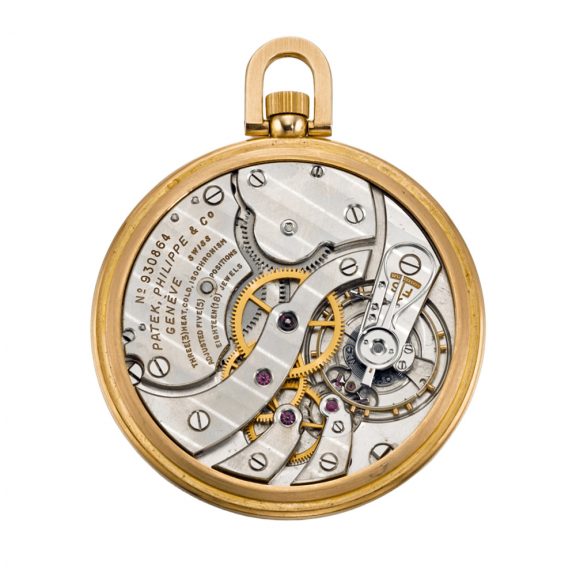
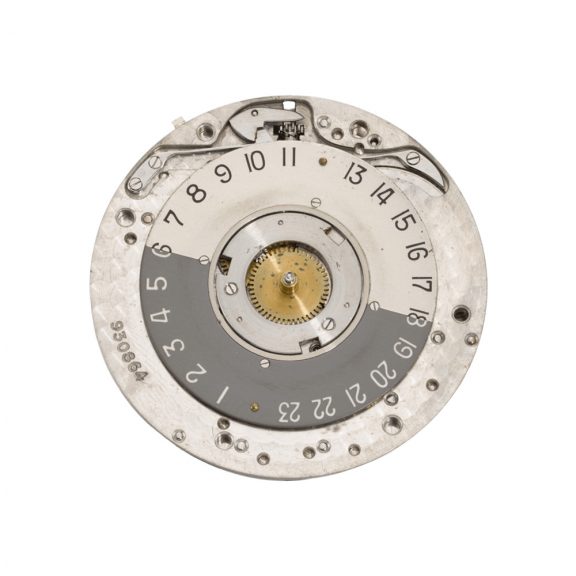
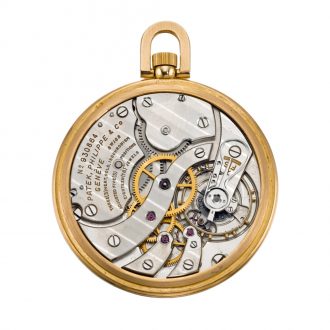
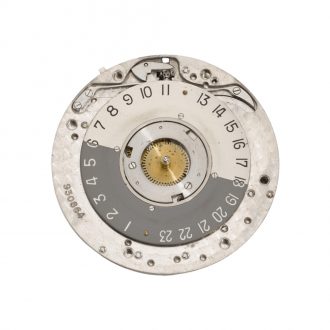
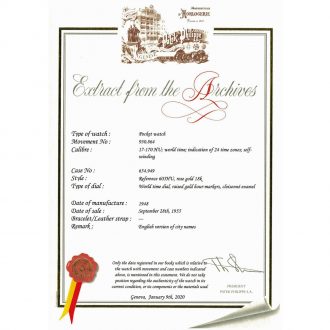
Calibre 17-170 HU with damascened decoration, a lever escapement, 18 jewels, a bimetallic compensation balance and a precision swan-neck regulator. It is signed Patek Philippe & Co. and numbered 930864.
–
Dial
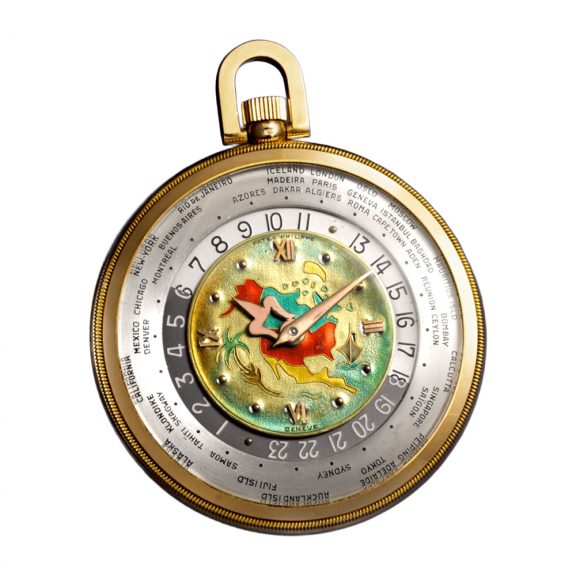
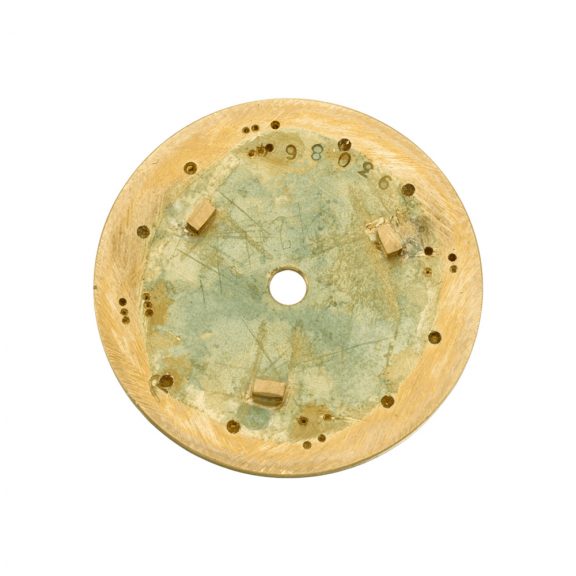
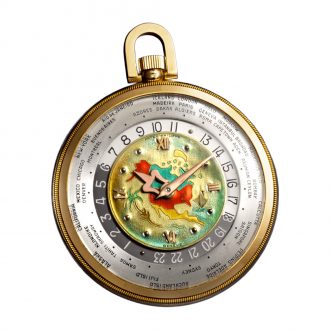
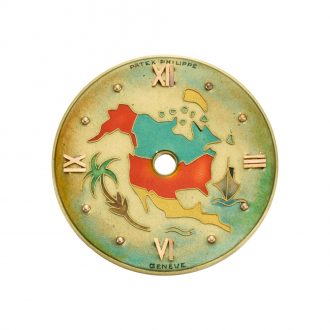
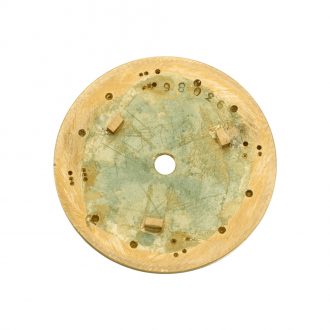
The centre shows North America in cloisonné enamel, with a palm tree at lower left and a ship on the right. The hours are marked with applied pink gold Roman numerals and dots. Around them, a two-tone revolving 24-hour ring separates day from night hours. The outer revolving ring has a satin finish, lists 41 cities and regions worldwide, and also shows 24 hours. The dial is signed Patek Philippe, Genève,
–
Case
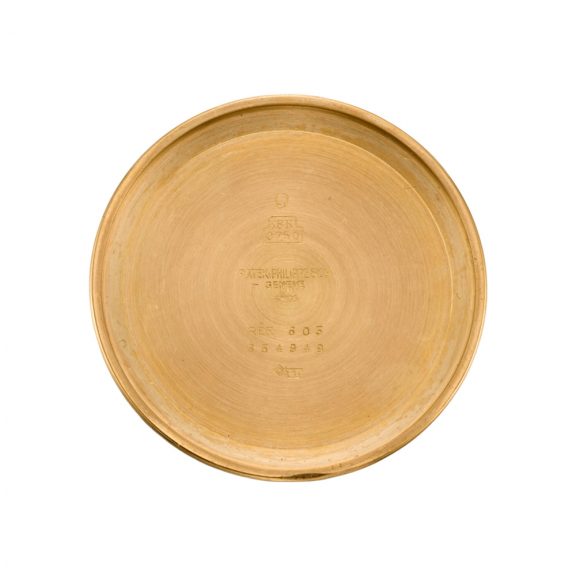
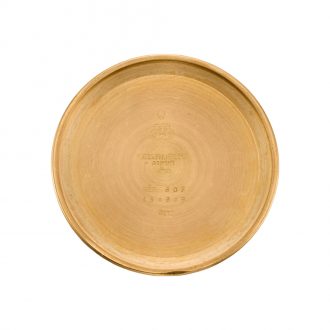
The case is 18k pink gold. Its polished bezel turns and has a chamfered edge with fine milling. The case sides are rounded, and the bow is polished. The snap-on back has a wide, polished, chamfered rim and a flat centre with a satin finish. It is signed Patek Philippe & Co., Genève, and numbered 654.949.
–
Diameter: 44.5 mm
–
Signed: Patek Philippe & Co., Genève
–
Patek Philippe’s Heures Universelles (world time) watches are among the most sought-after vintage models. They are often the centrepiece of the world’s finest watch collections.
–
Reference 605 was one of the first models to use the world time system invented by the famous watchmaker Louis Cottier. Production began in 1937 and lasted about thirty years. Fewer than one hundred were made. Research suggests about three quarters had yellow gold cases and about one quarter had pink gold cases.
–
The first examples had plain metal dials with satin-finished centres in champagne, pink or silver. In the late 1940s, Patek Philippe began ordering a small number of richly coloured cloisonné enamel dials. These usually showed stylised maps of continents. Some showed North America alone or North and South America together. Others showed wider views, such as Europe with Africa and Asia, or even the whole world.
–
Collectors especially value cloisonné enamel dials for their distinctive designs and bright colours that do not fade over time. Each dial is unique. Because they were made by hand, the shades of colour and the choice and placement of details vary slightly from one dial to the next.
–
On the Reference 605, the world time function is controlled by the bezel, a system also used on the Reference 1415 wristwatch. To set the watch, the owner turns the bezel until their current city is at twelve o’clock, then sets the hands to local time. The recessed 24-hour ring is geared to turn with the hands, so it always shows the correct time in every time zone.
–
The case, dial and movement all play a part in how the world time system works, so Louis Cottier supervised the making of each part. Like many of Cottier’s designs, this watch puts London and Paris in the same time zone, Greenwich Mean Time (GMT). On 15 June 1940, Paris moved to Central European Time because of the war. For many years, people expected Paris to return to GMT, so some Patek Philippe world time pocket watches and wristwatches made as late as the 1970s still show Paris and London in the same zone.
–
Louis Cottier (1894-1966) was born in Carouge and attended the Horological School of Geneva before beginning his career alongside his father, Emmanuel Cottier (1858-1930), also his horological mentor. Like his father, Louis was a mechanical genius who developed numerous patents that significantly impacted watchmaking.
–
In response to the challenges posed by the Great Depression, Cottier identified a niche in high-end watchmaking. He dedicated his skills to creating complicated timepieces for prestigious brands such as Patek Philippe, Agassiz, Rolex, and Vacheron Constantin. One of his most important inventions was the world time mechanism, developed in the 1930s. This groundbreaking innovation inspired some of Patek Philippe’s most iconic complications.
Signed: Patek Philippe & Co Genève
Share this page: