Unique English gold chronometer of historical interest Circa 1841
- Kenmerk
- TA4602
- Diameter
- 42 mm
- Estimate
- € 40.000 - 80.000
- Price sold
- € 50.400
Gold and enamel chronometer pocket watch
–
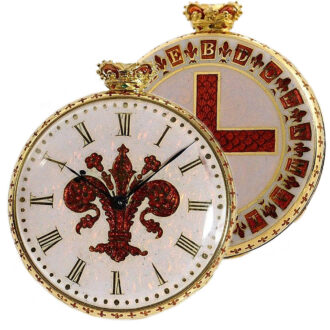
An extremely fine and unique English 18 carat gold and champlevé enamel pocket watch of historical interest and noble provenance, circa 1841. The case with London hallmarks for 1841-1842. Made to celebrate the marriage of French princess Mathilde Laetitia Wilhelmine Bonaparte and Russian industrialist Anatole Nikolaievitch Demidov, Prince of San Donato, Italy. Master mark LC for Louis Comptesse, London, polished bezel decorated with alternating translucent red champlevé enamel crosses and fleur de lis, royal blue enamel band with gold foliage and the Demidoff family motto Acta Non Verba (Deeds not Words).
–
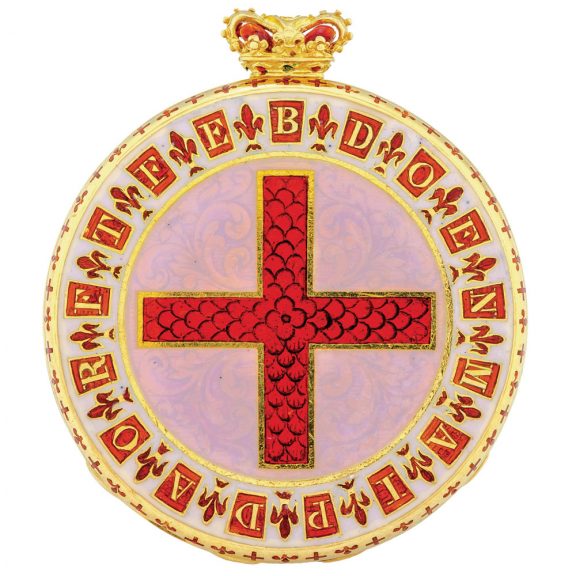
The back cover overlaid with opalescent enamel over a foliate engraved ground, the centre with a translucent red enamel cross on an engraved ground, the outer border with gold letters in translucent red enamel squares spelling the names Bonaparte and Demidoff with alternate letters BDOENMAIPDAORFTFE, intersected by fleur de lis, outermost border decorated to match the bezel, cast gold and red champlevé enamel royal crown pendant. Gold cuvette secured by a blued steel screw, apertures for winding hand setting and regulation. Pink coloured dial overlaid with translucent enamel over foliate engraving to match the case, radial polished gold Roman numerals and outer dot minute divisions, the centre with large gold and translucent red enamel fleur de lis. Blued steel fleur de lis hands.
–
Matte gilt movement, bridge calibre, jewelled to the third wheel, Earnshaw type Chronometer escapement with spring footed detent, cut bimetallic compensation balance with gold temperature adjustment screws, blued steel flat balance spring, index regulator, foliate engraved balance bridge. Cuvette signed case punched with case maker’s mark LC for Louis Comptess and London hallmarks for 1841-1842.
–
An extremely fine and unique English 18 carat gold and champlevé enamel pocket watch of historical interest and noble provenance, circa 1841. The case with London hallmarks for 1841-1842. Made to celebrate the marriage of French princess Mathilde Laetitia Wilhelmine Bonaparte and Russian industrialist Anatole Nikolaievitch Demidov, Prince of San Donato, Italy. Master mark LC for Louis Comptesse, London, polished bezel decorated with alternating translucent red champlevé enamel crosses and fleur de lis, royal blue enamel band with gold foliage and the Demidoff family motto Acta Non Verba (Deeds not Words).
–
The back cover overlaid with opalescent enamel over a foliate engraved ground, the centre with a translucent red enamel cross on an engraved ground, the outer border with gold letters in translucent red enamel squares spelling the names Bonaparte and Demidoff with alternate letters BDOENMAIPDAORFTFE, intersected by fleur de lis, outermost border decorated to match the bezel, cast gold and red champlevé enamel royal crown pendant. Gold cuvette secured by a blued steel screw, apertures for winding hand setting and regulation. Pink coloured dial overlaid with translucent enamel over foliate engraving to match the case, radial polished gold Roman numerals and outer dot minute divisions, the centre with large gold and translucent red enamel fleur de lis. Blued steel fleur de lis hands.
–
Matte gilt movement, bridge calibre, jewelled to the third wheel, Earnshaw type Chronometer escapement with spring footed detent, cut bimetallic compensation balance with gold temperature adjustment screws, blued steel flat balance spring, index regulator, foliate engraved balance bridge. Cuvette signed case punched with case maker’s mark LC for Louis Comptess and London hallmarks for 1841-1842.
–
Diameter: 42 mm
–
Signed: Mortimer & Hunt London
–
French princess Mathilde-Laetitia Wilhelmine Bonaparte 1820-1904.
–
Signed: Mortimer & Hunt London
–
French princess Mathilde-Laetitia Wilhelmine Bonaparte 1820-1904.
Russian industrialist Anatole Nikolaievitch Demidov 1813-1870, Prince of San Donato (1837), Italy.
–
Mortimer & Hunt, London, 1839-1843. John Hunt, son of John Samuel Hunt, became a third partner in the company Storr & Mortimer when Paul Storr retired on December 31, 1838. From then on the firm traded as Mortimer & Hunt. Upon the retirement of John Mortimer in 1843, new partners Robert Roskell and C.F. Hancock joined the company, which now continued to do business as Hunt & Roskell.
–
Louis Comptesse first registered his mark on 8th November 1804. Little information is available on this watch case maker, located at Soho Square, London, but he doubtlessly was a highly skilled and talented craftsman. Terence Camerer Cuss states: “The best known maker by far from the beginning of the period is Louis Comptesse, who worked in London and used the Goldsmiths’ Hall for assays.” His initials can be found in the cases made for the most celebrated English watchmakers of the time, notably Recordon, Barraud, Fatton, Viner, Barwise and Charman.
–
Historical and technical comments:
Despite the signature ‘à Londres’ the case was most likely produced in Geneva. It bears the so-called quality marks similar to the London hallmarks and the marks of case maker Louis Comtesse, who was the most eminent English maker of his time. At the time Geneva specialized in engraving and enamelling, and artists often faked the signatures of the most famous watchmakers. This annoying habit started around the end of the 17th century and went on until the second half of the 19th century when contracts were signed between Switzerland and the other industrial countries during and after the International Exhibition in Vienna in 1873. After these agreements were made, Switzerland established agencies for the registration and filing of trademarks as well as a patent office.
–
–
Mortimer & Hunt, London, 1839-1843. John Hunt, son of John Samuel Hunt, became a third partner in the company Storr & Mortimer when Paul Storr retired on December 31, 1838. From then on the firm traded as Mortimer & Hunt. Upon the retirement of John Mortimer in 1843, new partners Robert Roskell and C.F. Hancock joined the company, which now continued to do business as Hunt & Roskell.
–
Louis Comptesse first registered his mark on 8th November 1804. Little information is available on this watch case maker, located at Soho Square, London, but he doubtlessly was a highly skilled and talented craftsman. Terence Camerer Cuss states: “The best known maker by far from the beginning of the period is Louis Comptesse, who worked in London and used the Goldsmiths’ Hall for assays.” His initials can be found in the cases made for the most celebrated English watchmakers of the time, notably Recordon, Barraud, Fatton, Viner, Barwise and Charman.
–
Historical and technical comments:
Despite the signature ‘à Londres’ the case was most likely produced in Geneva. It bears the so-called quality marks similar to the London hallmarks and the marks of case maker Louis Comtesse, who was the most eminent English maker of his time. At the time Geneva specialized in engraving and enamelling, and artists often faked the signatures of the most famous watchmakers. This annoying habit started around the end of the 17th century and went on until the second half of the 19th century when contracts were signed between Switzerland and the other industrial countries during and after the International Exhibition in Vienna in 1873. After these agreements were made, Switzerland established agencies for the registration and filing of trademarks as well as a patent office.
–
The click work has been designed in a very specific space saving way to create an extra flat movement that could be fitted into an elegant case. The escapement is set between the bridges and has a 3/100-4/100 mm spring, while its gold spring is not more than 4/100 mm thick. Along with the inverted balance and its lower balance wheel, this makes the watch one of the flattest pocket chronometers ever produced. The manufacturing cost for this timekeeper’s movement must have been very high and it is not surprising at all that it was fitted into a similarly costly gold case with allover enamelling.
–
Mathilde Laetitia Wilhelmine Bonaparte Princesse Française, 1820-1904, was a French princess and Salon holder. She was a daughter of Napoleon’s brother Jérôme Bonaparte and his second wife, Catharina of Württemberg, daughter of King Frederick I of Württemberg. Born in Trieste, Mathilde Bonaparte was raised in Florence and Rome. She was originally engaged to her first cousin, the future Napoleon III of France, but the engagement was later broken following his imprisonment at Ham. She married a rich Russian tycoon, Anatole Demidov, on November 1, 1840, in Rome. Anatole was given the title of Prince by Grand Duke Leopold II of Tuscany shortly before the wedding to fulfil the wishes of Mathilde’s father and to preserve Mathilde’s station as Princess. Anatole’s princely title was never recognised in Russia. They had no children.
–
Count Anatoly (Anatole) Nikolaievich Demidov, 1813-1870, 1st Prince of San Donato, was a Russian industrialist, diplomat and art patron of the Demidov family. Born in Saint Petersburg or Moscow, he was the second son of Count Nikolai Nikitich Demidov and Baroness Elisabeta Alexandrovna Stroganova. He grew up in Paris, where his father was ambassador. He served briefly as a diplomat himself in Paris (living in the hôtel built by Charles de Wailly for the sculptor Augustin Pajou, at 87 rue de la Pépinière, now the rue La Boétie), Rome and Venice. On his father’s death in 1828, Anatole settled for good in western Europe, returning to Russia as little as possible. This attitude alienated him from Tsar Nicholas I of Russia, who always had an antipathy towards him. He also considerably expanded the Demidov collection assembled by his father at the Villa San Donato near Florence, being particularly interested in Romantic art. In the Paris Salon of 1834, he acquired Paul Delaroche’s The Execution of Lady Jane Grey, now in the National Gallery, London. A plan to marry Jérôme’s daughter Princess Mathilde Laetitia Bonaparte to Demidov was quickly formed. It was agreed she would receive a dowry of 50,000 francs in jewels. The marriage took place in Rome or Florence on 1 November 1840. In March 1841 the couple went to Saint Petersburg, where the Tsar was full of attention for his cousin (through the Wurttembergs) and the princess, losing no opportunity to humiliate Demidov by any means possible. In spite of this, Anatole began his own infidelities. On 17 August 1841, the couple arrived in Paris, where they lived at hôtel Demidoff, 109 Rue Saint-Dominique until June 1842, when they moved to spend a year in Saint Petersburg before finally setting up home at the villa San Donato. Their relationship soon soured, with the princess taking Count Émilien de Nieuwerkerke as a lover and Demidov taking Valentine de Sainte-Aldegonde, Duchesse de Dino, as a mistress.
–
Mathilde Laetitia Wilhelmine Bonaparte Princesse Française, 1820-1904, was a French princess and Salon holder. She was a daughter of Napoleon’s brother Jérôme Bonaparte and his second wife, Catharina of Württemberg, daughter of King Frederick I of Württemberg. Born in Trieste, Mathilde Bonaparte was raised in Florence and Rome. She was originally engaged to her first cousin, the future Napoleon III of France, but the engagement was later broken following his imprisonment at Ham. She married a rich Russian tycoon, Anatole Demidov, on November 1, 1840, in Rome. Anatole was given the title of Prince by Grand Duke Leopold II of Tuscany shortly before the wedding to fulfil the wishes of Mathilde’s father and to preserve Mathilde’s station as Princess. Anatole’s princely title was never recognised in Russia. They had no children.
–
Count Anatoly (Anatole) Nikolaievich Demidov, 1813-1870, 1st Prince of San Donato, was a Russian industrialist, diplomat and art patron of the Demidov family. Born in Saint Petersburg or Moscow, he was the second son of Count Nikolai Nikitich Demidov and Baroness Elisabeta Alexandrovna Stroganova. He grew up in Paris, where his father was ambassador. He served briefly as a diplomat himself in Paris (living in the hôtel built by Charles de Wailly for the sculptor Augustin Pajou, at 87 rue de la Pépinière, now the rue La Boétie), Rome and Venice. On his father’s death in 1828, Anatole settled for good in western Europe, returning to Russia as little as possible. This attitude alienated him from Tsar Nicholas I of Russia, who always had an antipathy towards him. He also considerably expanded the Demidov collection assembled by his father at the Villa San Donato near Florence, being particularly interested in Romantic art. In the Paris Salon of 1834, he acquired Paul Delaroche’s The Execution of Lady Jane Grey, now in the National Gallery, London. A plan to marry Jérôme’s daughter Princess Mathilde Laetitia Bonaparte to Demidov was quickly formed. It was agreed she would receive a dowry of 50,000 francs in jewels. The marriage took place in Rome or Florence on 1 November 1840. In March 1841 the couple went to Saint Petersburg, where the Tsar was full of attention for his cousin (through the Wurttembergs) and the princess, losing no opportunity to humiliate Demidov by any means possible. In spite of this, Anatole began his own infidelities. On 17 August 1841, the couple arrived in Paris, where they lived at hôtel Demidoff, 109 Rue Saint-Dominique until June 1842, when they moved to spend a year in Saint Petersburg before finally setting up home at the villa San Donato. Their relationship soon soured, with the princess taking Count Émilien de Nieuwerkerke as a lover and Demidov taking Valentine de Sainte-Aldegonde, Duchesse de Dino, as a mistress.
Signed: Mortimer & Hunt London
Share this page: