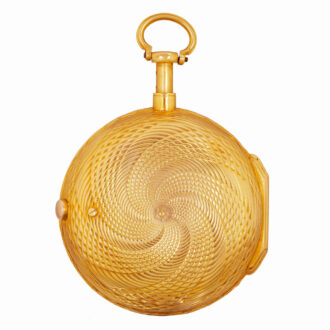
Fine French gold dumb quarter repeating watch Circa 1752


- Kenmerk
- FA0206
- Diameter
- 48 mm
- Estimate
- € 8.000 - 14.000
- Price sold
- -
Gold quarter repeater by Julien Le Roy
–
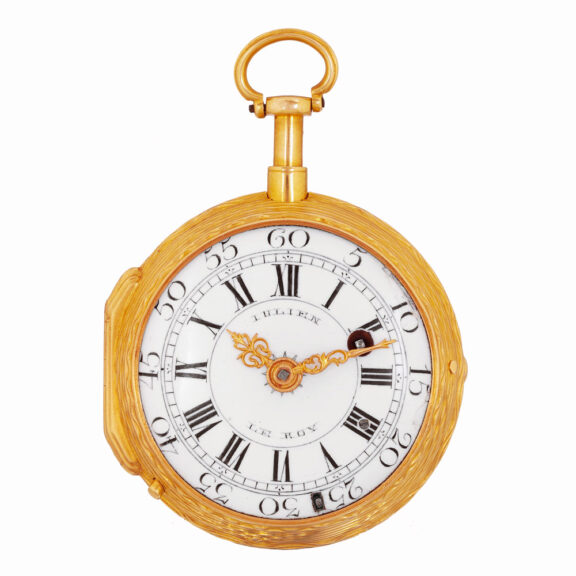
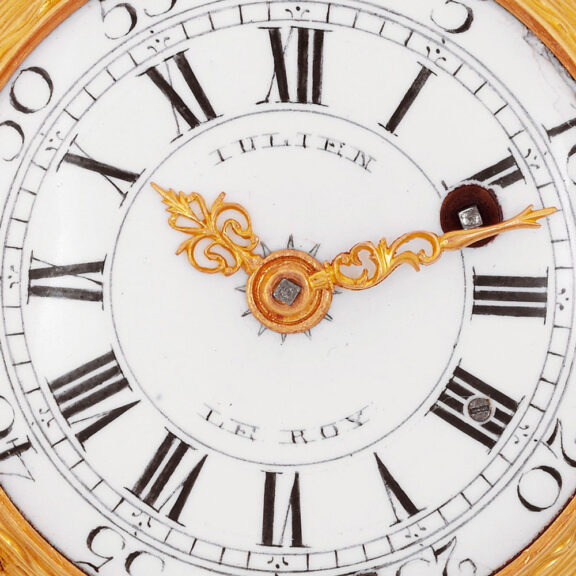
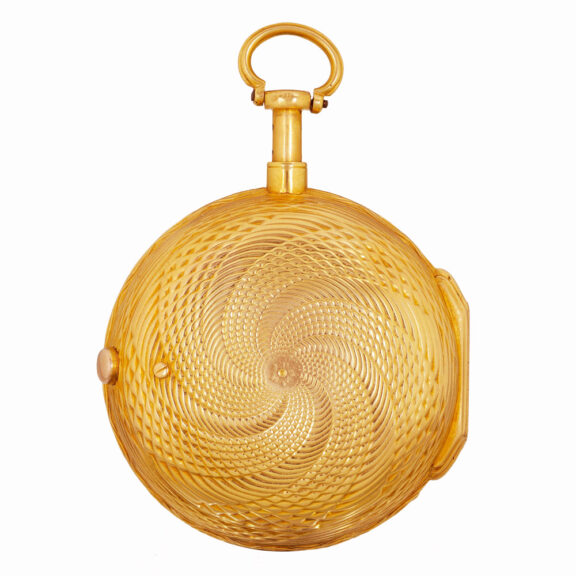
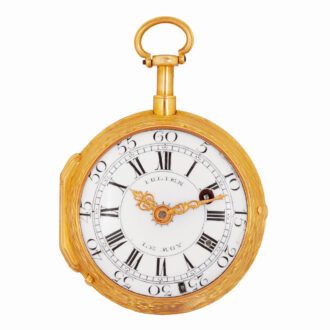
A very fine French 18 carat gold open faced dumb quarter repeating verge pocket watch, hallmarked Paris for 1752.
Fire gilded brass full plate movement, cylindrical pillars, fusee with chain, verge escapement, plain steel three-arm balance, flat balance spring, pierced and foliate chased continental type balance cock, polished steel end piece, silver regulation dial with a blued steel hand, repeating on the case activated by depressing the pendant.
Engine-turned case with a swirling basketwork pattern. White enamel dial with Roman hours, outer minute track with Arabic five minute numerals and gold Louis hands. Dial and movement signed, the dial plate ring inscribed Invente par Jul. Le Roy en 1740.
–
Diameter: 48 mm
–
Signed: Julien Le Roy à Paris
–
The inscription Inventé par Julien Le Roy en 1740 refers to the so-called invention ‘à bâte levée’. This new arrangement allowed more space for the repeater work. This invention was subsequently adopted by all French watchmakers.
–
Julien Le Roy is one of the clockmakers who contributed most to the progress and the reputation of French watch- and clockmaking. Born in Tours on August 6, 1686, and died in 1759 in Paris. He came to Paris in 1699. In 1713 he achieved his master’s degree and in the following years, he became a jury member of the Paris Guild of Watchmakers. Later, Le Roy became director of the Société des Arts de Genève and, in 1739, Court Watchmaker (French Horloger Ordinaire du Roi) under Louis XV, he had his private quarters in the Louvre. He improved almost all branches of clockmaking and many important inventions in the realm of time measurement are owed to him. In 1717, Julien Le Roy presented an equation clock to the Royal Academy of Sciences which showed the true time, the place of the sun and its decline. His most important discoveries concerned watch mechanisms. The adjustable ‘potence’ for the verge escape wheel considerably improved the escapement’s functioning and the steel end-piece (coqueret) which allowed oil to be retained in the balance pivots in order to diminish frictional force, was quickly adopted by other watchmakers. He was the inventor of dumb repeating watches too, in 1740, he created a new arrangement that allowed the area allotted to the repeating work to be enlarged. This invention, called ‘à bâte levée’, was also adopted by his fellow clockmakers. In 1755 he invented a small anchor escapement used as a regulator for the repeating train. He contributed to the Encyclopédie by writing several articles on clockmaking together with his son Jean-Baptiste, the Academician. Le Roy ran his workshop in the Rue de Harlay in Paris until his death. Examples of his timepieces can be found in various important museums around the world, such as the Louvre and the Victoria and Albert Museum.
–
Montre à toc. A ‘dumb’ repeater watch in which a hammer strikes the inside of the case to produce a muffled sound. Invented by Julian Le Roy in 1740.
–
A very fine French 18 carat gold open faced dumb quarter repeating verge pocket watch, hallmarked Paris for 1752.
Fire gilded brass full plate movement, cylindrical pillars, fusee with chain, verge escapement, plain steel three-arm balance, flat balance spring, pierced and foliate chased continental type balance cock, polished steel end piece, silver regulation dial with a blued steel hand, repeating on the case activated by depressing the pendant.
Engine-turned case with a swirling basketwork pattern. White enamel dial with Roman hours, outer minute track with Arabic five minute numerals and gold Louis hands. Dial and movement signed, the dial plate ring inscribed Invente par Jul. Le Roy en 1740.
–
Diameter: 48 mm
–
Signed: Julien Le Roy à Paris
–
The inscription Inventé par Julien Le Roy en 1740 refers to the so-called invention ‘à bâte levée’. This new arrangement allowed more space for the repeater work. This invention was subsequently adopted by all French watchmakers.
–
Julien Le Roy is one of the clockmakers who contributed most to the progress and the reputation of French watch- and clockmaking. Born in Tours on August 6, 1686, and died in 1759 in Paris. He came to Paris in 1699. In 1713 he achieved his master’s degree and in the following years, he became a jury member of the Paris Guild of Watchmakers. Later, Le Roy became director of the Société des Arts de Genève and, in 1739, Court Watchmaker (French Horloger Ordinaire du Roi) under Louis XV, he had his private quarters in the Louvre. He improved almost all branches of clockmaking and many important inventions in the realm of time measurement are owed to him. In 1717, Julien Le Roy presented an equation clock to the Royal Academy of Sciences which showed the true time, the place of the sun and its decline. His most important discoveries concerned watch mechanisms. The adjustable ‘potence’ for the verge escape wheel considerably improved the escapement’s functioning and the steel end-piece (coqueret) which allowed oil to be retained in the balance pivots in order to diminish frictional force, was quickly adopted by other watchmakers. He was the inventor of dumb repeating watches too, in 1740, he created a new arrangement that allowed the area allotted to the repeating work to be enlarged. This invention, called ‘à bâte levée’, was also adopted by his fellow clockmakers. In 1755 he invented a small anchor escapement used as a regulator for the repeating train. He contributed to the Encyclopédie by writing several articles on clockmaking together with his son Jean-Baptiste, the Academician. Le Roy ran his workshop in the Rue de Harlay in Paris until his death. Examples of his timepieces can be found in various important museums around the world, such as the Louvre and the Victoria and Albert Museum.
–
Montre à toc. A ‘dumb’ repeater watch in which a hammer strikes the inside of the case to produce a muffled sound. Invented by Julian Le Roy in 1740.
Signed: Julien Le Roy à Paris
Share this page: