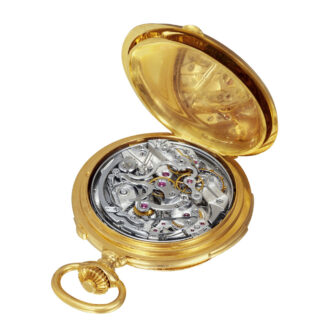
Historically interesting French gold repeating pocket watch Circa 1916
- Kenmerk
- TA1745
- Diameter
- 47 mm
- Estimate
- € 30.000 - 50.000
- Price sold
- € 36.000
Gold watch with split-seconds chronograph and register
–
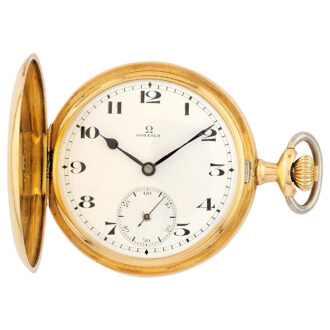
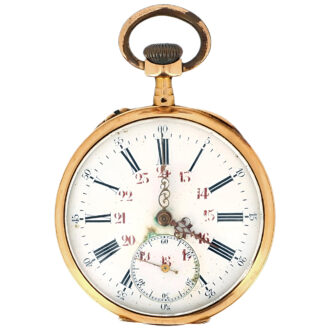
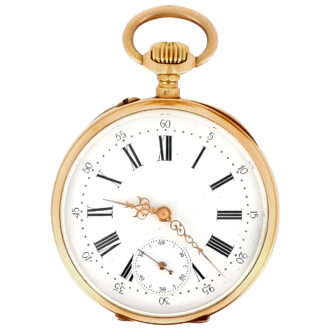
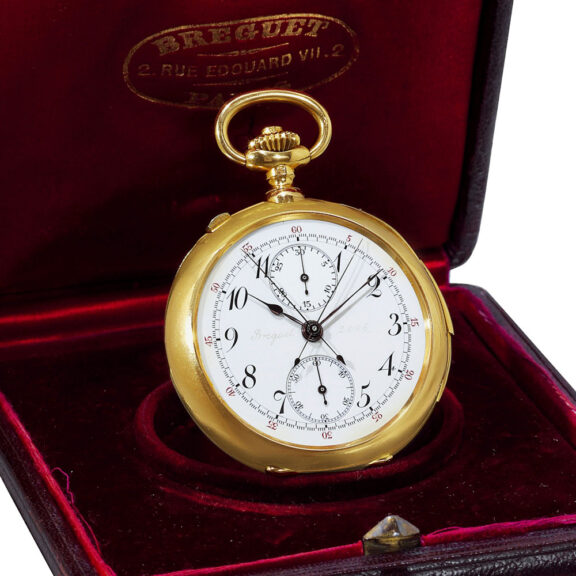
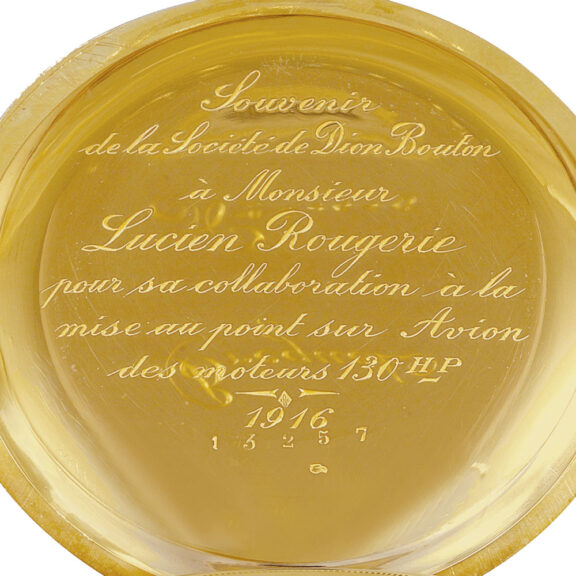
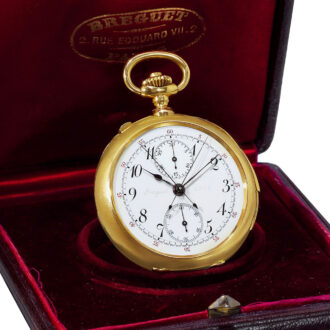
A very fine and historically interesting French, 18k gold minute repeating, a keyless pocket watch with split-seconds chronograph and register, circa 1916. Sold to De Dion Bouton for presentation to Lucien Rougerie. Given by the De Dion Bouton Company in recognition of the help of Lucien Rougerie in developing a 130 horse-power engine for aviation use. Accompanied by a certificate. A polished case, the back cover with an engraved monogram, the interior with engraved inscription. The inscription in the back of the case reads: Souvenir de la Société de Dion Bouton a Monsieur Lucien Rougerie pour sa collaboration à la mise au point sur Avion des moteurs 130 HP – 1916.
–
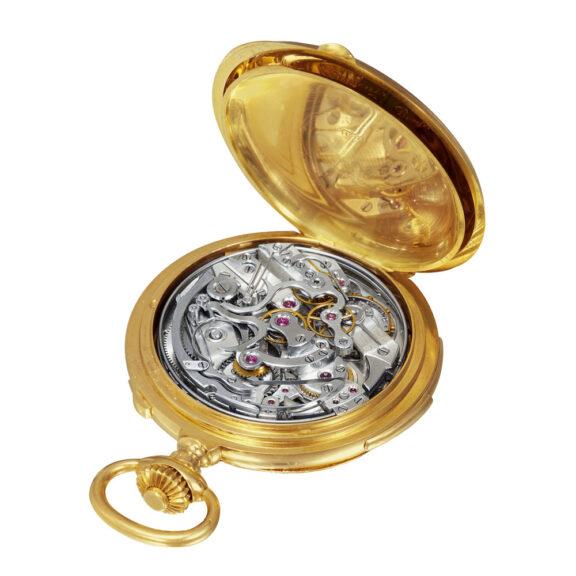
Hinged gold cuvette, white enamel dial, Breguet numerals, outer minute track, outermost fifths of a second chronograph division with five-minute/seconds red Arabic numerals, 30-minute register at 12, subsidiary sunk seconds at 6. Blued steel spade hands. A rhodium-plated movement, Geneva striping decoration, 35 jewels, wolf’s tooth winding, calibrated straight-line lever escapement, cut bimetallic compensation balance with blued steel Breguet balance spring, index regulator, visible chronograph mechanism, split-seconds mechanism under the dial, repeating on gongs activated by a slide in the band. Dial and case signed.
–
Diameter: 47 mm
–
Signed: Breguet Paris
–
Lucien Rougerie was born on December 5, 1885, in Limoges, where his father, Pierre Rougerie, had a furniture factory. The young Lucien was calm and reserved and was a good student at the Limoges high school. Afterwards, he trained as a cabinetmaker and began working in his father’s firm. His father entrusted him with the maintenance and improvement of the machines in the workshop. Like many of the early pioneers in aviation, Rougerie was interested in the arts as well as sports. He enjoyed bicycling, motorcycles, automobiles, sailing, and swimming. It is not surprising that he became interested in aviation from the start. On November 30, 1911, he obtained his brevet as a pilot, flying an aeroplane made by Maurice Farman. Rougerie, who was extremely interested in the technical aspects of aviation, was soon engaged by the Farman brothers as a pilot. His calm demeanour and natural authority, as well as his technical knowledge, quickly allowed him to achieve the status of director of the Farman school in Villesauvage near Etampes.
–
There he married Madeleine Giraud in 1912. The couple had one daughter. In 1914 Lucien Rougerie was made director of the Farman aerodrome in Toussus-le-Noble. During the war, he established many aerodromes for the Farman company, that were used by military aeroplanes. After the war, the Farman brothers turned their attention to civil aviation. At this point, Rougerie, concerned with heightened security in aviation, developed a system of flying without visibility. In 1928, he created a school that taught the technique and founded a school of aviation in Toussus-le-Noble, which met with great success. The most renowned pilots, both French and foreign, tried out his ground-testing system, the ancestor of flight simulators. In 1929, the French Aeroclub awarded Lucien Rougerie a medal for his contribution to security in aviation. He registered a patent in 1922 for a system that gave a visual warning of flat tires that was particularly intended for automobiles. As the inscription on this watch attests, he was involved in the development of aeroplane motors. Lucien Rougerie died tragically on December 12, 1929, when a storm blew the roof off the Farman hangar in Toussus-le-Noble. He was 44 years old.
–
The Marquis de Dion (1856-1946) count Jules-Albert de Dion (he became a marquis upon the death of his father) was a pioneer of the French automobile industry, and a politician. Born on March 9, 1856, in Carquefou near Nantes, he died on August 19, 1946, in Paris. In the days when French aristocrats did not work, and certainly not in engineering, Count Albert De Dion formed a partnership in 1883 with the brothers-in-law Georges Bouton and Charles Trépardoux, to make steam-powered vehicles. De Dion, Bouton and Trépardoux founded the De Dion-Bouton company in Puteaux, and for a brief period, they became the most important automobile manufacturer in the world. After the First World War, they also became the most important maker of rails for the railways. De Dion wanted to make cars that were simple and reliable, performed adequately, and was relatively inexpensive. Steampowered vehicles did not really meet these objectives. However, the high-speed internal combustion engine developed by Bouton in 1895 was soon to make this objective possible. These engines powered the Parisian firm’s mass-produced motor tricycles and they were sold in the thousands to other motor vehicle makers the world over. In 1898 De Dion created the Automobile Salon and co-founded the Automobile Club de France and the Aéro-Club de France. In 1900 he created the newspaper “L’Auto”.
–
His first creation was a dog cart, a steam vehicle capable of attaining a speed of 50 km/h, followed by a succession of tricycles and cars of increasingly better design. The company’s first gasoline-driven automobile featured an engine capable of 200 r.p.m. That engine was sold to several manufacturers: Renault, Delage, Corre, Clément, and Phébus in France, and Pierce-Arrow and Peerless in the United States. In 1898, De Dion wagered 400 francs that in less than two months he could design and build a car that was able to go from Paris to Rouen and back at an average speed of more than 15 km/h. That same year, he also founded the automobile manufacturer’s union – of which he remained President until 1926 – and created the Aéroclub. In 1899, the famous De Dion axle was developed. Over the next ten years, the firm was to produce some outstanding cars: an 8- horsepower two-cylinder vehicle in 1903; a four-cylinder model in 1905; and a V8 in 1910, the latter being one of the first luxury cars to be made in a series. In 1927, after negotiations with Peugeot and Mercedes, the business passed into German hands in 1927, and although an 8- cylinder, 16 horsepower car was produced in 1930, the firm ceased operations in 1932. The Marquis de Dion, a man of considerable vision, predicted and championed the future of the automobile from its earliest days. As early as 1906, he wrote an article entitled The Automobile, Queen of the World.
Signed: Breguet Paris
Share this page: