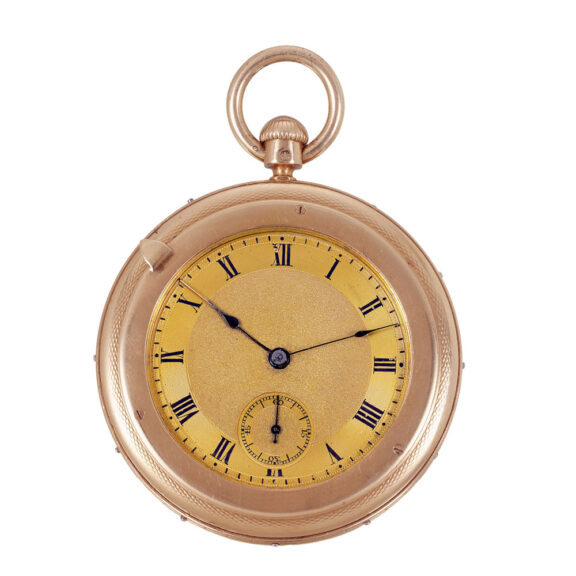
Important English 18 Carat gold watch with à tact option Circa 1851
- Kenmerk
- TA1469
- Diameter
- 48 mm
- Estimate
- € 7.000 - 12.500
- Price sold
- € 7.450
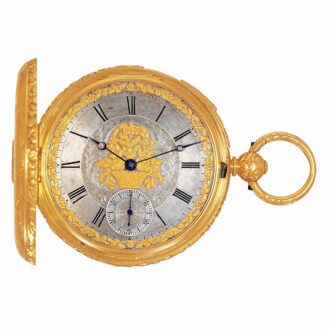
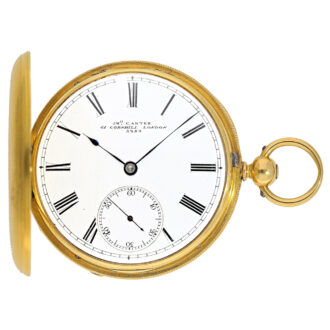
Gold open faced lever pocket watch
–
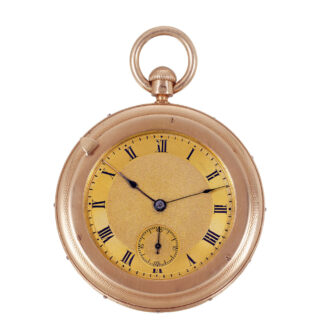
A very fine and important, thin English, 18 Carat gold pocket watch, circa 1851. With very early Adolph Nicole patent keyless winding mechanism and à tact option. English Montre à Tact London hallmarks for 1851. Engine turned and polished, the band with hour and quarter hour à tact markers, the bezel with à tact ring with pointer, small domed winding crown.
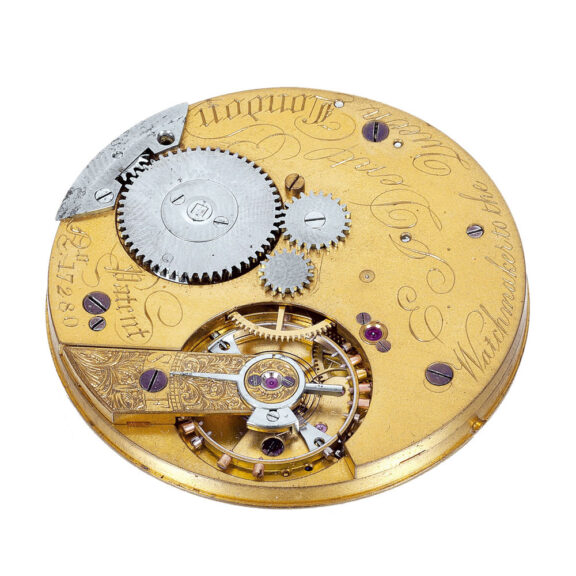
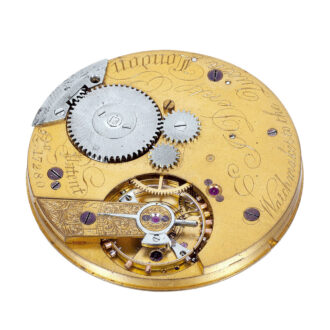
Gold dial with blue painted radial Roman numerals, outer minute divisions, subsidiary seconds, matte centre. Blued steel spade hands. A frosted gilt movement, three quarter plate, Adolph Nicole’s patent winding system with coasting, lateral lever escapement, cut bimetallic compensation balance, flat blued steel balance spring and an index regulator.
Movement signed.
–
Diameter: 48 mm
–
Signed: Edward John Dent, Watchmaker to the Queen, London
–
The present watch is extremely unusual for two reasons: it is very rare to find an English made watch with a tact option, especially on an open faced watch. The watch is very thin for its type and the design obviously derived from Breguet is very pleasing. The date of the hallmark of this watch 1851 is possibly significant as this was the year of the Great Exhibition in Hyde Park. With the very unusual design and the use of Adolph Nicole’s winding system, it is perhaps not too fanciful to suggest that the watch was made for an exhibition. The design for stem winding used in this watch is English patent No. 10348 of October 14, 1844. This pre dates by a few months Adrien Philippe’s French Patent of his first winding system but of course, Philippe’s system did not require a separate button for the hand setting. Adolph Nicole’s English Patent No. 10348 includes a chronograph mechanism and two keyless winding mechanisms, one for watches with fusee and chain and the mechanism used here. The crown must be rotated clockwise, it can rotate freely when the crown is turned anti clockwise (coasting) so that the hands may be moved forward when the handset is engaged. If the hands were to be moved backwards the watch would be wound at the same time. Thus the hands cannot be moved backwards when the watch has just been fully wound. Edward John Dent (1790-1853) A celebrated maker, worked with Richard Rippon around 1810 and on his own account in 1814. The firm of Arnold and Dent was working between 1830 and 1840 after which he worked alone. He made the clock for the Royal Exchange and received the order to supply the clock for Big Ben which was completed by his stepson Frederick.
Signed: Breguet
Share this page: