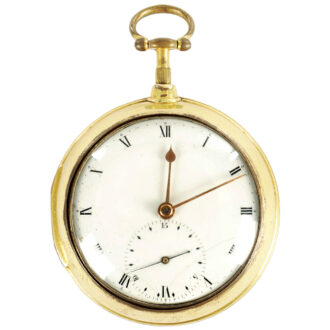
Extremely rare gold French quarter repeater Circa 1720
- Kenmerk
- SA1554
- Diameter
- 57 mm
- Estimate
- € 30.000 - 60.000
- Price sold
- € 44.450
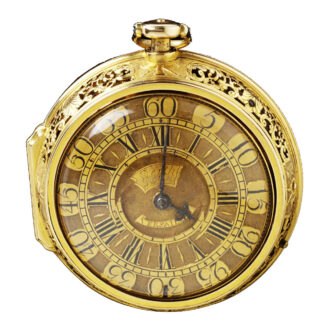
Extremely rare gold quarter repeating verge
–
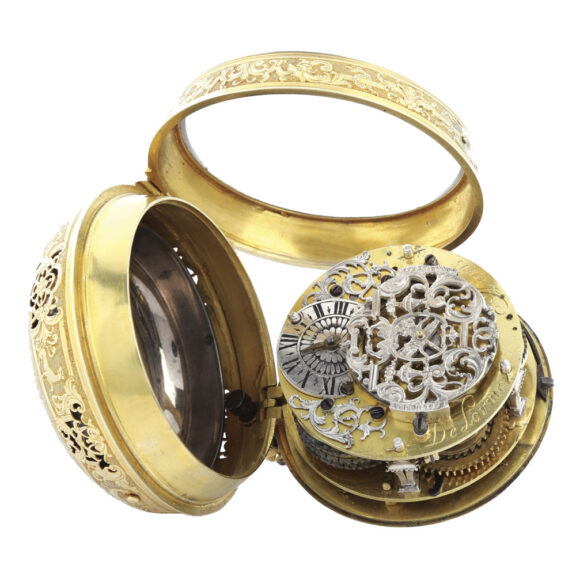
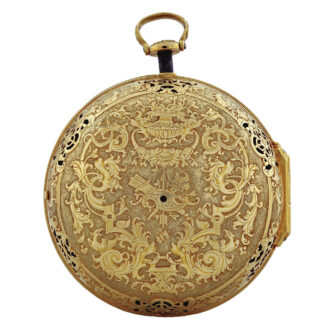
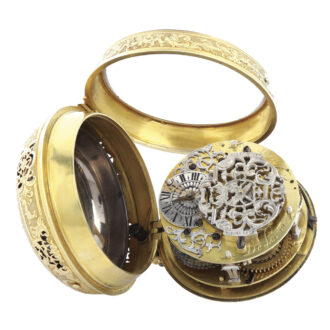
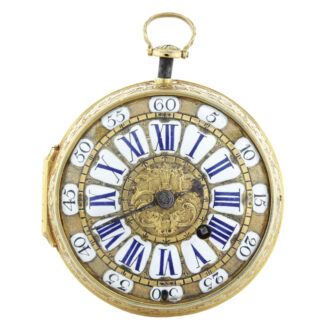
An extremely rare gold French quarter repeating oignon verge watch, circa 1720, gilt full plate verge movement, pierced and engraved balance bridge, fusée and chain, baluster pillars, silver regulation dial, the hammer striking on a bell for the repeating mechanism, signed on the plate Delorme Paris, gilt brass chased plate, Roman numerals set on.
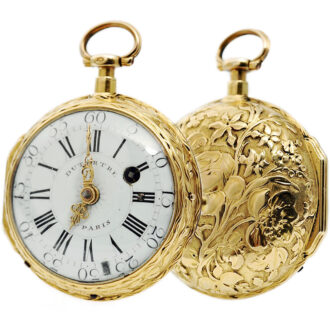
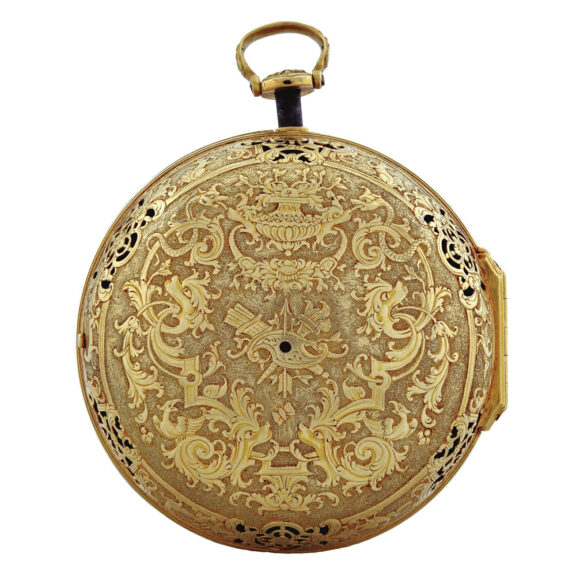
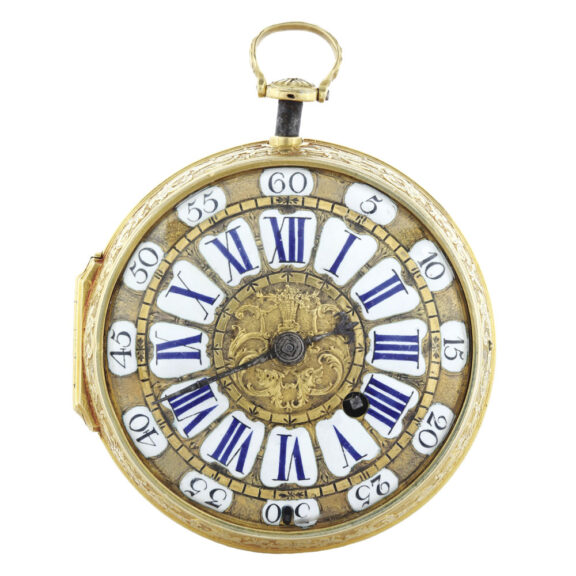
White enamel cartouches for the hours, outer Arabic numerals on white enamel cartouches for the minutes, the centre engraved with scrolls, gold case with an impressive foliage decoration to the band, pierced and engraved for sound of the reating mechanism on the edge of the case back, the back with a typical Louis XIV decoration, showing in the centre a trophy and finely chased figures all over, the pendant used to activate the repeating mechanism movement signed, bell stamped BIO.
–
Diameter: 57,5 mm
–
Signed: Delorme Paris
–
This watch example is one of only four 18th Century gold oignon watches. The others include one signed by Gloria, Rouen and illustrated on the cover of Watches, by Clutton and Daniels. A clockwatch by Baltazar (II) Martinot is now exhibited at the Patek Philippe Museum. The last one, signed Francois Joseph Camus is illustrated in Les Montres et Horloges de Table du Musée du Louvre, Catherine Cardinal.
Oignon watches were made following the most significant milestones in watch history, Christian Huyguens’ invention of the balance spring. This device for accuracy in timepieces resulted in the birth of a new type of watches such as the oignon watch made in France from 1685 to 1725. Watchmakers in France modified the dimensions to a bulbous shape, hence the name oignon. The typical shape of this watch was also adorned in some examples with specific decorations inspired by the work of famous French artists from the period such as the Bérain or the chaser and engraver Pierre Bourdon.
The upheaval caused by the Revocation of the Edict of Nantes (1685) forced Protestant watchmakers to seek refuge abroad, therefore halting technical watchmaking in France. Various European wars forced Louis XIV to order the melting of silver and gold, including oignon watches, in order to finance the war effort. The present watch is testimony of the greatness of French craftmanship from that time.
Signed: Delorme Paris
Share this page: