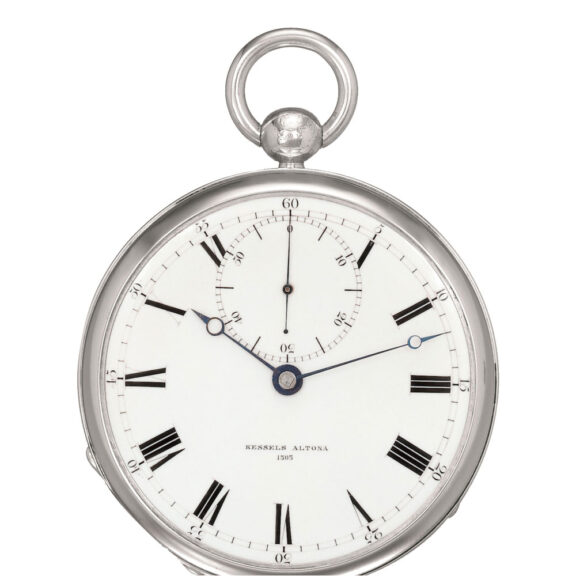
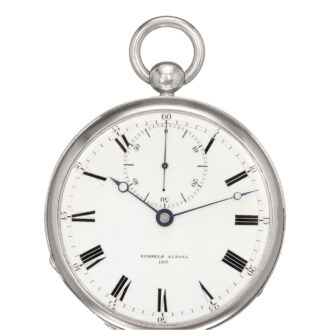
German silver chronometer marine deck watch Circa 1830
- Kenmerk
- TA1151
- Diameter
- 59 mm
- Estimate
- € 12.000 - 22.000
- Price sold
- -
Silver watch with pivoted detent escapement
–
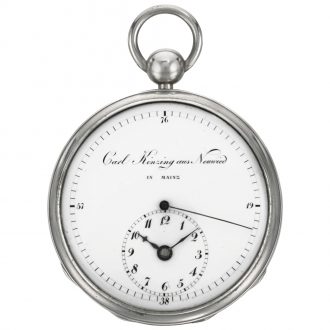
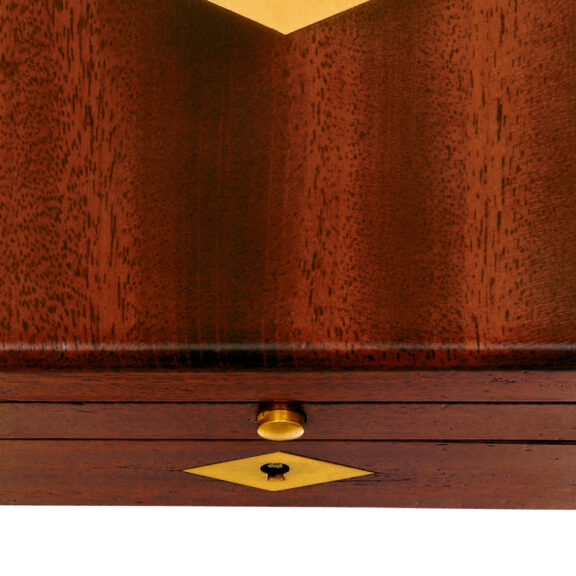
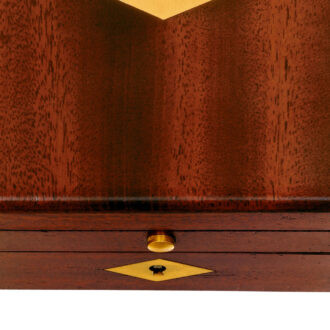
A very fine silver German pocket and deck chronometer in three-tier mahogany fitted display box by Kessels Altona, circa 1830. Silver hinged cuvette. White enamel dial, radial Roman numerals, outer minute track, five-minute Arabic numerals, large subsidiary seconds at 12. Blued steel Breguet hands.
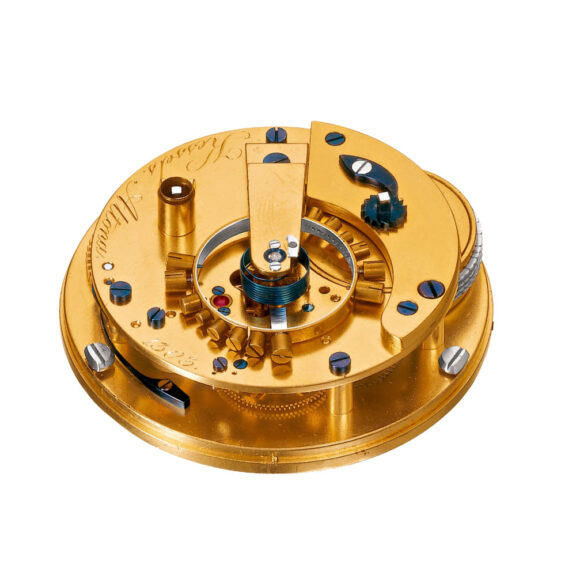
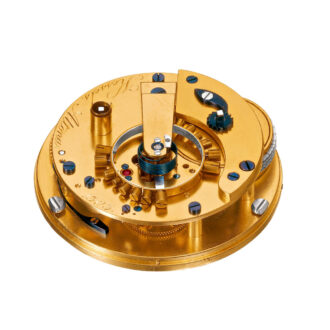
Full plate movement, frosted gilt, cylindrical pillars, fusee and chain with Harrison’s maintaining power, Earnshaw type spring detent escapement, cut bimetallic compensation balance with brass temperature screws and four brass mean time nuts, blued steel helical free-sprung balance spring with outer terminal curves, diamond endstone, escapement jeweled with endstones. Dial and movement signed.
–
Diameter: 59 mm
–
Signed: Heinrich Johannes Kessels Altona
–
Heinrich Johannes Kessels (1781-1849). He began his career as a blacksmith in Holland, his native country. Subsequently, he went to Paris and studied watchmaking with Breguet. Afterwards he went to England where he stayed with the Muston brothers, chronometer makers in Bristol. In 1821 he left for Copenhagen and secured the patronage of King Frederick VI, who induced him to settle in Altona, then Danish territory. Kessels had an excellent reputation, his contemporaries praising him highly. He was appointed chronometer maker to the Danish Navy, and became a member of the both the Royal Society of Sciences in Stockholm and the Mathematical Society in Hamburg. His chronometers show a strong English influence but are also very consistent with the Breguet style. Kessels also made observatory clocks with a Graham escapement that he modified, in which the anchor embraced only 6 teeth of the 30-tooth wheel. These were purchased by many observatories, including Kensington, Athens, Stockholm, Lund, Moscow, and Cracow.
Signed: Heinrich Johannes Kessels Altona
Share this page: