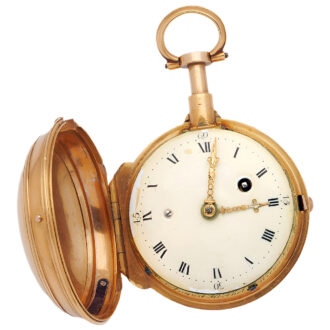
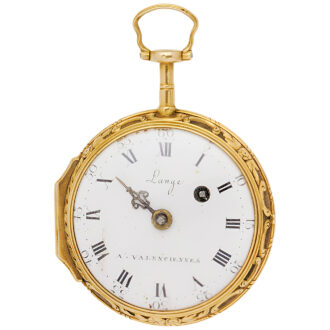
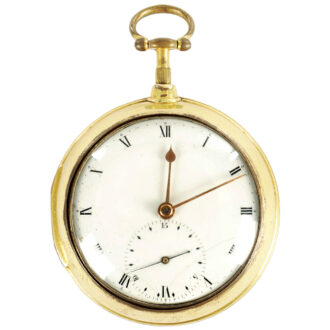
French large diameter and second beating balance Circa 1770
- Kenmerk
- HA0326
- Diameter
- 81 mm
- Estimate
- € 25.000 - 50.000
- Price sold
- € 28.700
Extremely rare large gilded brass portable marine timekeeper with locking case
–
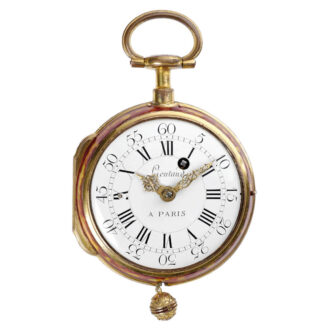
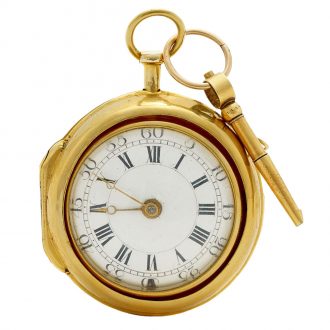
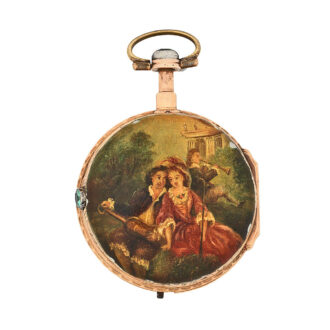
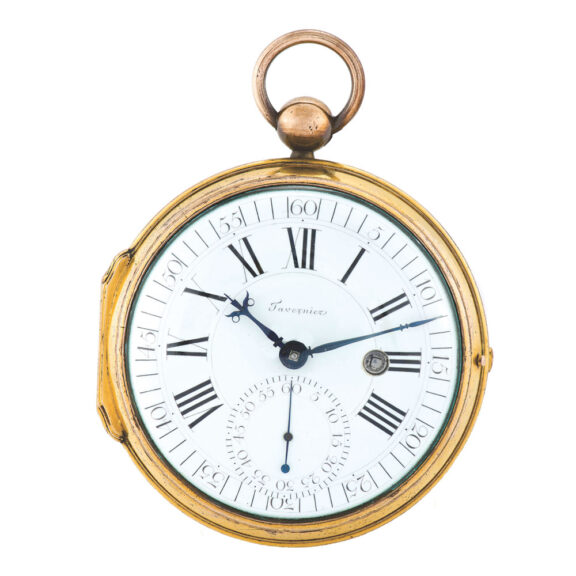
A very fine extremely rare and important large gilded brass portable marine timekeeper with a locking case and special case key, large diameter second beating balance, cylinder escapement with a large 60-toothed escape wheel for dead seconds with a stop feature. Made by Jean-Pierre Tavernier in Paris, France for navigational use, circa 1770. Two body, gilded brass and bassine with a deep back case. The movement can be locked into the case by means of a special bolt composed of a blued steel-toothed rack sliding to lock the case activated by a key with a pinion tip to mesh with the rack locking bolt, brass blocks inside the case secured by screws.
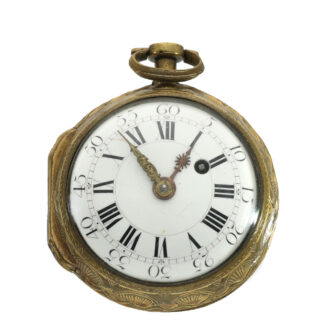
White enamel and convex dial with radial Roman numerals, outer minute divisions with Arabic five-minute numerals, subsidiary dead seconds with Arabic five-second numerals, winding aperture at 3 o’clock and fine blued steel beetle and poker hands.
–
Matte gilt movement with cylindrical pillars with flared ends, fusee and chain with Harrison’s maintaining power, steel stop work on the dial plate, cylinder escapement with 60-toothed brass escape wheel, the upper pivot jewelled, steel cylinder, the escape wheel pinion parallel mounted with another toothed wheel approximately 5 mm below the escape wheel, this wheel is for the stop feature and acted upon by a steel lever connected via a pivoted blued steel arm on the dial plate to the lever under the bezel, large diameter second beating steel three-arm balance with jewelled pivots, flat balance spring with a large blued steel rack and pinion regulation ring with corresponding silvered scale, very finely pierced, chased and engraved foliate continental balance cock, incorporated into the design are the initials ‘JPT’ for Jean-Pierre Tavernier, polished steel endplate with a jewel.
Dial signed balance cock pierced with Tavernier’s initials JPT.
–
Diameter: 81 mm
–
Signed: Tavernier
–
This substantial, well constructed and beautifully finished watch was evidently made for navigational use at sea. As such, it is a fascinating and extremely rare survival from the early period of the use of mechanical timekeepers for calculating longitude is perhaps the most intractable and difficult technological problem of the 18th century. The maker Tavernier was evidently very proud of this watch as he has incorporated his initials into the elaborate design of the balance cock. The movement can be locked into the case and once locked requires the special pinion-ended key to release it. This feature is provided so that no unauthorized person could interfere with the movement when in use. The dial and hands can be still accessed which suggests the likelihood that the watch was once housed in a lockable gimballed wooden box similar to the one surviving example for a watch of this period known as `La Petite Ronde` made by Julien Le Roy for navigational use at sea. Early marine timekeepers such as the present watch did not of course use the spring detent escapement which was not invented until around 1781 by John Arnold. Most of the watches designed for use at sea before the introduction of the detent escapement were fitted with a modified verge escapement including John Harrison’s H4 completed in 1759 which ultimately won the longitude prize in England. In France, the technical advances in timekeepers for marine navigation occurred more or less simultaneously with those being developed in England largely due to the fact that Ferdinand Berthoud was personally familiar with Harrison’s inventions. In France however, no standard form of marine timekeeper seems to have been made, each maker preferring his own particular form of construction. This resulted in quite a number of different calibres including the present watch which uses a cylinder escapement, the escape wheel having 60 teeth and the second beating balance therefore the seconds hand which is mounted on the escape wheel pinion gives dead seconds. Tavernier’s use of the cylinder escapement in this watch is interesting, the cylinder escapement whilst prone to shock damage and difficult to repair is otherwise quite stable and reliable and used in this watch perhaps for that reason, also the cylinder may have appealed to Tavernier as an experimental alternative to adapting a verge or other form of escapement. The fusee incorporates Harrison’s maintaining power, the balance is of very large diameter and the balance spring is a short spiral of steel with only three acting turns.
Jean-Pierre TavernierØ C. 1720 – AFTER 1804 Father of Louis and Pierre-Benjamin. He received Master on March 1, 1746 and established a shop in the rue de Bucy. He was particularly renowned for his watches, but also sold clocks, using cases by B. Lieutaud and F. Rémond. Among his clients was the Duc de Caylus. After Jean-Pierre’s death, his activity was continued by his son Louis.
Literature:
‘The Time Museum Catalogue of Chronometers’, Anthony G. Randall, 1991
‘Watches’, Clutton & Daniels, 1979, fig. 155d ‘La Petite Ronde’
‘Les Ouvriers du Temps’, Jean-Dominique Augarde
Signed: Tavernier
Share this page: