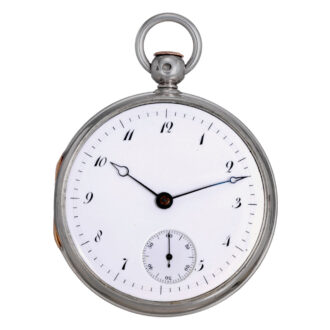
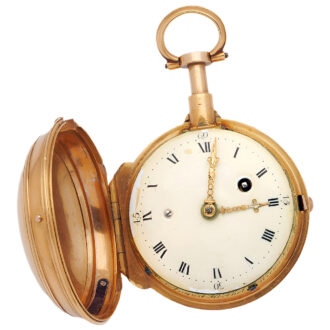
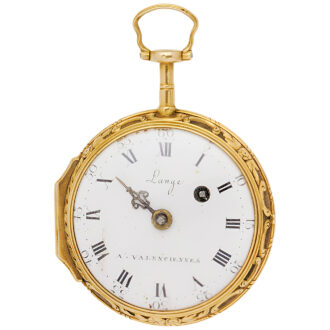
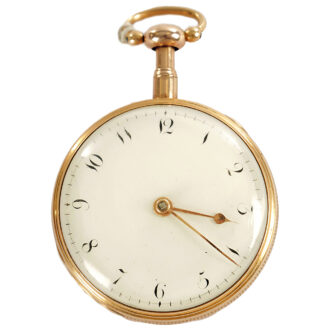
French quarter repeating calendar watch with moon phase Circa 1796
- Kenmerk
- AS1788
- Diameter
- 55 mm
- Estimate
- € 100.000 - 200.000
- Price sold
- € 187.500
Gold open faced lever watch by Breguet
–
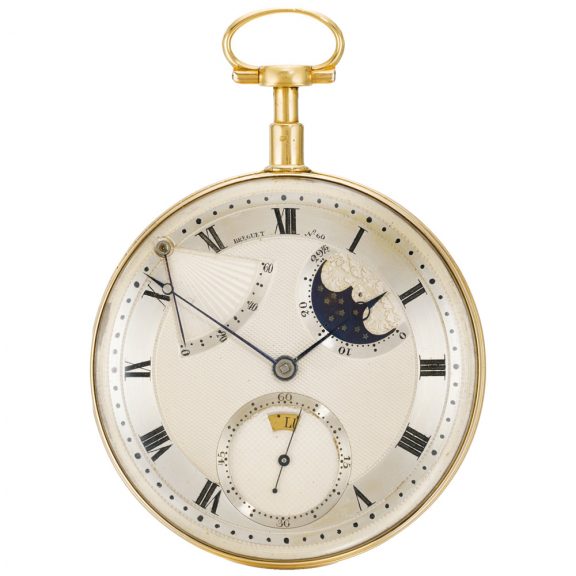
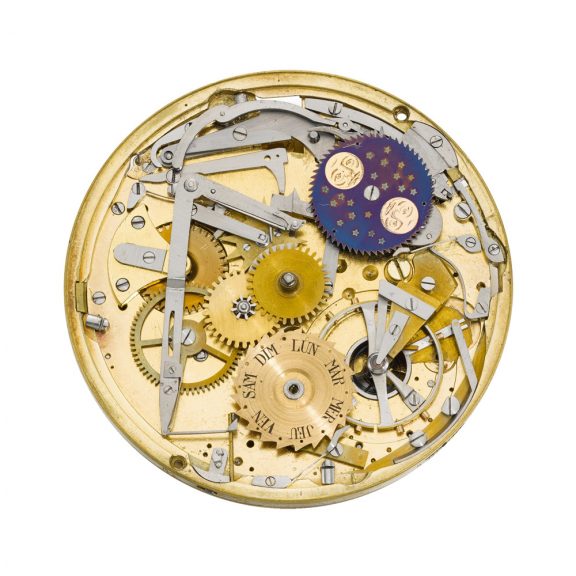
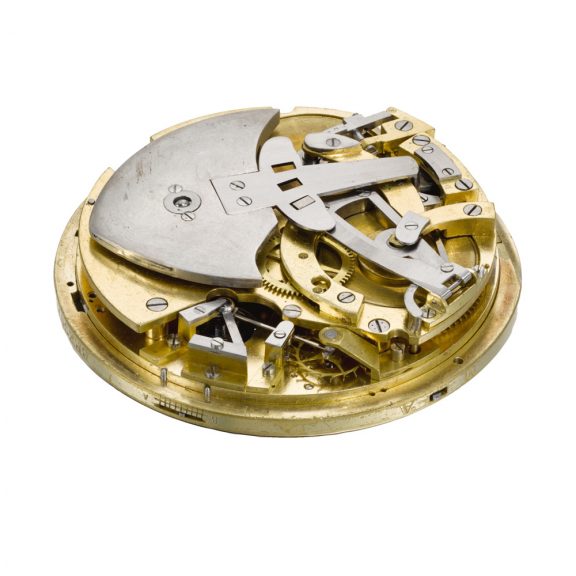
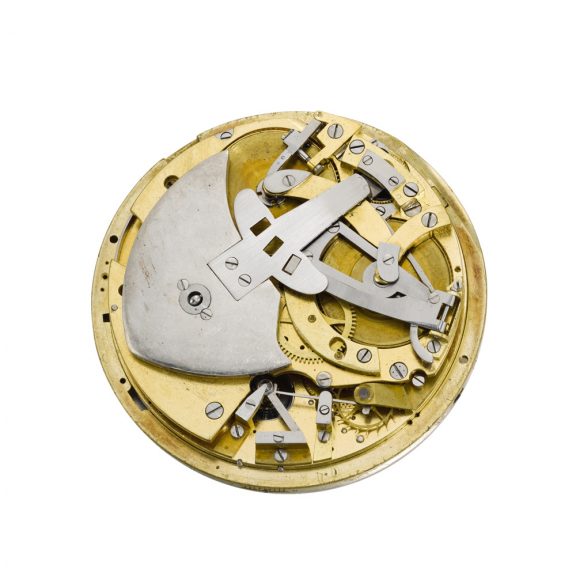
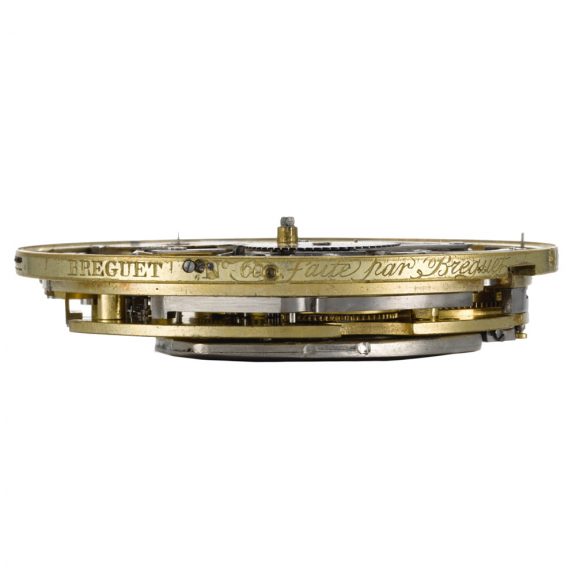
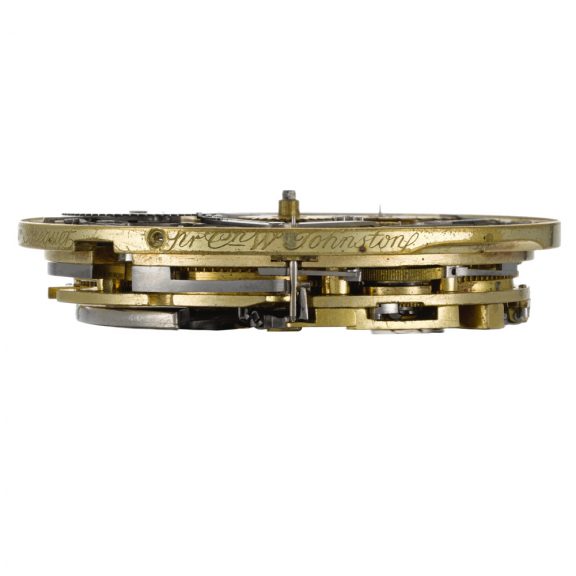
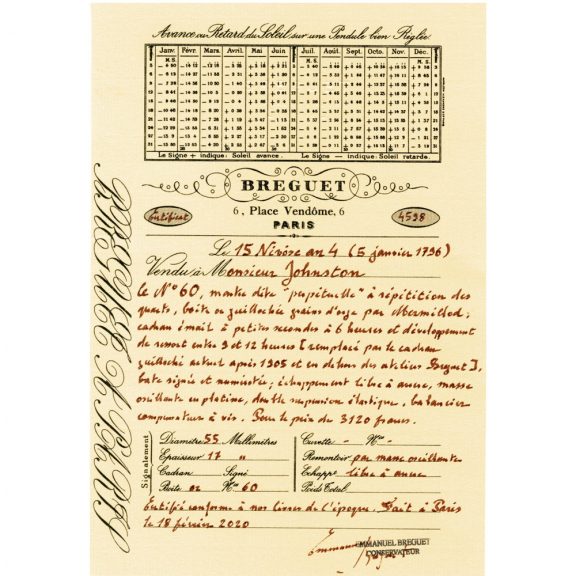
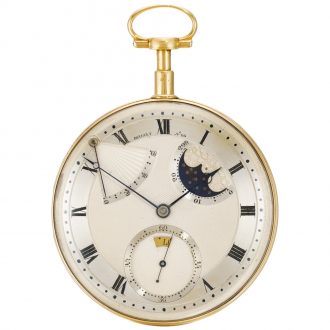
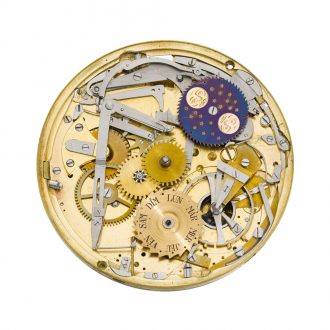
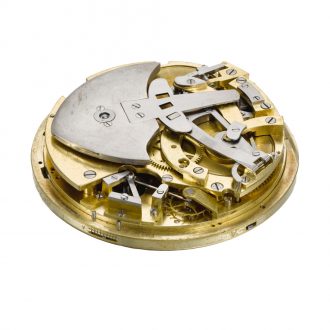
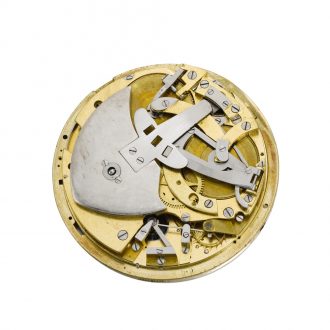
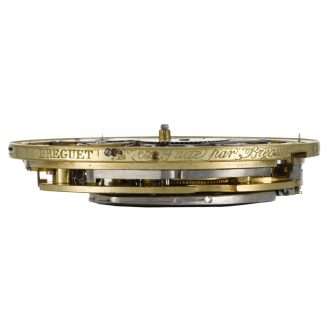
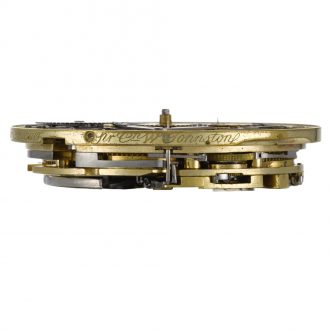
A rare French gold self-winding quarter repeating lever watch with moon phases, day of the week, and power reserve, circa 1796. This so-called pérpetuelle was sold to Monsieur Johnston on January 5, 1796, for 3,120 francs. This rare watch features a movement with several advanced components, including a lever escapement, helical spring with terminal curves and regulator, later compensation balance, double parachute suspension, and two going barrels wound by a large platinum weight. It also includes a repeating mechanism on the inside case back and is double signed to the rim as Breguet no. 60, faite par Breguet pr. Cn W Johnston (made by Breguet for Cn W Johnston). The dial, signed and numbered Breguet No. 60, is a later silver engine-turned dial replaced after 1905, with black Roman numerals, a radial engine-turned sector for power reserve, subsidiary seconds with an aperture for the day, aperture and sector for moon age and phases, and hands made of blued steel.
–
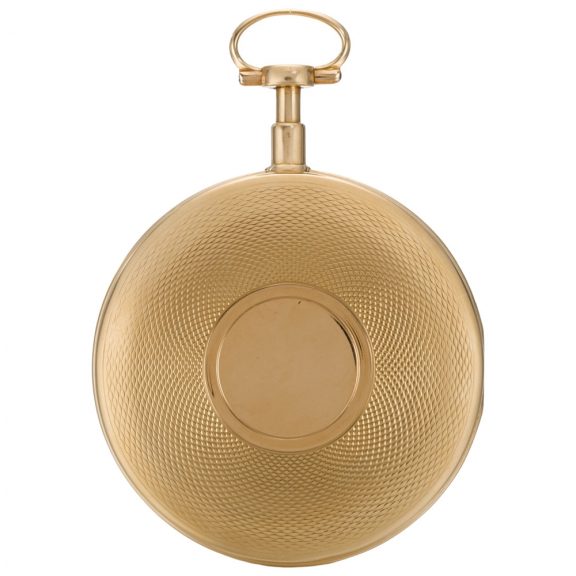
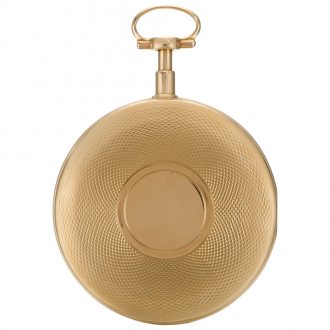
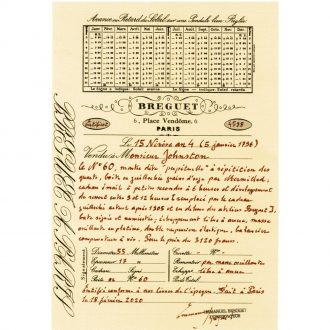
The case is made of gold, with a refinished engine turned back and band, and a polished vacant circular cartouche at the centre of the case back. Accompanied by a Breguet certificate dating back to 15 Nivose an 4 (15 January 1796) in the French Revolutionary calendar, with an additional certificate dated February 18, 2020. The certificate mentions that the dial was replaced outside the Breguet workshops after 1905.
–
Diameter: 55 mm
–
Signed: Breguet
–
The movement is not running, but the repeating function is operational. The dial and case are in bright and refreshed condition.
–
The self-winding watch, which emerged in the 1770s, presented an opportunity for Breguet to promote and expand his growing business. Recognising the potential of this new invention, Breguet developed his own version, called the perpetuelle. The earliest known perpetuelles, such as Breguet No. 2 10/82, date back to October 1782 and are believed to have been owned by Marie Antoinette. Breguet’s innovative contributions to the self-winding watch are further detailed in Daniels’ book, “The Art of Breguet.”
–
Breguet’s early self-winding watches faced criticism for their inability to stay efficiently wound during normal use, often requiring significant and prolonged motion by the wearer to charge the mainspring sufficiently. Breguet’s solution involved incorporating two mainsprings, which were wound together by a heavy platinum weight pivoted at the edge of the movement. The banking springs, positioned at each end of the pendulum-form weight’s arc of motion, had particularly flexible ends to maximise the weight’s motion. George Daniels’ examination of Breguet’s perpetuelle system revealed that “about a mile of gentle walking will fully wind the watch, and this is borne out in practice. The buffer springs for the weight have thin, flexible ends to aid the oscillations, and with their assistance, a brisk walk of less than half a mile will also fully wind the mainsprings” (George Daniels, The Art of Breguet, p. 344).
–
Breguet first introduced his parachute shock protection device in the perpetuelles, which positioned the balance staff between two jewelled bearings set at the ends of fine springs. This system aimed to prevent shock to the staff caused by the motion of the perpetuelle’s weight buffeting off its springs.
–
As per the Breguet certificate, the original enamel dial of the watch was later replaced with the current silver, engine-turned dial, which was a common practice for damaged enamel dials. The records indicate that the replacement of the dial took place outside the Breguet workshops after 1905. When the watch was sold at Sotheby’s in 1978, it was housed in a red Morocco box provided by the retailer Desoutter. Desoutter likely arranged for the dial replacement and refurbishment of the watch case between 1905 and 1920. It is also possible that the day of the week and moon phase indications were added during the same period, as they are not documented on the Breguet certificate.
–
“Breguet did not invent the perpetuelle, but he certainly did perfect it.” George Daniels, The Art of Breguet, 1975, p. 63.
Signed: Breguet
Share this page: