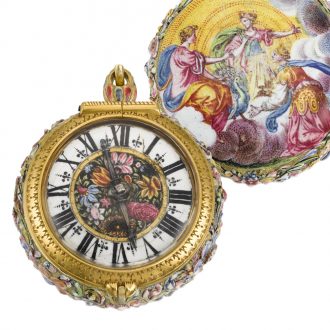
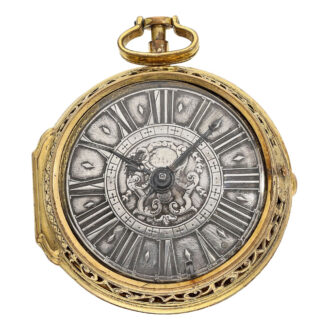
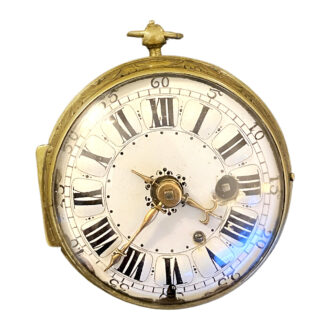
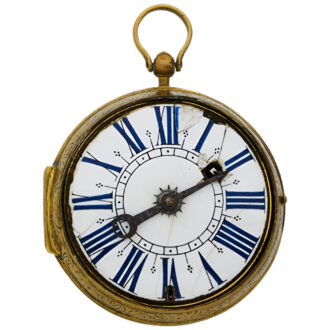
German single hand gold and enamel pendant watch Circa 1680
- Kenmerk
- AD9220
- Diameter
- 36 mm
- Estimate
- € 70.000 - 120.000
- Price sold
- € 99.600
Gold verge watch with painted enamel portrait by Michael Hoffrichter
–
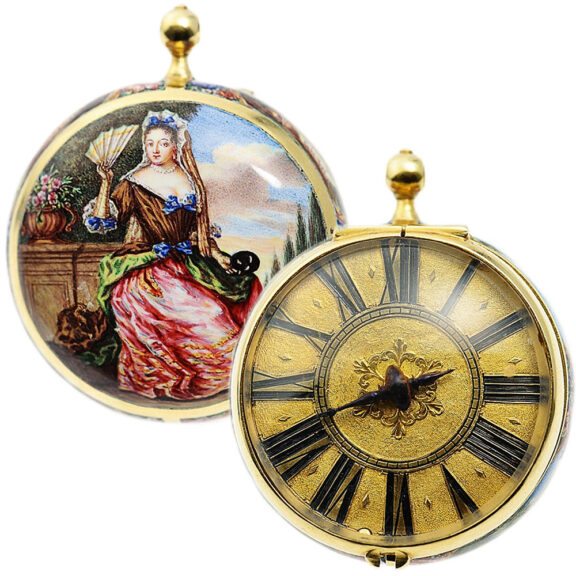
An important French 20K gold and enamel open faced single-handed verge pendant watch of museum quality, circa 1680.
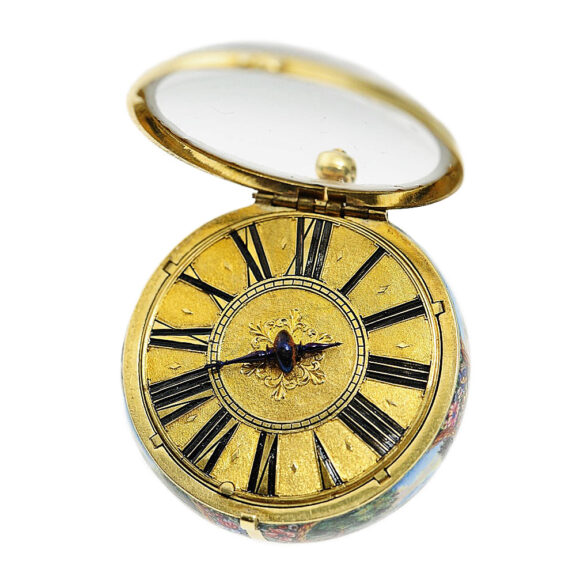
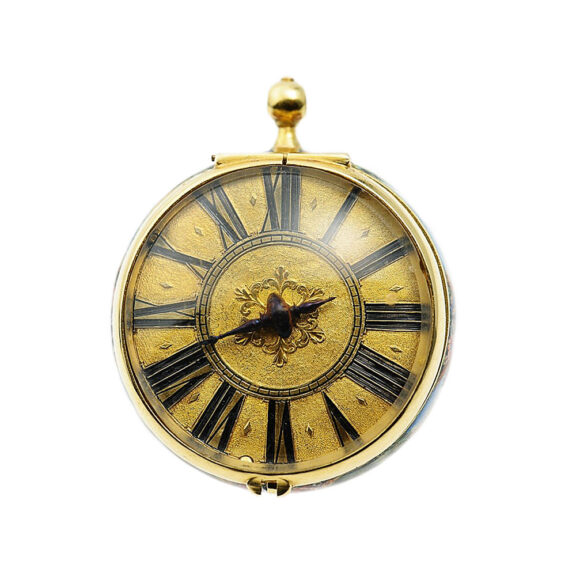
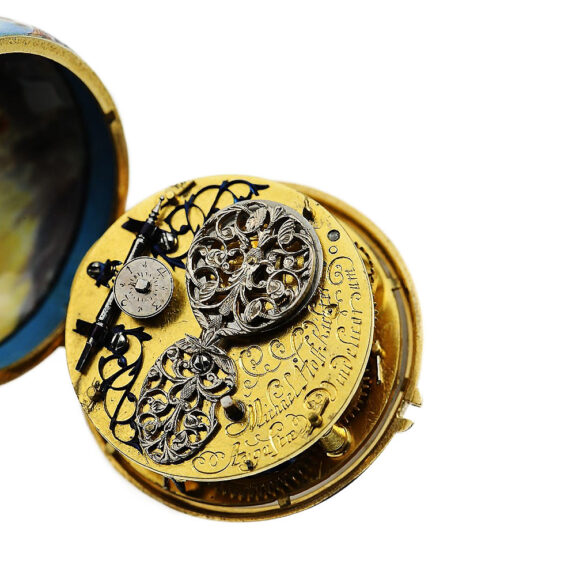
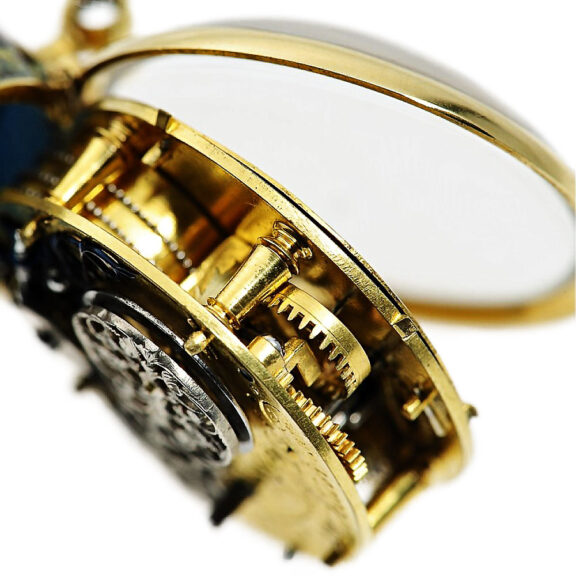
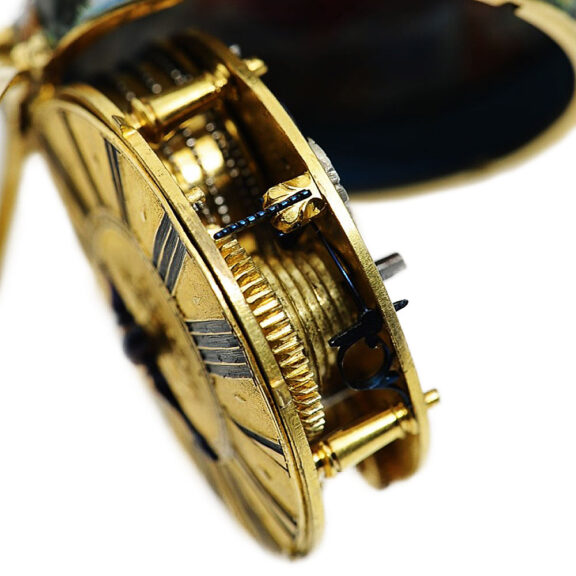
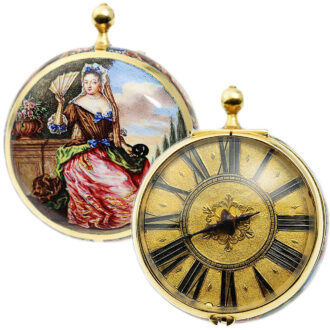
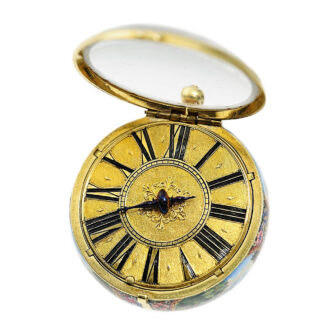
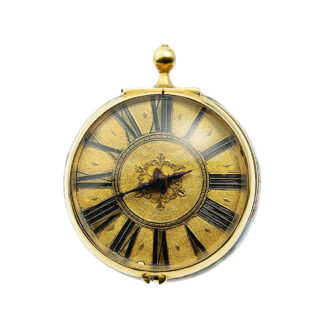
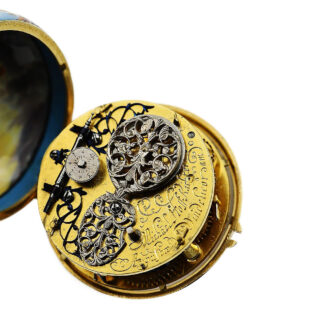
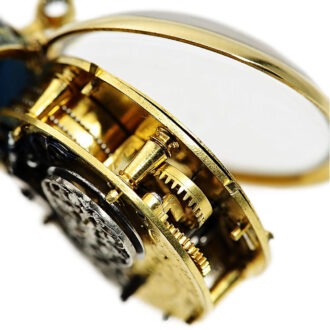
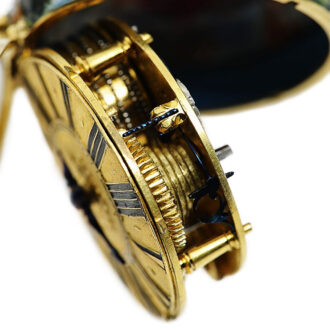
Signed gilt full plate movement with early chain and fusee, keywind, worm-and-wheel set-up, baluster pillars, four-wheel train with verge escapement, steel foliot without balance spring, oval pattern silver foliage engraved and pierced balance cock, pierced blued steel brackets, engraved silver setting disc. Gold champlevé dial with inlaid radial Roman numerals, half-hour markers, foliage engraved centre and blued steel single hand.
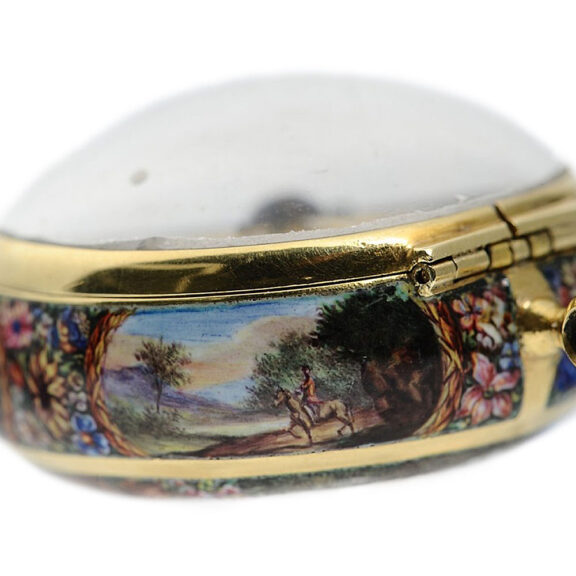
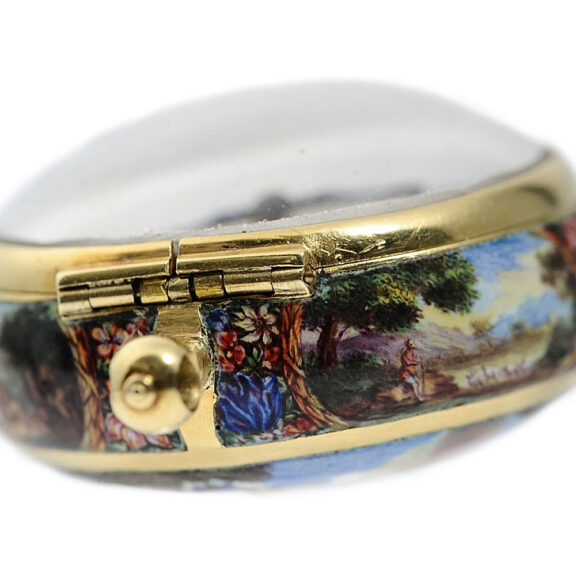
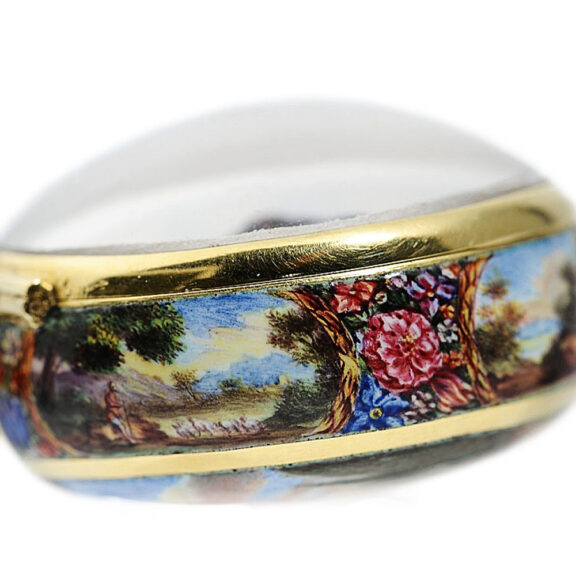
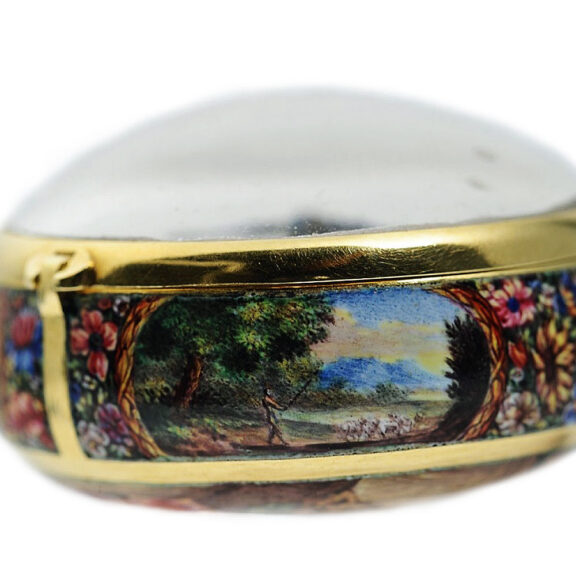
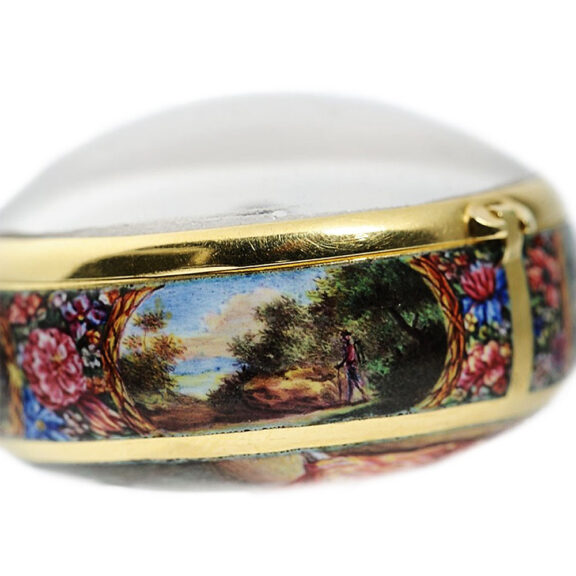
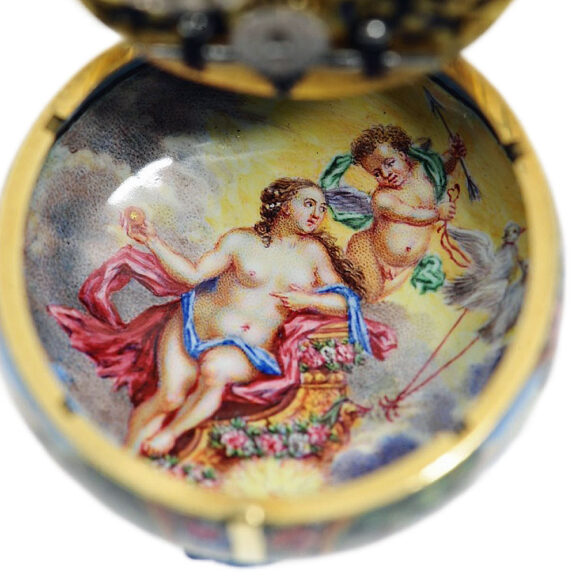
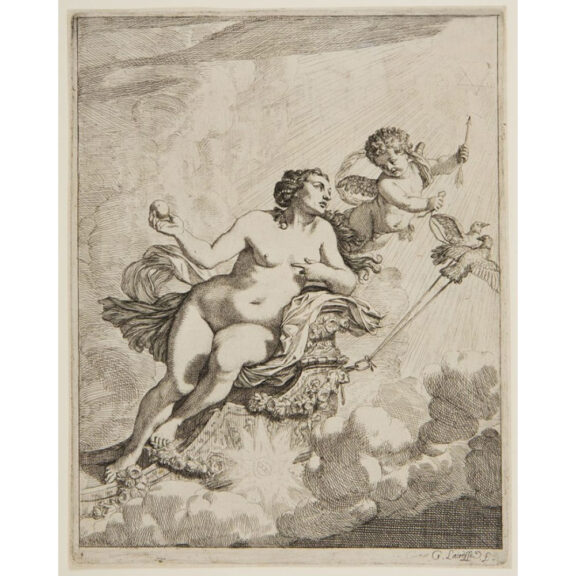
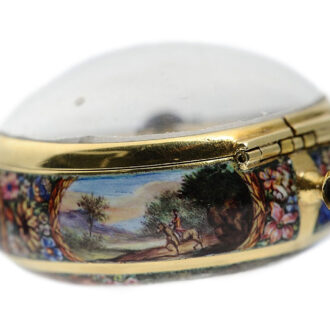
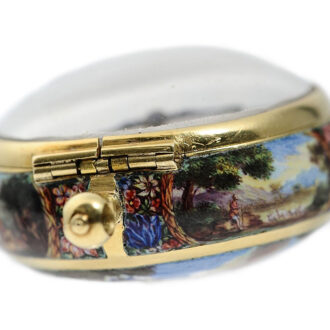
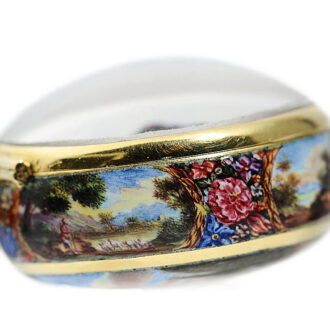
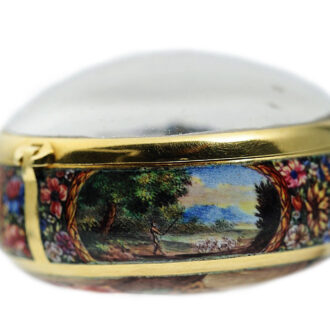
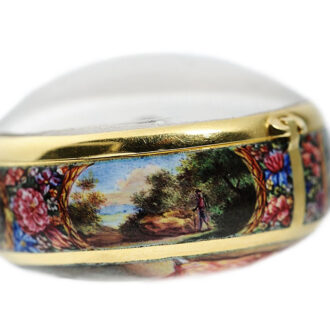
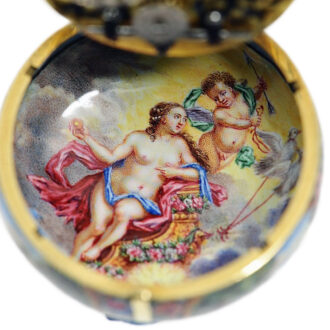
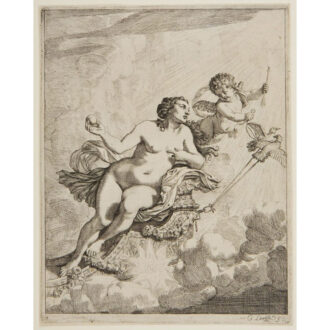
A portrait painted in a pointillist technique of a lady in a Spanish-inspired costume on the case back, a red silk skirt with trimmings, a brown top adorned with blue bows and a brown velvet train with green lining, the lady further wears a white lace bonnet with a blue bow, a veil, pearl earrings and long gloves, the very low-cut dress is emphasised by a pearl necklace, in her right hand she holds an open fan, in her left a black theatrical mask, she is seated in a park next to a pedestal with a bowl of flowers, a park landscape and an alley of trees in the background, the rim of the case is divided into cartouches with bouquets of summer flowers, four cartouches with country scenes depicting a horseman, wayfarer and two shepherds, on the inside of the lid a polychrome painting of Venus in a chariot drawn by doves, in the company of her son Cupid with his love arrow who holds the reins of the chariot after an engraving by Gérard de Lairesse of circa 1675.
–
Diameter: 36 mm
–
Weight: 48 g
–
Signed: Michael Hoffrichter Augustae Vindelicorum
–
This watch was made in Augsburg. It is not only the movement that was created there but also the exquisite enamel painting that is a fine example of German enamel art at the end of the 17th century, although we do not know who the enamel painter of this watch was.
–
Hans Boeckh the former curator of the Patek Philippe Museum in Geneva, states that in addition to the well-known strongholds such as Geneva, Blois or Paris, Augsburg was, by all means, another such centre. Boeckh considers it only fitting to speak of an independent ‘Augsburg school’. Unfortunately, examples of Augsburg enamelling are rare, only a few pieces have survived. The iconography used in Augsburg is different from that in Geneva, Blois or Paris. The enamellers in these cities usually took their inspiration from important works of old masters and often created portraits of illustrious personalities from engravings or paintings by famous painters of the 17th and 18th century. This portrait of a lady is different. The details in the painting, however, should indicate who the person in the painting is. The motif does not tell a story. To make a statement, the overall context must be considered. A great significance is attached to the counter enamelling, the inside of the watch shows a naked Venus, the personification of amorous desire. Venus sits in a chariot drawn by two doves and her son Cupid holds the rains. Cupid with his love arrow stands for falling in love. The watch was without a doubt custom made for an important customer who wished to immortalize his beloved. At first glance, the lady on the back of the case seems to be wearing a Spanish-inspired robe. She is holding a fan and a mask in her hands, accessories that are inevitably creating a reference to the person. Up to the 19th-century fans were considered a luxurious accessory and were as such a token of regality, folding fans, however, were an allegory of the volatility of women. The mask symbolizes duplicity but also alludes to the theatre and easy living. The lady wears what seems to be a sumptuous outfit made of silk, velvet and pearls, the bows on her dress are royal blue, these are signs that indicate a person of high rank. However, the combination of the dress with the contrived stance somehow reminds the viewer of a masquerade, the effect is intensified by the almost frivolous and unusually low-cut dress. All these details add up to the conclusion that the lady in question may have been an actress or even the mistress of a high-ranking gentleman. One of the most celebrated thespians of the time was Margaret Hughes, who is regarded as the first professional performer in England. She was also known to be the beloved mistress of Prince Rupert of the Rhine (1619-1682).
–
Margaret Hughes (1630-1719) was famous for her charms and her beauty. The great diarist Samuel Pepys describes her as a ‘mighty pretty woman’ and she was considered ‘a great beauty, with dark ringletted hair, a fine figure and particularly good legs’. In the late 1660s, Prince Rupert of the Rhine fell in love with her. The Prince was one of the most senior members of the royal family and his patronage allowed Hughes to advance quickly, she became a member of the King’s Company in 1669.
–
Venus is the Roman goddess of love, originally the ancient Italian goddess of vegetation, and protector of gardens and vineyards. Later she was identified with the Greek Aphrodite. She was born from the foam of the sea. Venus was often depicted in Roman culture as a woman with a round object in her hand, for example, an apple or a mirror, but sometimes also with Cupid (the Roman god of love) or Victoria (the personified Roman goddess of victory) on her hand and also with a rudder or a dolphin. She was a favourite subject for many artists in antiquity too.
–
In classical mythology, Cupid (also Amor) is the god of desire, erotic love, attraction and affection. He is often portrayed as the son of the love goddess Venus and the god of war Mars.
–
Michael Hof(f)richter was born around 1647 in Oberpeterswalde, Schlesien. He was established as master in 1670 and died around 1702.
–
Gérard (de) Lairesse (1641-1711) was a Dutch Golden Age painter, etcher, mezzotint engraver and art theorist. His broad range of talent included music, poetry and theatre. De Lairesse was born in Liège and was the second son of painter Renier de Lairesse (1597-1667). He studied art under his father and from 1655 at Bertholet Flemalle. He worked in Cologne and in 1660 in Aix-la-Chapelle (district Aachen) for Maximilian Henry of Bavaria (1621-1688), Archbishop-Elector of Cologne, Bishop of Hildesheim and Bishop of Liège. Hence it is clear, that de Lairesse was known in Germany at that time.
Signed: Michael Hoffrichter Augustae Vindelicorum
Share this page: