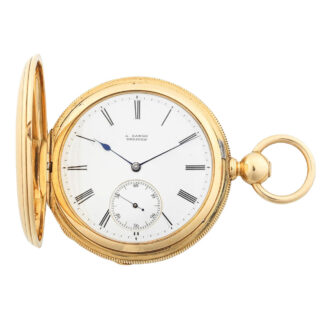
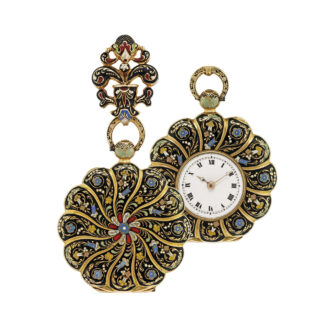
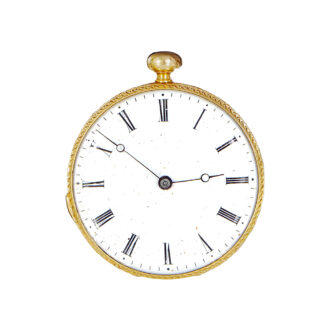
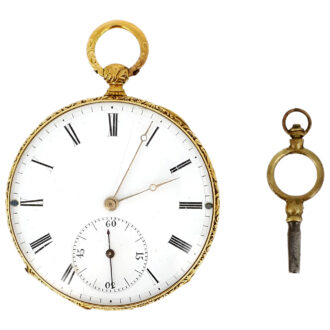
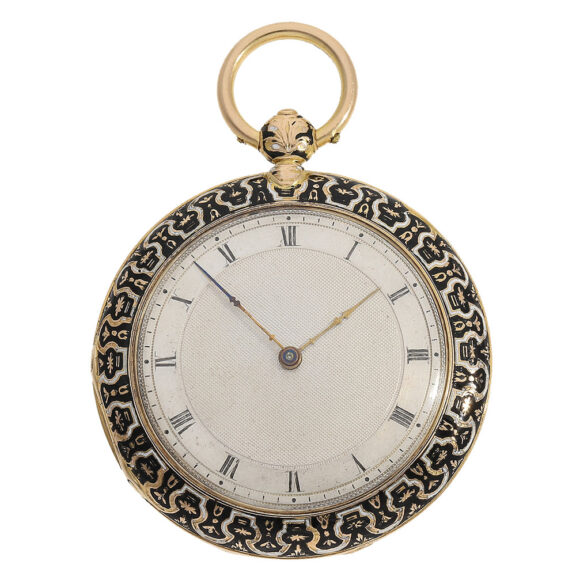
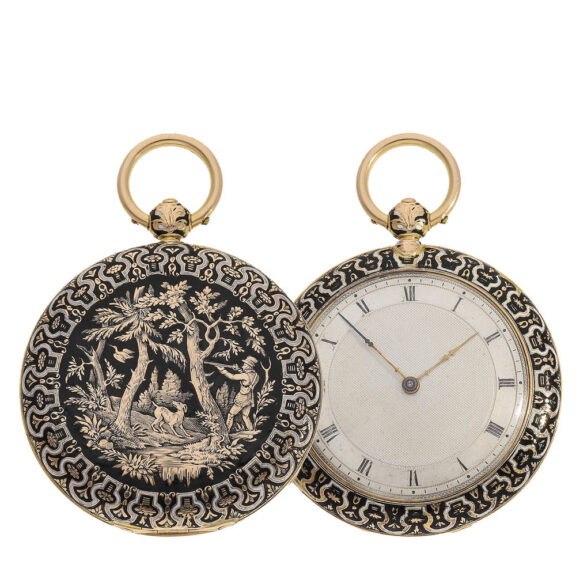
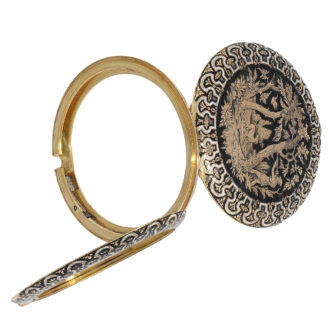
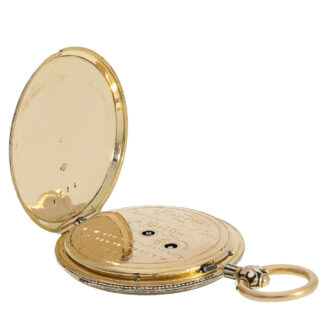
German super flat gold hunting cased cabriolet watch Circa 1830
- Kenmerk
- HC0443
- Diameter
- 45 mm
- Estimate
- € 3.500 - 7.000
- Price sold
- € 3.550
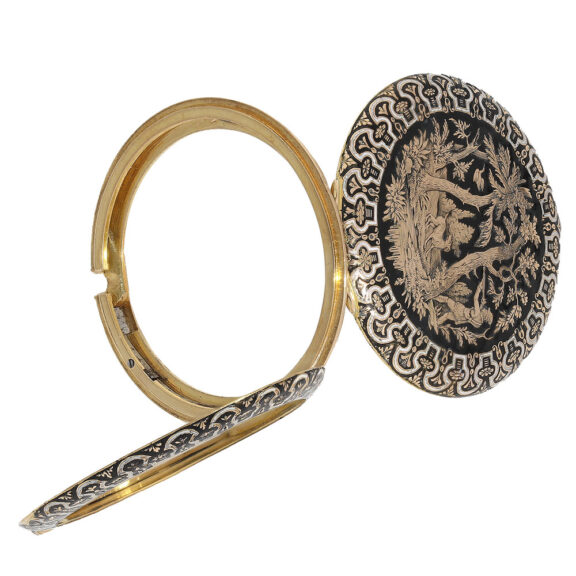
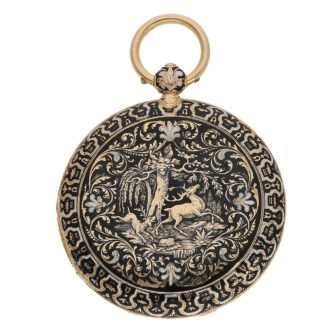
Gold full hunter with special enamelling technique
–
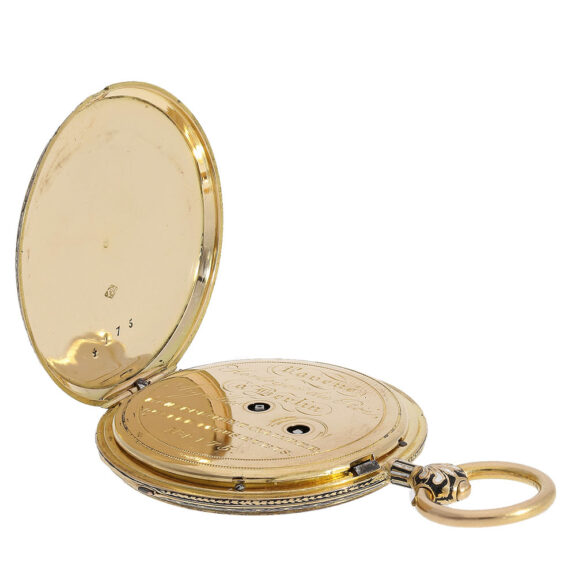
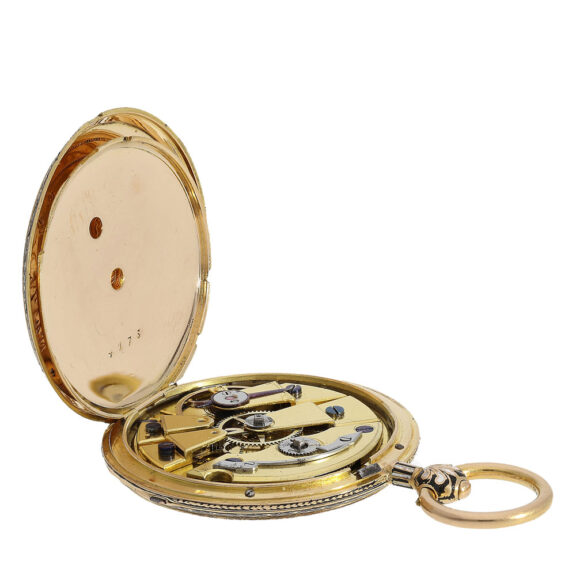
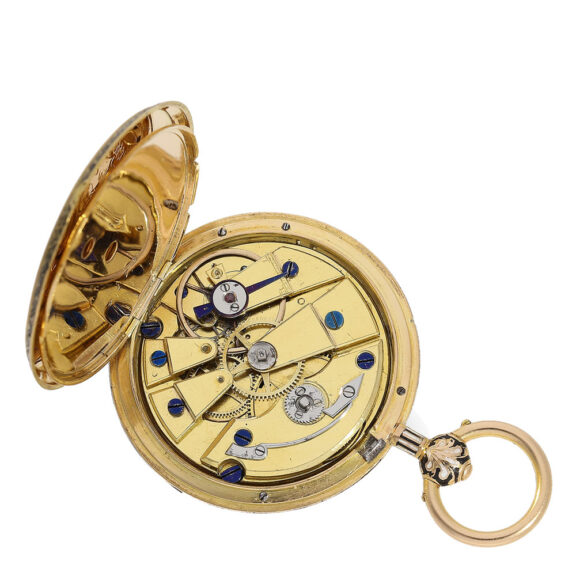
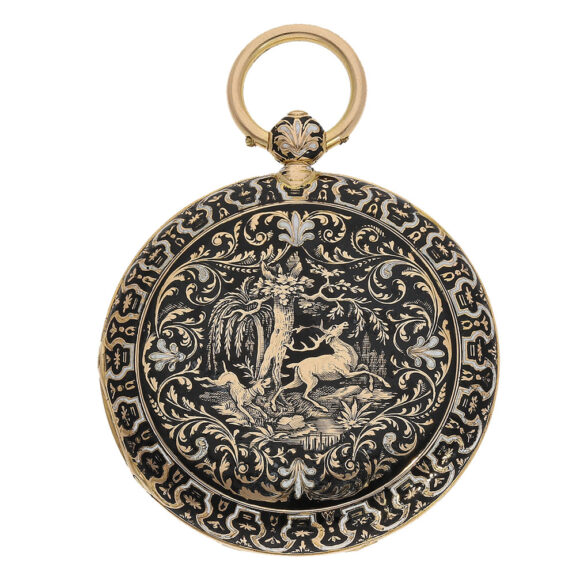
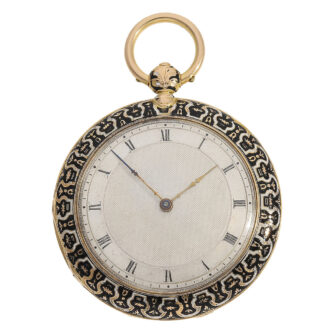
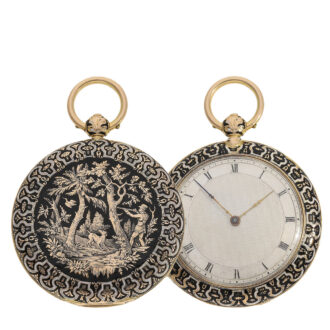
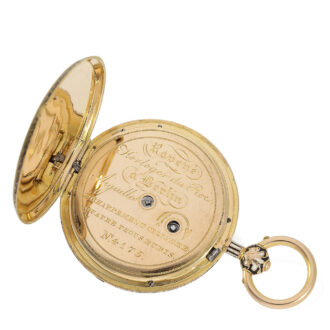
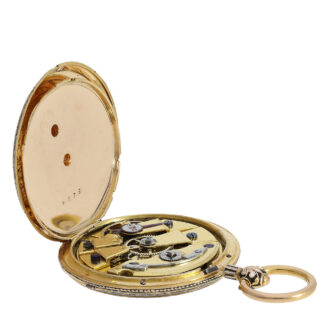
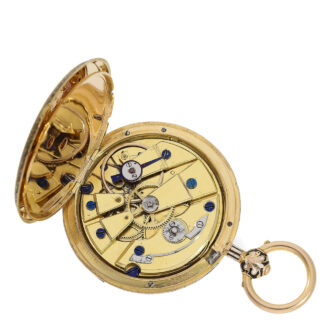
An extremely rare and super flat cabriolet Lépine pocket watch made by Samuel Frédéric Ravené in Berlin, Germany, circa 1830. This watch is crafted from 18 carat gold. It features a numbered cabriolet case, stamped with maker’s mark FM, that allows the inner case to be turned inside the outer case, enabling it to be worn as an open faced or a hunting cased timepiece. What sets this watch apart is that it is decorated with a special enamelling technique, the hunting scenes are lavishly engraved in rose gold against a black enamelled background, creating a striking contrast that is both elegant and eye catching. The bezels of the watch are also engraved with great care, featuring intricate patterns in black and white enamel. The engine turned dial has Roman hour numerals and outer minute divisions on a brushed chapter ring, and further original hands. The movement has a cylinder escapement.
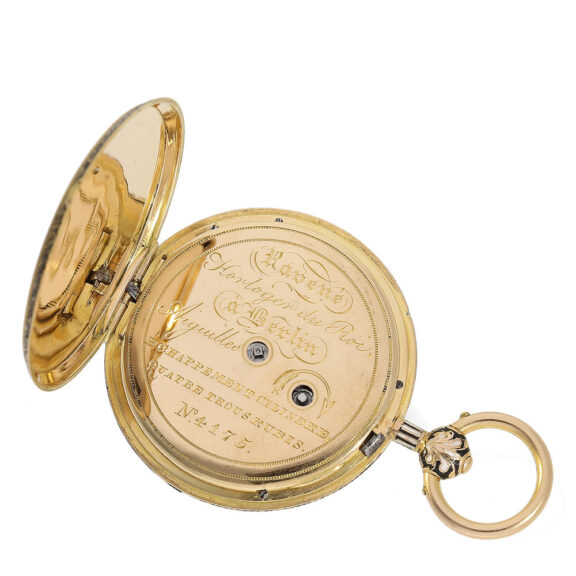
The cuvette is signed.
–
Diameter: 45 mm
–
Weight: 54 g
–
Signed: Ravené Horloger du Roi à Berlin
–
Samuel Frédéric Ravené was born in 1809 and died in 1887. He was active in Berlin. From 1794, Ravené was court watchmaker to King Friedrich Wilhelm III of Prussia. He is known for his fine pocket watches, travel and table clocks. He made significant and lasting contributions to the field of watchmaking. Some of his most notable contributions include:
–
The introduction of the free sprung balance system:
Ravené’s innovation allowed the watch to keep time more accurately by reducing the friction between the balance wheel and the rest of the watch movement.
–
Development of the chronometer escapement:
This innovation improved the accuracy of watches by reducing the effect of external factors such as temperature and position on the watch’s timekeeping.
–
The creation of the Ravené shock absorber: This system protected the delicate watch movement from damage caused by sudden shocks and vibrations.
–
The invention of the Ravené winding system:
This winding mechanism allowed for a more efficient transfer of energy from the mainspring to the watch movement, resulting in improved accuracy and power reserve.
–
Cabriolet case
A cabriolet case in watchmaking refers to a type of watch case that features a hinged cover that allows the inner case to be turned into the outer case so that the timepiece can be used either as an open faced or as a hunting cased watch. The main advantage of a cabriolet case is that it protects the watch dial while still allowing easy access to view the time. Additionally, the reversible case protects the watch face from impact when wearing the watch, especially during intense or vigorous activities – for ladies tied to a chain around the neck and for men in the pocket. The cases are therefore often used in sports watches and other timepieces that are designed for active use.
Signed: Ravené Horloger du Roi à Berlin
Share this page: