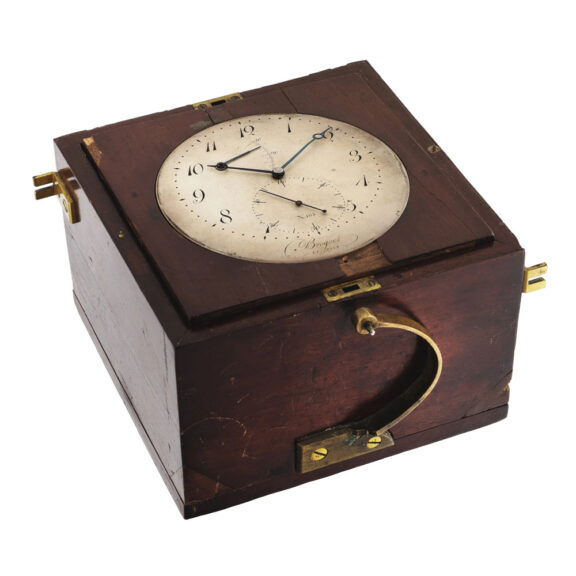
Rare and early French eight-day double boxed chronometer Circa 1815
- Kenmerk
- SB1307
- Diameter
- -
- Estimate
- € 90.000 - 200.000
- Price sold
- € 286.000
Gilt-brass eight-day marine chronometer in mahogany boxes by Breguet
–
This is a rare, early French marine chronometer from around 1815, made of gilt brass and housed in mahogany. It runs for eight days on two mainspring barrels and sits in two boxes, one inside the other. It was sold to Captain Charles Baudin for 2,000 francs.
–
The movement is openwork brass and has a detent escapement. The matt silvered dial has Arabic numerals for the hours, minute markers around the edge and a small seconds dial at 6 o’clock.
–
The chronometer sits in an inner mahogany box with spring arms. This fits into an outer box with a rectangular gimbal, which keeps the chronometer level as the ship moves, and a sliding window in the lid for reading the time. The dial and case are signed and numbered. It comes with a certificate and a numbered key.
–
Dimensions outer box: 30.5 x 29.2 x 29.2 cm
–
Dimensions inner box: 16.5 x 16.5 x 11 cm
–
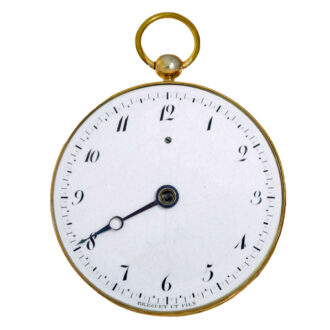
Signed: Breguet et Fils N. 104
–
Breguet’s earliest marine chronometers are numbers 104 (this one), 105 and 106. Until this chronometer was found, number 106 was thought to be the only one to survive. Oddly, the numbers don’t follow the order of sale: number 106 was sold first, in 1816, while number 104 was sold in 1817 and number 105 in 1818, each for 2,000 francs.
–
Work on these chronometers is thought to have begun before Breguet fled to Switzerland in 1793.
–
The box of number 104 is built differently from that of number 106, the only other early example that has been examined. Number 106 is closer to the work of the English chronometer maker John Arnold: like many of Arnold’s marine chronometers, it sits in an eight-sided mahogany box. Number 104, by contrast, sits in a large double mahogany box with rectangular gimbals, more like Breguet’s later work. Since number 104 was sold later, its box was probably finished later too, when Breguet was experimenting more with his own designs instead of following Arnold’s style.
–
The movements of the two chronometers, however, are strikingly similar and still clearly show Arnold’s influence. The balance resembles those made by Ferdinand Berthoud. It has four arms and half-moon weights, held by what appear to be gold and platinum screws.
–
In 1815 Breguet was given the title of Horloger de la Marine, watchmaker to the French Navy. Soon after, he sold number 106, followed by numbers 104 and 105. From 1818 onward, Breguet was making marine chronometers in earnest.
Signed: Breguet et Fils N. 104
Share this page: