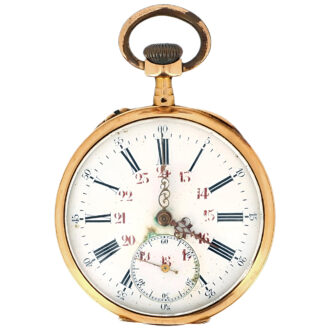
Swiss gold repeater made for the Indian market Circa 1900
- Kenmerk
- TA2151
- Diameter
- 52 mm
- Estimate
- € 75.000 - 125.000
- Price sold
- € 74.750
Gold, enamel, diamond, ruby and pearl-set lever watch
–
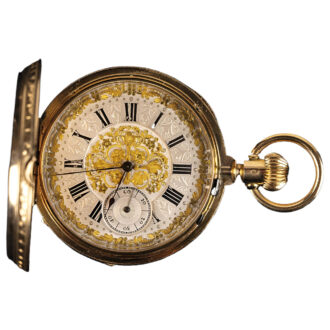
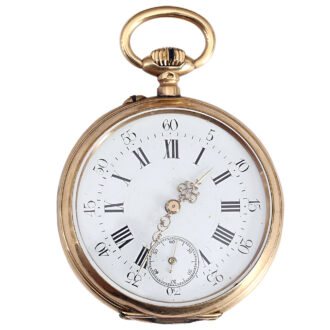
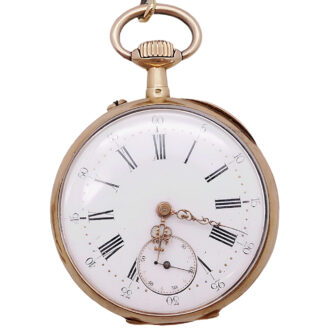
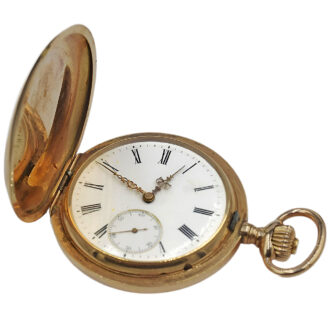
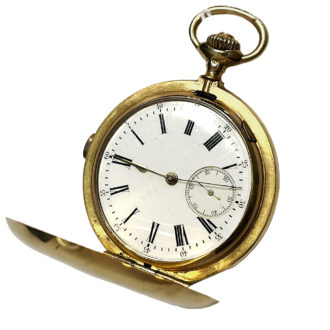
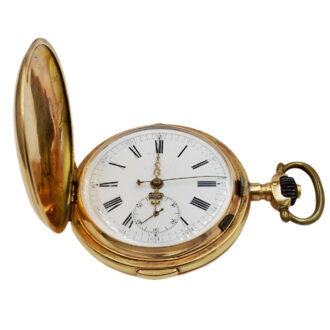
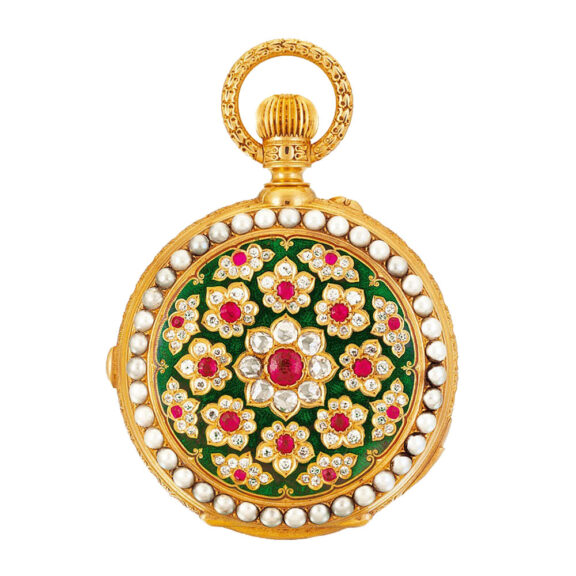
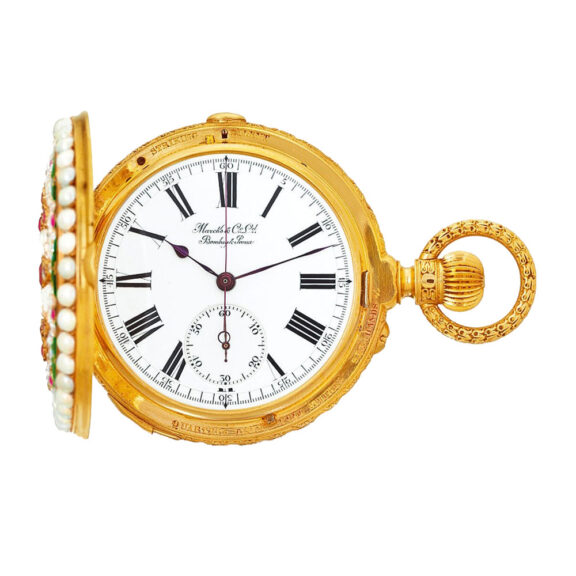
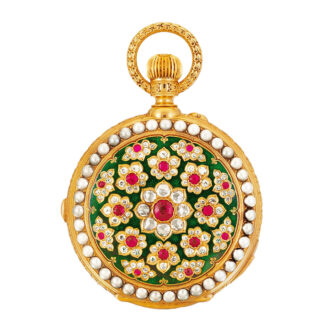
A very fine and rare Swiss heavy 18K gold, enamel, diamond, ruby and pearl-set hunting cased double barrel grande and petite sonnerie minute repeating keyless lever clock watch with chronograph made for the Indian market, circa 1900. Retailed by Marcks & Co Ltd, Bombay & Poona. Sold to the Sixth Nizam of Hyderabad, Mahbub Ali Khan who reigned from 1869 to 1911. The band, pendant and bow are chased and engraved with oval and stylized leaf decoration, the front and back covers are set with diamonds and rubies in an Indian geometric pattern on a dark green guilloché enamel ground. Hinged gold cuvette.
–
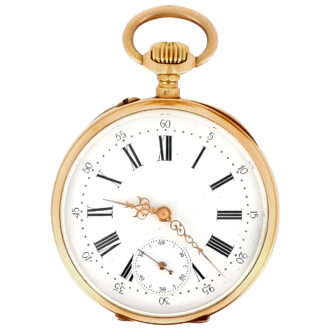
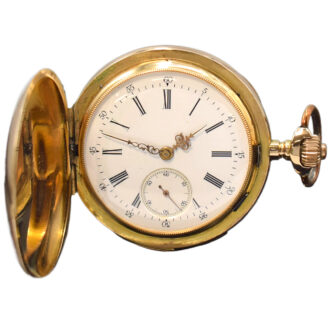
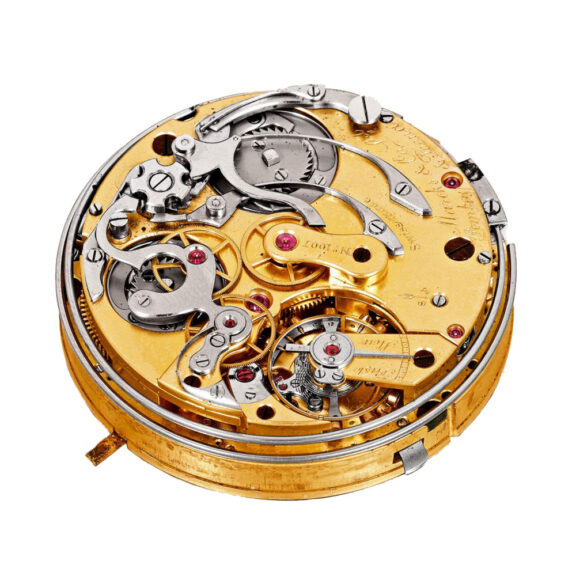
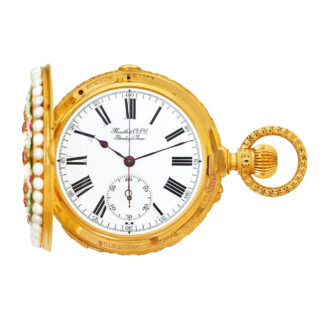
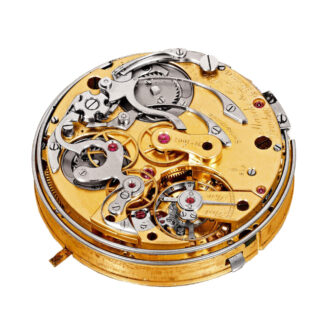
White enamel dial with radial Roman numerals, outer minute track and concentric seconds track with a fifth of a second division, Arabic five minute/seconds numerals, subsidiary seconds, blued steel spade hands. A frosted gilt three-quarter plate movement, two train with tandem winding, counterpoised straight-line lever escapement, cut bimetallic compensation balance, white metal Breguet balance spring, index regulator, striking the quarters and repeating on gongs through a trip-slide in the band, strike/silent, quarters only/full strike and hand setting levers in the bezel, chronograph button in the band. Dial, case and movement signed
–
Diameter: 52 mm
–
Signed: Henri Grandjean & Cie Le Locle
–
The case is repolished, edges are preserved.
–
Marcks & Co was the most prestigious store of luxury goods in India. Its major supplier was Henri Grandjean who made very high-quality watches. The company specialises in Grande Complication watches, watches with a perpetual calendar, independent seconds with diablotine, chronographs, repeaters, clock watches and tourbillons. Their watch cases were usually highly and ornately decorated, often with enamels, and precious and semi-precious stones in the manner that was so appreciated on the Indian market. Along with Constant Girard (later Girard-Perregaux), Henry Grandjean was one of the first to enter the South American Market. He was also, along with Ulysse Nardin, one of the first to establish a marine chronometer manufacturing business in Switzerland as well as an initiator of the Neuchâtel Observatory. In 1851, at the first Universal Exposition in London, Grandjean received a First Class medal. His list of medals continued until 1868, the year in which the company won an award for its marine chronometers.
–
In the meantime, they also received at least eight different awards, not including those from the Observatory of Neuchâtel. Henry died in 1879 but it appears that the company continued for the next twenty years until 1899, the year in which Rossel & Fils registered their name as successors, who were also most likely running the company during these 20 years. On January 9th, 1908, Rossel & Fils transferred the title to Charles-Ferdinand Perret. The Nizams of Hyderabad, Hyderabad, on the River Musi five miles east of Golconda, were founded in 1591-1592 by Muhammad Quli Qutb Shah. In the 16th century, the city grew to accommodate the surplus population of Golconda, which was the capital of the Qutb Shahi rulers. Many buildings sprang up along the River Musi. The Qutb Shahi dynasty founded the Kingdom of Golconda, one of the five kingdoms that emerged after the break up of the Bahamani Kingdom. The Qutb Shahis ruled the Deccan for almost 171 years. All seven rulers were patrons of learning and were great builders. They contributed to the growth and development of Indo-Persian and Indo-Islamic literature and culture in Hyderabad. During the Qutb Shahi reign, Golconda became one of the world’s leading markets for diamonds, pearls, steel for arms, and also printed fabric. The seven Nizams of the Asif Jahi dynasty ruled the Deccan for nearly 224 years, right up to 1948. During the Asif Jahi period, Persian, Urdu, Telugu and Marathi developed simultaneously. The highest official positions were given to deserving persons irrespective of their religion. Persian was the official language up to 1893 and then Urdu up to 1948.
–
When the British and the French spread their hold over the country, the Nizam soon won their friendship without bequeathing his power. The title ‘Faithful Ally of the British Government’ was bestowed on Nizam VII. The British stationed a Resident at Hyderabad, but the state continued to be ruled by the Nizam. The incalculable wealth of the Asaf Jah Dynasty. The collection of jewels of the Nizams of Hyderabad is one of the finest in the world. In addition to turban ornaments, gem-set and enamelled necklaces, earrings, armbands, bracelets, belts and other items of jewellery, it includes twenty-two unset emeralds and the fabled 184.50 carats Jacob Diamond – a magnificent South African gem believed to have been used by the last Nizam as a paperweight! After the integration of Hyderabad state into the Union of India in 1950. Nizam Mir Osman Ali Khan instituted a jewellery trust to which he assigned the most important items from the Hyderabad treasury, with the stipulation that they could only be sold after his death. In the nearly three decades since 1972 (when the collection was first offered to the government of India), the unfolding drama of the Nizam’s jewels entailed court cases, intrigue, conflicting decisions and colossal expenses.
–
Signed: Henri Grandjean & Cie Le Locle
Share this page: