Fine English silver pocket watch chronometer Circa 1807
- Kenmerk
- SA0155
- Diameter
- 65 mm
- Estimate
- € 10.000 - 20.000
- Price sold
- € 16.500
Silver pocket chronometer with Peto’s cross spring detent
–
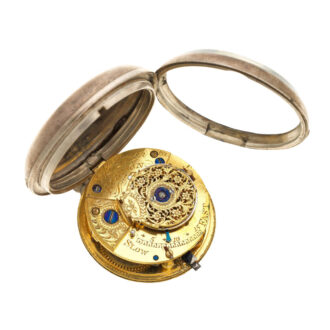
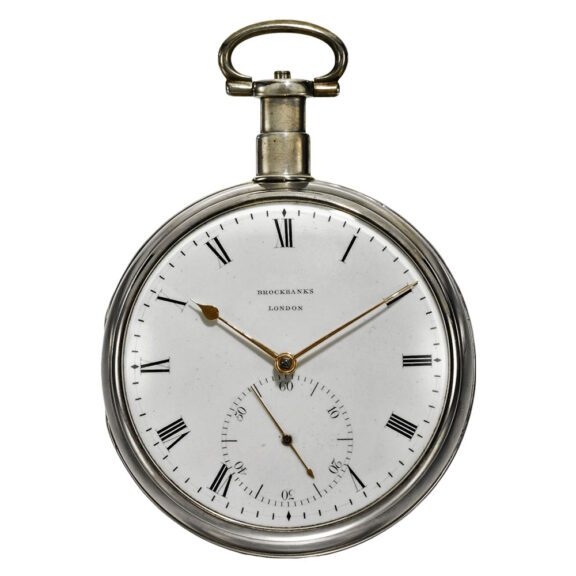
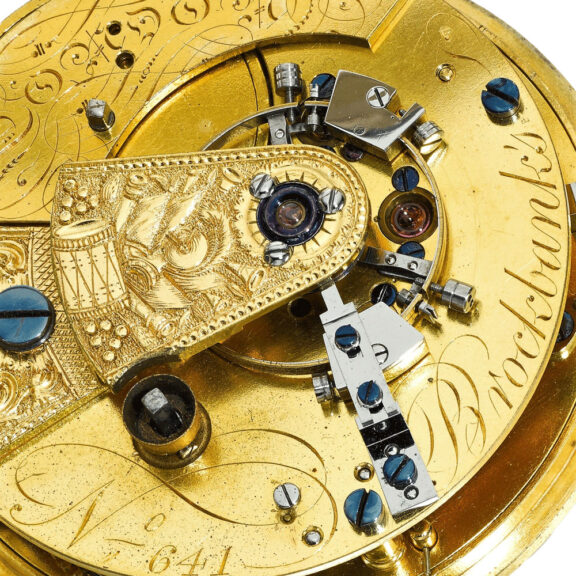
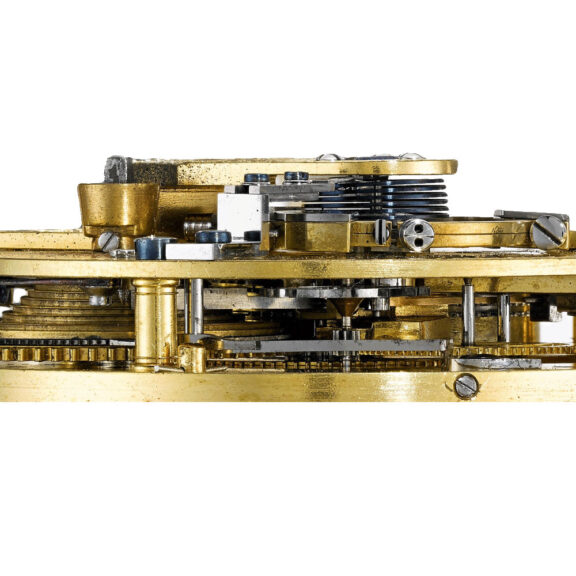
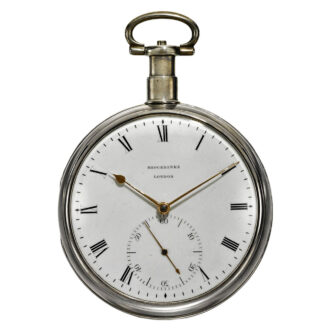
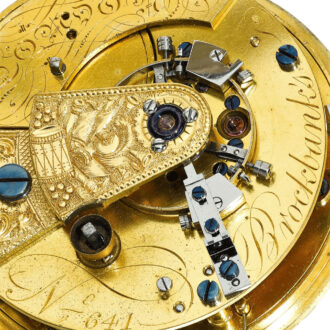
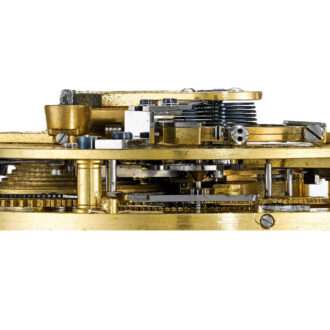
A very fine English silver pocket chronometer with Peto’s cross spring detent, circa 1807, gilded full plate, Peto’s cross-detent escapement, jeweled wheel train, three-arm balance with three bimetallic rims each with travel limit screws, highly polished steel weights with lateral and timing screws, blued steel helical spring, balance cock engraved with trophies of war, ruby endstone, signed Brockbank’s, London.
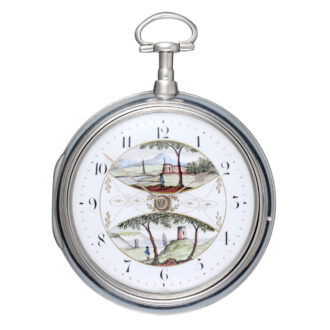
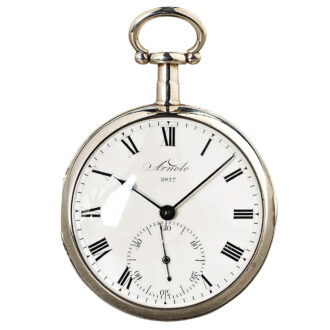
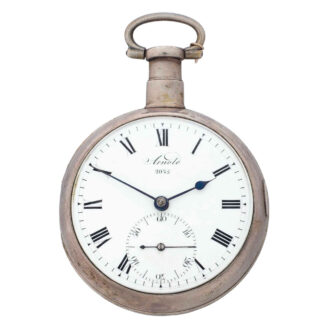
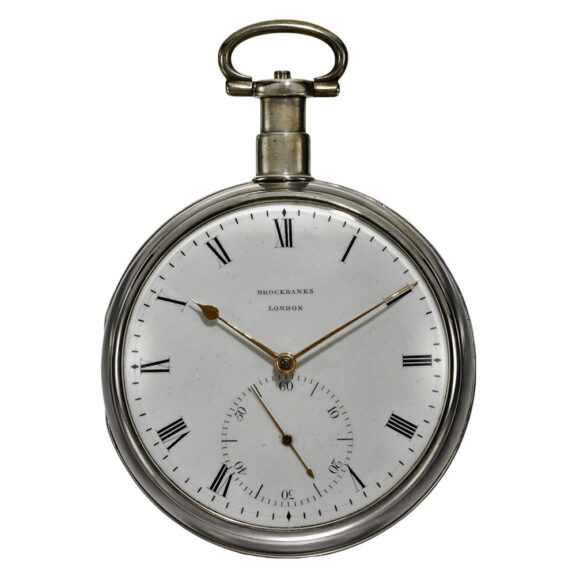
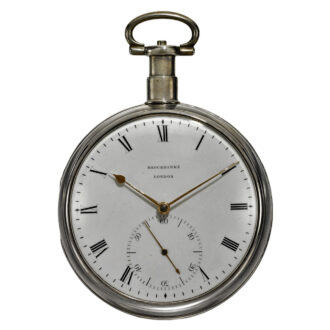
White enamel dial, Roman numerals, large subsidiary seconds, gold spade hands, signed Brockbanks, London
Silver case, fixed cuvette, plain polished back and bezel, the pendant with split push-piece for releasing bezel and back independently, case with maker’s mark TC for Thomas Carpenter
–
Diameter: 65 mm
–
Signed: Brockbank’s London
–
The movement of this watch incorporates James Peto’s cross-detent escapement which research suggests was introduced in the late 1780s. James Peto (active c. 1780- 1800) was an employee of the Brockbanks and invented his variant of the spring detent escapement. It combined Arnold’s in-tension detent and Earnshaw’s impulse but had high inertia causing considerable friction between it and the passing spring, and the use of oil was necessary. Earnshaw, who himself had worked for the Brockbanks, accused Peto of deliberately altering his own (Earnshaw’s) spring detent escapement to evade Wright’s patent of Earnshaw’s spring detent escapement (see lot 39). Earnshaw accused Peto of acting with the encouragement of the Brockbanks. For an examination and discussion of Earnshaw’s account see Vaudrey Mercer, John Arnold and Son.
The brothers John and Myles Brockbank used Peto’s cross detent in several of their watches. Interestingly, as Cecil Clutton and George Daniels pointed out in their book, Watches, “Breguet thought so well of it [Peto’s cross-detent] as to introduce it into at least two of his finest tourbillons made after 1810”. Peto’s cross-detent, as seen in the present watch, has a very pleasing action and is complemented by the impressive balance with its highly polished steel weights.
A diagram of Peto’s cross-detent and illustrations of Brockbanks’ distinctive balances, can be found in the two-part article of the firm by F. von Osterhausen, Antiquarian Horology, September and December 2001.
Signed: Brockbank’s London
Share this page: