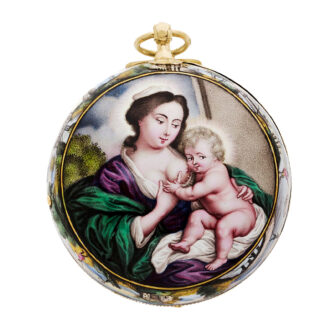
English silver hour striking coachwatch with alarm Circa 1655
- Kenmerk
- SA0402
- Diameter
- 95 mm
- Estimate
- € 30.000 - 50.000
- Price sold
- € 41.500
Silver coach watch with a protective case
–
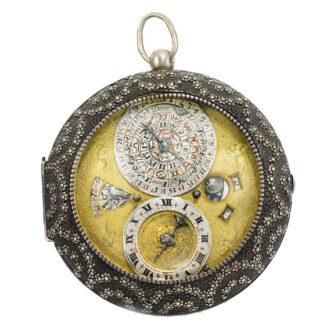
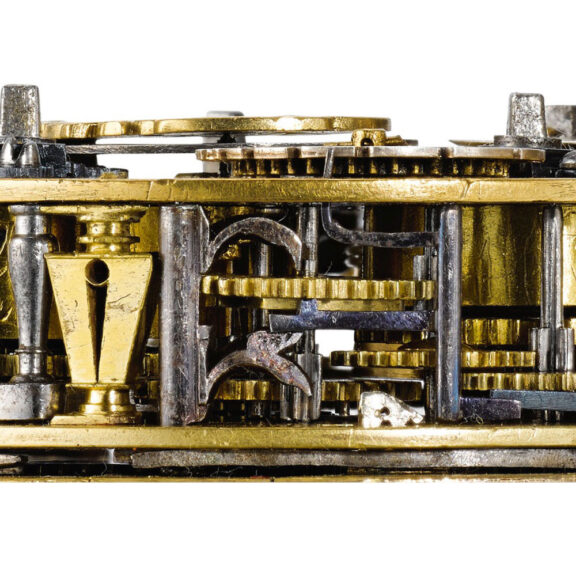
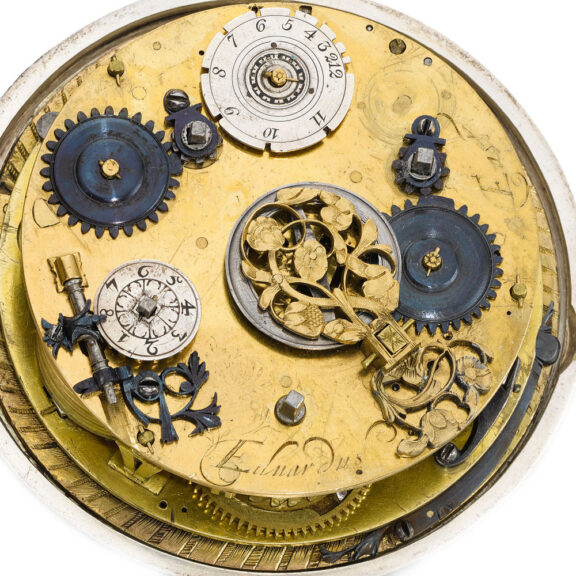
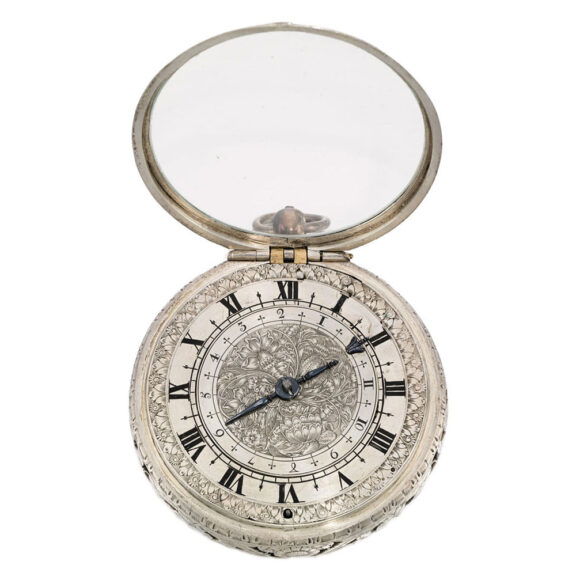
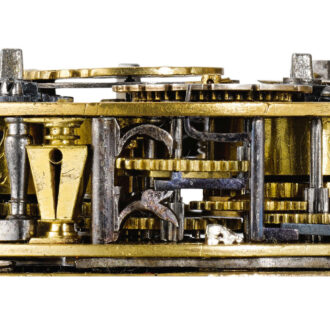
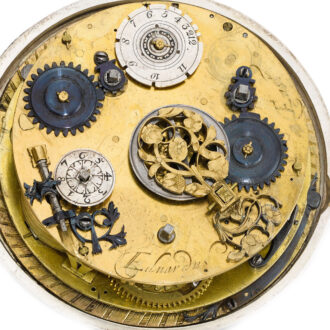
A very rare English silver hour striking coach watch with alarm and leather outer protective case, circa 1655, gilded full plate movement, verge escapement, decoratively pierced and floral engraved pinned on balance cock, silver locking plate for striking and blued steel stop work visible to the backplate, worm and wheel set up, Egyptian pillars, fusee and gut line, barrels for going, alarm and striking trains, signed.
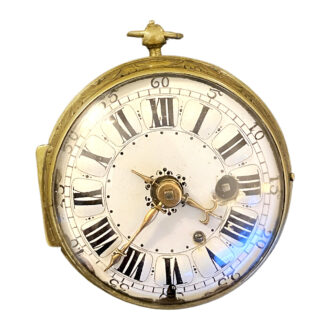
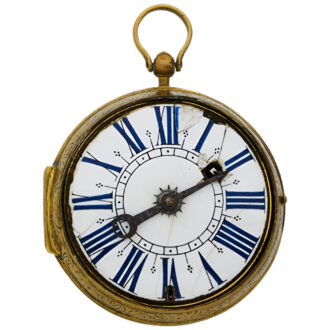
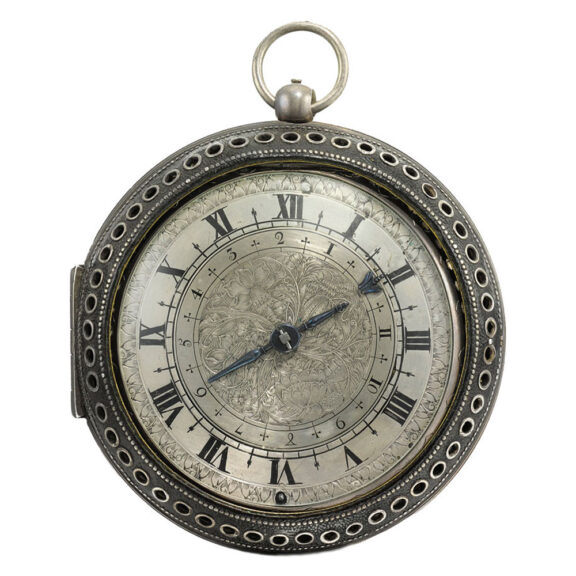
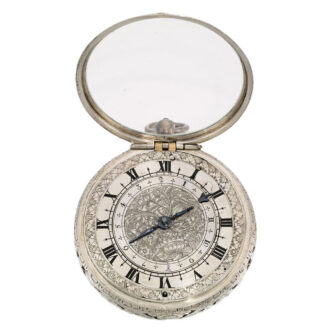
Silver dial, inner revolving disc engraved with tightly ordered flowers, Arabic numerals for alarm time indicated by central blued steel hand, a fixed blued steel bug indicating time against the Roman numerals to outer chapter ring with quarter hour divisions beneath, outermost edge with decoratively engraved border.
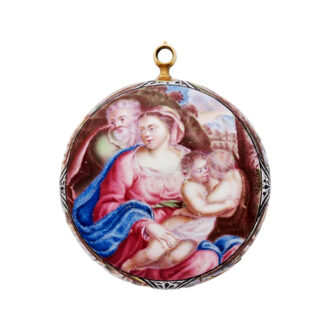
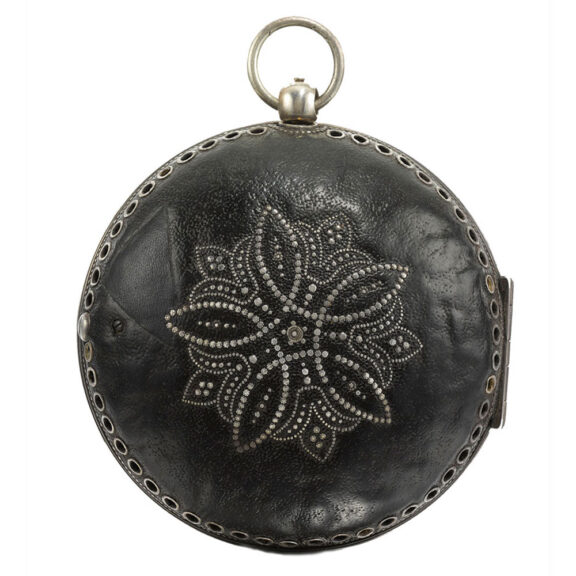
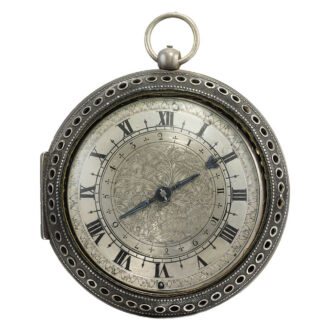
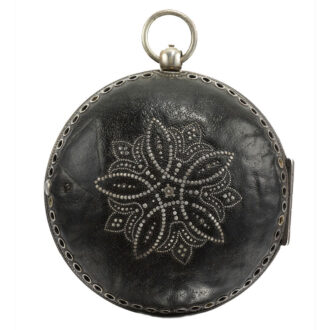
Silver inner case, the band decoratively pierced and engraved with flowers and foliage and stylized leaves to the bezel, winding apertures to back for going, alarm, hour striking trains, leather outer case, the bezels with pierced roundels for sound emission surrounded by pin work borders, the center of the case back with stylized floral pin work motif.
–
Diameter: 95 mm
–
Signed: Edwardus East
–
A similar clock watch with alarm by Edward East can be found in the Victoria and Albert Museum, London. Both the V and A watch and the watch presently offered for sale have engraved dial centers with a profusion of tightly ordered flowers. It has been noted by the V and A that the flowers are “in the style of the prints published for the use of engravers and enamellers by Jacques Vauquer (1621-1686) in Paris and Blois (Loir-et-Cher) in France and Johann Paul Hauer (born 1629) in Germany”. The central dial hand indicates the alarm time to the inner revolving ring, whilst the ‘bug’ or pointer displays the time to the outer chapter ring. When the alarm hand is not in use, it can be aligned with the ‘bug’ to form one long hand. Both the inner and outer cases have pierced decoration to allow for sound emission.
–
Without question one of the most important of early English watchmakers, Edward East was born in Southill, Bedfordshire in 1602. At the time there was no Clockmakers’ Company and so, in 1618, the young East was apprenticed to Richard Roger of the Goldsmiths’ Company, becoming a Freeman in 1627. In 1631 the Clockmakers’ Company was formed by Royal Charter and Edward East became one of the Company’s first assistants a year later, in 1632. East was made Warden of the Clockmakers’ Company in 1638 and Master in both 1645 and 1653. In 1660 he was appointed chief clockmaker to King Charles II. In October 1692, East gave £100 to the Clockmakers’ Company with the interest to be used to support poor members. The Early Clockmakers of Great Britain, 1981, p. 206. Edward East lived through almost the entire 17th century and died in 1697, leaving an extraordinary legacy of exceptional watches and clocks.
–
Interestingly, a clock watch (without alarm) by Edward East can be found in the Royal Collections and is said, by tradition, to have been bequeathed by King Charles I on the day of his execution (30th January 1649) to Sir Thomas Herbert. Herbert had been a companion of the King in the months before his death and that watch later passed through the Herbert and Mitford families before entering the Royal Collections as a gift to Queen Elizabeth II in 1971.
Signed: Edwardus East
Share this page: